
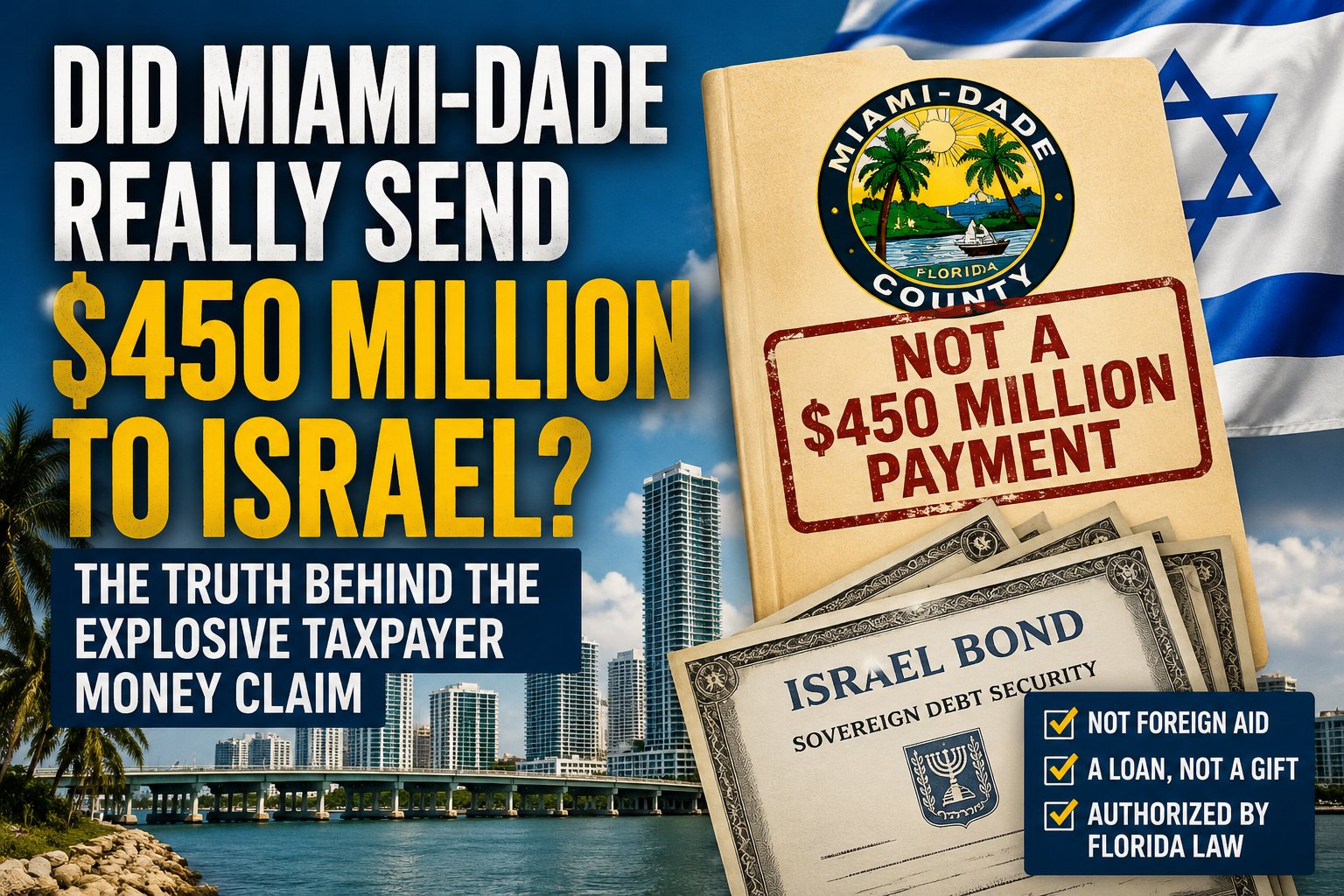
Did Miami-Dade Really Send $450 Million to the State of Israel? The Truth Behind the Explosive Taxpayer Money Claim
A politically explosive claim spreading across social media says Miami-Dade County approved sending roughly $450 million in taxpayer money to Israel. The number is large enough to grab attention, particularly as Miami-Dade confronts its own budget pressures and residents debate taxes, transit, housing and public services. But the viral version of the story leaves out the most important financial distinction: Miami-Dade did not approve a $450 million foreign aid package, donation or direct cash transfer to the Israeli government.
What county commissioners approved was a change to Miami-Dade’s investment policy increasing the maximum percentage of its investment portfolio that may be invested in bonds backed by the State of Israel. The ceiling increased from 3% to 5%, potentially allowing approximately $400 million to $450 million of the county’s multibillion dollar investment portfolio to be held in Israeli government bonds. That remains a significant financial decision involving public money, and residents are entitled to debate whether Miami-Dade should be investing that much in the sovereign debt of a foreign government. But describing the decision as Miami-Dade simply “sending $450 million to Israel” is financially inaccurate.
Miami-Dade Raised Its Israel Bond Investment Limit From 3% to 5%
The controversy centers on Miami-Dade’s investment portfolio, where the county places public funds in approved financial instruments rather than allowing billions of dollars in available cash to sit idle. Florida law specifically authorizes local governments with written investment policies to invest surplus public funds in several categories of securities, including U.S. Treasury obligations, federal agency securities, money market funds and bonds, notes or instruments backed by the full faith and credit of the government of Israel.
Miami-Dade has permitted Israel Bonds in its investment policy for years. In 2016, county commissioners approved a resolution authorizing investments in bonds, notes and other instruments backed by the Israeli government. Under the county’s previous policy, Israel Bonds could constitute no more than 3% of the overall portfolio. The latest change raises that maximum to 5%. Because Miami-Dade manages an investment portfolio worth billions of dollars, a 5% allocation could theoretically place roughly $400 million to $450 million into Israeli bonds. That potential maximum appears to be the source of the increasingly widespread claim that Miami-Dade “gave” or “sent” $450 million to Israel. The county did not authorize a $450 million check. It authorized a higher investment ceiling.
Miami-Dade Already Holds a Significant Amount of Israel Bonds
The distinction becomes even clearer when examining what Miami-Dade actually owns. Reporting surrounding the controversy indicated that Miami-Dade already held approximately $141 million in Israel Bonds, while county financial records from late 2025 showed Israel Bonds representing a much smaller percentage of the overall county investment portfolio than the new 5% maximum.
The county therefore did not suddenly transfer $450 million to Israel following the commission vote. Instead, commissioners gave county investment officials additional room to increase Israel Bond holdings in the future. That does not make the controversy insignificant. Raising the allowable concentration from 3% to 5% potentially permits hundreds of millions of additional dollars in exposure to Israeli sovereign debt, giving critics a legitimate basis to question whether that concentration is financially prudent, politically appropriate or in the best interests of Miami-Dade residents.
An Israel Bond Is a Loan, Not Foreign Aid
Israel Bonds are sovereign debt securities issued by the State of Israel. Functionally, the transaction works like other government bond investments: an investor provides capital to the issuer in exchange for a contractual obligation to repay the principal, along with interest, according to the terms of the security.
That means Miami-Dade is effectively lending money to Israel when it purchases an Israel Bond. The county receives a financial asset in return and expects repayment of the principal plus interest. That structure is fundamentally different from foreign aid, which generally involves government spending transferred for military, humanitarian, economic or other purposes without the recipient issuing a conventional investment security promising repayment of principal and investment returns.
The federal government can appropriate billions of dollars in military or economic assistance to foreign countries. Miami-Dade County does not operate a comparable foreign aid program. What Miami-Dade does have is an investment portfolio containing public funds, and Florida law expressly permits some of those funds to be invested in Israeli government debt.
Florida Law Explicitly Authorizes Israel Bonds
One of the most unusual aspects of the controversy is that Israel Bonds are specifically named in Florida law. Section 218.415 of the Florida Statutes establishes investment rules for local governments and expressly allows local governments operating under written investment policies to hold several categories of securities, including instruments backed by the full faith and credit of Israel. The statutory language matters because it means Miami-Dade is not independently creating a foreign-policy mechanism or inventing a way to transfer county money overseas. The Florida Legislature has expressly authorized local governments to purchase Israeli sovereign debt as an investment. Whether Israel should receive that explicit treatment in Florida law remains a separate political question, and it is increasingly being raised by critics of the policy.
James Fishback Was Removed From the Commission Meeting After Protesting the Investment
The issue erupted publicly when former Republican gubernatorial candidate James Fishback confronted Miami-Dade commissioners over the policy and was ultimately escorted from the commission chamber. Fishback framed the investment as a question of whether Miami-Dade officials were prioritizing local residents or a foreign country, arguing that the money should instead be invested within Miami-Dade County.
His confrontation attracted national attention, but he was not the only person objecting to the policy. Other speakers criticized increasing Miami-Dade’s potential exposure to Israeli debt while the county simultaneously confronts significant local budget pressures and while the war in Gaza continues to drive political divisions in the United States.
The substantive argument beneath the confrontation is broader than Fishback himself: even if Israel Bonds are investments rather than donations, critics are asking whether Miami-Dade should be placing hundreds of millions of dollars in the sovereign debt of any foreign government.
Critics Have a Legitimate Policy Argument Without Calling It a $450 Million Giveaway
Opponents do not need to characterize the transaction as foreign aid to raise legitimate questions. Miami-Dade is using public funds to purchase Israeli sovereign debt. Purchasing those bonds provides capital to the Israeli government, even though Miami-Dade receives a debt security and expects repayment with interest. Raising the allowable concentration from 3% to 5% substantially increases the amount of public money that could potentially be exposed to that issuer.
Critics can therefore reasonably ask why Israel should receive special consideration under Florida investment law, whether the bonds provide an appropriate risk adjusted return, how liquid the securities are, whether increasing the concentration is financially prudent and whether local public funds should be invested in foreign sovereign debt at all.
Supporters can counter that investment decisions should be judged primarily on security, yield, maturity, diversification and statutory authorization rather than political objections to the government issuing the bonds. Those are legitimate arguments on both sides. Calling the measure a $450 million foreign-aid package, however, misstates what the county actually approved.
The $450 Million Number Is a Maximum, Not the Amount Currently Invested
This is the most important distinction in understanding the controversy. The 5% figure establishes an allowable portfolio concentration. It does not require Miami-Dade to immediately purchase Israel Bonds up to that amount. If the county’s investment portfolio is worth approximately $8 billion to $9 billion, a 5% limit translates into roughly $400 million to $450 million in maximum permitted Israel Bond exposure. That mathematical ceiling is what has increasingly appeared in headlines and social-media posts. The actual holdings have been substantially lower, with reporting placing Miami-Dade’s Israel Bond position at approximately $141 million around the time of the latest controversy.
There is therefore an enormous difference between saying Miami-Dade can now invest as much as approximately $450 million in Israel Bonds and saying Miami-Dade sent Israel $450 million. The first broadly describes the policy change. The second does not.
The Controversy Is Still Bigger Than a Simple Fact Check
Correcting the $450 million claim should not be used to dismiss the underlying debate. Miami-Dade is one of the largest local governments in the United States and controls an enormous pool of public money. Decisions about where that money is invested deserve scrutiny, particularly when an investment involves the sovereign debt of a foreign government at the center of one of the world’s most politically divisive conflicts.
Residents have every right to ask why their county holds Israeli bonds, what return those bonds generate, how they compare with U.S. Treasury securities and other investments, what financial risks the county assumes, whether political considerations influence portfolio decisions and whether public money should be invested in foreign sovereign debt in the first place. But there is an equally important obligation to describe the transaction accurately. Miami-Dade did not vote to donate $450 million to Israel. It voted to increase the maximum share of its investment portfolio permitted to be invested in Israeli government bonds from 3% to 5%. The county already holds a substantial position in those securities, and the new ceiling potentially allows that position to grow to approximately $400 million to $450 million.
That is a major investment policy decision involving public money. It is not a $450 million foreign aid package.

Sources
- Miami-Dade County — 2026 Resolution Amending the County Investment Policy (File No. 261175) — Official county legislation raising and modifying investment thresholds, including the treatment of Israel-backed bonds.
- Miami-Dade County — Resolution R-367-16, Original Authorization of Israel Bond Investments — Official 2016 resolution that authorized Miami-Dade to invest public funds in bonds, notes and instruments backed by the Israeli government.
- Miami-Dade County Finance Department — December 2025 Investment Portfolio Summary — Official portfolio report showing Israel Bonds represented 1.42% of the county portfolio under the previous 3% limit.
- Florida Legislature — Section 218.415, Local Government Investment Policies — Florida law governing how local governments may invest surplus public funds.
- Miami-Dade County — 2023 Announcement Increasing Israel Bond Holdings — Official county announcement documenting an additional $25 million Israel Bond purchase that brought holdings to $76 million at the time.
- Axios Miami — Miami-Dade Moves to Increase Israel Bond Investment Limit — Reports that the county held approximately $141 million in Israel Bonds and proposed raising the allowable portfolio limit from 3% to 5%.
- Florida Politics — Miami-Dade Commission Raises Israeli Bond Cap Amid Protests — Coverage of the September 1, 2026 commission action and protests surrounding the investment-policy change.
- Fox News — James Fishback Removed From Miami-Dade Meeting While Protesting Israel Investments — Coverage of Fishback’s removal and the political dispute over potentially increasing county investment in Israeli bonds.

















































Want to join the conversation?
Create an account or sign in to share your thoughts, vote,
and reply to other readers.
Showing 0 of 0 comments
Don't have an account?
Already have an account?