
A Historic Automation Push Like We Have Never Seen
The future of manufacturing may be arriving faster than many expected. Hyundai Motor Group has announced plans to deploy more than 25,000 Atlas humanoid robots, developed by its subsidiary Boston Dynamics, across Hyundai and Kia production facilities over the next several years. If successful, the initiative would represent one of the largest humanoid robot deployments ever attempted in an industrial setting.
The announcement marks a major milestone for Boston Dynamics’ Atlas robot, which for years was best known for viral videos showcasing backflips, parkour maneuvers, and impressive displays of robotic agility. Today, however, Hyundai sees Atlas as much more than a technological curiosity. The company is positioning the humanoid robot as a core component of its manufacturing future.
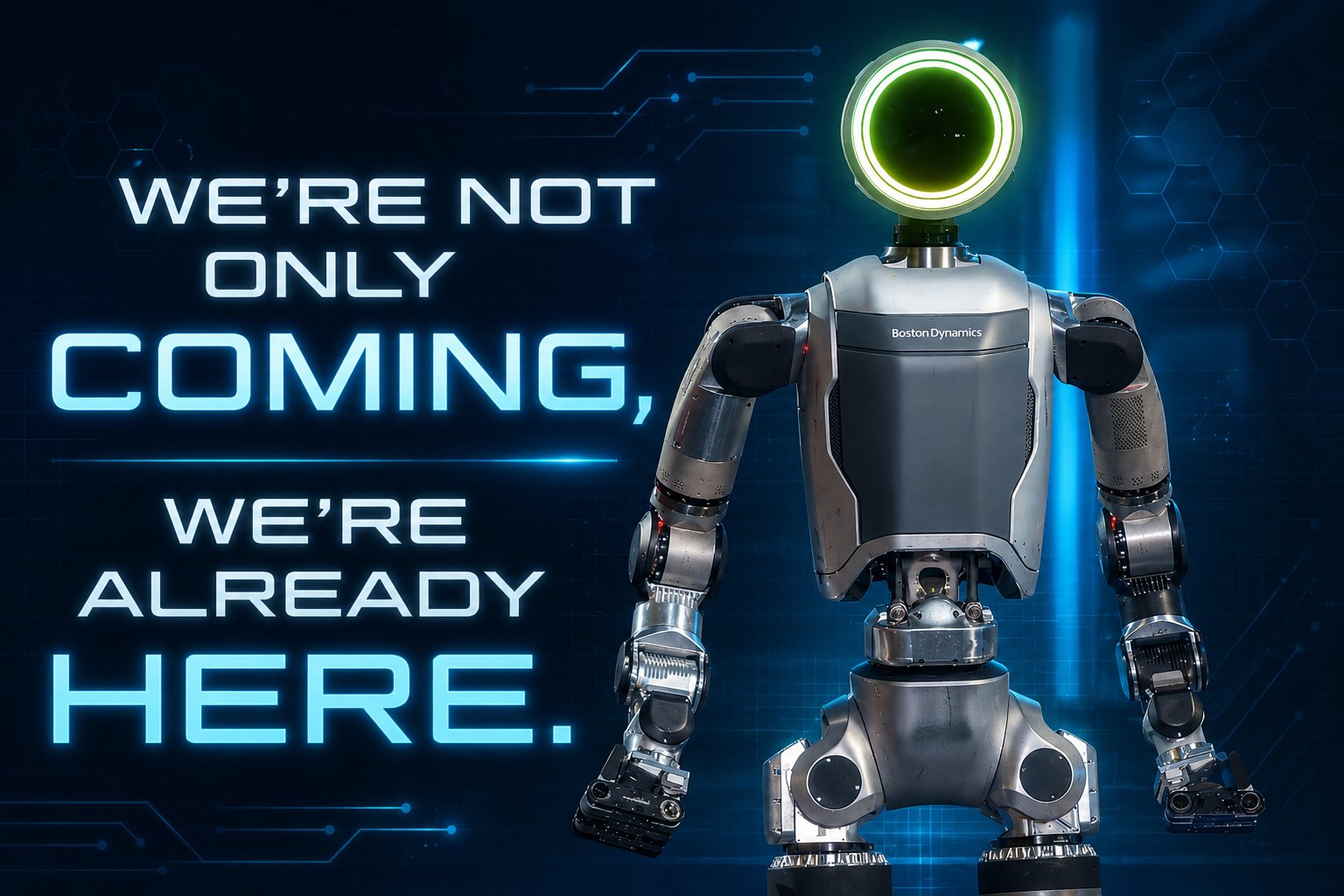
According to Hyundai’s roadmap, the company aims to build an annual production capacity of approximately 30,000 Atlas robots by 2028. More than 25,000 of those units are expected to be deployed internally throughout Hyundai and Kia facilities, making the automaker not only one of the world’s largest vehicle manufacturers but potentially one of the largest operators of humanoid robots as well.
The First Rollout is Coming to the United States
The first major rollout is expected to occur at Hyundai Motor Group Metaplant America in Georgia, where Atlas robots will initially perform tasks such as parts sequencing, material handling, and other repetitive factory operations. Over time, Hyundai plans to expand their capabilities into more complex assembly-line functions.
The newest version of Atlas differs dramatically from earlier prototypes. The fully electric humanoid robot features advanced mobility, highly dexterous hands, autonomous navigation, and the ability to operate in challenging industrial environments. Atlas can reportedly lift up to 110 pounds, recharge itself, and work in temperatures ranging from below freezing to extreme heat. Hyundai has also partnered with Google DeepMind and Nvidia to accelerate the robot’s artificial intelligence capabilities, allowing Atlas to learn new tasks more rapidly than previous generations of industrial robots.
Hyundai executives argue that Atlas is not intended to replace workers outright but rather to handle dangerous, repetitive, and physically demanding jobs that can lead to injuries and fatigue. The company describes its strategy as “human-centered automation,” where humans and robots work side by side to improve productivity and workplace safety.
They Say this Won’t Replace Human Workers… Labor Unions Disagree
Not everyone is convinced. Labor unions have already expressed concerns about the potential impact on manufacturing jobs. Reports indicate that labor groups in South Korea have pushed for formal agreements before large-scale deployments occur inside Hyundai factories. Critics worry that as humanoid robots become more capable, companies may be tempted to reduce human labor costs by replacing workers with machines.
Online reactions have reflected that divide. Some observers see Hyundai’s investment as proof that humanoid robots are finally moving from science fiction into real-world applications. Others argue that factory automation has existed for decades and that humanoid robots still face significant technical and economic challenges before widespread adoption becomes practical.
Regardless of where one stands in the debate, Hyundai’s commitment sends a powerful signal about the future direction of manufacturing. The company is investing heavily in domestic U.S. production of critical robot components, including actuators that serve as the “muscles” and joints of Atlas. By bringing much of the supply chain in-house, Hyundai hopes to accelerate production while lowering costs.
For decades, industrial robots have been confined largely to specialized assembly stations. Atlas represents a different vision: a general-purpose humanoid machine capable of moving through factories designed for humans. If Hyundai succeeds in deploying tens of thousands of Atlas robots by the end of the decade, the project could become one of the defining moments in the evolution of artificial intelligence, robotics, and manufacturing.
The question is no longer whether humanoid robots can perform useful work. Hyundai is betting billions that they soon will.

















































Want to join the conversation?
Create an account or sign in to share your thoughts, vote,
and reply to other readers.
Showing 0 of 0 comments
Don't have an account?
Already have an account?