
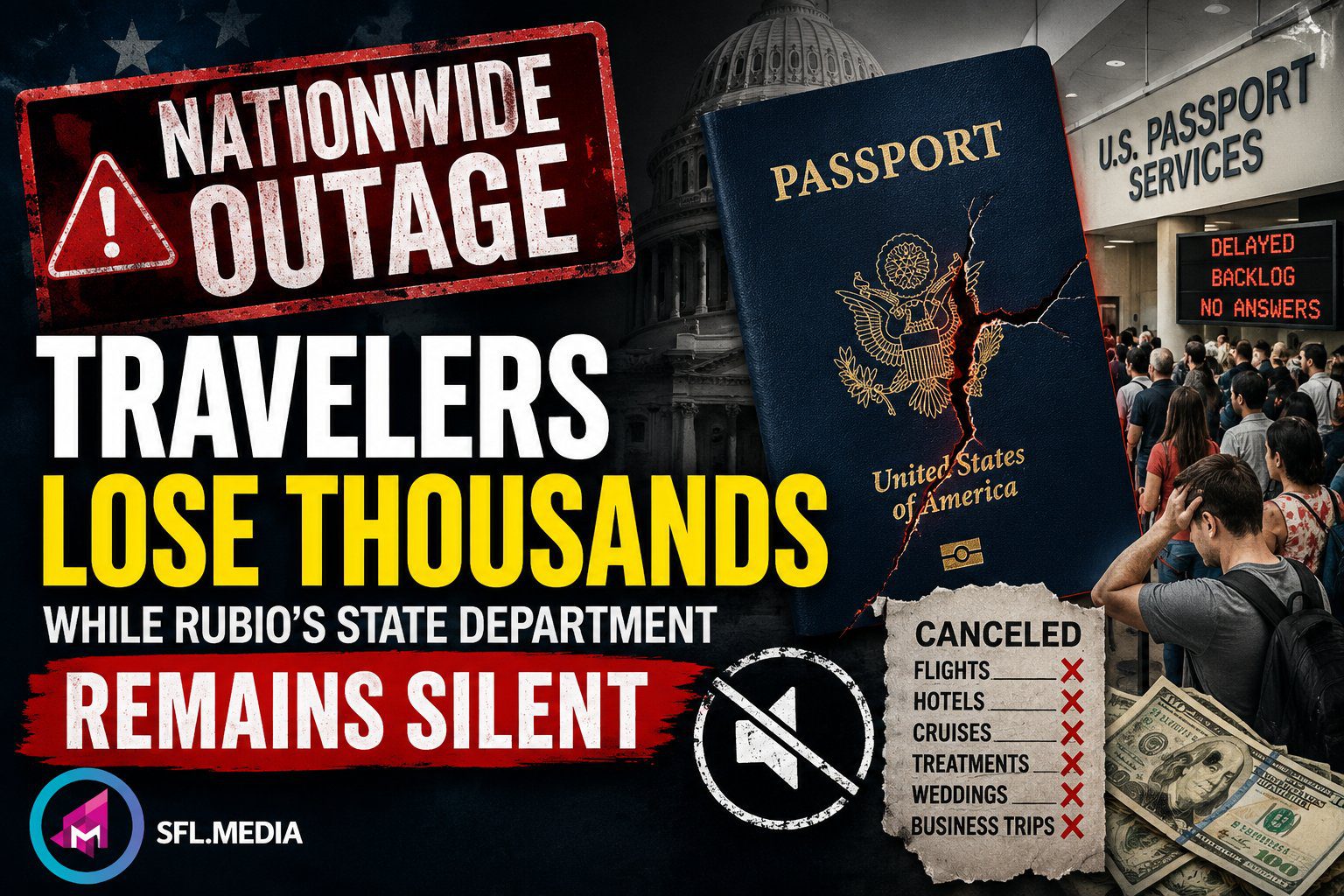
Chaos Inside America’s Passport System: Travelers Lose Thousands as State Department Faces Growing Questions Over Nationwide Processing Breakdown
Millions of dollars in vacations, weddings, business trips, cruises, and international travel could be hanging in the balance as what employees inside a U.S. passport agency described to South Florida Media as a nationwide passport system disruption continues with little public explanation from the U.S. Department of State.
South Florida Media spent the day inside the Miami Passport Agency, where employees told us the technical problems were affecting passport agencies across the country. Travelers standing in line echoed the same story. Some said they had already been waiting more than a week for passports that were supposed to be expedited, while others were watching carefully planned international trips unravel in real time.
For many Americans, this is no longer simply an inconvenience. It is thousands of dollars in unrecoverable financial losses delivered directly to taxpayers through a government service they are legally required to use.
Inside the Miami Passport Agency More Security Than Service
The atmosphere inside the Miami Passport Agency resembled an emergency response more than a routine federal office. Employees remained professional throughout the day despite facing increasingly frustrated travelers. No one working behind the counters appeared responsible for creating the crisis, yet they became the public face of a system that was clearly struggling to function. What stood out most wasn’t the dedication of the employees, it was the imbalance.
South Florida Media observed roughly seven teller windows actively processing passport applications despite dozens of available service stations throughout the office. At the same time, eight security personnel were highly visible, managing long lines and increasingly frustrated crowds. The contrast was impossible to ignore.
Every additional passport specialist could have reduced wait times, processed emergency applications, answered questions, and helped families make international flights. Instead, travelers watched service bottlenecks grow while the infrastructure designed to manage the crowd appeared more robust than the infrastructure designed to solve the underlying problem.
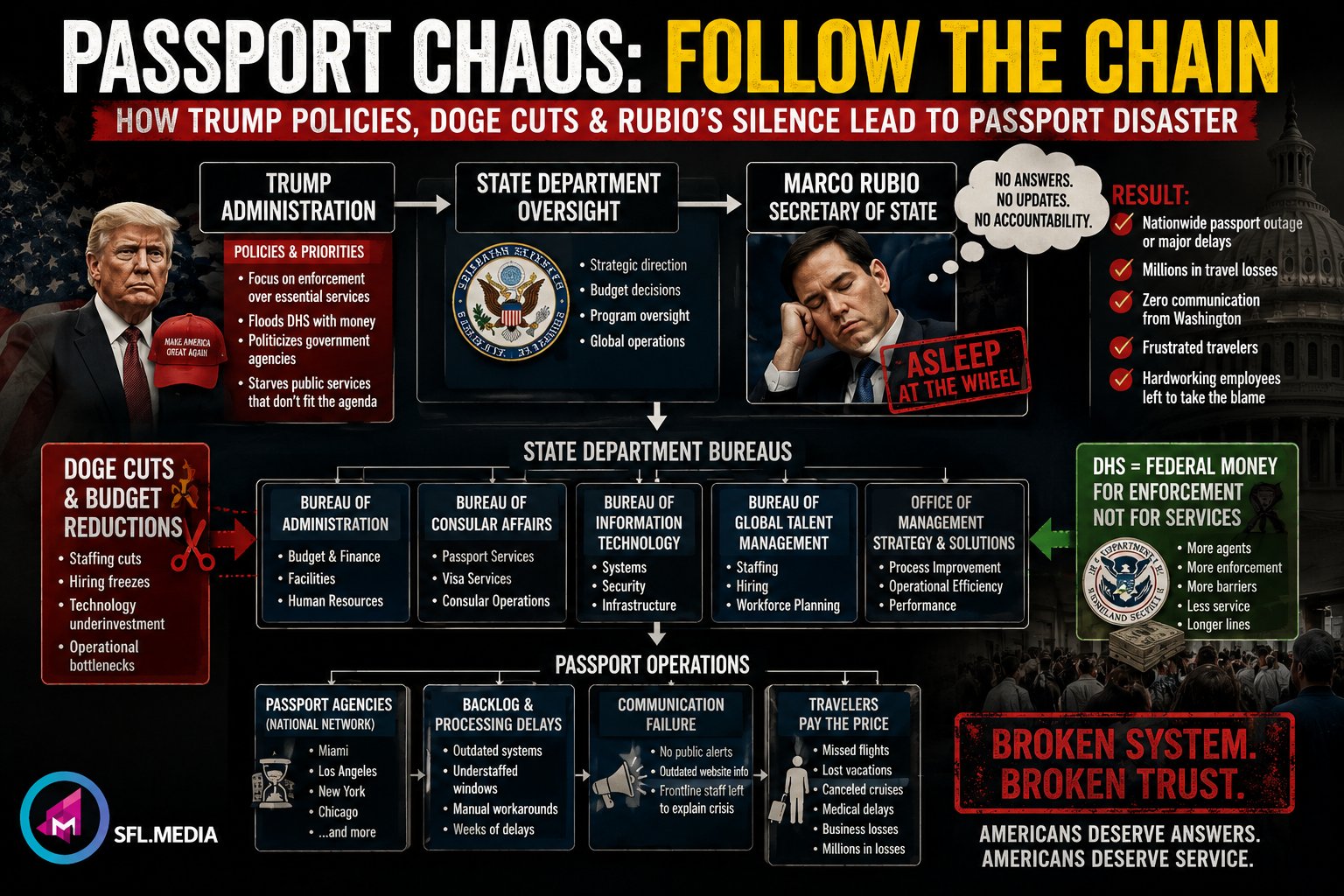
Whether that staffing imbalance stems from long term vacancies, operational decisions, budget priorities, or broader federal management policies is a question the State Department should answer. But the optics tell a story that extends well beyond one passport office.
For critics of the Trump administration, scenes like this have become emblematic of a broader governing philosophy: substantial investments in enforcement, security, and institutional control while many public facing services struggle with staffing shortages, aging technology, and reduced operational capacity. Supporters may argue those priorities strengthen government. Critics argue they leave Americans standing in line while essential services fall behind.
Inside the Miami Passport Agency, travelers weren’t asking for more security. They were asking for more people who could print passports. That distinction matters. Because government isn’t measured by how many people it can direct through a security checkpoint. It’s measured by whether it can deliver the public services taxpayers paid for when those services matter most.
Emergency Service That Was No Longer Emergency
Perhaps the most alarming discovery involved expedited passport processing itself. Several applicants arriving with emergency appointments expecting same day passport service were informed their documents would likely not be available until the following week because of the ongoing system problems. For travelers whose flights departed within days, that effectively transformed expedited processing into no processing at all.
One man waiting inside the agency told South Florida Media he was attempting to travel overseas for cancer treatment. Every additional day of delay, he said, pushed back medical care he could not easily reschedule. Others described missing weddings, family vacations, international business meetings, cruises, and long planned family reunions. These are not minor inconveniences. They are life events that often cannot be recreated.
Each additional day compounds the financial damage. Flights are missed. Hotels become non-refundable. Cruises depart without passengers. Business meetings disappear. Family celebrations proceed without loved ones. Medical appointments may have to be rescheduled, if they can be rescheduled at all. Unlike airline disruptions, government administrative failures frequently leave travelers with few practical options for reimbursement. The financial consequences extend well beyond the walls of any single passport agency.
If employees are correct that the disruption is nationwide, the economic damage is almost certainly measured in the millions of dollars. Every delayed passport represents prepaid airfare, hotel reservations, rental cars, cruise bookings, tour packages, lost wages, and other travel expenses that many families saved months, or even years, to afford. That money does not simply disappear from a government ledger. It comes directly out of individual Americans’ pockets.
The hidden cost is even greater. Vacation time cannot always be recovered. Honeymoons happen once. Weddings move forward. International conferences begin without absent attendees. Medical treatments are delayed. Family memories are lost forever. Government failures often get discussed in terms of computer systems and processing backlogs. For the people standing in line inside the Miami Passport Agency, the costs were far more personal. They were watching their time, their money, and in some cases opportunities they may never get back slip away while waiting for one of the federal government’s most essential services to function again.
Reduced to Pen and Paper
One of the clearest signs of the operational breakdown came when passport agency employees began asking citizens to write their mailing addresses by hand on blank sheets of printer paper because in person pickup had become so overwhelmed. The manual process reflected how severely normal operations had deteriorated.
Applicants who had surrendered perfectly valid passports simply to renew before expiration also found themselves unable to immediately retrieve those documents while delays continued. Citizens who had attempted to stay ahead of renewal deadlines instead found themselves trapped inside a backlog they never anticipated.
A Broken Pickup System
Even beyond the technical failures, South Florida Media observed a pickup process that appears to unnecessarily increase congestion. Customers returning only to collect completed passports must often stand through the same intake lines as applicants beginning entirely new passport applications.
There appears to be no operational reason completed pickups could not be handled through a separate waiting area where customers simply check in and are called when their passport is ready. Such a change alone could substantially reduce line volume inside already overwhelmed passport agencies. Sometimes government inefficiency isn’t created by billion dollar technology failures. Sometimes it is created by layouts and procedures that no longer make practical sense.
Silence From Washington
What may frustrate travelers most is not simply the delay itself. It is the lack of information. Despite employees describing what they said was a nationwide disruption, federal websites continued displaying standard passport processing information rather than prominently warning Americans about significant operational problems. If millions of dollars in personal travel expenses are potentially being affected, many travelers reasonably expect timely communication from the government.
Instead, much of the burden of explaining the crisis has fallen on frontline employees who have little authority to answer the public’s biggest questions. What caused the disruption? How many passport agencies are affected? How many applications are delayed? How many Americans have had travel plans disrupted? When will normal processing resume? Those questions remain largely unanswered publicly.
The timing of the disruption has also raised additional questions. The State Department is in the process of introducing an updated U.S. passport design under the Trump administration. While there is no public evidence linking the rollout of the redesigned passport to the current processing problems, the overlap in timing has prompted questions about whether any technology upgrades, production changes, or backend system migrations associated with the new passport program could have contributed to the disruption.
At this point, there is no public indication that the redesign itself caused the outage. However, neither the State Department nor passport officials have publicly addressed whether the ongoing rollout played any role or whether it is entirely unrelated. That silence has allowed speculation to flourish precisely because official information has been so limited. A straightforward explanation from the State Department about the nature of the outage, its scope, and its expected duration would likely do far more to restore public confidence than leaving affected travelers to piece together answers while standing in line.
A Broader Question About Government Priorities
The breakdown also raises broader questions about how government measures success. Inside the Miami office, South Florida Media observed dedicated employees working under intense pressure while limited operational staffing struggled to keep pace with demand. The contrast between heavily managed security operations and the limited number of active passport processing windows reflects a concern many Americans have voiced about modern government, that maintaining order increasingly receives greater institutional attention than delivering efficient public service. Reasonable people can disagree about the reasons for that imbalance. What is more difficult to dispute are the consequences. When essential government services fail, ordinary Americans, not politicians or bureaucrats, absorb the costs.
The Real Cost
Every delayed passport represents more than paperwork. It represents birthdays missed overseas. Parents separated from children. International medical appointments postponed. Students unable to begin semesters abroad. Businesses losing international opportunities. Families watching years of savings disappear because one federal system stopped functioning as expected.
Technology failures happen. Complex government systems occasionally break. Americans generally understand that. What they should not have to accept is prolonged uncertainty without clear communication while the financial consequences continue mounting. The Department of State now owes the public a detailed explanation of what occurred, how widespread the disruption became, how many travelers were affected, and what steps are being taken to restore confidence in one of the federal government’s most essential public services.
Because when Americans hand over their citizenship documents and pay hundreds of dollars for a passport, they are purchasing more than a booklet. They are purchasing the government’s promise that when life calls, the document they need will be there. For too many travelers this week, that promise was broken.











































Want to join the conversation?
Create an account or sign in to share your thoughts, vote,
and reply to other readers.
Showing 1 of 1 comment
Don't have an account?
Already have an account?