
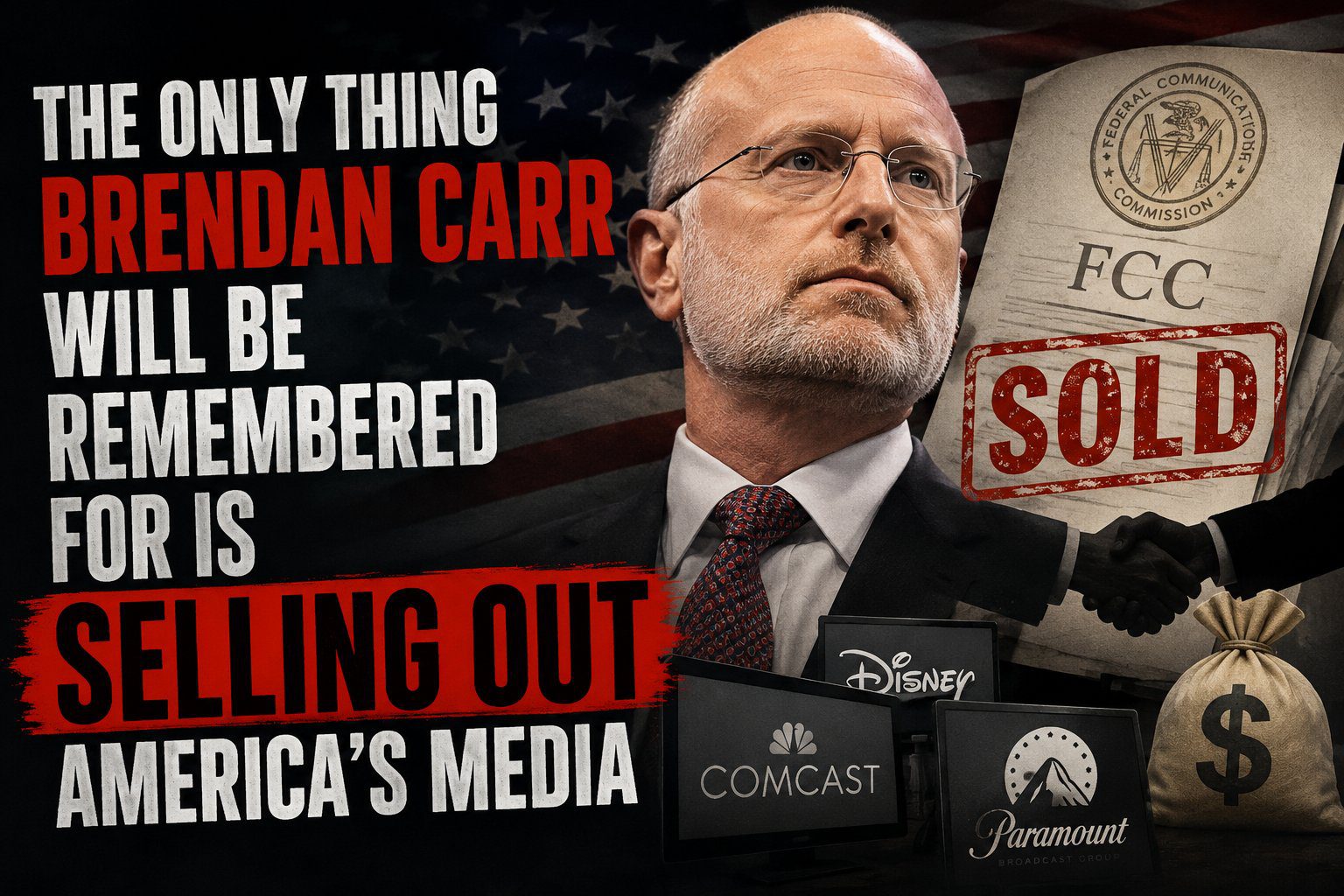
Brendan Carr’s Legacy Will Be the Sale of America’s Media
The Most Pathetic Man in the History of American Media…
Most Americans have never heard of FCC Chairman Brendan Carr. That may be the most important fact about him. While politicians fight on television and billionaires dominate headlines, Carr sits in a regulatory position capable of determining who ultimately controls much of the American media ecosystem. His signature does not create news organizations. It determines who gets to buy them.
And today, critics argue he is overseeing one of the largest transfers of media power in modern American history. Years from now, Americans may not remember the details of telecommunications policy or FCC rulemaking. They may remember something much simpler. Brendan Carr was the man who opened the door.
From Competition to Concentration
For decades, regulators worried about concentration of ownership. The reasoning was simple. A democracy functions best when information comes from many competing organizations, not a handful of powerful owners. That philosophy helped shape ownership restrictions, antitrust reviews, and foreign investment rules for generations. Today those protections appear to be rapidly eroding. The result is a media landscape increasingly controlled by a shrinking number of corporations, billionaires, and investment groups.
The Ellison Empire
The Ellisons are no longer simply technology investors. Through Skydance and Paramount, David Ellison is positioned to oversee one of the largest collections of media assets in the United States.
That portfolio includes CBS News, 60 Minutes, CBS Mornings, CBS Evening News, Face the Nation, Paramount Pictures, Showtime, MTV, Comedy Central, Nickelodeon, BET, VH1, Smithsonian Channel, Pluto TV, Paramount+, and dozens of local television stations. Viewed individually, each brand is significant. Viewed collectively, they represent one of the most influential information and entertainment platforms in the world.
The Next Prize
Critics are not focused solely on what has already been acquired. They are focused on what could come next. If further consolidation efforts succeed, additional assets frequently discussed by analysts include CNN, HBO, Warner Bros., Max, Discovery Channel, HGTV, Food Network, TLC, TNT, TBS, Cartoon Network, Adult Swim, and CNN International.
At that point, the debate stops being about business growth. It becomes a debate about power.
Why Critics Are Alarmed
The concern is not that any one company owns media assets. The concern is that too few companies own too many. When ownership consolidates, newsroom independence becomes harder to maintain. Corporate priorities become more influential. Editorial decisions become more centralized. Local reporting becomes less important. The public receives information from fewer gatekeepers. That trend has already transformed newspapers across America. Many journalists fear television news could be next.
The Foreign Investment Question
The most controversial aspect of the current debate involves foreign capital. Federal law historically limited foreign ownership of American broadcast assets because lawmakers understood that media is not merely another business sector. It is part of the nation’s civic infrastructure.
Supporters argue that outside investors are passive financial participants. Critics argue that influence does not require direct editorial control. The larger the investment, the larger the potential leverage. That concern has become a central point of opposition among media watchdogs and lawmakers questioning the direction of current FCC policy.
The Scott Pelley Warning
The recent implosion at CBS News has become a symbol of those fears. When a journalist with Scott Pelley’s reputation publicly states that “60 Minutes lost its DNA” and describes a collapse of values inside one of America’s most respected news organizations, people listen.
Whether one agrees with Pelley’s assessment or not, his departure has intensified concerns about the future independence of legacy news organizations. To many observers, it is not simply a personnel dispute. It is a warning.
How History Will Remember Brendan Carr
Brendan Carr’s supporters will argue that he helped American media companies compete in a rapidly changing digital world. His critics will argue that he presided over the greatest concentration of media ownership in modern American history. History will decide which interpretation survives. But if current trends continue, Carr’s legacy may not be defined by what he regulated. It may be defined by what disappeared under his watch. Independent ownership. Local journalism. Media diversity. And the belief that no small group of powerful interests should ever control so much of what Americans see, hear, and believe.































Want to join the conversation?
Create an account or sign in to share your thoughts, vote,
and reply to other readers.
Showing 0 of 0 comments
Don't have an account?
Already have an account?