
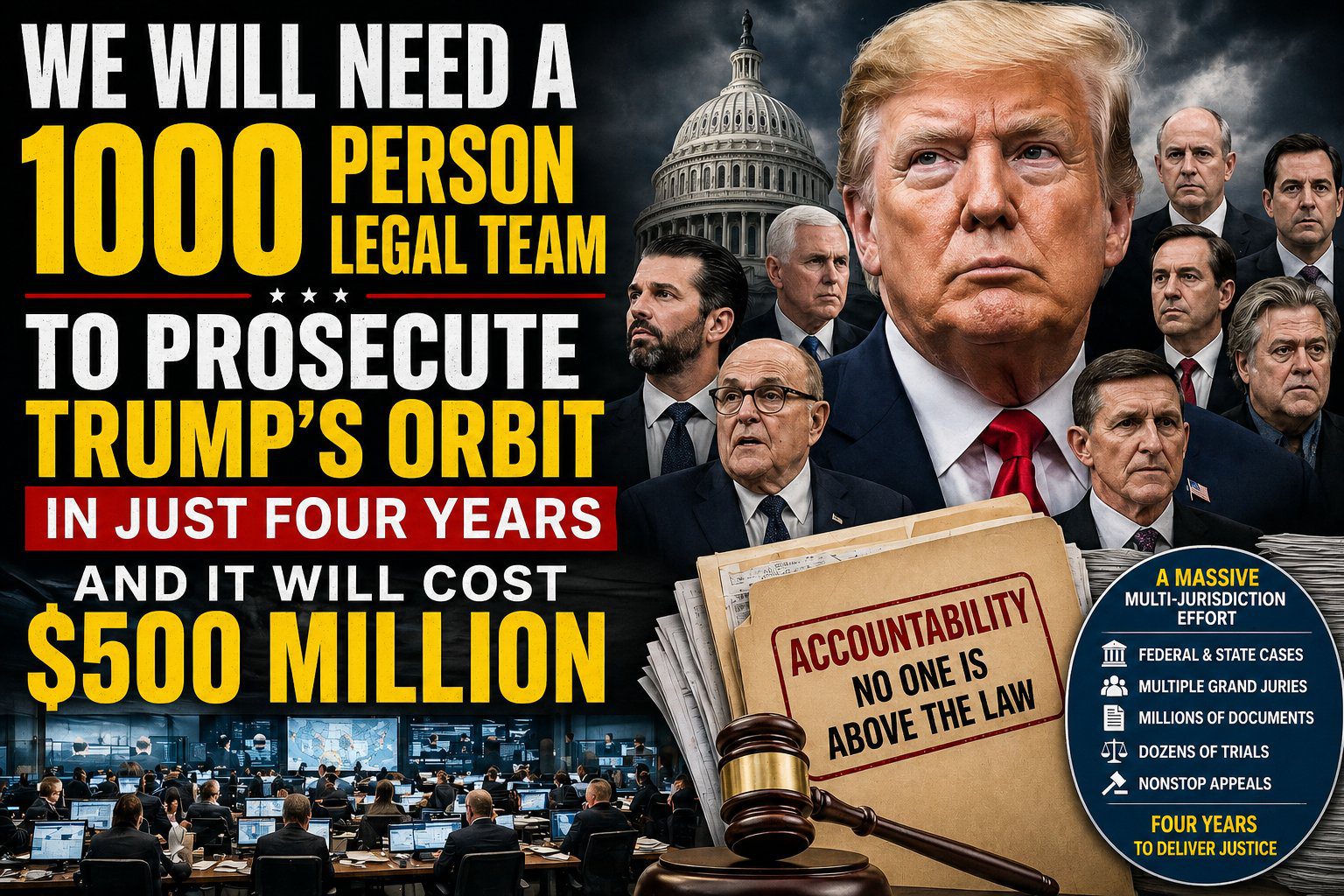
The $500 Million Reckoning: Why It Would Take 1,000 Legal Professionals to Prosecute Trump’s Orbit in Just Four Years
There’s a fantasy version of accountability in America, fast, sweeping, and decisive. Then there’s reality, where every case is fought inch by inch, every motion is weaponized, and every delay is intentional. If the United States were to seriously prosecute every provable crime tied to Donald Trump’s orbit, it wouldn’t look like a headline grabbing crackdown. It would look like one of the largest, most complex legal operations in modern U.S. history.
“You don’t win a case of this magnitude with outrage, you win it with infrastructure, discipline, and the ability to move faster than the system is designed to allow.” – Patrick Zarrelli
And it all has to function within the legal framework defined by Trump v. United States, which forces prosecutors to separate protected presidential conduct from prosecutable private actions before a jury ever hears a single argument.
The Scale: Why This Becomes a 1,000 Person Operation
At this level, prosecution is not about a single trial, it’s about running dozens of them at once. Federal cases today are built on millions of digital records: emails, encrypted messages, financial transfers, cloud backups, phone extractions, and metadata trails that require entire teams just to process. To keep cases moving instead of stalling under their own weight, the operation would need a workforce approaching 1,000 professionals. That includes prosecutors handling parallel trials across multiple jurisdictions, investigators tracking financial and communication networks, analysts managing massive datasets, and appellate attorneys responding to constant legal challenges in real time. Without that scale, the defense dictates the timeline. And if the defense controls the timeline, the four year window disappears.
The Cost: Why $500 Million Is Not Excess, It’s Necessary
There is no version of this effort that is cheap. High level prosecutions are resource wars, and every layer, expert witnesses, secure evidence systems, classified information handling, and nonstop litigation, adds cost. A four year, fully operational task force would likely land near $500 million. That figure reflects not just salaries, but infrastructure, technology, travel, security, and the kind of forensic accounting required to unwind complex financial networks. Underfund it, and cases slow down. Slow them down, and they die in pretrial litigation.
Jurisdiction: The Federal State Chessboard
One of the most misunderstood aspects of a prosecution like this is jurisdiction. Not every crime belongs in federal court. Some of the most significant allegations, particularly election interference at the state level, must be handled by state prosecutors. That means coordination between federal prosecutors and state offices in places like New York and Georgia, where separate cases can proceed without violating double jeopardy rules. A centralized federal strategy must work alongside independent state prosecutions, sharing evidence where legally permissible while avoiding conflicts that could derail cases entirely. This isn’t one case. It’s a network of cases that must be synchronized without being merged.
How Cases Actually Get Built: Grand Juries and Rolling Indictments
Prosecutions don’t begin in courtrooms, they begin in grand juries. And at this scale, you don’t use one. You run multiple grand juries in parallel, each focused on different tracks of evidence. Indictments would likely come in waves. Early charges based on clear evidence, obstruction, false statements, financial violations, would be filed first. More complex indictments would follow as evidence builds and cooperators come forward.
Sealed indictments would play a critical role, preventing defendants from coordinating responses or interfering with witnesses before arrests are made. This is how large cases move forward without tipping their hand too early.
The Engine of Every Major Case: Cooperators
No prosecution of this scale succeeds without insiders. Lower level defendants are the first pressure points. Faced with serious charges and potential prison time, some will cooperate. That cooperation, documents, testimony, internal communications, builds the cases that reach higher levels. This is not theory. It is how organized crime, corporate fraud, and public corruption cases have worked for decades. You build from the outside in, not the top down. Without cooperators, cases take longer. With them, they accelerate.
The Supreme Court Bottleneck
Every major move in a case like this eventually runs into one place: the Supreme Court of the United States. Emergency appeals, immunity challenges, and constitutional questions can pause proceedings at any moment. Even strong cases can be delayed if higher courts decide to intervene. That means prosecutors cannot treat appeals as a later phase. Appellate strategy has to be built into every decision from day one, anticipating challenges before they are filed. Because once a case is paused at the top, the clock doesn’t stop.
The Structure: One Command, Multiple Battlefronts
A single office cannot handle this. It requires a centralized command structure inside the Department of Justice, supported by regional prosecution hubs operating in parallel. Each unit focuses on a specific category, financial crimes, obstruction, classified documents, public corruption, while a dedicated appellate division ensures that no case stalls under legal pressure. This structure allows cases to move simultaneously instead of waiting in line, maintaining momentum across multiple fronts.
The Strategy: Start Where You Can Win
The instinct is to go after the biggest, most politically explosive cases first. That’s a mistake. The work already outlined by Jack Smith shows how complex election related prosecutions become under constitutional scrutiny. Those cases matter, but they are slow.
Instead, prosecutors start with what wins:
Financial crimes backed by hard evidence
Obstruction and false statements with clear documentation
Document retention and classified materials cases tied to physical proof
These cases move quickly, create pressure, and generate cooperation. That cooperation is what builds the larger, more complex prosecutions that follow.
The Timeline: Four Years Against the Clock
Time is the single biggest threat to the entire effort. Every defendant will attempt to delay through motions, appeals, privilege claims, and procedural challenges designed to run out the clock.
The only viable approach is sequencing and parallel execution:
Year One focuses on securing evidence, issuing subpoenas, and filing early indictments
Year Two moves fast cases to trial and establishes momentum
Year Three advances the most complex prosecutions with tested evidence
Year Four completes trials, defends appeals, and shifts unresolved matters into civil or state enforcement
Try to do everything at once, and the system stalls. Sequence it correctly, and cases keep moving regardless of resistance.
The Political Reality: Independence or Collapse
For any of this to work, it must be insulated from political interference. The Department of Justice must operate independently, even under intense public and congressional pressure. Any perception that prosecutions are politically motivated risks undermining cases in court and in public opinion. Oversight battles, funding disputes, and leadership changes are not side issues, they are existential risks to the entire effort. Credibility is as important as evidence.
What Success Actually Looks Like
There is no realistic scenario where every possible crime is prosecuted within four years. That’s not how the American legal system works.
Success looks different:
Convictions that survive appeal
A documented public record of wrongdoing
Financial penalties and civil enforcement where criminal prosecution isn’t viable
A reinforced legal standard that power does not override the law
“The real test isn’t whether every case is brought, it’s whether the cases that are brought hold up, endure, and prove that the system still works when it’s pushed to its limits.” – Patrick Zarrelli
That’s not just accountability. That’s whether the rule of law in the United States is still real.













































Want to join the conversation?
Create an account or sign in to share your thoughts, vote,
and reply to other readers.
Showing 0 of 0 comments
Don't have an account?
Already have an account?