
Brightline’s Parent Companies Enter Chapter 11 as Florida’s High Speed Rail Operator Confronts a Massive Debt Restructuring, Growing Ridership and a Staggering Safety Record
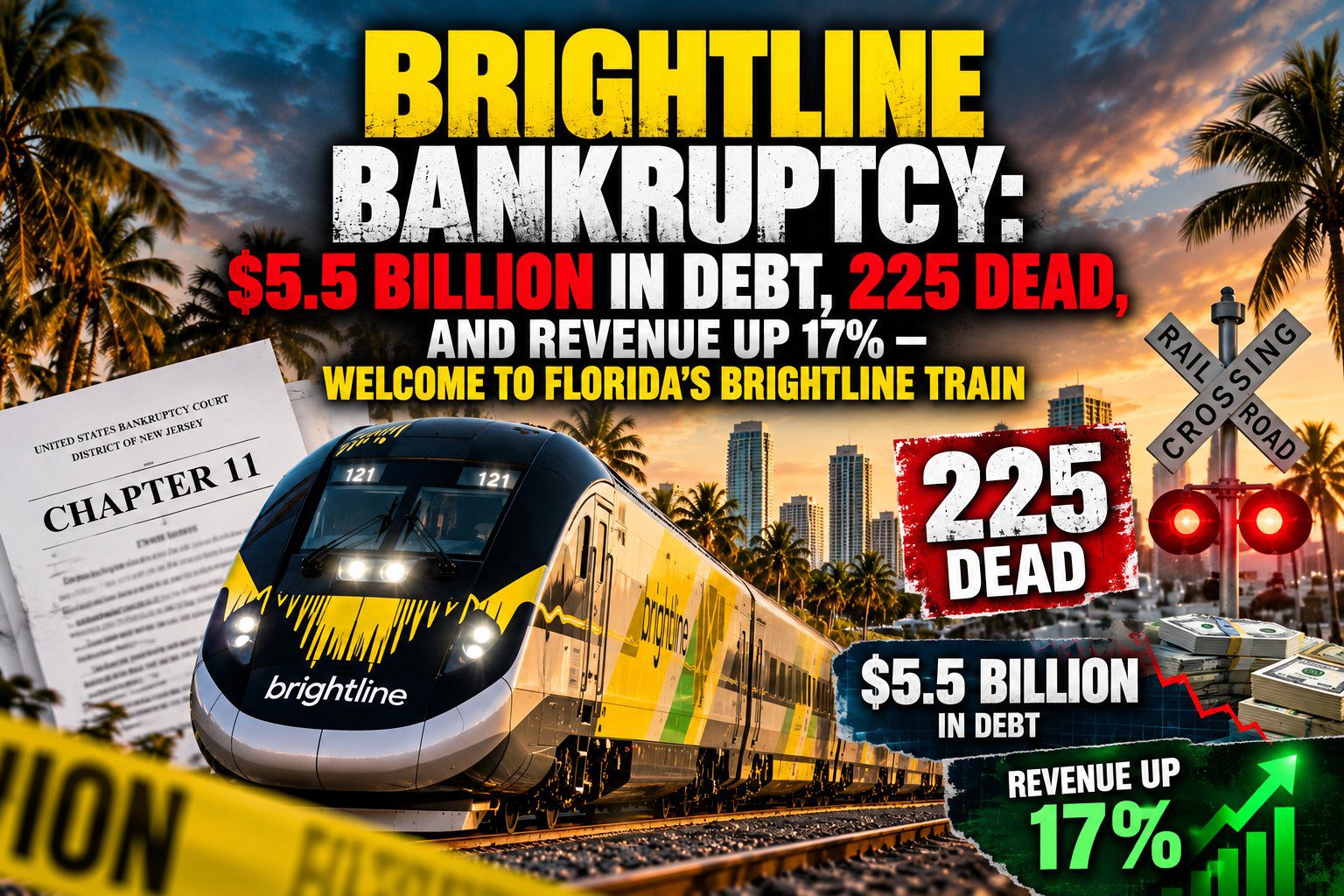
Brightline, Florida’s privately operated passenger railroad connecting Miami and Orlando, has entered one of the most consequential financial restructurings in the company’s history, with 17 affiliated parent companies filing for Chapter 11 bankruptcy protection as the railroad attempts to restructure a debt burden estimated at approximately $5.5 billion. The filings were made September 24 in the U.S. Bankruptcy Court for the District of New Jersey and include Brightline Holdings LLC, FIHPNP LLC and 15 other affiliated companies.
But there is an important distinction for Florida passengers: Brightline Trains Florida LLC, the operating company that actually runs the trains between Miami and Orlando, did not file for bankruptcy. That means Brightline’s trains are continuing to operate through Miami, Aventura, Fort Lauderdale, Boca Raton, West Palm Beach and Orlando while the company’s parent level finances are reorganized through the federal bankruptcy system.This is not a liquidation of Brightline’s Florida railroad. It is a prearranged Chapter 11 restructuring designed to reduce the enormous amount of debt accumulated while developing and expanding the system, inject hundreds of millions of dollars of additional financing into the business and give the railroad a more sustainable financial structure.
Brightline’s Trains Are Still Running
For passengers, the most immediate takeaway is simple: Brightline service is not shutting down. Brightline Trains Florida LLC remains outside Chapter 11 and will continue operating under its existing management, with the company saying schedules, stations and normal passenger operations are not affected by the bankruptcy proceedings involving its parent entities.Several companies holding rights connected to Brightline’s potential future expansion are also outside the bankruptcy.
Brightline Florida Holdings LLC, which indirectly holds rights associated with developing commuter rail service in Miami-Dade, Broward and Palm Beach counties, did not file Chapter 11. AAF Operations Holdings LLC, which indirectly holds development rights associated with a potential extension from Orlando toward Tampa, was also excluded. Brightline West, the separately financed project seeking to construct a high speed passenger railroad between Las Vegas and Southern California, is likewise not part of the Florida bankruptcy proceeding.
The complicated corporate structure matters because the bankruptcy is being conducted primarily above the railroad’s operating company rather than placing the company running Florida’s trains directly into Chapter 11.
Seventeen Brightline Affiliated Companies Filed Chapter 11
Court records show the Chapter 11 cases involve 17 affiliated entities: Brightline Management LLC, Brightline Holdings LLC, Brightline Property Holdings LLC, FIHPNP LLC, FIHP LLC, FIHPNPNJ LLC, AAF Jacksonville Segment LLC, BL Florida LLC, BH Investment LLC, BLTF Holdings LLC, Brevard FGT LLC, Brightline East LLC, DT Miami LLC, Flagler Management LLC, Flagler Management West LLC, Florida Investment Holdings LLC and New Flagler Development LLC.Brightline Holdings’ petition lists estimated assets and liabilities in the broad range of $1 billion to $10 billion, while reporting has placed the broader debt stack being addressed by the restructuring at approximately $5.5 billion. The companies have asked the bankruptcy court to jointly administer the 17 cases, with FIHPNP LLC proposed as the lead case.
How Brightline Ended Up With Approximately $5.5 Billion in Debt
Brightline’s financial problem is not difficult to identify: building a railroad is extraordinarily expensive, and the company’s passenger and revenue growth has not occurred fast enough to comfortably support the enormous amount of debt accumulated to build it. Brightline constructed and developed a roughly 235 mile passenger corridor between Miami and Orlando, including new stations, track infrastructure, signaling systems, maintenance facilities and a fleet of Siemens trainsets.
The company initially launched service between Miami and West Palm Beach in 2018 before completing its long awaited extension to Orlando International Airport in 2023. Much of that development was financed through billions of dollars in tax exempt bonds and other forms of debt. Brightline subsequently borrowed additional money as it attempted to finance operations and manage its existing obligations.
By 2026, its complicated capital structure included billions of dollars in municipal bonds along with other corporate obligations and financing arrangements. The result was a railroad that could attract millions of passengers and still face an unsustainable financial structure.
Ridership Is Growing, Just Not Fast Enough
Ironically, Brightline entered bankruptcy restructuring while its operating numbers were improving. The company reported that year to date ridership through August 2026 increased approximately 14% compared with the same period in 2025, while revenue increased roughly 17%. Those numbers would normally represent encouraging growth for a transportation company, but the problem is the enormous gap between Brightline’s current performance and the financial assumptions that helped support billions of dollars of borrowing.
Tim Hynes, head of Global Credit Research at Debtwire, told the Associated Press that Brightline is currently carrying approximately 3.5 million passengers annually and generating roughly $240 million in annual revenue. According to Hynes, that represents less than half the passenger volume and approximately one third of the revenue Brightline had projected in 2024.
That difference becomes critical when billions of dollars of debt have to be serviced: a railroad can increase ridership by double digits and still face a financial crisis if its original capital structure assumed substantially more passengers, higher revenue or both.
Brightline Had Been Negotiating With Creditors for Months
The Chapter 11 filing did not arrive without warning. Brightline spent much of the past year negotiating with creditors as it struggled with interest payments and upcoming financial obligations after borrowing extensively from the municipal bond market and attracting investors willing to purchase higher yield debt. The railroad’s financial difficulties eventually created competing interests among creditors seeking to protect their investments and potentially gain greater influence over the company through a restructuring.
Brightline explored alternatives outside bankruptcy, but negotiations ultimately produced the restructuring support agreement now being implemented through Chapter 11. Rather than enter court with no predetermined path forward, Brightline arrived with significant stakeholders already supporting the framework of a restructuring.
Brightline Secures $490 Million in New Financing
A critical component of the restructuring is a commitment for $490 million in new long-term financing for Brightline Trains Florida. Supporting financial stakeholders, including Assured Guaranty and an ad hoc group of mutual fund bondholders, have agreed to provide $140 million in additional senior debt and $350 million in new junior debt following the restructuring, with Assured Guaranty committing $70 million toward the additional senior financing. That money is intended to provide liquidity for Brightline’s continuing operations, strengthen its financial position after restructuring and repay financing being provided while the bankruptcy cases are underway. The company and its financial backers are effectively attempting to preserve the railroad’s operating business while dramatically reorganizing the financial structure surrounding it.
Another $258 Million Will Finance the Bankruptcy Process
Brightline’s stakeholders have also agreed to provide $258 million in post petition financing while the parent entities move through Chapter 11, with Assured Guaranty committing to provide as much as $178 million of that financing. Post petition financing is designed to provide liquidity while the restructuring moves through bankruptcy court and, under the proposed arrangement, is expected to be repaid when the Brightline entities emerge from Chapter 11. Together, the $258 million bankruptcy financing and $490 million in committed long term capital provide the financial bridge Brightline is relying on to continue operating while its balance sheet is reorganized.
Billions in Brightline Bonds Remain Outstanding
The restructuring is also notable for what it does not eliminate. Brightline says the $2.2 billion Brightline Trains Florida LLC Series 2024 tax exempt bonds will remain outstanding, along with the existing Assured Guaranty insurance policy connected to those bonds. Several other major bond issues associated with entities outside Chapter 11 are also expected to remain outstanding without reductions in their aggregate principal amounts.
Those obligations include approximately $985 million in Brightline Florida Passenger Rail Expansion Project Series 2025B bonds, $925 million in AAF Operations Holdings Series 2024 tax exempt bonds and approximately $285.7 million in AAF Operations Holdings Series 2024A tax-exempt bonds. The restructuring therefore should not be interpreted simply as Brightline wiping away $5.5 billion and starting over; it is a complicated reorganization involving different corporate entities, creditor classes, financing arrangements and bond obligations.
Restructuring Could Cut Brightline’s Debt Dramatically
Reporting preceding the bankruptcy indicated that the restructuring was designed to reduce Brightline’s roughly $5.5 billion debt burden to approximately $2.7 billion, which would amount to a reduction of roughly half of the debt being addressed by the broader restructuring. The final capital structure, however, remains subject to the bankruptcy process, restructuring documents and court approval.
The distinction is important because billions of dollars of municipal bonds are expected to remain outstanding at their existing principal amounts even as other parts of Brightline’s capital structure are reorganized. The ultimate objective is therefore not simply debt cancellation, but reorganizing which entities owe which obligations, restructuring claims and financing arrangements, improving liquidity and leaving the operating railroad with a debt burden its actual revenue can more realistically support.
Cocoa Station Still Moving Forward
Brightline’s financial restructuring also raises obvious questions about expansion projects planned across Florida, including a proposed station in Cocoa that would bring Brightline passenger service directly to the Space Coast. In August, the City of Cocoa and Space Coast Transportation Planning Organization announced that the Federal Railroad Administration had selected the Cocoa Multimodal Station and Rail Project for approximately $57.5 million in federal funding for final design and construction.
Brightline continues to list Cocoa among the additional stations it intends to pursue as part of its Florida growth strategy, while also saying it plans to continue working toward commuter access in Miami-Dade, Broward and Palm Beach counties and the eventual expansion of passenger service from Orlando toward Tampa.
Those development rights were deliberately kept in corporate entities outside the Chapter 11 filing. That does not mean every proposed expansion is financially guaranteed: major infrastructure projects still require enormous amounts of capital, regulatory approvals and financing, and Brightline’s ability to raise money in the future will inevitably be influenced by the outcome of its current restructuring. But none of those projects has automatically disappeared because of the Chapter 11 filings.
Brightline West Is a Separate Financial Story
The Florida restructuring also does not include Brightline West, the ambitious project seeking to connect Las Vegas with Southern California. Although the Florida railroad and Brightline West share corporate connections through Fortress Investment Group and billionaire investor Wes Edens, they are separate businesses with different financing structures, and Brightline West is not a debtor in the Florida Chapter 11 proceedings. That distinction is particularly important because headlines describing a “Brightline bankruptcy” can easily create the impression that the entire national Brightline enterprise has entered bankruptcy. It has not.
Brightline’s Other Staggering Number: At Least 225 People Killed
Brightline’s multibillion dollar financial problems are not the only controversy that has followed the railroad through South Florida. Since Brightline began testing trains along the Florida East Coast Railway corridor in 2017, at least 225 people have been killed in incidents involving its trains, according to reporting by the Miami Herald and WLRN. The grim milestone was reached in September 2026 after another pedestrian was struck and killed in Fort Lauderdale. The death toll has made Brightline an extraordinary outlier among American passenger railroads. Investigations by the Associated Press, Miami Herald and WLRN have documented an exceptionally high fatality rate per mile compared with other major U.S. railroads.
But the statistic requires an equally important qualification: the overwhelming majority of these deaths have not been attributed to wrongdoing by Brightline’s engineers or train crews.Many incidents have involved suicides, pedestrians illegally entering or walking along the railroad right of way, motorists stopping on tracks or drivers attempting to circumvent activated crossing gates. Trains traveling at high speeds require enormous distances to stop, leaving engineers with little or no ability to prevent a collision once a person or vehicle enters the tracks directly ahead of them.
That distinction does not make the human toll any less extraordinary. More than 225 people dying in incidents involving a single passenger railroad operation in less than a decade has generated years of scrutiny over whether additional infrastructure, fencing, crossing protections, public education and suicide prevention measures could reduce the number of people reaching the tracks in the first place.
Tens of Millions Have Been Poured Into Safety Improvements
Brightline, the Florida Department of Transportation and the federal government have responded with increasingly aggressive safety investments along the corridor. A major $45 million safety program has funded fencing, crossing delineators, roadway markings, railroad dynamic-envelope striping, crisis support signage and other intrusion prevention measures at hundreds of crossings along the approximately 195 mile Miami to Cocoa corridor. Federal transportation officials announced in June 2026 that 173 of 327 targeted crossings had already received improvements and more than 116 crisis support signs had been installed. Officials also reported that grade crossing collisions and trespassing incidents declined 30% year over year during the first quarter of 2026.
Other safety projects have included additional crossing gates, centerline delineators designed to prevent motorists from driving around lowered gates, pedestrian barriers, upgraded warning systems and technology capable of detecting trespassing along the railroad corridor.Brightline says it has invested substantially more beyond the current federal program, including nearly $230 million in crossing improvements and another $266 million for Positive Train Control, while supporting municipalities pursuing additional state and federal safety grants.
The railroad has consequently become an unusual transportation paradox: Brightline can maintain that its trains and crews are operating according to federal safety requirements while still operating along a corridor where an extraordinary number of people have been struck and killed.
The Death Toll Has Also Taken a Toll on Brightline Employees
The repeated collisions have affected more than victims and their families. Former Brightline conductor Darren J. Brown Jr. filed a federal lawsuit in December 2025 seeking more than $60 million in damages, alleging that repeated exposure to gruesome fatal collisions during his years working aboard Brightline trains left him suffering from severe psychological trauma. Brown said he worked for Brightline from approximately 2018 through 2023 and was involved in more than 10 traumatic incidents, including at least seven confirmed fatalities.
His lawsuit alleged that employees were repeatedly exposed to catastrophic accident scenes without adequate psychological support and that the company’s workplace culture failed to properly address the cumulative trauma experienced by train crews. Brightline and its parent company disputed the allegations.
In April 2026, a federal magistrate judge dismissed Brown’s complaint as an improperly constructed “shotgun pleading,” finding that it contained irrelevant material and was inadequately organized. The dismissal should therefore not be interpreted as a judicial finding that Brown’s underlying allegations were true; the ruling centered on deficiencies in how the lawsuit had been pleaded. Nevertheless, the case offered an unusually detailed look at another consequence of Brightline’s collision history: the engineers, conductors, first responders and other workers who repeatedly encounter fatal incidents along the tracks.
Brightline’s Safety Problem Is Bigger Than Assigning Blame
The distinction between responsibility and outcome is critical when examining Brightline’s safety record. A railroad cannot reasonably be expected to stop a train traveling at high speed when a person deliberately steps onto the tracks immediately ahead of it, nor can an engineer necessarily prevent a collision when a motorist ignores flashing lights, circumvents lowered gates or stops a vehicle on the tracks. But 225 deaths remain 225 deaths.
That makes the broader public policy question more complicated than determining legal fault after individual crashes. The question is whether additional engineering, fencing, crossing design, enforcement, technology and suicide prevention measures can prevent people from reaching the path of the trains in the first place. Federal transportation officials have increasingly focused their investments on precisely that problem, and there are signs those investments may be working: the reported 30% year over year decline in crossing collisions and trespassing incidents during the first quarter of 2026 suggests that physical infrastructure and prevention measures can make a measurable difference.
For Brightline, safety is therefore another critical component of the railroad’s attempted reset. The company now has to demonstrate not only that it can restructure billions of dollars in debt and eventually generate enough revenue to sustain its railroad, but also that America’s most prominent experiment in privately operated intercity passenger rail can coexist safely with the densely populated South Florida communities through which its trains travel every day.
The Bigger Question Is Whether Brightline’s Business Model Can Finally Support Its Railroad
Brightline has accomplished something unusual in American transportation: it built and launched a privately operated intercity passenger railroad connecting major metropolitan areas and expanded that system more than 200 miles to Orlando. But building the railroad and proving that the railroad can support the debt used to build it are two very different accomplishments. The current numbers illustrate that problem clearly. Approximately 3.5 million annual passengers and roughly $240 million in annual revenue represent a substantial transportation operation, while ridership growing 14% and revenue increasing 17% show that demand continues to expand. Yet those numbers remain dramatically below the assumptions that helped underpin Brightline’s previous financial structure.
The bankruptcy is therefore not primarily a referendum on whether people are riding Brightline. Millions are. It is a reckoning over whether the amount of money Brightline borrowed to build the railroad can realistically be supported by the amount of money the railroad actually generates. Chapter 11 gives Brightline an opportunity to reset that equation.For South Florida passengers, little changes immediately. The yellow trains will continue pulling into Miami, Aventura, Fort Lauderdale, Boca Raton and West Palm Beach before heading north toward Orlando.
Behind those trains, however, one of the most ambitious privately financed transportation projects in modern American history is undergoing a massive financial reconstruction.Whether that restructuring finally puts Brightline on sustainable financial footing will depend on what happens next: how much debt ultimately disappears or is reorganized, how quickly ridership and revenue continue growing, whether operating margins improve and whether the company can finance its next generation of expansion without recreating the same debt problem that forced its parent companies into Chapter 11 in the first place.
For Brightline, the numbers now tell two dramatically different stories at once: revenue is up 17% and ridership is growing, yet its corporate parents are restructuring approximately $5.5 billion in debt while the railroad carries the history of at least 225 deaths involving its trains. That contradiction captures the extraordinary position Brightline finds itself in today, a railroad that has successfully built a major passenger network through the heart of South Florida and attracted millions of riders, but must now prove that it can make that network financially sustainable while continuing to confront the enormous human toll accumulated along its tracks.

Sources & Further Reading
WLRN — Brightline Obtains $490 Million to Restructure Debt as Parent Entities Enter Bankruptcy
WLRN — Brightline Bankruptcy, $5.5 Billion Debt and 225th Reported Death
PR Newswire — Brightline Restructuring Agreement and Financing Details
WLRN / Miami Herald — Killer Train Investigation Into Brightline Fatalities
Associated Press — Brightline Debt Restructuring and Continued Florida Train Operations











































Want to join the conversation?
Create an account or sign in to share your thoughts, vote,
and reply to other readers.
Showing 0 of 0 comments
Don't have an account?
Already have an account?