
David Grusch Goes Further Than Ever on Joe Rogan, Claiming He Saw Video of Non Human Bodies and Warning AI Could Break the UAP Secret
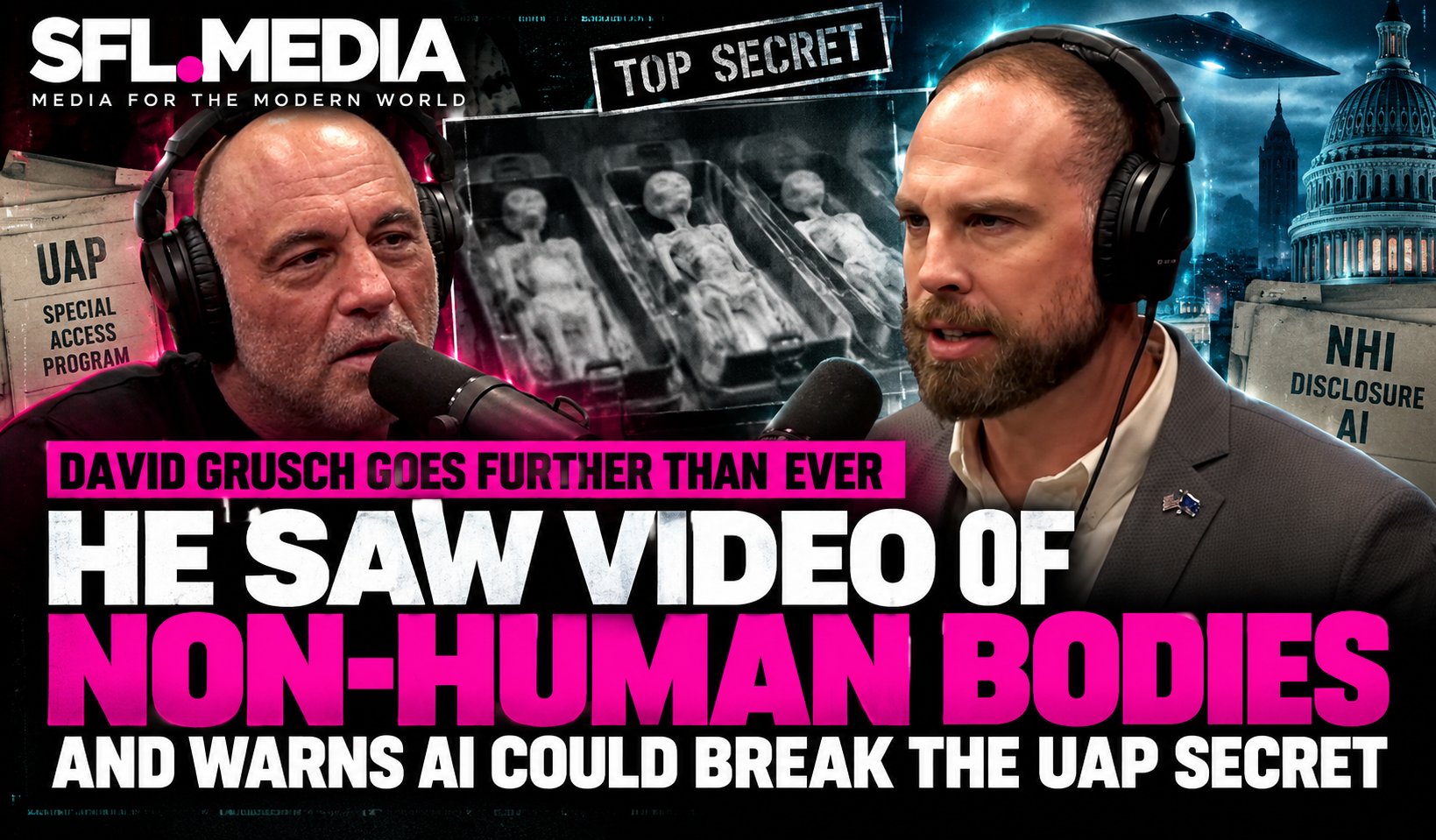
Former U.S. intelligence officer and UAP whistleblower David Grusch returned to The Joe Rogan Experience on Sept. 30 for what may be his most expansive public interview yet, moving well beyond his original allegations about secret crash retrieval programs and describing what he says he personally saw in classified imagery, what senior government officials allegedly confirmed to him and why artificial intelligence could eventually make decades of secrecy impossible to maintain.
The roughly two and a half hour conversation covered alleged intelligence community corruption and retaliation against whistleblowers, purported non-human bodies, unusual encounters reported by government personnel, the Vatican, Cold War-era disclosure discussions and the possibility that increasingly powerful AI systems could independently connect information that humans have spent decades keeping compartmentalized.
The significance of the interview is not that Grusch produced publicly verifiable physical evidence of extraterrestrial or non-human intelligence. He did not. Many of his most extraordinary assertions remain allegations that cannot currently be independently verified from publicly available evidence. What changed was how far Grusch was willing to go publicly. In several portions of the interview, he moved from describing what witnesses told him to describing material he says he personally reviewed and subsequently attempted to corroborate through additional classified sources.
Grusch Is No Longer Just Talking About What Other People Told Him
Grusch became nationally known in 2023 after publicly alleging that elements of the U.S. government and defense establishment had concealed a decades long crash retrieval and reverse engineering program involving unidentified anomalous phenomena. His original public case relied heavily on information he said had been provided by intelligence officials, military personnel and individuals with direct access to classified programs. His latest Rogan interview went considerably further.
At one point, Grusch discussed classified video that he said showed bodies associated with an anomalous retrieval. Asked by Rogan how many he remembered seeing, Grusch responded that he believed there were “three or four.” He described them as very human looking, with pale bluish white skin and grayish hair, while emphasizing that the footage was not close enough for him to provide detailed anatomical observations. Grusch also acknowledged considering whether the material itself could have been a deception operation designed to manipulate him, but said he used additional sources and methods to independently corroborate that the underlying event had occurred.
That does not independently establish what the imagery depicted, who created it or whether Grusch’s interpretation is correct. But it represents an important evolution in his public account because Grusch was no longer simply describing testimony supplied by unnamed insiders. He was claiming direct exposure to classified audiovisual material that he believes depicted non-human bodies.
From Whistleblower to Congressional Adviser
Grusch also described the unusual chapter that followed his public testimony: working directly on Capitol Hill for Rep. Eric Burlison, one of the lawmakers involved in congressional scrutiny of UAP secrecy. Burlison’s office publicly announced Grusch’s appointment as a special adviser in March 2025, saying he would assist the congressman’s work on government transparency, UAPs and the House Task Force on the Declassification of Federal Secrets. House expenditure records subsequently listed Grusch as a part time employee in Burlison’s office.
The position allowed Grusch to continue examining government secrecy from inside the legislative branch rather than solely from outside government as a whistleblower. He portrayed the experience as exposing a broader oversight problem extending beyond UAPs, arguing that extreme classification and compartmentalization can create environments where legitimate national security secrecy also makes conventional auditing, financial oversight and accountability extraordinarily difficult.
That argument became one of the most grounded parts of the interview because Grusch connected it to a remarkable intelligence scandal that has nothing inherently to do with UFOs.
The David Rush Gold Case Shows How Strange Classified Programs Can Become
Grusch pointed to the extraordinary case of David J. Rush, a former senior CIA official whose name bears an almost comical resemblance to his own. Federal agents searching Rush’s Virginia home in May seized more than 300 gold bars valued at roughly $40 million, approximately $2 million in cash and around 35 luxury watches. Federal authorities accused Rush of theft of public money, while subsequent reporting described allegations that he created a fraudulent highly classified intelligence program and used the secrecy surrounding special-access programs to help move government resources.
Reporting by The Washington Post and The Wall Street Journal said investigators believe Rush constructed a fake special access program related to continuity of government operations and brought colleagues into the purported program, limiting their ability to discuss it with others. According to those reports, the scheme allegedly helped direct millions of dollars through a fraudulent government contract and ultimately obtain large quantities of gold. Rush later reached a tentative plea agreement with prosecutors, although the publicly filed theft charge has focused on alleged salary fraud, and his attorney has argued that the gold is separate from that charge.
That distinction is important: the discovery of the gold and reporting about the alleged fake program are real, but the precise criminal disposition of the gold allegations remains unresolved publicly. Grusch used the episode to make a broader point that extraordinary secrecy can create extraordinary opportunities for abuse. The Rush investigation does not substantiate Grusch’s claims about non-human intelligence, but it does provide a real-world example of how highly compartmentalized government structures can complicate ordinary oversight.
Grusch Says Whistleblowers Have Faced More Than Career Retaliation
The conversation became considerably darker when Grusch discussed what he described as retaliation against people investigating UAP-related programs. He alleged that some individuals experienced unusual physical symptoms that they believed could be consistent with directed energy exposure, drawing comparisons to the unexplained health incidents commonly associated with the term “Havana Syndrome.”
Grusch also described classified discussions with congressional intelligence staff concerning alleged retaliation and secret programs. The existence of classified congressional briefings concerning UAP allegations is not itself evidence that the underlying claims are true; lawmakers routinely investigate allegations precisely because their accuracy has not yet been established. Grusch nevertheless portrayed those sessions as part of a much larger attempt to give Congress information he believes had historically been withheld from meaningful oversight.
The directed energy allegations require particular caution. Symptoms associated with anomalous health incidents have been the subject of years of scientific and intelligence debate, and publicly available evidence does not establish that Grusch or other UAP whistleblowers were attacked with microwave or other directed-energy weapons. In the interview, these claims remained Grusch’s account rather than independently demonstrated fact.
The Vatican, Religion and the Fear of “Theological Distress”
Grusch also returned to one of the most controversial elements of the modern UAP narrative: alleged Vatican knowledge of anomalous phenomena. He discussed the possibility that religious institutions and intelligence agencies have historically considered how confirmation of non-human intelligence might affect theological systems and public belief, suggesting that concerns over “theological distress” have played a role in discussions about disclosure.
Claims connecting the Vatican to recovered anomalous craft have circulated for years and formed part of Grusch’s earlier public allegations, particularly his account of an alleged 1930s Italian recovery later transferred to the United States. Publicly available documentation has not independently established the central claim that the Vatican possessed verified knowledge of extraterrestrial or non-human technology.
Still, the subject led into a larger question running through the interview: if officials genuinely believed non-human intelligence existed, would secrecy be motivated exclusively by weapons technology and national security, or also by fear of destabilizing existing political, cultural and religious institutions?
Grusch Raises an Even Stranger Possibility: Disclosure Could “Trigger” Something Else
Grusch went beyond concerns about human reaction and discussed what he characterized as intelligence assessments involving the possibility that disclosure itself could affect whatever phenomenon officials are allegedly observing. The concept is fundamentally speculative from the standpoint of publicly available evidence. Grusch suggested that some officials have worried about whether revealing certain information, identifying particular entities or exposing aspects of the alleged interaction could provoke a response from another intelligence.
That represents a dramatically different explanation for secrecy than the familiar argument about protecting classified aircraft or reverse-engineering technology. Under that theory, secrecy would not simply be about preventing China or Russia from learning what the United States possesses; officials could also be concerned about how the intelligence behind the phenomenon itself might react. No public evidence currently demonstrates that such an intelligence exists, much less that it monitors human disclosure policy. The importance of Grusch’s statement is therefore not that it establishes the theory, but that he says ideas this extraordinary have been discussed within the national-security environment surrounding the UAP issue.
Grusch Says He Saw Imagery Showing Multiple Bodies
One of the most consequential exchanges came when Rogan pressed Grusch about imagery he says he viewed during his investigation. Grusch described seeing video associated with an anomalous retrieval and acknowledged seeing what appeared to him to be bodies. When Rogan asked how many, Grusch said he remembered “three or four.” He described the figures as human looking and said the footage came from a contemporary retrieval operation rather than grainy archival material.
Grusch said he had considered the possibility that someone inside government deliberately showed him fabricated material, explaining that he attempted to corroborate the event independently before accepting it as genuine. That distinction is critical. Grusch’s testimony establishes that he says he saw classified imagery and believes he corroborated the event through additional sources. It does not provide the public with the imagery, forensic evidence, chain of custody, biological samples or independent scientific analysis necessary to determine what those bodies actually were.
Grusch himself effectively acknowledged the evidentiary problem. His frustration throughout the interview was that the strongest information he says exists remains classified, leaving the public in the unusual position of evaluating extraordinary testimony without access to the evidence that would prove or disprove it.
His Central Complaint Is Increasingly About Unelected Control of Information
Despite the sensational subject matter, Grusch repeatedly returned to a more conventional democratic argument: even if everything involved were entirely terrestrial, he believes a small group of officials and contractors should not possess a fundamentally different understanding of reality than Congress and the American public.
Grusch argued that elected lawmakers and appropriate oversight bodies should have access to whatever the government actually possesses. He expressed frustration with the possibility that defense contractors and unelected officials could control information with enormous scientific, technological and historical implications while elected representatives remain partially or completely excluded. In one of the clearest statements of his position, Grusch argued that Americans should know and that unelected bureaucrats and contractors should not have exclusive access to information that would give them what he described as a completely different “map of the world.”
Whether his underlying NHI claims are eventually substantiated or disproven, that oversight question is considerably easier to separate from the alien debate itself. Congress cannot effectively oversee programs it does not know exist, which has been one of the recurring issues raised by lawmakers examining Grusch’s allegations since his 2023 testimony.
The George H.W. Bush Era Disclosure Story
Near the end of the interview, Grusch introduced another remarkable historical claim: that officials during the George H.W. Bush era considered a structured public disclosure of non-human intelligence and that government audiovisual material was prepared as part of the proposed rollout.
According to Grusch’s account, the concept involved something more deliberate than a presidential press conference. Officials allegedly contemplated presenting evidence to the American public through a controlled audiovisual production intended to accompany announcements about the phenomenon. Grusch himself acknowledged that he did not know all of the details and speculated humorously about what the old government production might have looked like.
No publicly authenticated Bush administration document or government video currently establishes that such a disclosure plan existed in the form Grusch described. Until documentary evidence is released, the account remains another extraordinary allegation rather than an established historical event. Its inclusion, however, illustrated how far beyond his original 2023 testimony Grusch was willing to travel in the Rogan interview. He was no longer discussing only crash retrievals and congressional obstruction; he was describing an alleged history in which senior administrations periodically approached the threshold of disclosure and then retreated.
Grusch’s Most Radical Idea May Be That AI Will End the Secret Anyway
The interview’s final stretch shifted from government secrecy to artificial intelligence, producing one of Grusch’s most forward-looking arguments. His theory is straightforward: governments have historically protected sensitive programs through compartmentalization. One office knows one piece, another agency possesses another dataset, a contractor controls another technical record and intelligence systems restrict who can connect them.
Artificial intelligence is built to do essentially the opposite. As advanced systems gain the ability to analyze increasingly large collections of imagery, sensor information, scientific literature, biological data, historical archives and government records, Grusch believes AI could identify correlations that individual humans were never authorized, or able to assemble.
Under that scenario, disclosure would not necessarily come from a president, whistleblower or congressional investigation. It could emerge because an advanced AI system notices that supposedly unrelated datasets contain patterns pointing toward the same hidden phenomenon. It is a speculative prediction, but the underlying technological problem is understandable: information compartmentalization becomes more difficult when machines can analyze enormous collections of data and identify relationships across them.
Could AI Become the Translator?
Grusch pushed the AI argument even further, speculating that sufficiently advanced artificial intelligence could eventually serve as an intermediary between humans and a fundamentally different intelligence. If an alleged non human intelligence communicated through structures humans struggled to interpret, whether mathematical, biological, technological or something entirely unfamiliar, AI might theoretically detect patterns and construct translations beyond ordinary human cognitive capabilities.
There is no publicly verified evidence establishing that humanity currently possesses a non-human intelligence with which such communication is possible. Grusch’s argument should therefore be understood as a hypothesis about what AI could potentially do if his larger claims about NHI are ultimately demonstrated, rather than evidence that such communication is already occurring.
Grusch Describes the Phenomenon as “Cohabitation,” Not an Invasion
Perhaps the biggest philosophical departure from traditional UFO narratives was Grusch’s characterization of the phenomenon itself. Rather than describing humanity as facing an approaching extraterrestrial invasion, Grusch discussed the possibility of a long running coexistence, something closer to “cohabitation” than first contact suddenly occurring in the modern era.
Near the conclusion of the interview, Grusch entertained the possibility that the phenomenon has coexisted with humanity and may have guided or aided human development in some way. There is currently no publicly available scientific evidence demonstrating such intervention, and the statement should be understood as speculation rather than an established finding.
But it reveals where his thinking has moved. The whistleblower who first became famous for alleging that the government recovered anomalous vehicles is now publicly discussing a phenomenon that he believes may have existed alongside humanity for far longer than modern UFO culture itself.
The Evidence Problem Remains
For all of the interview’s extraordinary claims, the central problem surrounding the Grusch story remains unchanged: the public still does not have the evidence necessary to independently verify its most consequential assertions. There is no publicly authenticated recovered vehicle available for independent scientific examination, no publicly verified non human biological specimen, and the imagery Grusch says he viewed has not been released. The alleged Bush era disclosure materials remain unavailable, while claims involving the Vatican, non-human entities and secret retrieval programs remain disputed and largely dependent on classified evidence and testimony.
That does not automatically make the claims false; it means they remain publicly unproven. Grusch’s government background, however, is well documented. Burlison’s office has described him as a former Air Force officer and senior intelligence official who represented the National Reconnaissance Office on the UAP Task Force and later worked at the National Geospatial-Intelligence Agency. His 2023 congressional testimony and subsequent appointment as a special adviser to Burlison have made him one of the most consequential figures in the modern UAP disclosure debate. The unresolved question is whether the extraordinary world Grusch says exists behind classified doors can ever be demonstrated outside them.
This Was Grusch Going Further Than Before
That is ultimately what made this Rogan appearance significant. Grusch did not merely repeat his original allegations. He described imagery he says he personally viewed, discussed three or four apparent bodies, alleged deeper institutional corruption, described purported concerns about retaliation and anomalous health incidents, revisited alleged Vatican knowledge, introduced a Bush-era disclosure plan and suggested that artificial intelligence may eventually make government secrecy technologically impossible.
Near the end of the interview, Grusch reflected on the personal toll of becoming the public face of the issue and said he hoped this would be the last time he needed to sit for an interview like this for a while. He described the experience as debilitating and said he had put himself in danger, while maintaining that he believes he helped expose what he called a “core secret of the United States.”
For skeptics, none of that substitutes for physical evidence. For investigators, journalists and lawmakers, however, the latest interview creates a much more specific set of claims that can theoretically be tested against documents, witnesses, congressional records and whatever classified material the government eventually releases. After years of UAP hearings, whistleblower allegations and official investigations, that remains the dividing line in the entire story: not whether extraordinary claims can be made, but whether extraordinary evidence can finally be brought into public view.

Sources & Further Reading
Joe Rogan Experience — #2560: David Grusch, Sept. 30, 2026
https://www.youtube.com/@joerogan
JRE Database — Joe Rogan Experience #2560 — David Grusch Transcript
https://joeroganpodcast.org/episodes/2560-david-grusch/transcript
Podscripts — The Joe Rogan Experience #2560 — David Grusch Transcript
https://podscripts.co/podcasts/the-joe-rogan-experience/2560-david-grusch
U.S. Rep. Eric Burlison — Rep. Burlison Welcomes Former U.S. Air Force Officer David Grusch as Special Advisor
https://burlison.house.gov/media/press-releases/rep-burlison-welcomes-former-us-air-force-officer-david-grusch-special-advisor
Associated Press — Ex-CIA Official Charged With Stealing Millions of Dollars in Gold Bars From the Federal Government
https://apnews.com/article/689029ef34d6ccb2bb3aaf3f3cc259f4
The Washington Post — CIA Officer Who Had Millions in Gold Bars Accused of Creating Fake Spy Program
https://www.washingtonpost.com/national-security/2026/06/05/cia-officer-accused-stealing-gold-bars-created-fake-black-box-spy-program/
Associated Press — Former CIA Official Found With Gold Bars Reaches Tentative Plea Deal After Charge of Salary Theft
https://apnews.com/article/7be1def515c9aa99326eab39cd8ff589
U.S. Rep. Tim Burchett — UAP Caucus and Congressional Request for Information Following David Grusch’s Testimony
https://burchett.house.gov/media/press-releases/rep-burchett-launches-uap-caucus-leads-letter-intelligence-community-inspector











































Want to join the conversation?
Create an account or sign in to share your thoughts, vote,
and reply to other readers.
Showing 0 of 0 comments
Don't have an account?
Already have an account?