
If anyone expected a tight, low-scoring Stanley Cup Final between two of the NHL’s most structured defensive teams, the Carolina Hurricanes and Vegas Golden Knights have delivered the exact opposite.
In a series where two-goal leads have become as fleeting as a desert breeze, the Hurricanes continued the trend Tuesday night, storming past the Golden Knights 5-3 in Game 4 to even the Stanley Cup Final at two games apiece.
The latest chapter in this wildly entertaining championship series was defined by another momentum swing, another comeback, and a memorable game-winning goal from veteran captain Jordan Staal, whose remarkable postseason run continues to rewrite the record books.
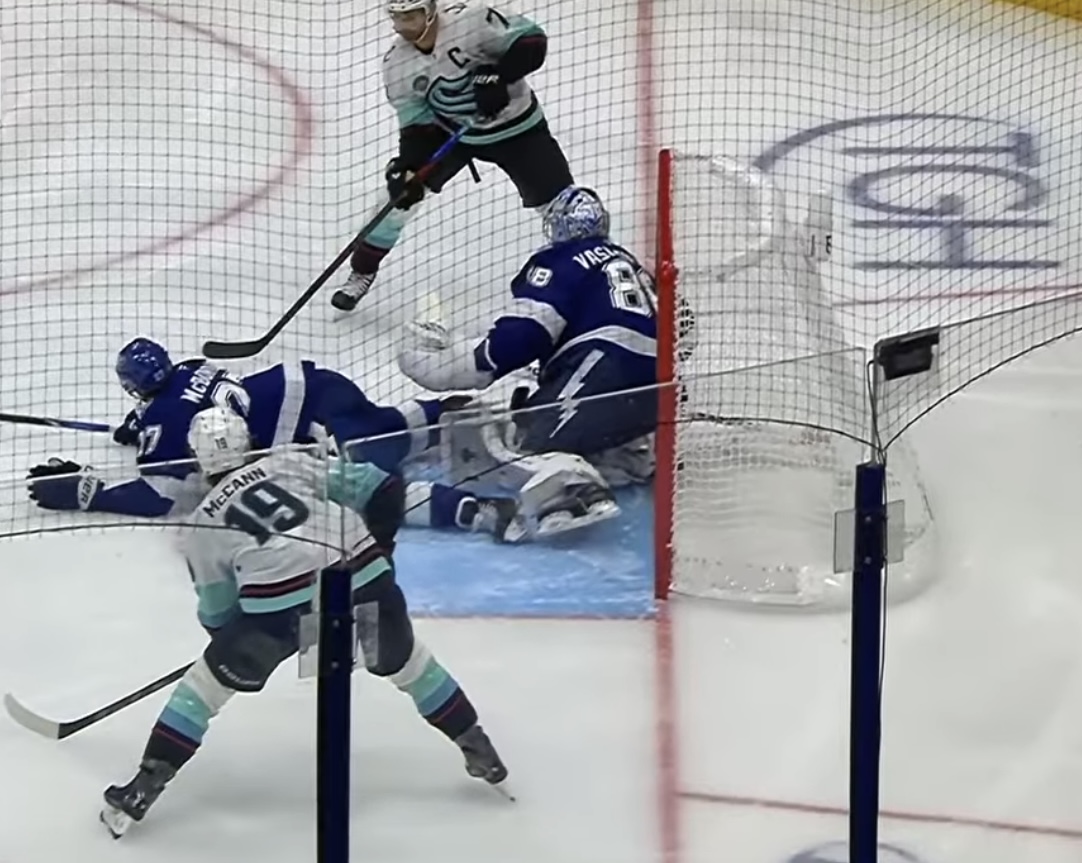
Staal scored his second goal of the night at 6:32 of the third period while sprawled on the ice, somehow finding a way to beat Vegas goaltender Carter Hart in one of the most dramatic moments of the Final. The goal proved to be the winner as Carolina seized control before Nikolaj Ehlers sealed the victory with an empty-netter from 187 feet away.
The victory sends the series back to Carolina for a pivotal Game 5 on Thursday night, with the Hurricanes now potentially having two opportunities on home ice to capture their first Stanley Cup since 2006. Brind’Amour, who captained that championship team two decades ago, understands the significance but remains focused on the task at hand.
For the Golden Knights, the loss shifts home-ice advantage back to Carolina and leaves them needing at least one road victory to secure their second Stanley Cup in four seasons.
Staal’s game-winning tally was only part of another historic night for the Carolina captain.
The 37-year-old became the first player in 44 years to score at least one goal in each of the first four games of a Stanley Cup Final. The last player to accomplish the feat was Hall of Famer Mike Bossy in 1982 for the New York Islanders against the Vancouver Canucks.
Overall, Staal became just the ninth player in NHL history to score in each of the first four games of a Final, adding yet another remarkable achievement to an already memorable postseason.
The Hurricanes came out flying, building a 3-1 lead during a dominant first period.
Jackson Blake contributed a goal and an assist, Logan Stankoven added a goal, and Carolina appeared poised to finally put together a comfortable victory.
Vegas nearly cut the deficit to one before intermission when Brayden McNabb found the net, but the puck crossed the line just after the horn sounded, leaving the Golden Knights frustrated heading into the dressing room.
The second period, however, belonged once again to Vegas.
The Golden Knights scored twice to erase the deficit, continuing a remarkable trend. Through four games, Vegas has outscored Carolina 9-1 in the middle frame, repeatedly using strong second-period surges to swing momentum.
Goals from captain Mark Stone, William Karlsson, and Brett Howden helped pull Vegas even, and it appeared the Golden Knights had positioned themselves for another comeback victory.
Instead, Carolina delivered the final blow.
One of the night’s biggest storylines unfolded in the crease. With starting goaltender Frederik Andersen unavailable and needing rest, Brind’Amour turned to Brandon Bussi, who was making his first start in nearly two months. The little-used netminder responded admirably under the brightest spotlight of his career.
Bussi stopped 18 shots and remained composed despite Vegas’ second-period surge. Including his relief appearance in Game 2, Bussi has now stopped 36 of 40 shots in the series. Pyotr Kochetkov served as Carolina’s backup while Andersen was available only as an emergency option.
At the other end, Hart made 23 saves for Vegas but could not stop Carolina’s decisive third-period push.
Perhaps the most surprising aspect of this Final has been the offensive explosion. Entering the series, many expected every game to resemble a playoff chess match featuring disciplined defense and elite goaltending. Instead, fans have witnessed one of the highest-scoring championship matchups in recent memory.
The teams have combined for 33 goals through four games, tied for the third-highest total through four games of a Stanley Cup Final, matching the famous 1980 showdown between the New York Islanders and Philadelphia Flyers.
Even more astonishing is the recurring pattern of blown leads. In all four games, a two-goal advantage has vanished. Both teams have built two-goal leads twice, only to watch them disappear.
The first three games were each decided by a single goal, and Tuesday’s contest seemed destined for a similar finish until Ehlers’ long-distance empty-net strike finally provided breathing room.
After four games of chaos, momentum swings, and unforgettable moments, the Stanley Cup Final has effectively become a best-of-three series.
The Hurricanes return home with renewed confidence and a chance to move within one victory of their first championship in 20 years. The Golden Knights, meanwhile, remain in familiar territory, needing two more wins to bring another Stanley Cup to Las Vegas.
If the first four games are any indication, neither team can feel comfortable with any lead, any momentum, or any prediction.
In a Final where nothing has made much sense and every game has delivered another twist, the only certainty is that the race for the Stanley Cup remains completely up for grabs.

































































Want to join the conversation?
Create an account or sign in to share your thoughts, vote,
and reply to other readers.
Showing 0 of 0 comments
Don't have an account?
Already have an account?