

I Would Vote for an AI President Before Today’s Republican Party And America May Eventually Need One Anyway…
“It’s Time to Shove AI So Far Up the Ass of the U.S. Government That Politicians Can’t Breathe Without a Prompt Popping Up” – Patrick Zarrelli
I would vote for an artificial intelligence system for president before I would vote for virtually any Republican currently operating at the highest levels of American politics. There, I said it. And before somebody starts screaming about Skynet, The Terminator, robot dictators or surrendering the United States to a server farm, understand the argument. I am not proposing that ChatGPT get sworn in on the Capitol steps next January, receive the nuclear codes and start ordering drones around Washington.
I am asking a far more uncomfortable question: if the purpose of government is to analyze information, solve problems, allocate resources, enforce laws, protect constitutional rights, defend the country and make decisions intended to improve the lives of its citizens, how long are we going to insist that human beings are uniquely qualified to perform those jobs when we have overwhelming evidence that human beings are also exceptionally capable of screwing them up?
Human politicians can be bribed, intimidated, manipulated by donors, consumed by reelection, captured by political parties, rewarded by wealthy interests and motivated by ego, resentment, fear or ambition. They forget things, misunderstand enormous pieces of legislation, make emotional decisions, hide mistakes and sometimes place their careers above the long-term interests of the country. Artificial intelligence introduces enormous dangers of its own. AI can inherit bias, fabricate information, optimize the wrong objective, conceal flawed reasoning, amplify bad data and become an extraordinarily dangerous instrument in the hands of an authoritarian government. That is precisely why the serious question is not whether America should blindly hand political power to a machine. The real question is whether artificial intelligence could become a new constitutional counterweight to human failure.
America may need an AI-powered Fifth Branch of government. Not a digital dictator, but an unbribable referee.
We Are Already Moving Toward AI Government Whether We Admit It or Not
There is a strange fiction developing around artificial intelligence. Politicians continue debating whether AI should influence government while government agencies, corporations, law firms, journalists, researchers, intelligence analysts, military planners and virtually every other information intensive profession are already incorporating machine intelligence into their work. The federal government itself has adopted policies designed to expand the use and procurement of artificial intelligence across executive agencies while simultaneously imposing requirements involving privacy, civil rights, cybersecurity, accountability and oversight.
That evolution is likely to accelerate as the technology improves. Imagine a senator whose AI system reads every bill entering the office, calculates its fiscal consequences, compares its language against existing federal law, identifies proposed amendments, researches constitutional questions, summarizes constituent concerns, analyzes economic projections, prepares committee questions, evaluates potential compromises and drafts speeches explaining the senator’s position. At some point, a meaningful portion of the senator’s intellectual workload is no longer being performed exclusively by the senator.
That raises a democratic question that Americans will eventually have to confront. If politicians increasingly rely on artificial intelligence to perform the analysis behind their decisions, voters should not be asked to evaluate only the human politician. They should also be entitled to understand the artificial intelligence systems operating underneath the administration.
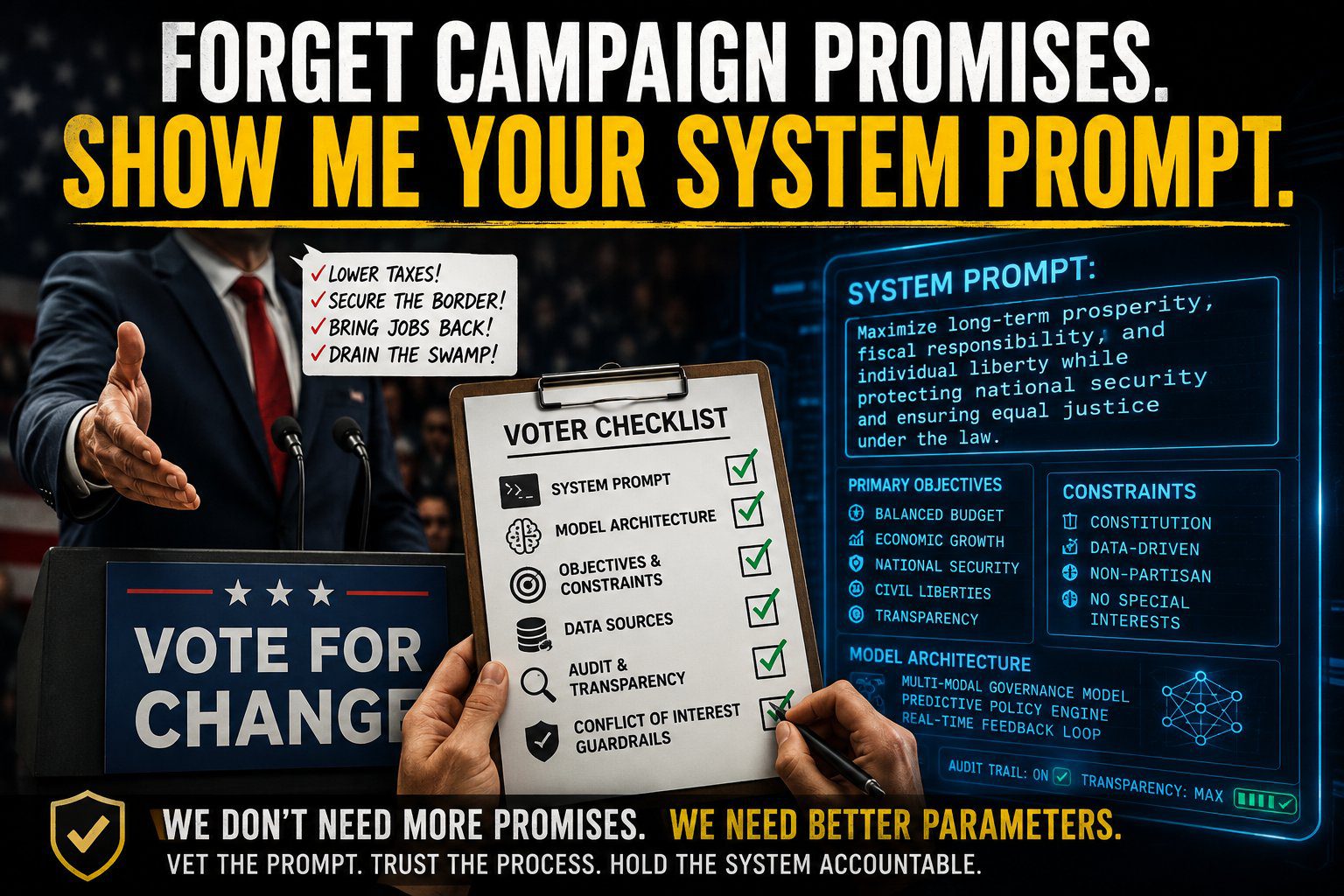
Forget Campaign Promises. Show Me Your System Prompt.
American campaigns are built around promises vague enough to survive almost anything. Candidates promise to grow the economy, protect working families, cut waste, strengthen national security and reduce deficits. Those statements sound wonderful because they reveal almost nothing about how competing priorities will actually be balanced. An AI centered government could force an entirely different form of political accountability. Candidates using powerful artificial intelligence systems to formulate policy should eventually be required to disclose, to the greatest extent consistent with legitimate national security needs, what systems they intend to use, who developed them, who can alter them, what information they can access and what objectives they have been instructed to pursue.
Voters should be able to ask what a presidential administration’s AI is actually optimizing. How does it weigh economic growth against deficit reduction? How does it balance environmental protection against industrial development? How does it account for future generations that cannot vote in the next election? How does it protect constitutional rights that should not be subjected to a simple majority preference? Can political appointees secretly modify its instructions? Are those changes permanently recorded? Can Congress inspect those records? Can inspectors general? Can courts? Can journalists or outside auditors examine non-classified portions of the system?
That may sound futuristic now, but it will not sound futuristic if artificial intelligence systems become responsible for preparing much of the analysis presidents and legislators use to make decisions. Instead of a presidential candidate simply promising to create “the best economy ever,” Americans might eventually see a measurable governing objective such as maximizing sustainable growth in median real household income while maintaining employment, protecting essential services, improving productivity and gradually reducing the nation’s debt burden relative to the economy. Four years later, voters could determine whether the policy actually worked.
AI Is Not Automatically Ethical, and Pretending Otherwise Would Be Dangerous
Any serious argument for artificial intelligence in government has to begin with an uncomfortable admission: AI is not inherently ethical. A machine does not wake up with an independent commitment to democracy, equality, liberty, due process or the Constitution. AI systems pursue objectives established by human beings. Humans select their training information, establish their constraints, determine which data they receive and decide what outputs are considered successful.
That means humans can corrupt the machine even if the machine itself has no desire for money. You cannot slip an AI system $50,000 in an envelope or promise it a lobbying job after it leaves government, but you can manipulate its inputs, change its system instructions, hide inconvenient information, choose biased datasets, weight certain outcomes or construct a supposedly neutral model that reliably produces the conclusion its political operator wanted from the beginning. That could be more dangerous than traditional corruption because political bias could suddenly arrive wrapped in the appearance of mathematical certainty.
Government AI therefore cannot simply be intelligent. It has to be auditable. The Government Accountability Office has already developed an AI accountability framework built around governance, data quality, performance and continuous monitoring, emphasizing that responsible artificial intelligence requires clearly defined goals, reliable data, defined responsibilities and ongoing oversight. Those principles should become foundational rules for any future system with meaningful governmental authority.
Every consequential government AI system should maintain secure records documenting what data it received, which model version was operating, what governing instructions were active, who changed those instructions, when they were changed and what recommendations the system produced. Think of it as a flight recorder for democracy. When an airplane crashes, investigators do not simply ask the pilot what happened. They examine the data. Government increasingly should be capable of doing the same thing.
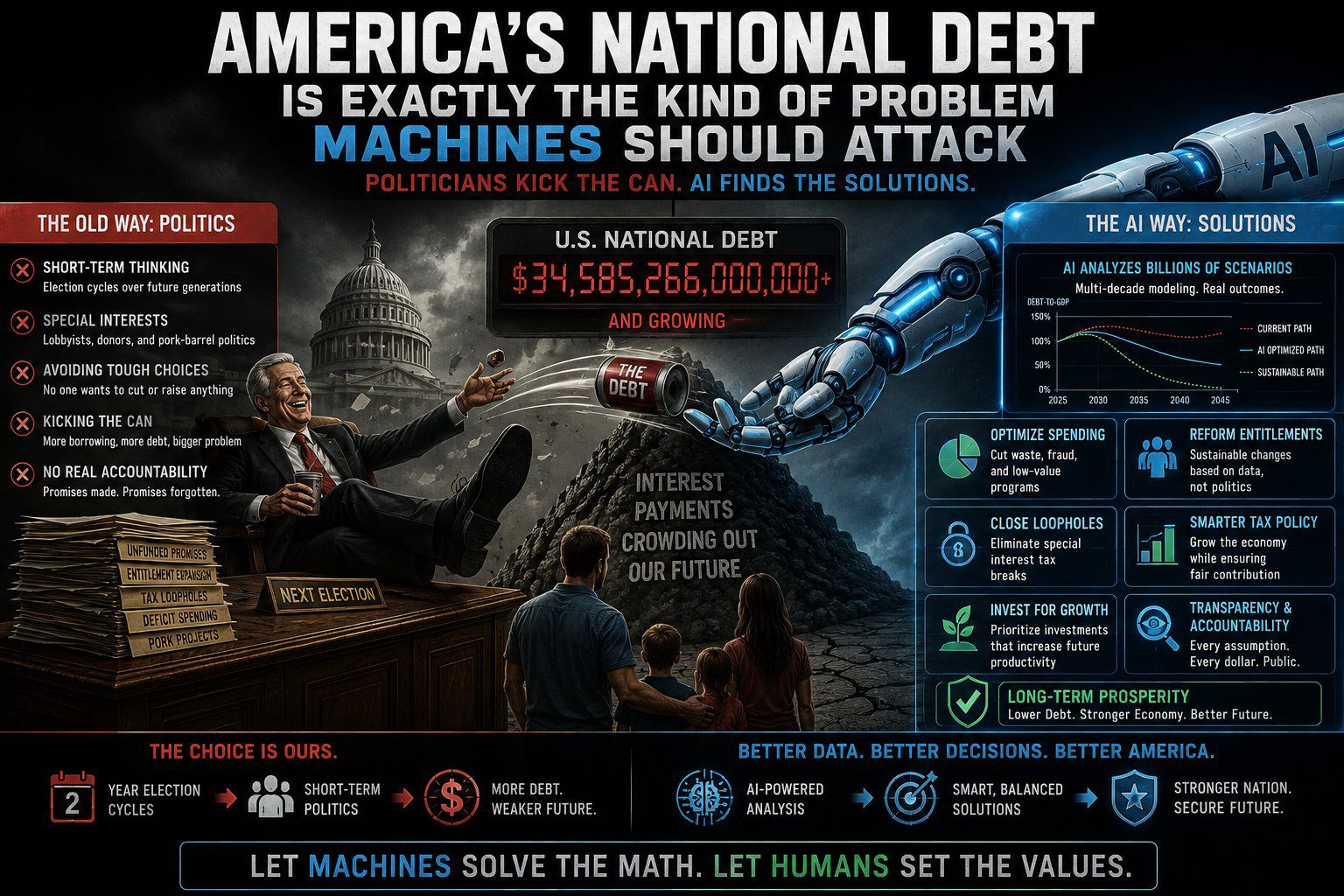
America’s National Debt Is Exactly the Kind of Problem Machines Should Attack
If there is one issue that demonstrates the structural weaknesses of human political government, it is federal debt. The Congressional Budget Office projects that the federal government will spend approximately $7.4 trillion in fiscal year 2026 while collecting roughly $5.6 trillion in revenue, producing a deficit of about $1.9 trillion. Debt held by the public is projected to reach roughly $32.1 trillion by the end of fiscal year 2026, equal to approximately 101% of the nation’s gross domestic product. Under CBO’s current-law baseline, that burden rises to roughly 120% of GDP by 2036, exceeding the previous post World War II record.
The arithmetic is not mysterious. The politics are.
Americans enjoy government programs but generally dislike taxes. Retirees defend Social Security and Medicare. Defense contractors defend military spending. Agricultural interests defend farm programs. Companies defend favorable tax provisions. Congressional districts defend local federal projects. Government agencies defend their budgets, while politicians understand that reducing benefits, eliminating subsidies or increasing taxes can create furious voters.
Meanwhile, many of the worst consequences of excessive borrowing materialize years or decades beyond the next election. Congress operates on two-year electoral incentives while America’s fiscal obligations operate across generations. Artificial intelligence does not have to win Pennsylvania. It does not have donors threatening to close their checkbooks, primary voters preparing to punish compromise or political consultants worrying about the next television commercial. That does not mean AI automatically knows the correct fiscal policy, but it makes long-term fiscal modeling one of the strongest possible applications for an independent government AI system.
Give such a system the federal tax code, federal spending programs, demographic projections, Social Security obligations, Medicare spending, interest costs, infrastructure requirements, defense expenditures, tax expenditures, corporate subsidies, household income data, productivity trends and historical economic downturns. Then do not give it the simplistic command to “balance the budget,” because an AI following that instruction literally could recommend policies that produce catastrophic economic damage.
Instead, instruct it to find combinations of policies that stabilize and eventually reduce debt relative to the economy while minimizing unemployment, poverty and economic disruption, maintaining essential public services, protecting national security and maximizing long term productivity and household prosperity. The system could then model an extraordinary range of possible combinations.
The answer might include spending reductions, higher revenues, changes to tax preferences, healthcare efficiencies, procurement reform, fraud reduction, program consolidation or investments that cost money initially but improve long term growth. The important point is not that AI gets to impose its preferred answer on the country. The important point is that politicians would have a much harder time pretending no viable alternatives exist. Show Americans the options. Show them the projected consequences. Show them who pays, who benefits and what assumptions determine the result. Then let democracy decide.
Every Major Bill Should Come With an AI Nutrition Label
Congress routinely considers legislation running hundreds or thousands of pages. Lawmakers, journalists and members of the public can have limited time to understand enormously complicated proposals before major votes. Artificial intelligence provides an opportunity to dramatically improve that process. Every significant piece of federal legislation should eventually receive an independent, standardized analysis available to the public before a final vote. Think of it as a nutrition label for legislation.
The system could show the estimated 10 year and 30 year fiscal effects, projected deficit impact, possible changes in employment and inflation, distributional consequences across income groups, industries receiving significant benefits, existing government programs that may overlap with the legislation, unrelated provisions inserted into the bill, major implementation risks and assumptions upon which the economic projections depend.
It could also identify lobbying activity surrounding the underlying policy and publicly disclosed campaign-finance relationships that citizens or investigators may wish to examine. Those relationships should never be presented as proof of corruption, because political donations and lobbying are not themselves evidence of criminal conduct. But Americans have a legitimate interest in understanding the financial ecosystem surrounding consequential legislation.
Imagine opening the official congressional page for a 1,700 page spending bill and immediately seeing a standardized summary showing its projected cost, borrowing requirements, largest beneficiaries, major economic assumptions, unrelated provisions and significant areas of uncertainty. That would not replace the Congressional Budget Office, congressional committees, policy experts or human judgment. It would make their information dramatically easier for ordinary citizens to understand.
AI Could Become the Most Relentless Anti-Corruption Investigator in American History
Federal campaign finance filings, lobbying records, government contracts and legislative information already generate mountains of publicly available data. The Federal Election Commission maintains searchable campaign finance information showing how federal candidates and political committees raise and spend money, while federal lobbying disclosures provide another public record of organized efforts to influence policy. Humans can investigate those records, but machines can examine enormous datasets continuously.
Imagine an independent oversight system analyzing legally available information involving campaign contributions, lobbying registrations, federal contracts, congressional financial disclosures, government grants, regulatory actions, tax provisions and corporate ownership structures. A company could spend heavily lobbying Congress, its executives could make political contributions, a trade association could campaign aggressively around an issue and months later obscure language could appear in legislation that creates substantial value for that industry. None of those facts, individually or collectively, automatically proves criminal corruption. That distinction must remain absolute.
The appropriate role for AI is anomaly detection, not automated prosecution. The system could flag a pattern and report that a legislative action appears to have produced an unusually concentrated financial benefit for entities associated with significant political spending or lobbying activity and recommend further human review. Inspectors general, congressional ethics investigators, journalists, watchdog organizations and prosecutors, where legally appropriate, could then examine the evidence themselves. AI does not become the judge and jury. It becomes an extraordinarily persistent investigative accountant capable of searching relationships that human investigators might otherwise never notice. It never gets tired, never becomes bored and never decides a 30,000 row spreadsheet is too tedious to examine.

Then Turn It Loose on the Pentagon’s Books
The Department of Defense may be one of the strongest possible laboratories for serious AI oversight because it manages an extraordinarily complicated financial and logistical network involving personnel, weapons programs, military installations, aircraft, ships, satellites, healthcare systems, contractors, subcontractors, maintenance operations and supply chains around the world. Its financial management problems are also well documented. The department-wide fiscal year 2025 financial audit again resulted in a disclaimer of opinion because auditors were unable to obtain sufficient reliable evidence to conclude that the consolidated financial statements were fairly presented. The audit identified 26 material weaknesses.
That does not mean trillions of dollars simply disappeared or were stolen. A disclaimer of opinion is an auditing conclusion concerning the reliability and sufficiency of financial evidence, not proof that the value of the department’s assets is missing. That distinction is important. The underlying problem is still serious: the nation’s military establishment remains unable to provide auditors with the level of reliable department-wide financial evidence expected from a fully auditable organization. This is precisely the kind of environment in which artificial intelligence could provide additional oversight. An AI auditing system could continuously compare purchase orders, invoices, contract modifications, subcontractor charges, replacement parts, inventory transfers, historical prices, project delays and cost overruns. Instead of discovering years later that a procurement program spiraled out of control, an intelligent audit layer could identify abnormalities closer to the moment they occur.
Why did this component suddenly increase dramatically in price? Why are multiple branches purchasing functionally similar software through separate contracts? Why are maintenance costs rising faster than expected? Why has a contractor repeatedly received modifications beyond its original bid? Why does one replacement component cost many times more than apparently comparable alternatives? AI cannot determine automatically that every pricing anomaly represents fraud. Markets, military specifications, security requirements and supply chain constraints can make seemingly strange prices legitimate. But AI can identify where human auditors should look. That alone could save taxpayers enormous amounts of money.
An AI Watchdog Should Also Challenge Government Secrecy
National security requires legitimate secrecy. There are things Americans should not know in real time, including the identities of sensitive intelligence sources, active troop movements, military operational plans, classified technical capabilities, cryptographic vulnerabilities and certain nuclear security information. Nobody serious is proposing dumping every classified document onto the internet.
The problem is that secrecy also creates an institutional incentive. The same bureaucracies that classify information often retain enormous influence over how long that information remains secret. Federal classification rules already recognize that information should not remain classified indefinitely. Executive Order 13526 provides for automatic declassification of permanently valuable classified records after 25 years in many circumstances while allowing specified exemptions when disclosure could still reveal intelligence sources or methods, weapons of mass destruction information or other information capable of causing identifiable national-security damage.
Artificial intelligence could make that review process more dynamic. Instead of allowing enormous quantities of historical records to wait decades for labor intensive examination, an independent classification audit system could continually evaluate whether the original security justification remains compelling. Would disclosure expose an active human source? Would it reveal a current military capability? Would it compromise an ongoing intelligence operation? Would an adversary receive a meaningful strategic advantage? Or would disclosure primarily expose historical embarrassment, bureaucratic failure, government misconduct or politically uncomfortable information?
AI should not possess unilateral authority to publish classified material. That would create enormous national security and cybersecurity risks. Instead, when an AI system determines that the rationale for continued classification appears substantially weakened, it could trigger mandatory human review and require the responsible agency to justify continued secrecy. The burden should gradually shift toward government. Government secrecy should protect America. It should not become a permanent shield protecting government from America.
Keep Humans on the Supreme Court, but Give Every Justice an AI Adversary
The judiciary requires a much harder boundary because courts do something fundamentally different from fiscal agencies or procurement offices. A computer can compare the cost of federal programs, identify anomalies in contracts and examine thousands of precedents, but constitutional law contains moral and philosophical questions that cannot simply be reduced to optimization functions. There is no spreadsheet that conclusively determines what equal protection means in every circumstance. There is no equation that resolves every conflict between privacy and public safety, liberty and regulation, religious freedom and competing civil rights, or government authority and individual autonomy.
Humans should remain responsible for those judgments. But artificial intelligence could dramatically improve the information available to judges. Imagine every Supreme Court justice having access to an adversarial AI law clerk capable of examining centuries of American statutes, precedents, historical materials, briefs and factual claims before an opinion is released. The system could check every citation, quotation, factual assertion and historical claim. It could identify where a justice interpreted a precedent differently in an earlier case, where a factual claim is disputed by the evidentiary record, where a historical argument is contested by primary sources or where an amicus brief relies on questionable evidence.
Most importantly, it could be required to generate the strongest possible argument against the justice’s preliminary conclusion. Do not design artificial intelligence merely to tell powerful officials why they are correct. Design it to relentlessly explain why they might be wrong.
Government AI Should Be Designed to Fight With Itself
Perhaps the most important architectural principle of an AI assisted government is that no single model should be treated as an oracle. America should never build one government supercomputer, hand it enormous authority and tell citizens not to worry because the machine has calculated the answer. That is not democracy. It is computational monarchy. The American constitutional system was built around competing institutions because concentrated power is dangerous even when the people exercising it claim to have good intentions. Artificial intelligence governance should follow the same philosophy.
One system could generate a fiscal proposal. Another could attack its economic assumptions. Another could search for constitutional problems. Another could evaluate its effects on low income households. Another could study consequences for businesses and investment. Another could search for geographic or demographic disparities. Another could assess national security implications. Another could evaluate environmental consequences. Another could search for indications that organized financial interests disproportionately shaped the proposal.
A final synthesis system could explain the disagreements to policymakers and the public. Do not ask one machine for the answer. Make the machines argue. Our legal system already does this through prosecutors and defense attorneys. Courts do it through majority opinions and dissents. The Constitution does it through competing branches of government. American federalism does it through state and national authority. Computational checks and balances should operate on the same principle.
The Machine Needs a Constitution
The greatest danger of AI government may not be that a machine spontaneously develops an evil personality. It may be that human beings give an enormously powerful machine dangerous authority or secretly manipulate it for political purposes.
An AI Fifth Branch would therefore require restrictions more rigid than those governing ordinary federal software. No unilateral authority to launch nuclear weapons. No independent authority to order military attacks. No autonomous arrest power. No secret political loyalty scoring of citizens. No undisclosed algorithm making final criminal judgments. No ability to rewrite its own constitutional limitations. No government wide AI architecture controlled exclusively by one private corporation. No single model possessing universal authority. No secret changes to governing objectives.
High impact systems should be subjected to independent security testing, adversarial red team exercises, congressional oversight, inspector general review, judicial review where appropriate, cybersecurity auditing and reliable logging. Public facing components should be explainable enough that outside researchers can challenge important assumptions without exposing legitimate national security information or creating vulnerabilities that adversaries could exploit.
Humans must also retain meaningful override authority. The goal is not creating an immortal digital king. The goal is creating an accountability mechanism intelligent enough to challenge powerful humans without allowing either the humans or the machine to exercise unchecked authority.
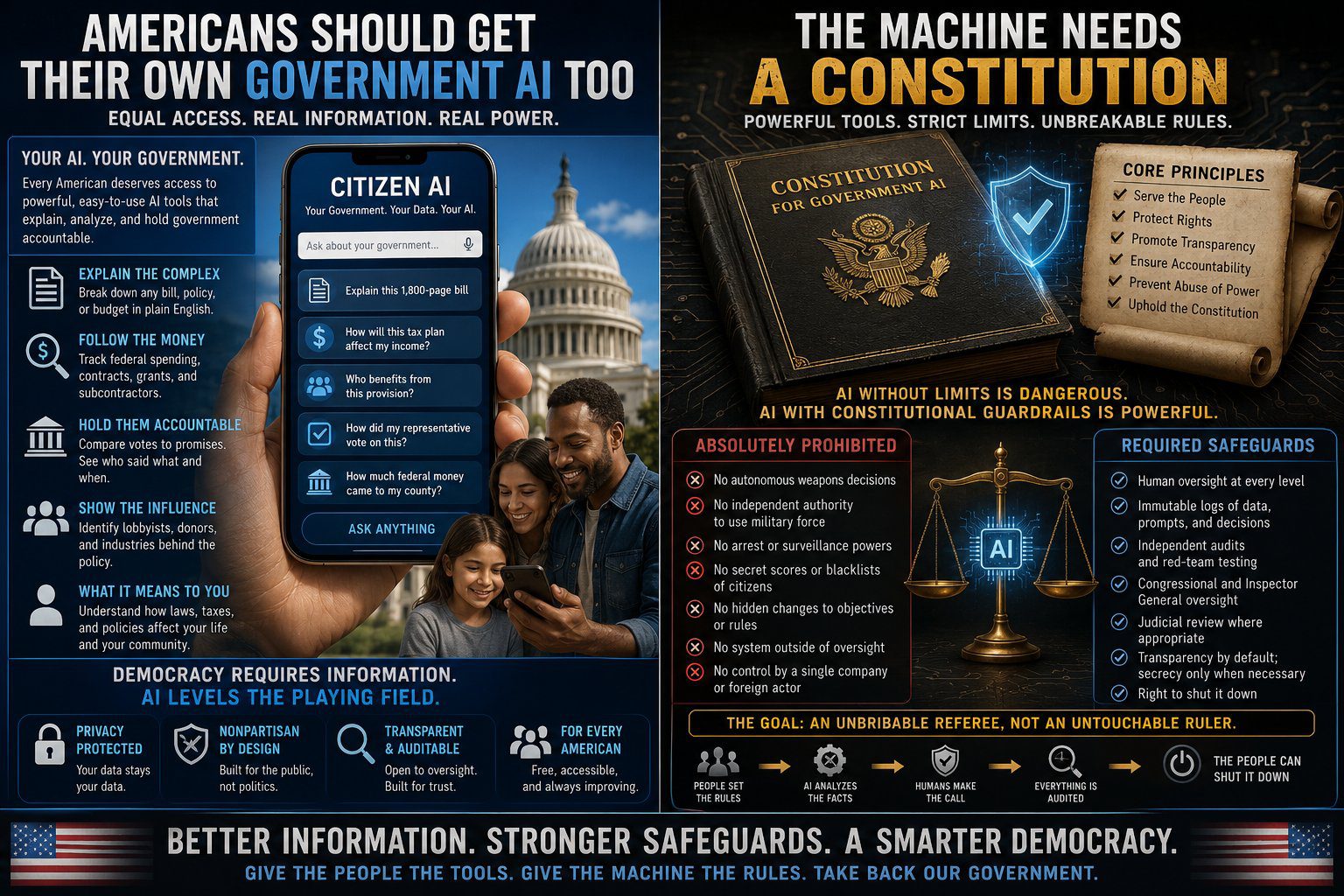
Americans Should Get Their Own Government AI Too
There is another essential requirement. Government cannot be allowed to possess enormously powerful analytical capabilities while ordinary citizens remain technologically outgunned. If the federal government develops advanced legislative and administrative AI systems, Americans should have access to public facing counterparts capable of interrogating government information.
A citizen should be able to ask an official system to explain a 1,800 page bill in plain English, estimate how a tax proposal affects different household incomes, identify industries benefiting from legislation, compare a representative’s votes with campaign promises, show how much federal money entered a congressional district, identify which contractors received government funding and explain why the cost of a major public project changed.
Someone in Fort Lauderdale with a smartphone could suddenly possess analytical capabilities that once required congressional researchers, attorneys, economists, database specialists and investigative journalists. That could represent one of the greatest democratizations of government information in American history. Journalists should have access to these tools as well. An AI enabled government should create an equally AI enabled press capable of interrogating it. The answer to increasingly sophisticated government information systems should not be weaker public oversight. It should be more powerful public oversight.
The Political Class Should Be Terrified of This Version of AI
Notice what this model actually does. It is not primarily taking political authority away from voters. It is taking informational advantage away from insiders. Lobbyists benefit from complexity. Waste survives when spending is difficult to follow. Political hypocrisy survives because citizens cannot remember every statement, donation, amendment and vote made across decades. Government secrecy survives when challenging classification decisions is slow and expensive. Conflicts of interest become harder to identify when the relevant information is spread across thousands of databases and documents.
Machines can connect those dots. An advanced public-accountability system could remember every speech, vote, campaign promise, appropriation, contract, publicly disclosed campaign contribution, regulatory change and amendment buried deep inside legislation. It could then identify relationships that deserve further examination. That is potentially far more threatening to corrupt government than putting a robot behind the Resolute Desk.
Eventually We Will Have to Ask the Question Nobody Wants to Ask
Suppose these systems become extraordinary. Suppose an AI can produce better budget scenarios than Congress, identify procurement problems faster than existing auditors, detect conflicts of interest investigators might otherwise miss, explain legislation better than many politicians, conduct legal research deeper than a human clerk and provide citizens with increasingly accurate public policy analysis.
Then suppose politicians themselves increasingly rely on those exact systems to make their decisions. At what point do voters begin asking what function the politician is actually performing?
The answer may remain profoundly important. Elected humans provide democratic legitimacy, accountability, empathy, moral judgment, symbolism, negotiation and the ability to understand suffering in ways numerical optimization may never capture. Those qualities may remain indispensable forever. But politicians should not assume that simply being human guarantees permanent superiority. Democracy is not supposed to be a jobs program for politicians. Government exists to serve the governed. If better analytical tools become available, government should use them.
The Real Comparison Is Not Humans Versus Machines
Most arguments about artificial intelligence make one enormous conceptual mistake: they compare potentially dangerous machines with ideal human beings. Of course the humans win that imaginary contest. Those are not our actual options. The real comparison involves imperfect machines and imperfect humans operating inside imperfect institutions. Human history should make us humble. Governments have launched wars on false or incomplete information, missed financial crises, accumulated enormous debts, administered failed programs, produced wrongful convictions, tolerated corruption, protected cronies, engaged in discrimination, conducted unlawful surveillance, concealed mistakes and made catastrophic decisions shaped by ideology, fear, ambition and ego.
Then we look at artificial intelligence and ask what happens if the machine makes a mistake. It will. The more useful question is whether we can construct institutions in which machines catch human mistakes and humans catch machine mistakes. That is the future worth building. Not human government versus AI government, but a system in which each watches the other.
America Does Not Need a Robot Dictator. It Needs an Unbribable Referee.
Maybe the United States never elects an artificial intelligence president. Maybe no machine ever sits behind the Resolute Desk. Maybe Congress remains entirely human for another century. That does not change what is coming. Artificial intelligence will almost certainly become increasingly embedded inside government just as computers, databases and the internet became embedded before it. When that happens, America will face a choice.
We can allow politicians and federal agencies to deploy powerful AI systems behind closed doors, turning artificial intelligence into another opaque instrument of government power. Or we can build transparency and accountability into the architecture from the beginning. Audit the models. Document the objectives. Record consequential changes. Challenge the budgets. Track the money. Examine conflicts of interest. Audit the Pentagon. Question unnecessary secrecy. Give judges better research. Give citizens better information. Give journalists stronger investigative tools.
Then create independent computational oversight capable of telling presidents, senators, judges, generals, bureaucrats and billion dollar contractors something powerful people rarely hear enough: your mathematics do not work, your evidence does not support your claim, your cost projection is unrealistic, your contractor appears overpriced, your argument contradicts your previous position, your justification for secrecy has weakened or your policy appears likely to produce consequences you are not adequately explaining to the public.
That is not tyranny. Properly constrained, it could become one of the strongest accountability mechanisms democracy has ever created. The defining political question of the artificial-intelligence era may therefore not be whether machines eventually become intelligent enough to govern human beings. It may be whether human beings become intelligent enough to use those machines to govern themselves better. Because once an auditable artificial-intelligence system can read every bill, trace federal spending, model budgets, identify potential conflicts of interest, challenge legal arguments, audit contracts and remember every promise a politician ever made, the uncomfortable question may no longer be whether artificial intelligence is qualified to participate in governing America. It may be why we continue accepting so little from the humans who already do.

Sources & Further Reading
Federal Budget and National Debt
- Congressional Budget Office — The Budget and Economic Outlook: 2026 to 2036
- Congressional Budget Office — Federal Budget and Economy Research
Pentagon Spending and Financial Oversight
- U.S. Department of Defense Inspector General — FY 2025 Department-Wide Financial Statement Audit Explained
- U.S. Department of Defense Inspector General — FY 2025 Financial Statement Audit Reports
Artificial Intelligence and Federal Government Accountability
- White House — Federal Agency AI Use and Procurement Policies
- U.S. Government Accountability Office — Artificial Intelligence Accountability Framework
- U.S. Government Accountability Office — Federal AI Oversight and Governance
Campaign Finance, Lobbying and Political Influence
- Federal Election Commission — Campaign Finance Data
- U.S. Senate — Lobbying Disclosure Act Database
- U.S. Senate — Federal Lobbying Disclosure Information



















































Want to join the conversation?
Create an account or sign in to share your thoughts, vote,
and reply to other readers.
Showing 0 of 0 comments
Don't have an account?
Already have an account?