
Putin May Be Preparing Russia for Another Massive Military Draft After September’s Parliamentary Election
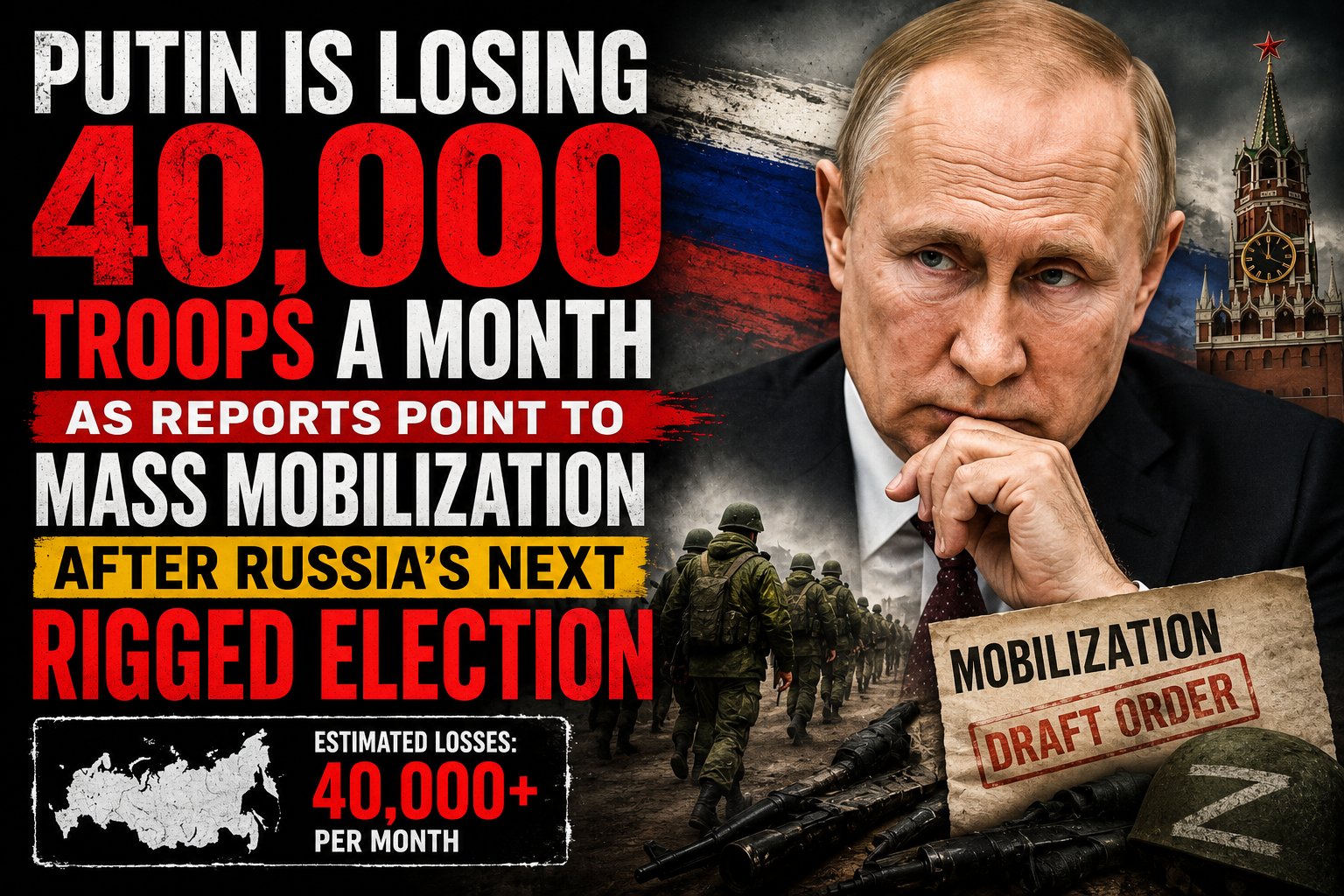
Russia may be approaching one of the most politically dangerous decisions Vladimir Putin has faced since ordering the full scale invasion of Ukraine in February 2022: whether to force hundreds of thousands more Russians into military service as battlefield casualties increasingly threaten Moscow’s ability to replace the soldiers it is losing.
A growing collection of battlefield estimates, recruitment data, Ukrainian intelligence assessments and independent reporting suggests the Kremlin is building the infrastructure and political conditions that would allow it to dramatically expand mobilization after Russia’s September parliamentary election. The available evidence does not establish that Putin has made a final decision to order another nationwide draft, and the Kremlin continues to deny that a new mobilization is imminent. What the evidence does show is that Russia is confronting an increasingly difficult manpower equation as the war moves through its fifth year.
The political calendar has intensified the speculation. Russia is scheduled to hold elections for all 450 seats in the State Duma from September 18 through September 20, and announcing another major mobilization before voting would risk reminding millions of Russian families that the human cost of the war could soon reach directly into their homes. If Putin intends to dramatically expand compulsory military recruitment, waiting until after the election would remove an obvious political obstacle and give the Kremlin additional time to prepare the machinery necessary to execute it.
That possibility is now being discussed openly by Ukrainian officials, Russian opposition figures and outside analysts as Moscow attempts to sustain a grinding war of attrition that continues consuming soldiers at an extraordinary rate.
Russia’s Battlefield Losses Are Beginning to Collide With Recruitment
Russia has sustained enormous battlefield casualties in part because the Kremlin constructed a recruitment system based heavily on financial incentives rather than repeating the politically explosive mass mobilization Putin ordered in September 2022. Large signing bonuses, comparatively high military salaries, debt relief and regional incentives persuaded hundreds of thousands of Russians to sign military contracts, allowing Moscow to replenish much of its fighting force without another nationally announced call up.
That system is showing increasing signs of strain. Recent estimates indicate Russia is suffering extremely high monthly personnel losses, while recruitment appears to be struggling to keep pace. Precise casualty figures remain difficult to independently verify during an active war, and estimates from Russia, Ukraine and Western governments differ significantly. Nevertheless, the broader picture across multiple assessments points toward an increasingly expensive manpower problem for Moscow.
Ukrainian intelligence has presented one of the most detailed recent estimates, claiming Russia suffered approximately 240,000 personnel losses between January and July 2026 while recruiting approximately 232,000 contract personnel during the same period. Those figures originate with one of the belligerents and should therefore be treated as intelligence estimates rather than independently established totals, but the broader recruitment problem has also appeared in outside assessments.
The Institute for the Study of War reported in July that Russian contract recruitment appeared to be struggling against rising casualty rates. Citing Ukrainian foreign intelligence, ISW reported that Russia had recruited approximately 195,000 contract soldiers by early July, less than half of a reported annual target of 409,000, while the average daily recruitment rate had declined from approximately 1,200 people in 2024 to roughly 1,090 by mid-2026.
The arithmetic is becoming increasingly uncomfortable for Moscow. Russia can continue replacing enormous numbers of soldiers through voluntary contracts only as long as enough people remain willing to accept the financial incentives in exchange for the extraordinary risks of service in Ukraine. If battlefield losses consistently exceed recruitment, the Kremlin eventually has to either reduce those losses, find new recruiting pools or compel additional people to serve.
The Kremlin Has Already Tried Throwing More Money at the Problem
For much of the war, Russia’s answer to manpower shortages has been straightforward: increase the price. Federal and regional governments have offered increasingly lucrative signing bonuses and compensation packages that can dwarf ordinary salaries in poorer Russian regions. The strategy helped the Kremlin disproportionately draw recruits from economically disadvantaged areas while insulating wealthier populations in Moscow and St. Petersburg from some of the war’s direct human consequences.
That financial model has limits. As casualty rates remain high and stories of wounded and killed soldiers circulate through Russian communities, additional compensation must overcome an increasingly obvious risk. PBS NewsHour reporting has documented the pressure surrounding Russia’s manpower system, including allegations of coercive recruiting practices and Moscow’s expanding efforts to obtain soldiers from outside its traditional recruiting pool.
Russia can increase bonuses, expand foreign recruitment, relax eligibility requirements, recruit from prisons, target migrants and search increasingly marginalized populations for additional manpower. Those measures can delay the political necessity of another mobilization, but they cannot guarantee an unlimited supply of soldiers. If the voluntary system can no longer produce enough recruits to replace battlefield losses, compulsory mobilization becomes one of the Kremlin’s remaining options.
Ukrainian Intelligence Says Russia Has Prepared a 600,000 Person Mobilization Scenario
The most significant recent allegation comes from Ukrainian intelligence services, which have said Russia’s military leadership prepared a scenario for mobilizing as many as 600,000 additional people across 2026 and 2027. According to the Ukrainian assessment, approximately 300,000 could be mobilized during 2026 and another 300,000 during 2027.
Ukrainian President Volodymyr Zelenskyy has separately claimed Putin intends to draft approximately 300,000 additional troops after Russia’s September parliamentary election. The claims have not been independently confirmed, and Moscow has denied that another mobilization is imminent. They nevertheless align with the broader manpower pressures visible across the Russian military and with the Kremlin’s efforts to modernize the administrative systems used to identify and summon people eligible for military service.
A 300,000-person call-up would carry enormous political significance because it would roughly match the headline scale of Putin’s September 2022 “partial mobilization,” when the Kremlin announced plans to call approximately 300,000 reservists into service. That decision triggered one of the most visible episodes of domestic anxiety in Russia since the invasion began, as flights out of the country sold out, lines formed at land borders and large numbers of military-age men attempted to leave rather than risk being drafted.
Putin has powerful political and economic reasons to avoid repeating that experience. The question is whether Russia’s military requirements will continue allowing him to do so.
Why September’s Parliamentary Election Matters
Russia’s State Duma elections are scheduled to take place over three days, from September 18 through September 20, with voters formally selecting all 450 members of the lower house of parliament. The election is taking place within a heavily controlled political environment in which meaningful anti war opposition has faced severe restrictions, prosecutions, disqualifications and other forms of state pressure.
Elections nevertheless remain important to the Kremlin. Even within an authoritarian political system, they provide a demonstration of institutional control, measure regional loyalty, mobilize supporters and allow the government to claim a renewed popular mandate. Creating a major domestic political shock immediately before voting would therefore offer Putin little obvious benefit.
This year’s campaign has also unfolded amid intensified pressure on anti-war political activity. Opposition figures have accused the Kremlin of attempting to prevent meaningful challenges, while liberal and anti-war political organizations have faced restrictions that further narrow the field of organized opposition.
Against that backdrop, announcing a mass mobilization immediately before voting would create an unnecessary political risk. Even within an electoral system heavily tilted toward the ruling establishment, forcing hundreds of thousands of families to contemplate sending fathers, sons and husbands to Ukraine could generate anxiety and resentment precisely when the Kremlin wants to project stability and control. If another major mobilization is coming, the weeks immediately following the election would therefore represent a far more politically convenient window.
Putin Says the Mobilization Reports Are “Utter Nonsense”
There is an important counterpoint: Putin denies that another mass mobilization is coming. Speaking on September 1, the Russian president rejected reports that a new call-up was imminent, describing the speculation as “utter nonsense” while continuing to present Russia’s military position as strong.
The denial matters and should not simply be dismissed. Russia could continue attempting to sustain its military through contract recruitment, larger bonuses, foreign fighters, increasingly coercive recruiting practices and smaller rolling call-ups rather than ordering another nationally announced mobilization. The Kremlin has strong incentives to avoid repeating the disruption created by the 2022 call up if alternative manpower sources remain available.
There is also a significant economic argument against another mass draft. Russia already faces labor shortages as workers have been redirected toward military service, defense production and other war-related sectors. Removing hundreds of thousands of additional working-age men from the civilian economy could further strain businesses, increase labor costs and create additional pressure on Russia’s industrial capacity.
Those factors give Putin legitimate reasons to avoid another mobilization, but they do not eliminate the underlying manpower problem. If Russia remains committed to high intensity offensive operations while battlefield losses continue approaching or exceeding recruitment, the Kremlin’s range of alternatives will continue narrowing.
The Next Mobilization May Not Look Like the Last One
One of the most important possibilities is that Russia never repeats the highly visible model of September 2022. Rather than announcing another dramatic nationwide “partial mobilization,” Moscow could expand what effectively amounts to a rolling or silent mobilization through regional recruitment targets, digital summonses, administrative pressure, intensified contract recruitment and restrictions designed to make avoiding military service increasingly difficult.
Such an approach would allow the Kremlin to distribute the political consequences over months rather than creating a single moment of national panic. Hundreds of thousands of additional soldiers could theoretically be generated through a combination of mechanisms without Putin ever delivering another nationally televised announcement resembling the one that triggered the 2022 exodus. That possibility is particularly significant because Russia has spent years improving one of the systems that performed poorly during the first mobilization: its military registration and conscription bureaucracy.
Russia Has Built a Digital Draft System That Makes Avoiding the State Much Harder
The chaotic 2022 mobilization exposed major weaknesses in Russia’s military bureaucracy. Draft notices depended heavily on paper records and physical delivery, databases were fragmented, information was frequently outdated and many eligible men were able to leave the country before authorities could effectively prevent them from doing so. Russia subsequently developed a centralized electronic military registry intended to integrate information about people eligible for service and allow summonses to be issued electronically. The new architecture significantly expands the state’s ability to identify potential recruits, track their status and impose administrative consequences when military summonses are ignored.
That changes the practical meaning of another mobilization. Instead of relying primarily on officials physically locating people and handing them paper notices, a more integrated digital system gives the Russian government significantly greater administrative control over the population eligible for military service. It could make another call-up substantially more organized and more difficult to evade than the operation conducted in 2022. The existence of that system does not prove Putin has ordered another mobilization. It does mean that the Kremlin has spent years building infrastructure that would make one easier to execute.
Russia Is Already Searching Far Beyond Its Traditional Recruiting Pool
The pressure for manpower is visible beyond Russia’s borders. PBS NewsHour and other international outlets have documented Russia’s recruitment of foreign nationals, including African fighters, while some recruits have described promises involving employment, money or citizenship that ultimately resulted in military service near the Ukrainian front.
Ukraine has accused Russia of recruiting tens of thousands of foreign nationals from more than 100 countries during the war. Those totals are difficult to independently verify, but substantial foreign recruitment has been documented and illustrates how widely Moscow has searched for additional manpower.
Russia has also reportedly expanded recruitment among prisoners, migrants and residents of occupied Ukrainian territory while relaxing standards and offering increasingly aggressive financial incentives. Each additional recruiting pool allows the Kremlin to postpone the moment when a much larger portion of the Russian population must personally participate in the war, but none necessarily eliminates the fundamental manpower requirement created by sustained high battlefield losses.
A New Draft Would Reveal Something Important About Putin’s War
Another major mobilization would carry significance far beyond the number of soldiers called into service. It would amount to an implicit acknowledgment that Russia’s existing manpower model is no longer sufficient to achieve the Kremlin’s military objectives at an acceptable pace.
Putin continues to publicly project confidence and portray Russian forces as advancing. Yet those gains have come at immense human and economic cost, while Ukraine’s increasingly sophisticated drone operations have expanded the battlefield far behind the traditional front lines and created new challenges for Russian forces.
If voluntary contract recruitment can no longer replace battlefield losses, Moscow faces a limited set of choices. It can reduce the intensity of operations, accept slower military progress, dramatically increase recruitment incentives, expand foreign and coercive recruiting practices, pursue a negotiated end to the war or compel substantially more Russians to serve.
Nothing in Putin’s recent public posture suggests the Kremlin is preparing to abandon its principal military objectives. If those objectives remain unchanged while the manpower required to pursue them continues increasing, the pressure for additional mobilization becomes correspondingly greater.
The Election Could Be Putin’s Last Political Buffer Before a Much Harder Phase of the War
There is not yet sufficient evidence to state as fact that Putin will announce a full nationwide draft immediately after September’s parliamentary election. Ukrainian intelligence assessments could prove accurate, partially accurate or incorrect, and the Kremlin may prefer a quieter rolling mobilization specifically to avoid the political shock created in 2022.
The underlying conditions, however, are becoming increasingly difficult to dismiss. Russian battlefield casualties remain extraordinarily high, recruitment appears to be struggling against those losses, financial incentives have become increasingly expensive, Moscow has reached deeper into foreign and marginalized recruiting pools, and the Russian state has constructed a substantially more sophisticated digital system capable of supporting future conscription.
At the same time, the Kremlin is approaching a tightly controlled parliamentary election in which meaningful anti-war political competition has been sharply constrained. Announcing a major mobilization before that vote would create political risk while offering little obvious advantage. Waiting until immediately afterward, or gradually escalating recruitment once the election has passed, would be considerably easier politically.
Russia’s September election could therefore represent more than the beginning of another State Duma term. It may become the dividing line between the Kremlin’s current manpower strategy and a more coercive phase of the war in which the Russian government asks substantially more of its own population.
For more than four years, Putin has managed to sustain the invasion through a combination of enormous financial incentives, regional economic disparities, foreign recruitment, coercive measures and a willingness to absorb staggering battlefield casualties. That model has allowed the Kremlin to keep much of Russia’s urban middle class insulated from direct military service while continuing to prosecute a massive war. If that system can no longer generate soldiers quickly enough, the fundamental choice facing Putin becomes increasingly difficult to avoid. He can scale back Russia’s military ambitions, or he can demand substantially more sacrifice from the Russian population. The growing evidence surrounding Russia’s manpower shortages, recruitment infrastructure and political calendar suggests the Kremlin is making sure it is prepared for the second option.

Sources & Further Reading
Russia’s Manpower Crisis and Potential Mobilization
PBS NewsHour — Russia May Force More Men to Fight in Ukraine as Military Faces Heavy Losses
https://www.youtube.com/watch?v=6oBXrnXXSso
Reuters — Putin Denies Reports of a New Russian Mobilization
https://www.reuters.com/world/europe/putin-says-russia-is-winning-battlefield-wont-negotiate-with-terrorists-2026-09-01/
Reuters — Zelenskyy Says Putin Plans to Draft 300,000 Troops After September Elections
https://www.reuters.com/world/europe/putin-will-draft-300000-new-troops-after-september-elections-zelenskiy-says-2026-08-23/
Institute for the Study of War — Russian Offensive Campaign Assessment
https://understandingwar.org/research/russia-ukraine/russian-offensive-campaign-assessment-july-14-2026/
Ukrainian Intelligence Assessments
Foreign Intelligence Service of Ukraine — Preparation for a New Wave of Mobilization in Russia
https://fisu.gov.ua/en/news-media/news/preparation-for-a-new-wave-of-mobilization-in-russia-briefing-by-the-defense-intelligence-of-ukraine-and-the-foreign-intelligence-service-of-ukraine
Interfax-Ukraine — Ukrainian Intelligence Reports Russian Mobilization Plans for 2026 and 2027
https://en.interfax.com.ua/news/general/1196413.html
Russia’s September Parliamentary Election
Interfax — Russian State Duma Elections Scheduled for September 18–20, 2026
https://interfax.com/newsroom/top-stories/118123/
Reuters — Russian Anti-War Politician Says Kremlin Is Trying to Stop His Election Campaign
https://www.reuters.com/world/europe/russian-anti-war-politician-says-kremlin-is-bent-stopping-his-election-run-2026-07-14/
Russia’s Recruitment System and Foreign Fighters
PBS NewsHour — Russia Lures African Soldiers to the Deadly Front in Ukraine
https://www.pbs.org/video/russian-invasion-1783113778/
PBS NewsHour — Russian Corruption Fuels Massive Casualties in Ukraine
https://www.pbs.org/video/russian-morale-1775170227/








































Want to join the conversation?
Create an account or sign in to share your thoughts, vote,
and reply to other readers.
Showing 0 of 0 comments
Don't have an account?
Already have an account?