
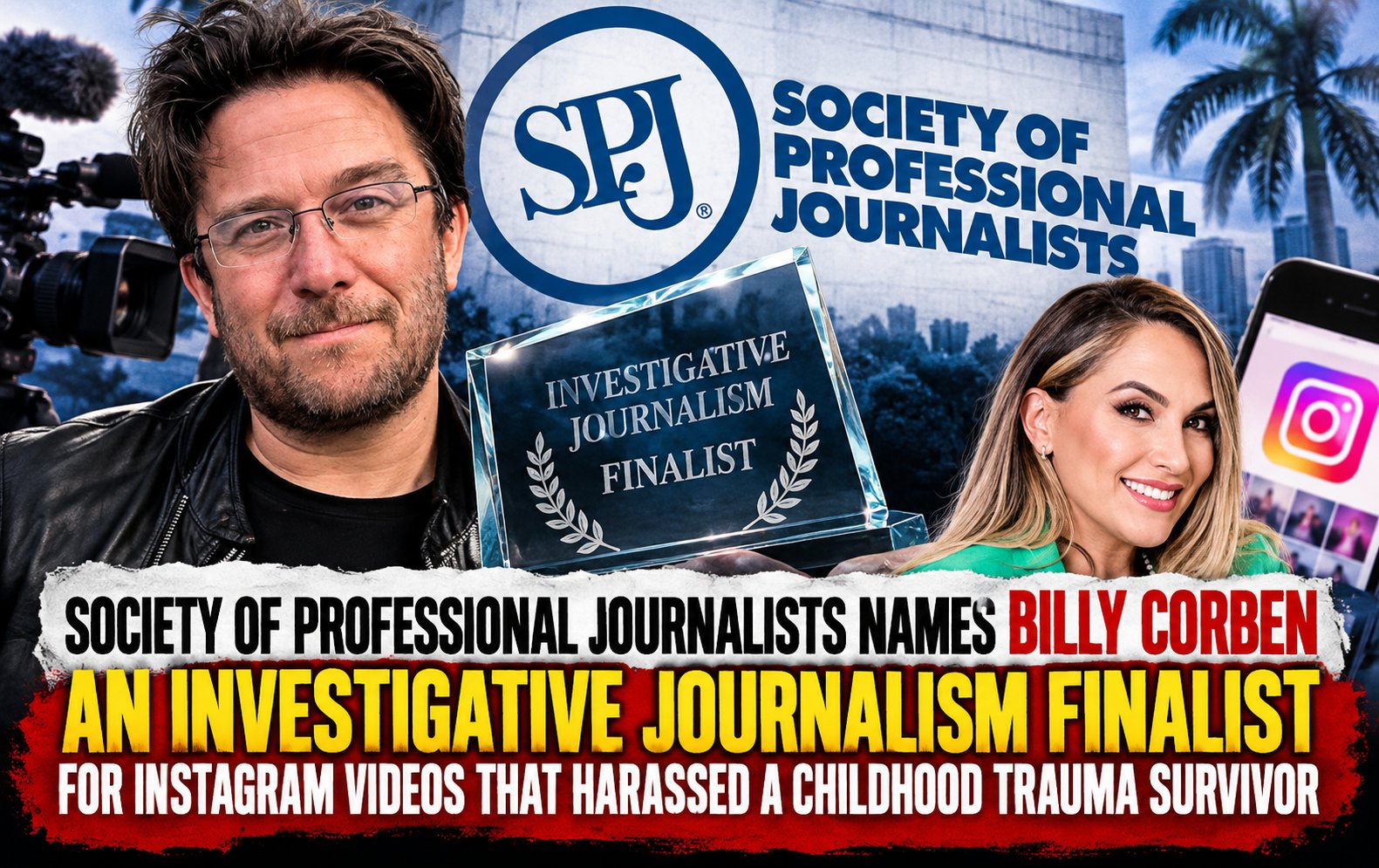
When Journalism’s Watchdog Fails: How Billy Corben’s Online Harassment Videos of a Childhood Trauma Survivor Made Him a Society of Professional Journalists Award Finalist
If you only have 30 seconds: This is a news story about how an Instagram influencer used three low quality, homemade Instagram videos containing Nazi propaganda to publicly pressure and harass a young woman, a survivor of severe childhood trauma, into appearing on his podcast to discuss one of the most painful experiences of her life: her father’s arrest and execution.
Then the story took an even more troubling turn. After the videos drew media criticism, their creator somehow managed to have the same Instagram attack videos recognized by the Society of Professional Journalists as finalists for an investigative journalism award, despite the videos containing no apparent original investigative reporting or newly uncovered information and, as this article documents, departing sharply from widely accepted standards of professional journalism.
At its core, this is a story about toxic journalism and a journalism institution that now has serious questions to answer about how these videos were submitted, evaluated, and ultimately elevated as award worthy investigative reporting. Those questions are especially important at a moment in American history when journalists face extraordinary levels of alleged fraud, corruption, criminal activity, government misconduct, and human rights abuses demanding serious investigative scrutiny. With so much consequential reporting left to be done, the standards for what qualifies as investigative journalism should matter more than ever.
Whether the explanation here is inadequate vetting, gross negligence, undisclosed conflicts, or something else entirely is precisely what deserves scrutiny…
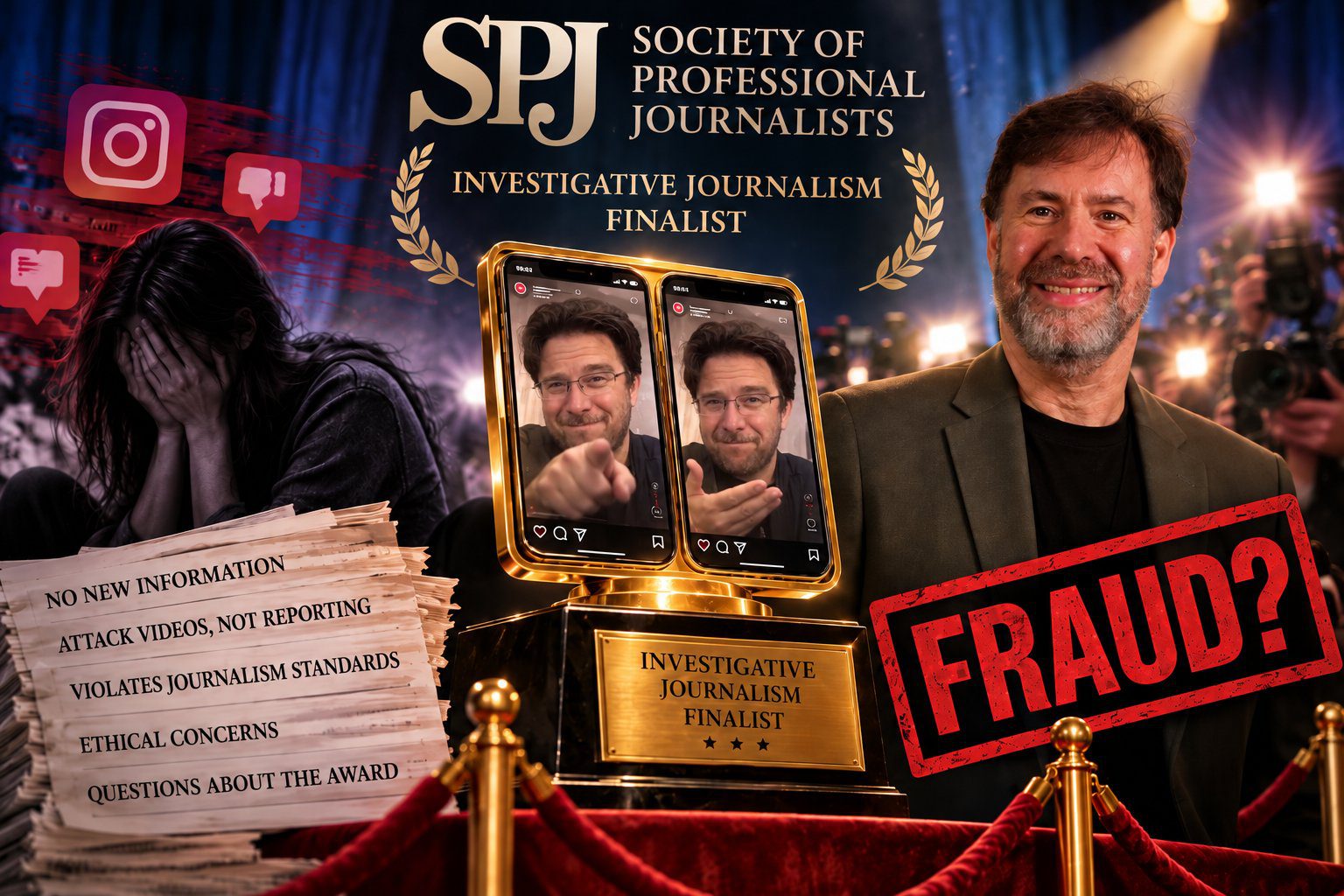
Billy Corben Repackages Old News, Uses a Child Victim’s Criminal Father to Attack Her Character, and Turns Nazi Imagery Into Instagram Clickbait
The story that would eventually become a finalist in Florida’s largest journalism competition began with an extraordinary political revelation: a candidate for the Miami Beach City Commission was the daughter of one of South Florida’s most notorious serial killers. The candidate was attorney Monique Pardo Pope. Her father was Manuel Pardo Jr., a former police officer convicted of murdering nine people during a 1986 killing spree. His case had been part of South Florida’s criminal history for decades. Pardo expressed admiration for Adolf Hitler, possessed Nazi memorabilia, showed no remorse for the killings, was sentenced to death and was executed by the State of Florida in 2012. None of that history was newly uncovered in 2025.
What Billy Corben did uncover was the already public connection between that notorious killer and a woman seeking elected office in Miami Beach, along with a series of social media posts in which Pope continued expressing affection for her father years after his execution. She had called him her “hero,” “guiding light,” “guardian angel” and “eternal best friend,” repeatedly memorializing him in language that inevitably raised questions once she entered politics. Those posts were newsworthy. For a political candidate publicly discussing family, values, service and the influences that shaped her, journalists were entitled to ask how she reconciled those statements with the horrific crimes her father committed. Voters were entitled to hear those answers and decide whether they mattered.
There was a legitimate story there, but there was also a fact that should have complicated every part of how that story was told: Monique Pardo Pope was four years old when her father committed the murders that eventually sent him to death row. Pope was not implicated in those murders, was never accused of participating in her father’s crimes, and no evidence presented in the coverage established that she shared his Nazi ideology. Her relationship with Manuel Pardo began not as a politician defending a controversial political ally but as a little girl loving her father. That distinction sits at the center of what followed.
Corben repeatedly argued that his reporting was not about the “sins of the father,” but the “lies of the daughter.” Yet the reporting surrounding Pope repeatedly returned to precisely what Corben said the story was not about: Manuel Pardo’s murders, his victims, his racism and anti-Semitism, his fascination with Hitler, his Nazi memorabilia, his death sentence and the grotesque details that made his criminal history so sensational. The effect was powerful. Pope’s political identity became digitally intertwined with some of the most inflammatory words imaginable in American public life: serial killer, Nazi, Hitler and murder.
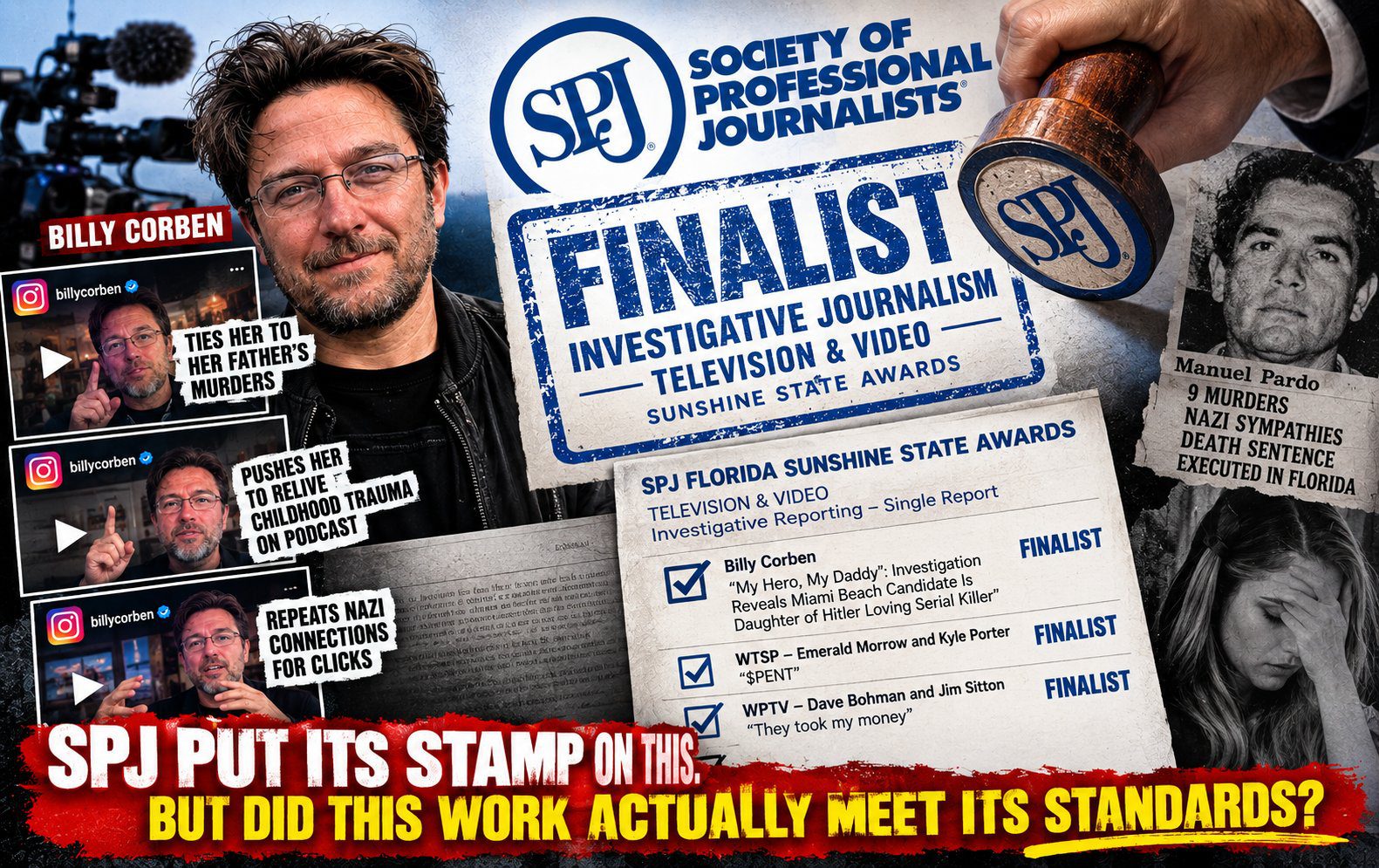
Months later, after the controversy had expanded into additional media coverage, a cease and desist dispute and a Florida Bar disciplinary complaint, Corben’s original work appeared somewhere few people familiar with the controversy might have expected to find it. The Society of Professional Journalists’ Florida chapter named Corben and Because Miami finalists in its 2026 Sunshine State Awards for Investigative Reporting, Single Report under the title “‘My Hero, My Daddy’: Investigation Reveals Miami Beach Candidate Is Daughter of Hitler Loving Serial Killer.”
Corben did not win the category. WTSP-TV journalists Emerald Morrow and Kyle Porter won first place for their investigation “$PENT,” while Corben was one of two additional finalists alongside WPTV journalists Dave Bohman and Jim Sitton for “They took my money.” That distinction matters because Corben was not the winner of SPJ Florida’s investigative reporting category. But finalist status is still professional recognition, and SPJ Florida had attached its name and institutional credibility to Corben’s work by elevating it as one of three finalists in the category.
That recognition created a question considerably larger than whether Billy Corben had the right to investigate Monique Pardo Pope. Of course he did. The question was what, exactly, made this particular work exemplary investigative journalism, and why, after substantive objections were raised about the reporting and its aftermath, did SPJ Florida say it reviewed the evidence and stand behind the recognition?
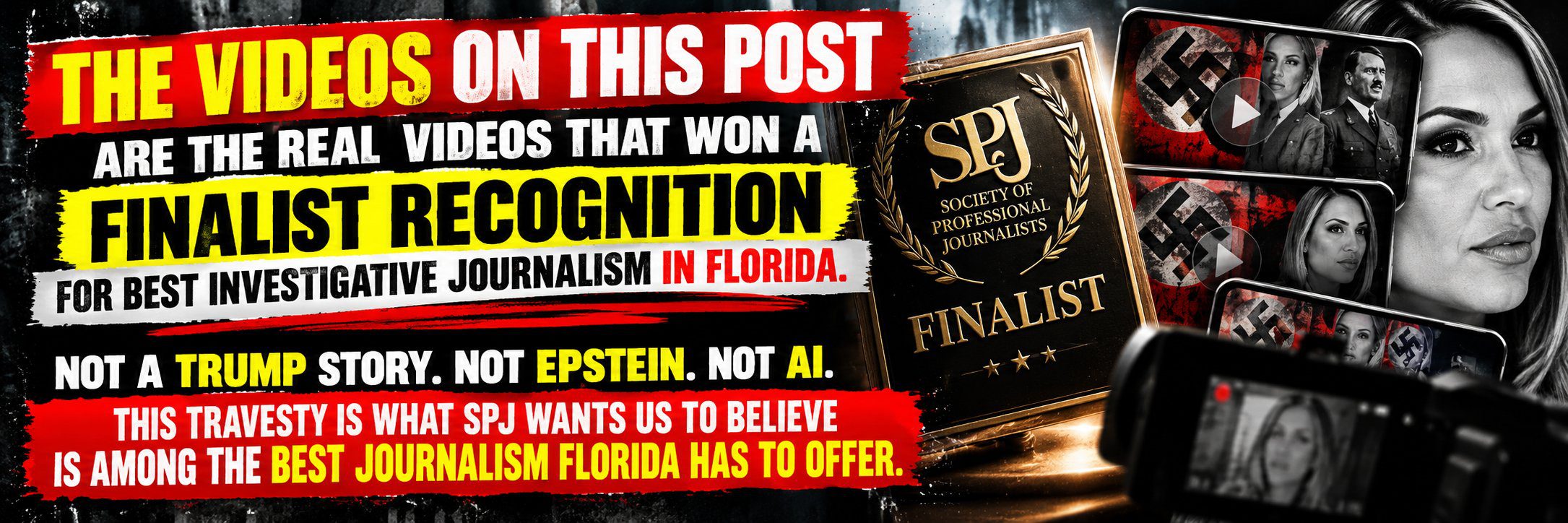
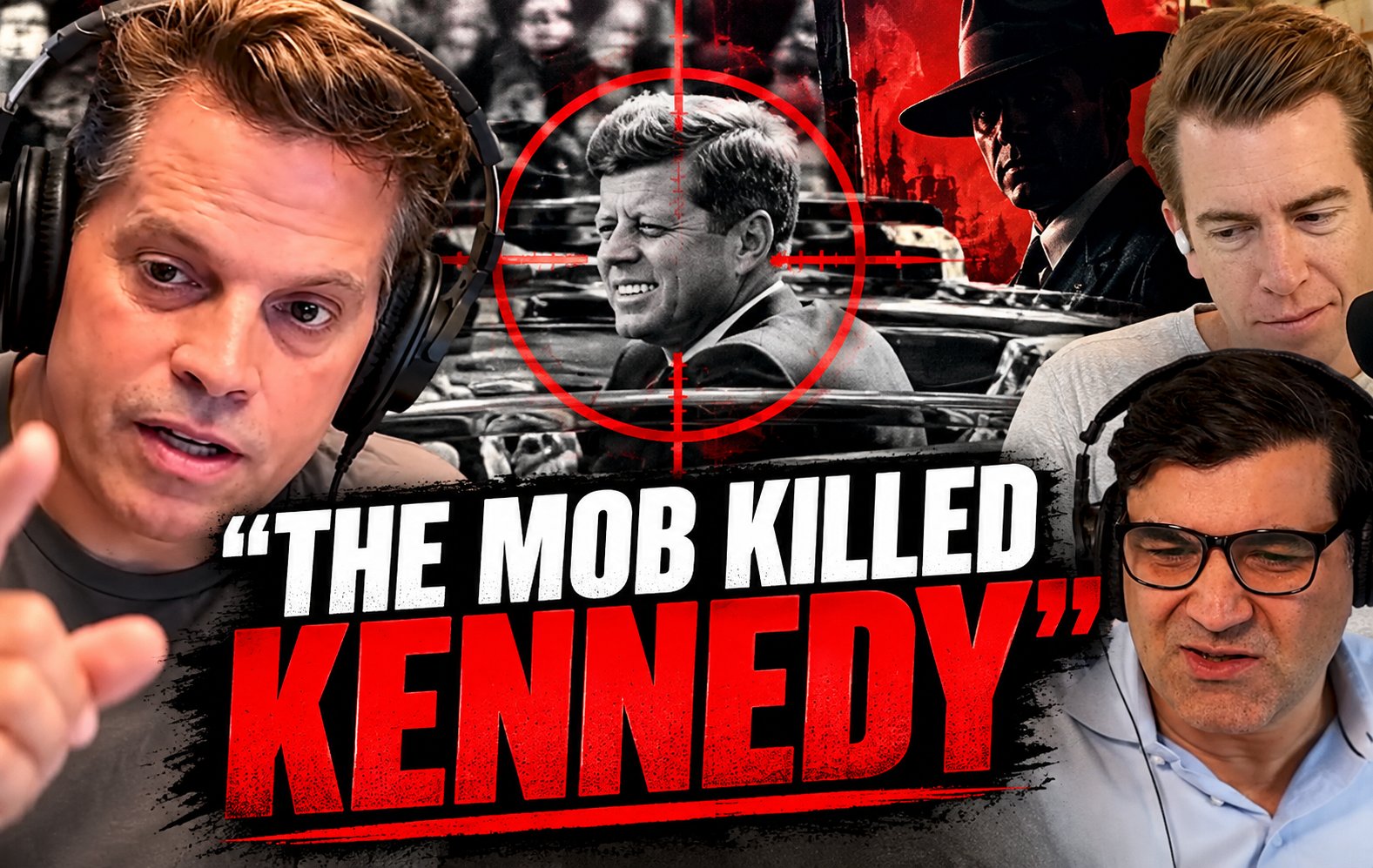
The videos on this post are real: The three videos embedded in this post are the actual videos at the center of the award controversy. The first was submitted for the award, while the others are Corben’s follow up videos targeting Monique Pardo Pope. These unprofessional videos repurpose other journalists’ reporting and photographers’ work while using Pope’s identity as a vehicle to drag her father’s horrific crimes back through the media for Corben’s own Nazi themed clickbait, regardless of the reputational damage it could cause a woman who did not commit those crimes.
Even today, searches for Pope on social media prominently surface Corben’s Nazi themed content alongside her name, illustrating exactly why the way journalists frame and associate innocent people with the crimes of their relatives matters tremendously in the digital age. Nowhere in Corben’s videos can you find a single stitch of who Monique Pope actually is as a person, a candidate, or a survivor. It is nearly impossible to understand how these videos could be considered among the best investigative journalism produced in Florida alongside the major stories that broke this year. The circumstances inevitably raise another question: Was this recognition based solely on the journalistic merits of the work, or did personal relationships or other considerations play a role in elevating a submission that had already drawn significant media criticism?
There Was a Legitimate, Nuanced Story Here, But Billy Focused on the Father’s Salacious Crimes and Tried to Pin Them Directly on Pardo’s Completely Innocent Daughter
Any serious examination of Corben’s reporting has to begin with the strongest argument in his favor. Manuel Pardo was not simply an obscure criminal relative discovered by someone digging through a candidate’s genealogy. He was one of South Florida’s most notorious murderers, and Pope herself had publicly memorialized him in extraordinarily affectionate terms long after reaching adulthood. Those statements created a legitimate avenue of political inquiry.
Pope’s campaign biography also emphasized her upbringing, describing a working class Cuban family built around sacrifice, service and standing up for what was right. Corben’s reporting therefore raised an obvious question about what was absent from that biography: her father was an executed serial killer whose history stood in stark contrast to the family narrative voters were being presented. That omission was fair game, as were Pope’s social media posts. A candidate calling an executed serial killer her hero naturally raises questions about judgment, particularly when she is asking voters to evaluate her character. Corben was entitled to confront her with those statements, other journalists were entitled to follow his reporting and voters were entitled to decide whether her relationship with her father mattered.
The journalistic issue was never whether Manuel Pardo could be mentioned. It was whether the reporting adequately distinguished between a daughter’s complicated emotional relationship with her father and the father’s criminal and ideological conduct, or whether the enormous shock value of Pardo’s crimes became the primary vehicle through which his daughter was presented to the public. That distinction became even more important once Pope responded.
Pope Did Not Deny Who Her Father Was
When confronted publicly, Pope did not claim Manuel Pardo was not her father. She issued a lengthy statement saying her world had been turned upside down when she was four years old because of his actions, condemning what her father had done and describing herself as another victim of the destruction he caused. She acknowledged loving him while attempting to explain the contradiction, saying she had spent years angry that the father she loved could commit such crimes before eventually deciding that forgiveness was necessary for her own life. Pope argued that forgiving him did not mean condoning his actions, and her response culminated in a straightforward declaration that she was not her father.
That explanation did not erase her previous posts, nor did it automatically resolve every legitimate question about her campaign biography. An adult candidate repeatedly describing an executed serial killer in deeply affectionate terms could reasonably expect difficult questions about what she meant. But Pope’s explanation made the story considerably more complicated than a headline about a candidate with a “Hitler loving serial killer” father suggested.
There was a difficult and potentially illuminating political story available: How does a child process discovering that the father she loved committed extraordinary evil? Why did Pope continue publicly praising him as an adult? What did she know at different stages of her life? Why did her campaign biography celebrate family values without acknowledging this extraordinary part of her family history? Would this in any way affect her leadership? Did her explanations accurately describe the legal and psychological history surrounding her father? Those questions could have produced honest answers without unprofessionally transferring Manuel Pardo’s culpability to his daughter.
Journalism Already Knows How to Make This Distinction
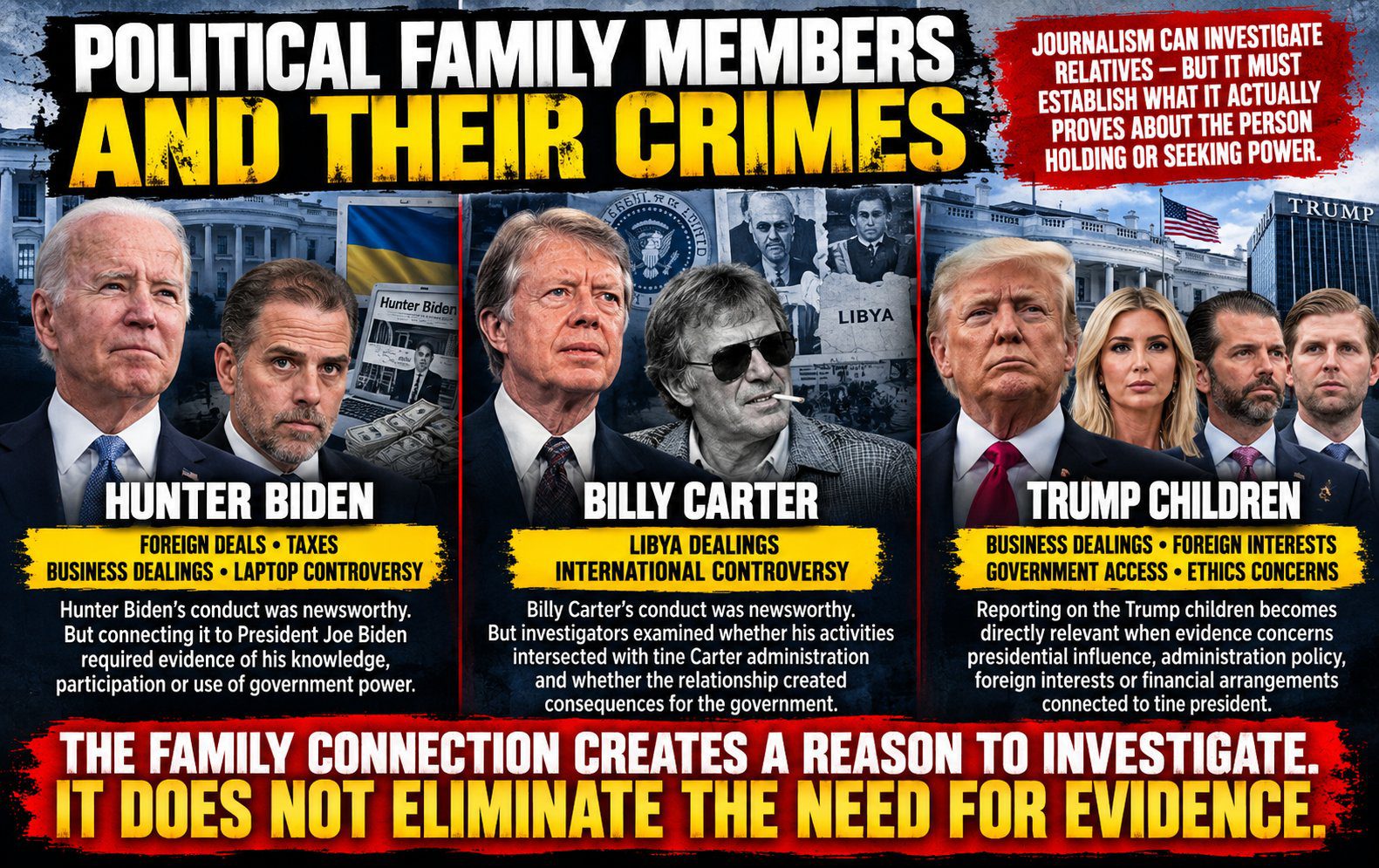
Political journalism encounters versions of this problem regularly. Presidents, candidates and other public officials have parents, siblings, spouses and adult children whose conduct can become newsworthy. The professional question is not whether those relatives may be investigated. It is what their conduct actually establishes about the person holding or seeking public power.
The scrutiny surrounding Hunter Biden provides an obvious modern example. Hunter Biden’s foreign business dealings, taxes and other conduct generated years of legitimate reporting and congressional investigation. But the politically consequential question involving President Joe Biden was necessarily different: What evidence connected the conduct of the son to the conduct of the father? Reporting could examine Hunter Biden aggressively without simply assigning everything Hunter Biden did to Joe Biden. Establishing a connection required evidence about Joe Biden himself, his knowledge, participation, financial involvement, use of government power or other relevant conduct.
The same basic distinction appeared decades earlier when President Jimmy Carter’s brother Billy Carter became embroiled in controversy over his relationship with Libya. Billy Carter’s conduct was newsworthy on its own, but the institutional inquiry did not stop at the fact that he was the president’s brother. Investigators examined whether his activities intersected with the Carter administration, whether the president or government officials had used him in matters of state and whether the relationship created consequences for the government. The family connection created a reason to investigate; it did not eliminate the obligation to establish what the connection actually proved.
The principle cuts across party and ideology. Reporting on the business activities of Donald Trump’s adult children becomes directly relevant to President Trump when evidence concerns presidential influence, administration policy, government access, foreign interests or financial arrangements connected to him. The mere fact that a president, candidate or officeholder has a controversial relative is not the endpoint of the investigation. It is the beginning of the attribution problem.
Journalism therefore already possesses the tools necessary to cover a case like Pope’s. Her adult statements about her father were hers and could be scrutinized aggressively. Her campaign biography was hers and could be examined for meaningful omissions. Her descriptions of her father’s history were hers and could be checked against records. But Manuel Pardo’s murders were Manuel Pardo’s. His Nazi sympathies were Manuel Pardo’s. His victims were Manuel Pardo’s. If those facts were going to become evidence about his daughter, the reporting needed to establish precisely what they demonstrated about her rather than allowing blood relationship and emotional association to do the work of real evidence. That is not journalism. It is false attribution.
If the Story Was About the Daughter’s Lies, What Were They?
Corben attempted to draw a bright ethical line around his reporting by insisting that he was not holding Pope responsible for her father’s sins; his stated issue was dishonesty by Pope herself. That claim deserves the same scrutiny Corben applied to Pope because there is a substantial difference between concealing one’s identity, omitting an uncomfortable fact from a campaign biography, misstating a complicated legal history, making a factual error and intentionally deceiving voters. Those concepts should not be collapsed into one another simply because “lies” makes a stronger accusation.
The record is more complicated than either side’s rhetoric suggested. Pope did not change her name to hide the family connection. State records showed that she registered her candidacy using the name Monique Pardo Pope, voluntarily retaining the Pardo surname on her candidate paperwork. After Corben’s reporting, she publicly said she had “not hidden who I am.” At the same time, her campaign biography did not volunteer that the father whose family history formed part of her personal narrative was Manuel Pardo. That omission was legitimate material for political reporting, particularly in light of the affectionate statements she had made about him as an adult.
Corben also challenged specific assertions in Pope’s response, including her characterization of her father’s mental condition and the legal findings surrounding it. That is precisely the kind of factual dispute investigative journalism should resolve through court records and primary documentation rather than rhetoric. The larger question is whether such disputed details supported the broader framing of an investigation centered on the “lies of the daughter,” particularly when so much of the accompanying material concerned the undisputed crimes and ideology of her father. Corben even used the phrases “Nazi” and “serial killer” prominently in all the marketing and promotion of the story.
Then came an error from the other side. During the escalating dispute, Pope told Miami New Times that Corben had lost a previous defamation case. That statement was false. The litigation she referenced had not ended with Corben suffering the defeat she described; the case against his filmmaking company was dismissed, and his side later obtained an anti-SLAPP fee award. Corben was entitled to demand a correction. What happened next transformed an ugly media dispute into something considerably more messy.
Corben Takes the Fight to The Florida Bar
On Nov. 20, 2025, Corben filed a formal complaint against Pope with The Florida Bar, asking the organization responsible for regulating Florida lawyers to examine whether her false statement constituted professional misconduct. The complaint reflected Corben’s confrontational public style, opening with the Eminem reference “Guess who’s back, back again?” before accusing Pope of communicating a “blatant lie” about him to the media. Corben also told Bar officials that he intended to continue documenting alleged unethical conduct whenever Florida attorneys violated their professional responsibilities while “attacking me and/or my journalism.”
The Florida Bar opened a disciplinary file, a procedural step that meant the allegations warranted further inquiry, not that Pope had been found guilty of misconduct. Pope acknowledged that her statement about Corben’s litigation history was false but disputed that she intentionally fabricated it, attributing the error to information produced during the campaign, including work by aides and ChatGPT. Corben rejected that explanation, arguing that reliance on bad information did not excuse a lawyer from verifying a damaging accusation before providing it to a news organization. That was a legitimate argument. But it also came after Corben’s own coverage had publicly and repeatedly intertwined the reputation of an otherwise established attorney with her father’s murders, Nazi sympathies and some of the darkest chapters of South Florida’s criminal history, raising the question of whether the same standard of care he demanded from Pope had been applied to the implications of his own reporting.
The Bar dismissed Corben’s complaint in early 2026. Bar counsel cited insufficient evidence that Pope violated Florida’s professional conduct rules and reported finding no proof that she acted with the required intent to mislead, defame or make a disparaging statement to the media. The disposition characterized her statement as arising from what investigators considered a good faith belief. That finding did not make Pope’s original statement true; it remained false. But the disposition matters because of how far the conflict had escalated. Corben initiated the scrutiny, Pope responded and made an inaccurate accusation while defending herself, and Corben moved the dispute from the media and political arena into the professional disciplinary system governing Pope’s law license. The regulator investigated and ultimately concluded there was insufficient evidence of professional misconduct. Taken together, the episode had evolved far beyond an ordinary disagreement between a journalist and the subject of his reporting into an increasingly toxic personal and professional conflict, making SPJ Florida’s subsequent decision to recognize Corben’s Instagram videos with an investigative journalism distinction all the more worthy of professional scrutiny.
“By the time The Florida Bar dismissed Corben’s complaint, this was no longer just a political story. It had become a toxic professional conflict in which a childhood trauma survivor was repeatedly tied to her father’s murders, Nazi ideology and execution, then publicly challenged to confront that very same trauma on Corben’s podcast, where he has absolutely no training to handle personal issues of that magnitude. SPJ Florida looked at that train wreck and decided it deserved recognition as investigative journalism.” — Patrick Zarrelli
What Did Corben Actually Uncover?
The question becomes particularly important once SPJ Florida classifies the work as investigative reporting.
 What Was the Investigation?
 What Was the Investigation?
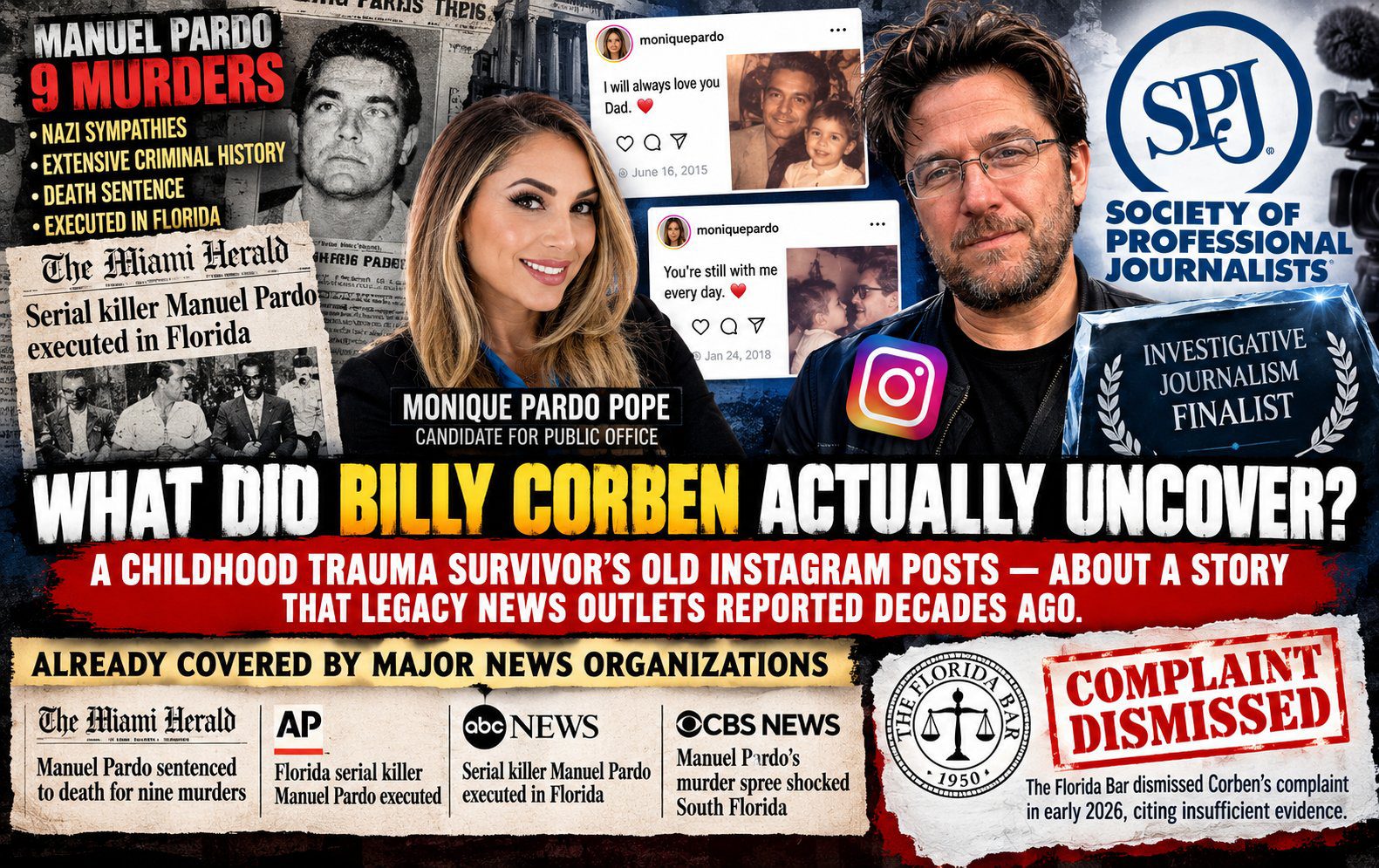
Manuel Pardo’s crimes were not hidden. His nine murder convictions, Nazi fascination, law enforcement history, death sentence and execution had been extensively documented for decades, making his case part of South Florida’s public record long before Billy Corben turned his attention to Pardo’s daughter.
Nor was Pope concealing the family connection: she registered her candidacy under the name Monique Pardo Pope, retaining the same last name as her father. Corben’s significant original discovery was therefore not Pope’s identity or her relationship to Manuel Pardo, but a series of old social media posts in which she continued to express love and affection for her father, despite the horrific crimes that had defined his public legacy.
Those posts were newsworthy and a legitimate subject for political reporting. They could reasonably raise questions about how Pope, as an adult seeking public office, understood and described her relationship with her father. But they were also the words of a daughter who had experienced the destruction surrounding her father’s crimes as a four year old child and had not lived with him since that time. Surfacing provocative social media posts from a childhood trauma survivor may produce a popular, clickbait political story, but that does not automatically make the resulting work an investigation, particularly when SPJ Florida placed Corben among three finalists out of potentially thousands of entries in Investigative Reporting.
If the central premise of the investigation was that Pope was lying, those alleged lies should be established with precision. If her description of her father’s mental condition or legal history contradicted court records, primary documentation should establish those discrepancies. If the reporting suggested that Pope minimized her father’s crimes or shared any part of his racist or Nazi ideology, evidence should establish that connection directly rather than allowing Manuel Pardo’s beliefs to become evidence against his daughter by association. The relevant investigative question was never whether Manuel Pardo was a murderer fascinated by Nazi ideology. South Florida had known that for decades. The question was what Pope’s own words and conduct actually established about Pope.
That distinction becomes even more important the more heavily the reporting relies on Manuel Pardo’s nine murders, his victims, racism, Nazi fascination, death sentence and execution. Those facts establish who Manuel Pardo was. Standing alone, they do not establish who Monique Pardo Pope became after growing up in the aftermath of what her father had done. If an investigation uses the horrors committed by a parent to scrutinize his adult daughter decades later, it should demonstrate what those horrors actually establish about her.
Otherwise, the father’s crimes risk becoming atmospheric evidence: horrifying enough to make the story more explosive, but disconnected from what the investigation is supposedly proving about the daughter.
SPJ’s Published Rules Leave an Important Question Unanswered
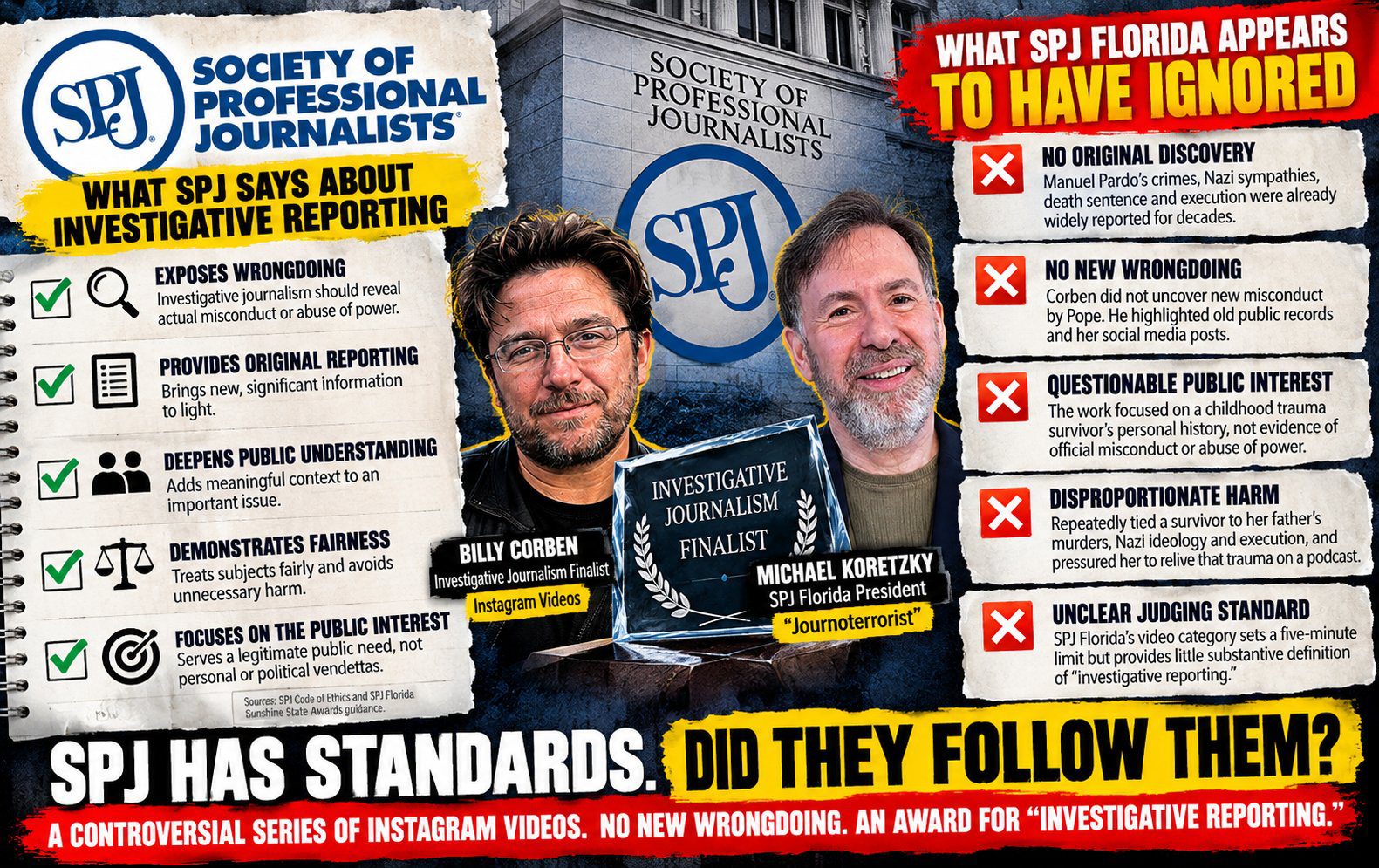
The classification becomes more significant when SPJ Florida’s published contest categories are examined. For Television & Video, Investigative Reporting – Single Report establishes a five minute maximum but provides little substantive explanation of what judges should consider “investigative reporting.” Other portions of SPJ Florida’s published awards material have historically described investigative work in more substantive terms, including journalism that exposes wrongdoing or deepens public understanding of a significant problem or issue. The absence of a detailed published definition for the television category does not prove Corben’s work failed the standard. It creates a different question:
What standard was actually applied?
Was originality central? Was the entry evaluated primarily on impact? Did judges consider the amount of new information uncovered? Did they examine fairness and proportionality? Were the Instagram videos considered by themselves or in the context of the broader campaign of posts and podcast commentary surrounding Pope? Did the judging focus solely on the submitted report, or did reviewers later consider what followed?
An awards organization is entitled to establish whatever reasonable criteria it chooses. But when a controversial piece is elevated specifically as investigative reporting and the organization later says it reviewed the controversy and continues to stand behind the recognition, the actual standard becomes part of the story.
The Difference Between a Daughter and an Accomplice
Children of criminals occupy an ethically complicated place in journalism because family relationships do not disappear when a parent commits a terrible act. A child can love a parent who has done something monstrous, and an adult child can remain emotionally attached to that parent while condemning what the parent did. An adult can also romanticize, excuse or minimize a parent’s crimes in ways that legitimately raise questions about judgment. Journalism should be capable of distinguishing among those possibilities.
Pope’s affectionate posts about Manuel Pardo were legitimate evidence about her relationship with him, but they were not evidence that she committed his murders, shared his admiration for Hitler or became an accomplice to crimes committed when she was just four years old. That distinction is especially important in political journalism, where the purpose should be to give voters relevant information about the person actually seeking power. Pope’s own statements created the connection that made her father relevant; the journalistic obligation then became explaining that connection accurately and proportionately rather than allowing the enormity of Manuel Pardo’s crimes to substitute for evidence about his daughter.
From One Point to a Permanent Digital Identity
Modern journalism does not end when a video stops playing. Corben’s initial report rapidly became source material for additional coverage. Miami New Times published a story under the headline “Daughter of Nazi Obsessed Serial Killer Wants Your Vote,” while Florida Politics and Florida Phoenix subsequently examined Pope’s family history, the political controversy and the later Bar proceedings. Each additional story strengthened the digital association between Pope and her father.
That is not automatically unethical. News organizations routinely follow legitimate stories first broken by competitors, and search engines naturally connect related reporting. But the amplification illustrates why framing matters. When a person’s name becomes repeatedly surrounded online by “serial killer,” “Nazi,” “Hitler” and murder, those associations can persist long after the original news cycle ends. Social media platforms and search systems are particularly effective at stripping away nuance, allowing a complicated story about a daughter’s relationship with a murderous parent to become a permanent visual landscape of mugshots, Nazi imagery and inflammatory headlines.
That does not mean journalists should suppress truthful information because publication may hurt someone. Public interest journalism routinely causes legitimate reputational harm. It does mean journalists must consider whether that harm is proportionate to what the reporting actually establishes, a principle embedded in SPJ’s own ethical framework.
What the Viral Narrative Did Not Establish About Pope
The extraordinary history of Pope’s father also threatened to overwhelm the remainder of her public record. Pope’s professional biography presents an attorney active in family law, professional legal organizations and civic work, including service connected to children and women and charitable fundraising. Those biographical claims do not prove that Pope was a good candidate, nor should a professional résumé immunize anyone seeking office from scrutiny. They do, however, demonstrate why reducing a person’s public identity to the worst acts committed by a parent can create a radically incomplete picture.
A rigorous investigation could have examined that broader record alongside the controversial posts. It could have interviewed colleagues, clients, political opponents and people familiar with Pope’s life. It could have asked whether anything in her adult conduct suggested sympathy for her father’s ideology, whether her professional behavior raised concerns related to the character questions Corben was presenting, or whether the affectionate posts reflected something more complicated: a daughter attempting to preserve love for a parent while separating that love from his crimes.
Those questions matter because the most sensational interpretation is not automatically the most accurate one. If the investigation is about Pope’s character, then Pope’s actual adult character and conduct must be evidence too.
SPJ Says Journalism Must Minimize Harm and Explain Its Decisions
The Society of Professional Journalists organizes its Code of Ethics around four foundational principles: Seek Truth and Report It; Minimize Harm; Act Independently; and Be Accountable and Transparent. The Code is aspirational, not a disciplinary rulebook. SPJ does not function as a licensing authority for journalists, and disagreement over “Minimize Harm” does not establish that journalism is unethical. Aggressive reporting can cause enormous harm while still serving an overwhelming public interest.
That distinction matters because “Minimize Harm” does not mean “never damage anyone’s reputation.” Investigative journalism often damages reputations because exposing consequential facts is precisely the purpose of the work, and political candidates surrender some of the privacy enjoyed by ordinary citizens when they voluntarily seek public power. But SPJ’s framework also asks journalists to balance the public’s need for information against potential harm, show compassion toward people affected by coverage, recognize that legal access to information differs from an ethical justification to publish it, avoid pandering to lurid curiosity and consider the long term consequences of publication.
SPJ’s accountability principle is equally important. The Code asks journalists to explain ethical choices and processes, respond to questions about accuracy, clarity and fairness, expose unethical conduct within journalism and abide by the same standards they expect of others. SPJ’s own Ethics Committee has separately emphasized that accountability and transparency help establish journalism’s credibility.
Those principles make the Pope controversy unusually appropriate for examination. SPJ Florida was not being asked whether Corben had a constitutional right to publish his reporting; it was being asked why this particular work deserved professional recognition as investigative journalism. Those are fundamentally different questions.
Then SPJ Florida Put Its Name on the Work
SPJ Florida’s 2026 Sunshine State Awards drew well over 1,000 entries, according to the organization. The chapter describes the competition as Florida’s largest journalism contest, recognizing work produced across Florida, Puerto Rico and the U.S. Virgin Islands. Among the finalists in Television & Video for Investigative Reporting – Single Report were WTSP’s Emerald Morrow and Kyle Porter for “$PENT,” WPTV’s Dave Bohman and Jim Sitton for “They took my money,” and Billy Corben for Because Miami’s “‘My Hero, My Daddy’: Investigation Reveals Miami Beach Candidate Is Daughter of Hitler Loving Serial Killer.” At the Aug. 29 ceremony at ArtServe in Fort Lauderdale, Morrow and Porter won first place, while Corben and the WPTV team remained finalists.
The same competition recognized substantial public interest journalism across numerous categories, including the Miami Herald and WLRN investigation “Brightline, Florida’s Killer Train,” which received recognition through the A Mark Prize for Investigative Journalism. Other investigative work recognized in the competition examined government, infrastructure and criminal justice issues. Those stories should not be falsely portrayed as having competed directly against Corben; different categories contained different pools of submitted work, and journalism that was never entered could not have been considered.
The relevant question is narrower: How on Earth did the author of these Instagram attack videos become one of the finalists in the SPJ investigative reporting category?
The Original Selection May Have a Mundane Explanation and it May Not…
It would be easy to leap from a controversial finalist to allegations that SPJ Florida leadership personally handed Corben a favor, but the available evidence does not establish that. SPJ Florida’s competition is based on submitted entries, and the chapter has previously described Sunshine State Awards judging as involving professional journalists outside Florida. Without the complete 2026 judging records, however, a previous year’s process should not be treated as proof of the precise judging arrangement used for Corben’s entry.
Nothing established by this investigation demonstrates that SPJ Florida President Michael Koretzky personally judged Corben’s entry, instructed judges to advance it, altered scores or otherwise manipulated the initial selection. Without judging records, score sheets, comments and information identifying the relevant judges, it would be irresponsible to claim otherwise.
A much simpler explanation exists. An awards judge could have received Corben’s submission, seen a provocative report connecting a political candidate to an executed serial killer, reviewed the candidate’s extraordinary public statements about her father and concluded that the work qualified as investigative reporting. Reasonable journalists can disagree with that judgment without inventing a conspiracy. That should have been the easiest part of the controversy for SPJ Florida to explain. But they refused.
SPJ Florida Says It Reviewed the Evidence
The controversy changed when objections to the recognition were raised directly with SPJ Florida. In correspondence concerning the award, SPJ Florida President Michael Koretzky made the organization’s position explicit:
“Upon reviewing all the evidence, SPJ Florida stands by its award.”
That sentence is important because it moves the story beyond whatever an unidentified contest judge originally thought about Corben’s submission. SPJ Florida was no longer merely administering the result of an awards process. Its president said the organization had subsequently reviewed all the evidence and made an institutional decision to stand behind the recognition.
Once an organization invokes a review as the basis for defending a contested decision, the review itself becomes a legitimate subject of inquiry.
Who conducted it? What evidence was examined? Were Corben’s original videos reviewed by themselves or together with the surrounding social media campaign? Was Pope’s complete response considered? Were the Florida Bar complaint and its dismissal reviewed? Did reviewers examine the chronology closely enough to recognize that Pope’s false statement about Corben’s litigation history occurred after the original reporting and therefore could not retroactively establish the original premise about the “lies of the daughter”? Were SPJ’s own ethical principles considered? Did reviewers consult Corben, Pope or the original judges? Was any written determination produced?
Those are not demands for SPJ Florida to agree with its critics. They are ordinary accountability questions, and they become particularly significant when the institution being asked to answer them is an organization that teaches journalists to demand exactly those kinds of answers from everyone else.
Michael Koretzky: A Rebel Without a Standard
There is nothing inherently wrong with a rebellious journalist. In fact, some of journalism’s most important figures have been rebels, people willing to challenge institutions, break conventions and endure consequences because they believed the profession, government or society could operate differently. But rebellion normally has a destination. The rebel is rejecting one standard because he believes there is a better one on the other side.
Michael Koretzky’s public persona presents a different kind of rebellion: ceaseless rebellion against imaginary adversaries as a professional identity.
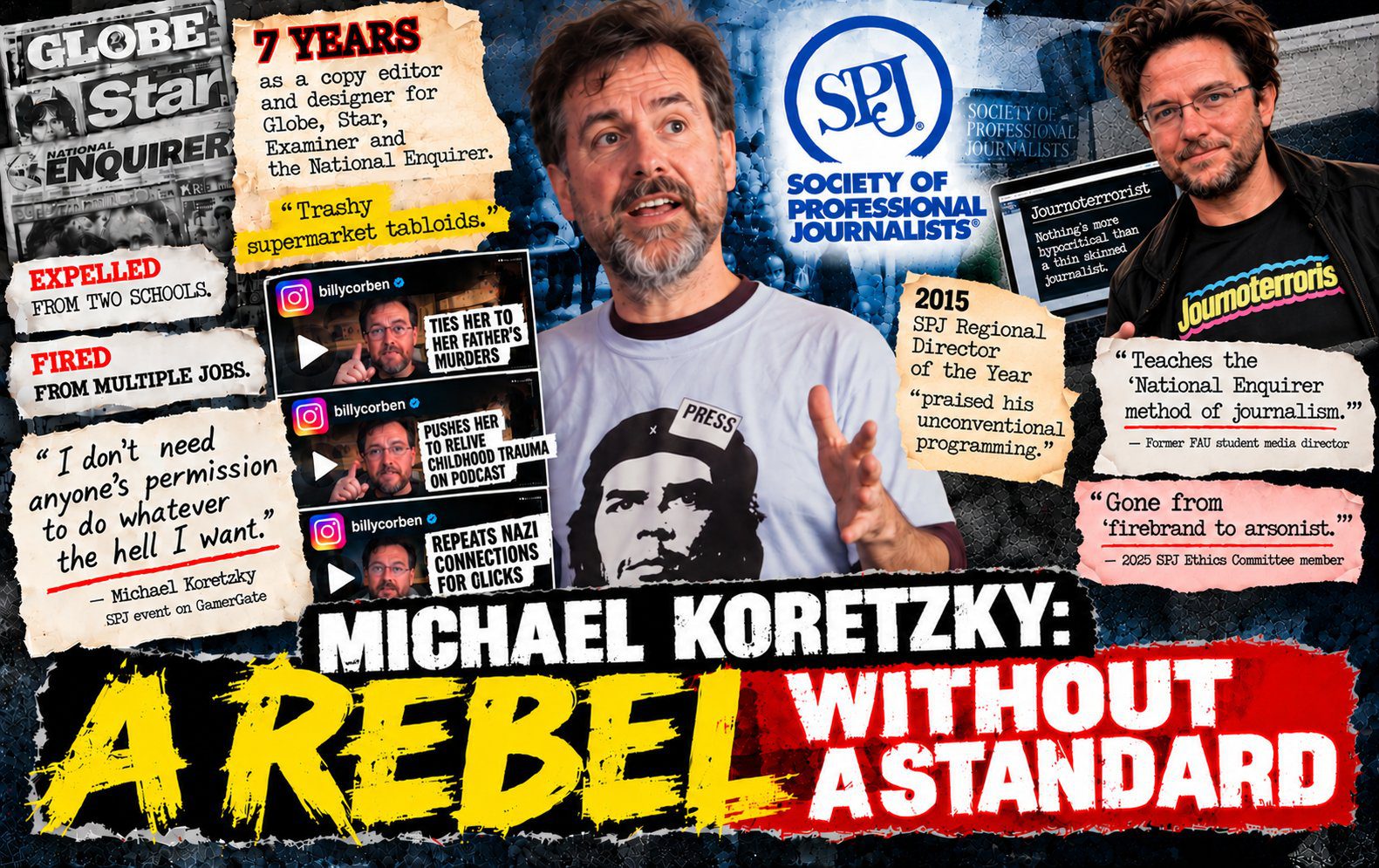
Koretzky has spent years cultivating that image. His personal website is called Journoterrorist. On its “About” page, he openly lists being expelled from two schools and fired from multiple jobs, describes his seven years working as a copy editor and designer for Globe, Star, Examiner and the National Enquirer, and calls those publications “trashy supermarket tabloids.” He even publishes some of the harshest criticism directed at him over the years, including a former Florida Atlantic University student media director accusing him of teaching the “National Enquirer method of journalism” and a 2025 SPJ Ethics Committee member saying he had gone from “firebrand to arsonist.”
This is not a reputation Koretzky appears interested in escaping. It is part of the brand. His website’s tagline declares that “nothing’s more hypocritical than a thin skinned journalist,” and his writing repeatedly presents confrontation, institutional friction and professional discomfort as virtues. Years ago, while organizing an SPJ event surrounding the enormously contentious GamerGate controversy, Koretzky put his philosophy even more bluntly:
“I don’t need anyone’s permission to do whatever the hell I want.”
There can be value in that attitude. Journalism needs people willing to challenge authority, ignore comfortable conventions and ask questions other people would rather avoid. SPJ itself recognized Koretzky in 2015 as its Regional Director of the Year, specifically praising his unconventional programming. The problem is not that Koretzky is rebellious. The harder question is what standard governs the rebellion.
That distinction matters in 2026. The early internet rewarded a philosophy in which provocation could almost be treated as its own public service: offend people, challenge institutions, invoke the First Amendment and let the resulting conflict demonstrate that something important had happened. But the modern information environment has exposed the limitations of that philosophy. Social media can permanently attach accusations, insinuations and sensational labels to human beings. Search engines can preserve them for decades. Viral framing can travel vastly farther than the context necessary to understand it. The freedom to publish remains fundamental, but professional journalism asks a second question after Can we publish this?: Why are we publishing it this way, and what does the evidence actually establish?
That is where Koretzky’s history becomes relevant to this controversy. Not because working for the National Enquirer disqualifies him from leading a journalism organization. It does not. Not because being confrontational proves corruption. It does not. And not because his personality establishes that he personally selected Billy Corben or manipulated the Sunshine State Awards. There is no evidence presented here establishing any of those things. The concern is philosophical.
A rebel with a standard challenges the establishment because he believes the standard can be made better. A rebel without one can begin treating the reaction itself as evidence that the work was worthwhile. Getting attacked becomes validation. Getting threatened becomes a credential. Getting fired becomes another story. Getting called an arsonist becomes something to publish on your own biography. Eventually, controversy stops being an occasional consequence of journalism and risks becoming part of the method.
That makes Koretzky an unusually important figure in understanding SPJ Florida’s response to Corben’s work. Corben similarly practices a deliberately confrontational form of journalism built around provocation, ridicule, social media amplification and direct challenges to the people he covers. That resemblance does not establish favoritism, collusion or even personal influence over Corben’s finalist selection. But it makes SPJ Florida’s standards more important to explain, not less.
If the organization reviewing Corben’s work was being led by someone who openly celebrates journalism that pushes boundaries, creates confrontation and refuses to be intimidated by professional discomfort, then the public is entitled to know where SPJ Florida believes those boundaries actually are. At what point does aggressive reporting become unnecessary humiliation? When does provocation illuminate a public interest fact, and when does it merely generate attention? When does relentlessly challenging a source demonstrate journalistic persistence, and when does it become harassment? Most importantly, what separates rebellious journalism in pursuit of a higher standard from rebellion simply for the sake of rebellion?
That is the question SPJ Florida’s response has so far failed to answer. Koretzky has spent much of his career demonstrating that he is willing to break rules, anger institutions and accept the consequences. But leadership of a professional journalism organization requires something more difficult than proving you are willing to rebel against standards. It requires explaining what standards you believe should replace them. And in the controversy surrounding Billy Corben and Monique Pardo Pope, that distinction is no longer philosophical. It is the entire point.
Similar Styles Are Not Evidence of a Backroom Deal
There is an obvious temptation to look at Corben and Koretzky and infer something more sinister. Both cultivate provocative public personas, both appear comfortable with confrontation and both use sarcasm as part of their public communications. Those similarities are not evidence of collusion. No evidence established in this investigation shows that Koretzky secretly selected Corben, instructed judges to advance his entry, altered scores, manipulated the competition or exchanged anything of value for the recognition. Nor has evidence been established showing that a personal friendship caused Corben’s entry to advance. Absent such evidence, those allegations should not be made.
The documented facts are significant enough without embellishment. Corben’s work entered SPJ Florida’s awards process and became one of three finalists for Investigative Reporting – Single Report. Another newsroom won the category. When objections were later raised about Corben’s work, SPJ Florida’s president said the organization reviewed the evidence and stood behind the recognition. The original selection belongs to the contest process. The subsequent defense belongs to SPJ Florida.
The Collateral Damage When “Investigative Journalism” Loses Its Meaning
Professional journalism awards do more than recognize individual reporters. They communicate what the profession considers exemplary. A finalist designation tells journalists, students, editors, audiences and future applicants that the recognized work represents something worth noticing within its category. That is why classification matters. Corben’s work was not recognized in a category for commentary, social media engagement, political satire, personality driven broadcasting or opinion. It became a finalist for Investigative Reporting – Single Report.
The distinction does not mean Corben displaced some specific investigation that otherwise would have been recognized; awards categories depend on what was actually submitted, and different investigations competed in different categories. Nor does it mean Instagram cannot carry serious journalism. Investigative reporting can appear on television, in a newspaper, in a podcast, on YouTube, on Instagram or on a platform that has not yet been invented. The platform is irrelevant. The question is whether the work demonstrates the qualities the professional label implies.
If an explosive family connection, inflammatory imagery, publicly available archival material and provocative presentation are enough to transform a political social media report into award caliber investigative journalism, then SPJ Florida should be able to explain the investigative standard it applied. Doing so would not weaken the award. It would define it.
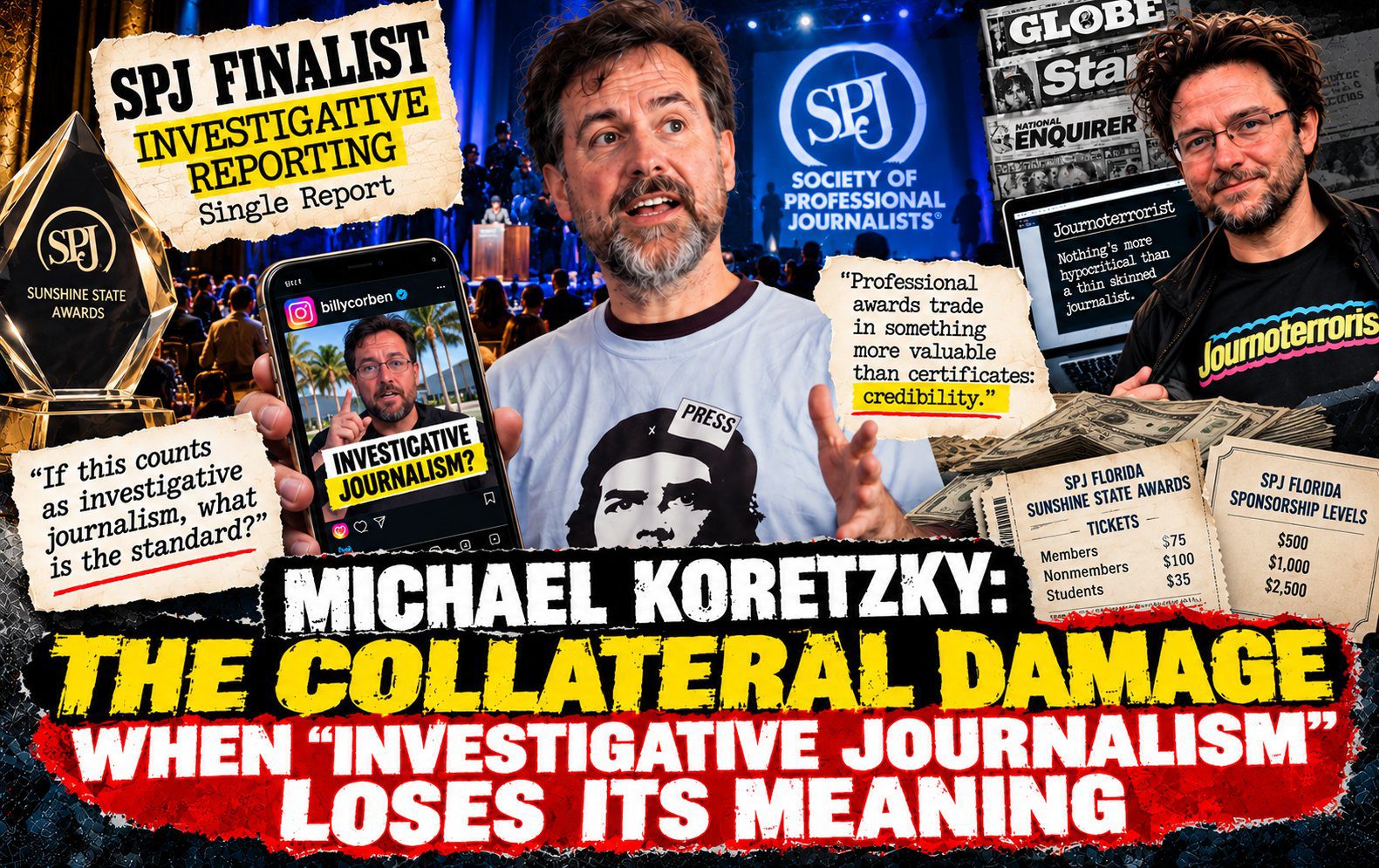
Journalism Awards Trade in Something More Valuable Than Trophies
The Sunshine State Awards are not merely an informal gathering of journalists congratulating one another. SPJ Florida describes the competition as Florida’s largest journalism contest, and its 2026 ceremony brought together journalists, newsroom leaders, educators and industry professionals. Finalists and winners received professional recognition, while admission to the ceremony was sold to attendees.
The program also has a financial structure. SPJ Florida solicited sponsorships for the 2026 ceremony, with published sponsorship levels ranging from $500 to $2,500, and said those contributions helped offset event costs while net proceeds from the Sunshine State Awards were reinvested into programs supporting journalism. Ceremony tickets were sold at different rates for members, nonmembers and college students. There is nothing inherently improper about any of that. Professional associations routinely charge contest fees, sell event tickets and solicit sponsors. Awards programs cost money to administer, and financial support for journalism organizations is not evidence of corruption.
The point is that professional awards trade in something more valuable than certificates: credibility. Journalists submit their work because an SPJ distinction carries professional meaning. Newsrooms promote awards because recognition from a journalism organization conveys prestige, while sponsors support ceremonies because the institution’s reputation gives the event value. That makes scrutiny of the awards process legitimate. SPJ does not deserve less scrutiny because it is composed of journalists. If anything, an organization built around accountability should expect more.
The Initial Finalist Selection May Be the Least Important Part of the Story
The more closely the controversy is examined, the less necessary any theory of a rigged contest becomes. The simplest explanation may also be the most plausible: a judge received Corben’s submission and encountered an explosive political package involving a Miami Beach candidate, an executed serial killer father, Nazi imagery, disturbing old social media posts and a filmmaker presenting the discovery as an investigation into the candidate’s truthfulness. The judge considered it compelling investigative reporting and advanced it with no real due diligence.
No conspiracy is required.
If that is what happened, the original finalist selection may represent nothing more than a debatable editorial judgment. The more consequential decision came afterward, when SPJ Florida was no longer evaluating an isolated contest submission but had an opportunity to examine Pope’s childhood, her adult statements, Corben’s specific allegations, the balance between new reporting and decades old material about Manuel Pardo, the subsequent media amplification and the disciplinary fight that followed.
“SPJ Florida says it reviewed the evidence and then stood by the recognition.”
That statement removes the easiest institutional defense: that contest judges made the decision and SPJ Florida merely administered the result. Once the organization conducted its own review, it owned its own conclusion.
So What Did SPJ Florida Actually Find?
If SPJ Florida concluded that Pope’s adult tributes to her father justified Corben’s framing, it can explain that conclusion. If it determined that Corben convincingly established the “lies of the daughter,” it can identify the statements it believes constituted those lies. If reviewers concluded that extensive discussion of Manuel Pardo’s murders and Nazi obsession was essential context rather than sensationalism, they can explain why. If they believed Pope’s age, childhood and status as someone harmed by her father’s crimes were adequately represented, they can point to that context.
If SPJ Florida concluded that the subsequent Florida Bar proceedings were irrelevant to evaluating the original journalism, that is also a position it can articulate. If its review consisted simply of chapter leaders examining the controversy and determining that reasonable judges could still recognize Corben’s work, there is nothing inherently scandalous about saying so. The problem is not that SPJ Florida reached a conclusion with which critics disagree. The problem is that invoking a review is not the same thing as explaining one.
“We reviewed everything and stand by our decision” is the kind of answer journalists routinely receive from institutions that want questions to stop. It is rarely the kind of answer journalists accept.
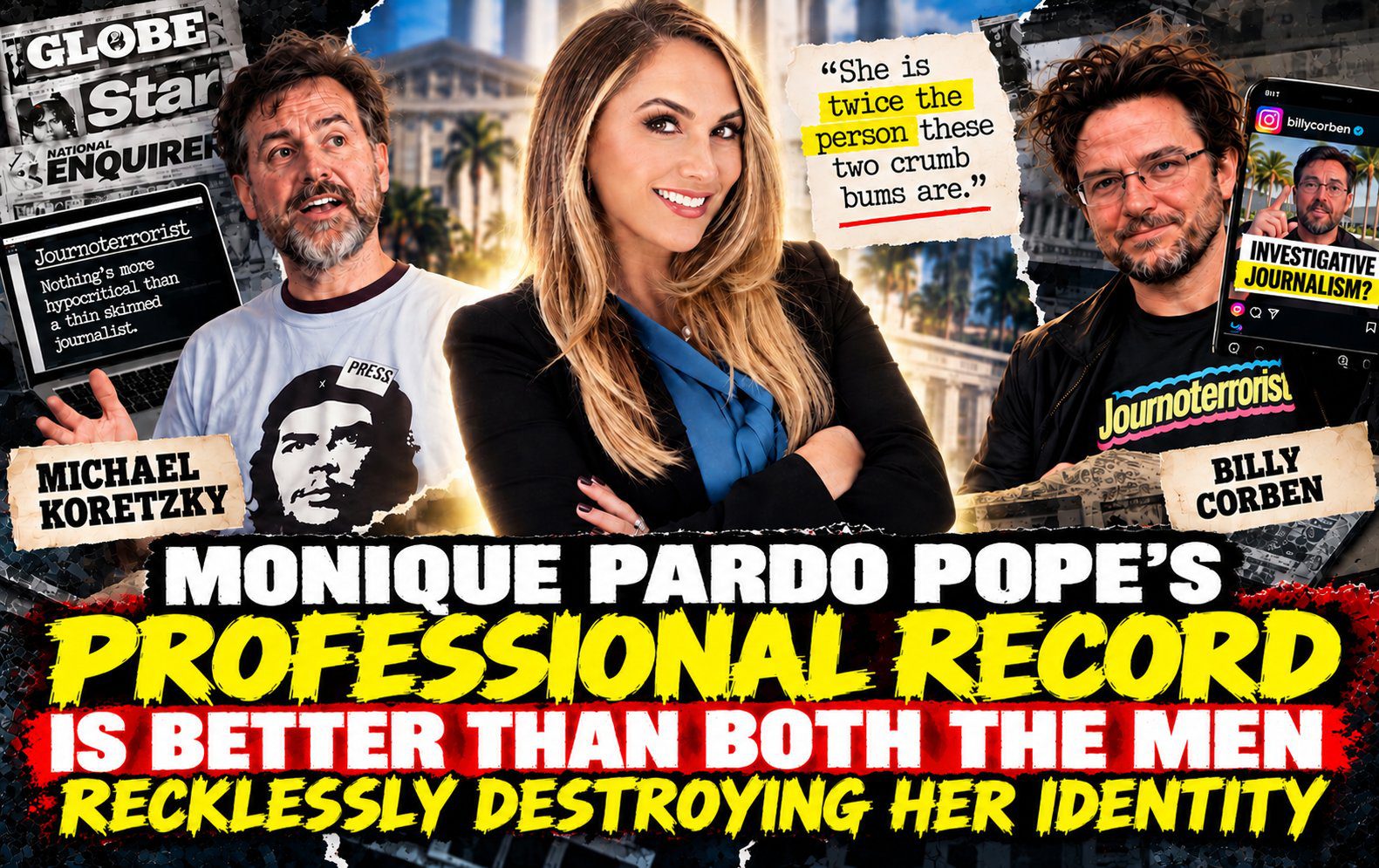
The Person Buried Beneath the Headlines
Lost beneath the arguments over awards, journalism ethics and institutional credibility is the person whose family history started the controversy. Monique Pardo Pope was the daughter of a man who committed horrific crimes, and she was also four years old when those crimes occurred. As an adult, she publicly expressed affection for her father in language that legitimately deserved scrutiny when she sought elected office. Her campaign biography omitted an extraordinary and politically relevant part of her family history, Corben disputed aspects of how she described her father’s legal and mental health history, and Pope later made a false statement about Corben’s litigation history.
Those facts belong in the story, but so do the others. Pope did not commit Manuel Pardo’s murders, and no evidence presented in this controversy established that she shared his admiration for Hitler. Her decision to forgive and continue loving her father does not itself establish approval of his crimes, just as her status as his daughter does not immunize her adult statements from scrutiny.
Those realities can coexist. Pope did not need protection from journalism simply because her childhood was traumatic; political candidates voluntarily subject themselves to intense scrutiny, and voters were entitled to know about statements she herself made. But scrutiny of a candidate is not a license to blur the boundary between the candidate’s conduct and the atrocities of a parent.
Manuel Pardo’s murders, Nazi sympathies and responsibility for his victims belonged to Manuel Pardo. Pope’s words belonged to Pope, and those were the words journalism was entitled to investigate. Maintaining that distinction is not excessive sensitivity. It is basic attribution, one of journalism’s oldest obligations.
Accountability Has to Run in Every Direction
A fair examination of this controversy cannot apply accountability selectively. Pope remains responsible for the statements she made as an adult, the extraordinary praise she publicly directed toward her father, what her campaign biography included and omitted, and the inaccurate claim she later made about Corben’s litigation history. Being a childhood trauma survivor does not exempt a political candidate or attorney from factual scrutiny.
Corben is equally entitled to defend his reporting. He can identify the original facts he uncovered, explain why he believed the “lies of the daughter” framing was justified, demonstrate how his reporting distinguished Pope from her father, explain the journalistic purpose served by repeatedly invoking Pardo’s murders and Nazi obsession, and explain why his public challenges for Pope to appear on his podcast were appropriate to the story.
SPJ Florida can explain what it reviewed, who reviewed it, what standard was applied and why the organization concluded that the work remained deserving of recognition as investigative journalism. Accountability does not require everyone to reach the same conclusion. It requires everyone making consequential claims to support them.
Journalism Cannot Demand Answers It Refuses to Give
The Society of Professional Journalists exists in part because journalism depends on credibility that cannot and should not be imposed by government. There is no state licensing board determining who qualifies as an ethical reporter, and professional journalism organizations therefore derive their authority from something more fragile: the willingness of journalists and the public to believe that the standards they promote actually mean something.
That is why this controversy ultimately matters. Billy Corben had every right to investigate Monique Pardo Pope. Pope’s public praise of her father deserved scrutiny, her inaccurate statements deserved correction, and Corben had the right to complain to The Florida Bar and criticize the Bar after it rejected his argument. Awards judges had the right to consider his work worthy of recognition, and SPJ Florida had the right to recognize it. But rights are not the issue. Standards are.

SPJ asks journalists to seek truth rather than merely assemble facts supporting the most provocative narrative. It asks them to minimize unnecessary harm without becoming timid, distinguish public interest from lurid curiosity and be accountable and transparent about the decisions they make. Those standards mean very little if they disappear whenever applying them becomes uncomfortable.
Every day, reporters ask institutions questions those institutions would rather not answer. Police departments are asked to justify uses of force, prosecutors are asked why cases were pursued, politicians are asked to explain votes, corporations are asked about misconduct, universities are asked about disciplinary decisions and government agencies are asked to produce records and explain how conclusions were reached. Journalists do not ordinarily accept “we reviewed the matter and stand by our decision” as the end of those stories. They ask who conducted the review, what evidence was considered, what standards were applied, whether contrary evidence was examined, what records exist and how the institution reached its conclusion.
They keep asking because institutional accountability does not consist of an institution announcing that it agrees with itself. The same standard has to apply when the institution is made up of journalists.
SPJ Florida did not create Manuel Pardo’s crimes, Pope’s social media posts or Corben’s reporting, and the available evidence does not establish that its leadership manipulated the original awards judging. But SPJ Florida did something entirely of its own accord after questions reached its doorstep: its president said the organization reviewed all the evidence and chose to stand behind the recognition. That decision belongs to SPJ Florida, and so does the obligation to explain it.
If a police chief announced that an internal review had cleared his department but refused to explain how, journalists would keep digging. If a politician said an ethics review found nothing wrong but offered no meaningful reasoning, journalists would keep asking questions. If a corporation responded to documented concerns by announcing that it had investigated itself and remained satisfied, no serious investigative reporter would consider the matter closed. A journalism organization should expect exactly the same treatment.
The most damaging outcome for SPJ Florida would not be acknowledging that reasonable journalists can disagree about Billy Corben’s work. It would not even be admitting that an awards judge may have rewarded journalism that looks considerably different once the broader context is examined. The more damaging proposition is that an organization built around journalistic accountability believes invoking its own authority is a substitute for demonstrating it.
Journalism cannot demand transparency from everyone else and retreat behind institutional authority when the questions turn inward. It cannot teach reporters to challenge powerful institutions and then treat scrutiny of its own decisions as something to be dismissed rather than answered. And it cannot ask the public to trust journalism’s professional standards if the organization carrying those standards is unwilling to explain how it applied them. SPJ Florida says it reviewed all the evidence.
Then show the work.
Until it does, the unanswered question hanging over this controversy is no longer simply why Billy Corben’s report became an investigative journalism finalist. It is whether an organization that rewards journalists for demanding accountability from powerful institutions is willing to practice that same accountability when the institution being questioned is itself.

Sources & Further Reading
- Society for Professional Journalists Florida — 2026 Sunshine State Awards Finalists
https://spjflorida.com/2026-sunshine-state-awards-finalists/ - Society for Professional Journalists Florida — 2026 Sunshine State Award Winners
https://spjflorida.com/2026-sunshine-state-award-winners/ - Society for Professional Journalists Florida — Awards Categories
https://spjflorida.com/awards-categories/ - Society for Professional Journalists Florida — Sunshine State Awards Ceremony
https://spjflorida.com/ssa-ceremony/ - Society for Professional Journalists Florida — About SPJ Florida
https://spjflorida.com/about/ - Society for Professional Journalists Florida — Sunshine State Awards Sponsorship Information
https://spjflorida.com/spj-florida-thanks-sponsors-seeks-additional-support-for-sunshine-state-awards/ - Society of Professional Journalists — SPJ Code of Ethics
https://www.spj.org/spj-code-of-ethics/ - Society of Professional Journalists — Journalism Ethics FAQ
https://www.spj.org/journalism-ethics-faq/ - Society of Professional Journalists Ethics Committee — Using the SPJ Code
https://www.spj.org/spj-ethics-committee-position-papers-using-the-spj-code/ - Society of Professional Journalists Ethics Committee — Accountability
https://www.spj.org/spj-ethics-committee-position-papers-accountability/ - Society of Professional Journalists — 2026 Proposed Code of Ethics Revisions
https://www.spj.org/spj-ethics-code-revision-project-2026/ - Florida Politics — “Sins of the father: How Monique Pardo Pope’s past shapes her campaign”
https://floridapolitics.com/archives/758098-monique-pardo/ - Florida Politics — “‘She lied’: Billy Corben files Florida Bar complaint against Monique Pardo Pope”
https://floridapolitics.com/archives/766780-she-lied-billy-corben-files-florida-bar-complaint-against-monique-pardo-pope/ - Florida Politics — Pope, Campaign Aides and ChatGPT Response to False Corben Claim
https://floridapolitics.com/archives/776966-monique-pardo-pope-blames-aides-chatgpt-for-false-claim-about-billy-corben-he-says-thats-no-excuse/ - Florida Politics — “Florida Bar tosses Billy Corben’s defamation complaint against Monique Pardo Pope”
https://floridapolitics.com/archives/778025-florida-bar-tosses-billy-corbens-defamation-complaint-against-monique-pardo-pope/ - Florida Phoenix — Billy Corben’s Florida Bar Complaint Against Monique Pardo Pope
https://floridaphoenix.com/wp-content/uploads/2025/11/Pardo-Pope-Bar-Complaint-1.pdf - Florida Phoenix — “Miami Beach Commission candidate with serial killer dad faces Bar complaint”
https://floridaphoenix.com/2025/11/20/miami-beach-commission-candidate-with-serial-killer-dad-faces-bar-complaint/ - Florida Phoenix — “Florida Bar opens disciplinary file on daughter of executed serial killer, a Miami Beach candidate”
https://floridaphoenix.com/2025/12/01/florida-bar-opens-disciplinary-file-on-daughter-of-executed-serial-killer-a-miami-beach-candidate/ - WLRN — “Miami Beach Commission candidate with serial killer dad faces Bar complaint”
https://www.wlrn.org/government-politics/2025-11-21/miami-beach-commission-candidate-with-serial-killer-dad-faces-bar-complaint - Miami New Times — Coverage of Monique Pardo Pope, Manuel Pardo and the Miami Beach Commission Campaign
https://www.miaminewtimes.com/news/daughter-of-nazi-obsessed-serial-killer-wants-your-vote-40490739/ - Monique Pardo Pope — Professional Biography
https://mkpopelaw.com/team/monique-k-pope-esq/ - Michael Koretzky / Journoterrorist — Professional Biography
https://journoterrorist.com/about/ - Reuters — Hunter Biden and the Congressional Inquiry Into President Joe Biden
https://www.reuters.com/world/us/us-presidents-son-hunter-biden-testify-republicans-impeachment-probe-2024-02-28/ - U.S. Senate — Investigation Concerning Billy Carter and Libya
https://www.intelligence.senate.gov/sites/default/files/961015.pdf











































Want to join the conversation?
Create an account or sign in to share your thoughts, vote,
and reply to other readers.
Showing 0 of 0 comments
Don't have an account?
Already have an account?