
Tim Tebow Pauses Relationship With Christian Wealth-Seminar Company After Investigation Uncovers Allegations of High Pressure Sales and Crushing Debt
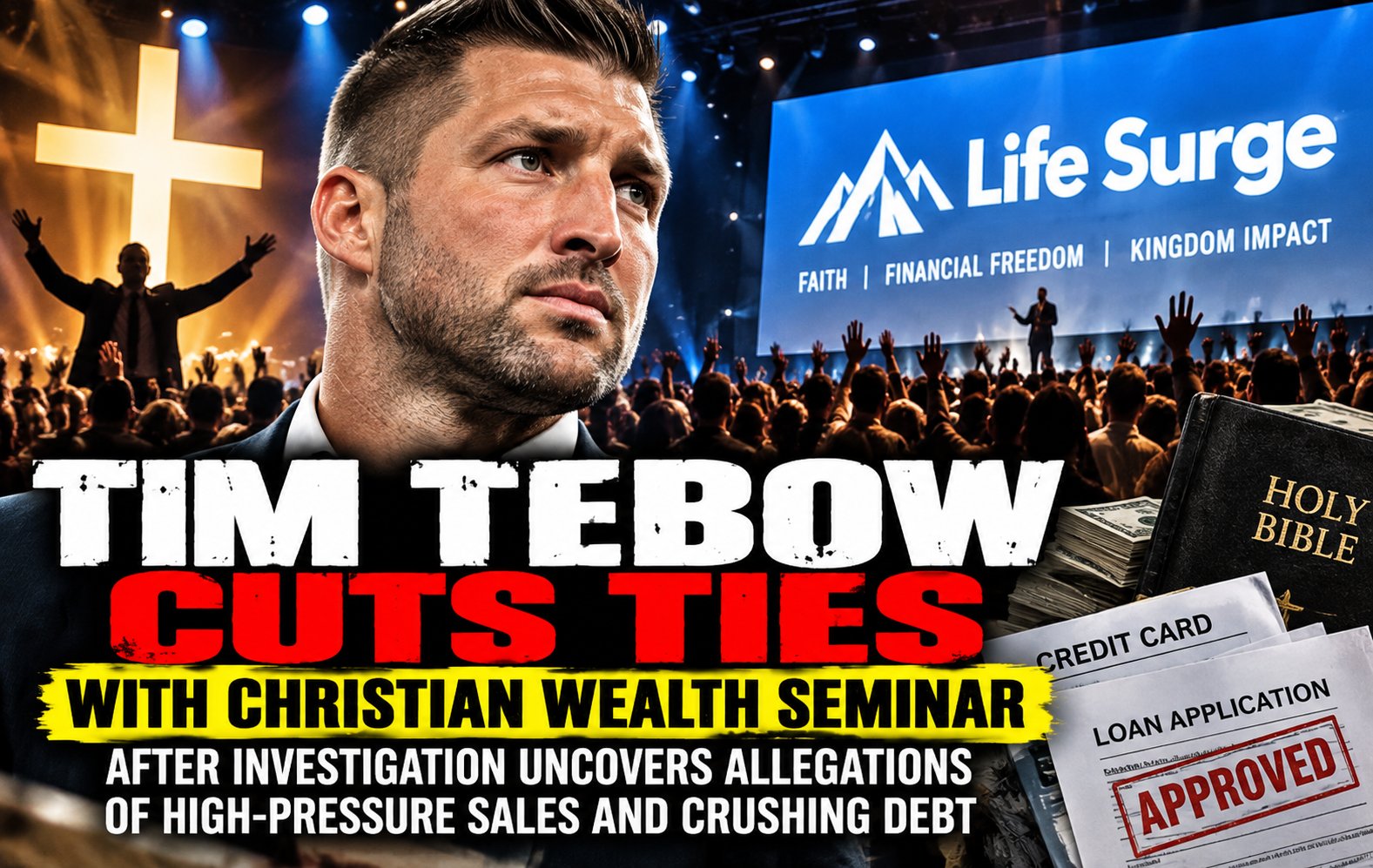
Tim Tebow has paused his relationship with Life Surge, a fast growing Christian events and financial education company, after a months-long investigation by journalist Pablo Torre and Mother Jones reporter Kiera Butler documented allegations that customers were drawn to inexpensive faith centered events featuring trusted celebrities before being funneled toward investment-training programs costing tens of thousands of dollars. Tebow has not been charged with a crime or accused by authorities of operating an illegal scheme, and the investigation does not establish that he designed or managed Life Surge’s financial-education programs. His significance to the controversy instead comes from his prominent and repeated role as a celebrity speaker and from customers who said the former Heisman Trophy winner’s reputation as an outspoken Christian helped make the organization appear trustworthy.
The investigation, published September 24 by Pablo Torre Finds Out and Mother Jones, examined Life Surge’s combination of Christian worship, motivational speaking, celebrity appearances and financial education. Reporters interviewed customers and current and former employees, attended a Life Surge event, obtained consumer complaints submitted to the Federal Trade Commission, and reviewed recordings and company materials describing its programs. Life Surge strongly disputes allegations that it encourages customers to assume debt they cannot afford or improperly exploits people’s religious beliefs, pointing to thousands of favorable reviews and maintaining that enrollment in its educational programs is voluntary.
Following publication of the investigation, Tebow publicly addressed the allegations and announced that he was pausing his relationship with Life Surge while his representatives investigated the matter. Tebow said he had used the events to discuss his Christian faith and had been caught off guard by the allegations, which he described as “extremely, extremely serious.” His response marked a significant development because the original investigation reported that he had not responded to detailed questions before publication.
From a $20 Christian Event to Investment Courses Costing Tens of Thousands
Life Surge describes its mission as inspiring, training and equipping people to increase their “resources & influence for Kingdom impact.” The company stages large one-day events across the United States featuring Christian speakers, worship music, business personalities and celebrities, and says it hosts more than 100,000 people annually. Life Surge says tickets can generally be purchased for $20 or less and typically provide attendees with a full day of programming featuring a dozen or more speakers and lunch.
During those events, attendees are offered the opportunity to purchase three-day “Impact Classes” for $97 focusing on stock-market or real-estate investing. Those introductory classes can then lead customers into Life Surge’s more advanced SurgeU educational programs, where the financial commitment becomes dramatically larger. The investigation reported packages ranging from roughly $10,000 to $40,000, while subsequent coverage has described some offerings reaching approximately $50,000 depending on the program. Life Surge says participation at every stage is voluntary, that only a small percentage of event attendees ultimately purchase advanced education and that the introductory programs are designed to provide foundational investment knowledge rather than promises of easy wealth.
Life Surge has also emphasized that investing inherently involves risk and that financial outcomes are never guaranteed. In its detailed response to the investigation, the company said it rejects prosperity-gospel teachings that equate faith with guaranteed financial success and instead promotes what it describes as biblical stewardship.
Customers Describe High-Pressure Sales Tactics and Debt
The investigation found a stark divide between many enthusiastic customers and others who say their experience left them deeply disappointed or financially damaged. Life Surge points to thousands of positive customer reviews as evidence of widespread satisfaction, while Torre and Butler uncovered a substantially different body of complaints from customers who described pressure to make expensive financial commitments.
The reporters obtained 49 complaints submitted to the Federal Trade Commission involving Life Surge, according to their investigation, while also examining Better Business Bureau complaints and interviewing customers and current or former employees. One FTC complaint came from a disabled person living on limited income who specifically cited Tebow’s involvement as one reason the organization initially appeared trustworthy, writing that seeing prominent Christians associated with the company influenced her confidence in it.
The existence of an FTC complaint does not mean the agency has determined that the allegations contained in it are true. Consumer complaints are reports submitted to the government and are not equivalent to enforcement findings, criminal charges or civil judgments. As of publication, the reporting did not establish that the FTC had brought an enforcement action against Life Surge based on the allegations documented by Torre and Butler.
Other customers described being encouraged to obtain financing to pay for expensive educational programs or to provide capital for investing. Former attendees told the reporters about using credit cards, home equity and other borrowing after entering the company’s educational pipeline, while the investigation also described allegations involving retirement funds. Life Surge denies that it trains representatives to pressure people into borrowing money they cannot afford to repay and says decisions involving third-party financing are ultimately between customers and lenders.
One Couple Says a $20,000 Course Led to Much More Debt
One of the investigation’s most detailed accounts came from Cathy Luebke, who attended a Life Surge event with her husband in Carmel, Indiana, in 2024. Luebke said a stock market demonstration made the investment strategy being presented appear accessible enough that the couple decided to attend the $97 three-day program. During the secondary event, she recalled counselors encouraging attendees to purchase additional courses while special pricing remained available, and the couple ultimately purchased approximately $20,000 in investment education.
Luebke told Mother Jones that after speaking with a financial counselor at the event, she and her husband borrowed approximately $40,000 using promotional interest free credit cards so they would also have money available to invest. She recalled being told they could potentially repay the debt within a year through trading. The couple did not make money in the stock market, she said, and when promotional credit card periods expired and interest rates climbed to approximately 29 percent, they ultimately used a home-equity loan to address the remaining credit-card balance.
Their experience represents one customer’s account rather than a finding about typical Life Surge results. Life Surge maintains that investment outcomes vary substantially and says customers are warned that they could make little or no money and could lose money. The investigation also reported that investment risk disclaimers were displayed during the event Butler attended, although she questioned how prominently some of those warnings were presented.
Another Customer Says She Used Home Equity to Pay for SurgeU
Karen Neal, a 61-year-old former Life Surge customer interviewed by Mother Jones, described a similar experience. Neal said she was encouraged to use equity in her home to pay for a SurgeU real estate training package costing approximately $13,000. She and her husband ultimately did not make money investing in real estate, she said, and continued using a home-equity line of credit while dealing with debt associated with the program. Neal said Life Surge later offered her a partial refund of approximately $5,000 after she complained.
Neal acknowledged that she should have researched the program more carefully before purchasing it, but said her broader concern was the pressure she felt to make a major financial decision without taking sufficient time to consider it. That allegation became a recurring theme in the investigation. One former attendee told Mother Jones that a counselor attributed her hesitation about purchasing investment courses to the devil, an allegation Life Surge rejected. The company said using a person’s religious faith, fear or spiritual beliefs to pressure that person into purchasing a product would violate its policies.
Employees Raised Concerns About Mixing Faith With Financial Sales
Current and former Life Surge employees interviewed for the investigation described instances in which staff members allegedly oversold the simplicity of the company’s investment programs or invoked Christianity while encouraging customers to enroll. One employee questioned whether celebrity speakers understood what could happen farther down the company’s sales pipeline and described concerns involving customers considering retirement savings or credit to finance expensive courses.
Life Surge says such conduct is contrary to its policies. That distinction is important: the investigation documents allegations concerning the behavior of employees and sales representatives, but those allegations do not by themselves establish that Life Surge formally instructed employees to pressure financially vulnerable customers or exploit their religious beliefs. The company says it does not train representatives to pressure customers into borrowing money they cannot afford to repay and does not condone using faith as a sales weapon.
Tebow’s Role Is More Complicated Than Simply Being a Guest Speaker
Tebow’s involvement is one of the investigation’s most significant elements because Life Surge says its celebrity headliners are not hired to endorse its investment programs. The company maintains that Tebow’s compensation was not connected to sales of classes or educational products and that headline speakers are invited to discuss their personal stories, faith and experiences rather than sell advanced financial training.
However, the investigation obtained a recording from a 2023 Life Surge event in which Tebow addressed people who had enrolled in classes and encouraged them to complete their commitment. “I want to encourage you to finish that, to follow through on that commitment, to finish strong,” Tebow said, according to the recording obtained by the reporters. That statement does not establish that Tebow knew about any alleged high pressure sales tactics occurring elsewhere in the organization. It does, however, complicate a characterization of him as entirely disconnected from Life Surge’s educational offerings because he directly encouraged attendees who had already enrolled in classes to follow through.
Tebow’s speeches also fit naturally within Life Surge’s broader Christian message. At the event attended by Butler, Tebow spoke about his faith, following God’s purpose and responding to a calling. By the time he appeared near the end of the event, the investigation reported that many attendees in Butler’s section had already enrolled in the $97 Impact Classes.
How Much Was Tebow Paid?
The investigation also examined the financial value of celebrity speakers to Life Surge’s business model. Life Surge declined to disclose Tebow’s compensation, citing contractual obligations, and emphasized that whatever he was paid was not tied to sales of educational products. Public reports following the investigation have cited estimated appearance fees of approximately $50,000 to $100,000 per engagement. The original investigation used third party speaker fee estimates and Tebow’s frequency of appearances to estimate that his compensation from Life Surge could have reached into the millions of dollars. Those figures are estimates, not confirmed disclosures of Tebow’s actual compensation, and should not be presented as established payments from Life Surge.
The investigation reported that Tebow appeared at numerous Life Surge events during 2024 and 2025 and was scheduled for an expanded slate in 2026. Life Surge has also featured numerous other prominent athletes, entertainers, pastors, financial educators and motivational speakers over the years, illustrating the central role recognizable public figures play in attracting audiences to its events.
Why Tebow’s Reputation Matters
Tebow’s involvement carries unusual weight because his public identity has been closely associated with Christianity for nearly two decades. His expressions of faith became nationally famous during his football career, and he subsequently built a substantial charitable operation through the Tim Tebow Foundation, including work involving vulnerable children, people with special needs and efforts against human trafficking. That reputation is precisely why complaints naming him are relevant to the controversy. Some customers described prominent Christian figures as a source of credibility that lowered their skepticism toward Life Surge. For those attendees, the reasoning was not simply that a famous athlete had been hired to speak; it was that recognizable Christians whom they trusted were appearing onstage at a company explicitly presenting itself as a Christian organization.
That creates a broader question for celebrities lending their names and reputations to businesses selling financial education: How much responsibility does a celebrity speaker have to understand what customers are being sold after the celebrity leaves the stage? The investigation does not establish that Tebow knew customers were allegedly being pressured into substantial debt, but it does document customers saying his presence influenced their decision to trust the organization.
Life Surge Says the Investigation Misrepresents Its Business
Life Surge issued an extensive response defending its practices and disputing the implication that its business depends on financially exploiting Christians. The company says enrollment is voluntary, investment risks are disclosed and customers are never guaranteed financial success. It says only a small percentage of ticket purchasers ultimately enroll in advanced training, argues that its programs provide legitimate educational value and points to overwhelmingly positive customer reviews.
Life Surge also says it works with third party financing companies to provide additional payment options but does not receive compensation based on whether customers choose financing. According to the company, borrowing decisions remain between students and lenders. The company further maintains that it does not ask celebrity speakers to endorse Impact Classes or SurgeU programs and that Tebow’s compensation was not tied to educational sales.
Life Surge’s position therefore differs fundamentally from the picture presented by its critics. The company portrays itself as a Christian educational organization offering optional investment training to adults who knowingly choose whether to participate. Dissatisfied customers and former employees interviewed by the reporters describe an environment in which religious trust, urgency and sophisticated sales techniques sometimes combined to push people toward financial commitments they later regretted.
Life Surge’s Founder Has a Longer History in the Seminar Business
The investigation also examined Life Surge founder Joe Johnson’s history in the motivational seminar and financial education industries. Johnson previously became involved with Get Motivated, another seminar business combining celebrity speakers with financial and investment education. The investigation examined a historical financial dispute involving Amy Wolfe, who helped finance Johnson’s acquisition of Get Motivated. Life Surge’s response said subsequent litigation was settled, that Johnson satisfied the approximately $1 million personal guarantee he had provided, and that Wolfe and Johnson have since reconciled.
Life Surge disputes the implication that it is simply a continuation or rebranding of Get Motivated. The company says Life Surge was developed years later by a broader team around an explicitly Christian mission and was not an evolution of the previous business. The investigation nevertheless identified similarities in the general approach: inexpensive large scale motivational events featuring recognizable speakers followed by opportunities to purchase investment education.
The reporting also examined Johnson’s involvement with Welfont Group and federal litigation concerning charitable real-estate “bargain sale” transactions. Life Surge’s response says the matter was resolved in 2026 with no monetary damages or civil penalties and no admission of wrongdoing by Johnson, although he agreed to restrictions on future participation in the specific transactions at issue. Life Surge itself was not a defendant in that case. The litigation therefore provides background on Johnson’s business history but does not establish wrongdoing by Life Surge.
A Previous FTC Case Provides Context, but Not a Case Against Life Surge
Another portion of the investigation requires an important distinction. Some Life Surge executives previously worked for Online Trading Academy, a financial-education company sued by the Federal Trade Commission in 2020 over allegedly deceptive claims about customers’ ability to generate investment income.
The FTC alleged that Online Trading Academy used false or unsupported earnings claims to sell training programs costing as much as $50,000 and that many customers made little or no money. The case ultimately produced a settlement requiring Online Trading Academy to offer debt forgiveness to thousands of consumers while its founder and other individuals agreed to turn over millions of dollars and assets. In 2021, the FTC announced more than $5.4 million in refunds to over 31,000 consumers and said more than $13 million in consumer debt had been forgiven.
However, Life Surge was not the defendant in the Online Trading Academy case, and the Life Surge personnel discussed in the current investigation were not defendants in the FTC action simply by virtue of having previously worked there. The connection is relevant background concerning experience within the investment education industry, but presenting the FTC’s enforcement action against Online Trading Academy as an enforcement action against Life Surge would be inaccurate.
FTC Complaints Against Life Surge Are Allegations, Not Government Findings
The same distinction applies to the 49 FTC complaints that the investigation says it obtained concerning Life Surge. A consumer complaint submitted to the FTC is not a government determination that misconduct occurred. Consumers can report suspected fraud, deceptive practices and other problems to the agency, which can use complaint information when determining whether further investigation or enforcement may be appropriate.
The complaints uncovered by Torre and Butler are therefore relevant evidence of customer allegations and potential patterns worthy of scrutiny, but they should not be characterized as federal findings against Life Surge. As of publication, the available reporting does not establish that the FTC has brought an enforcement action against Life Surge based on those allegations.
Tebow Says He Was Caught Off Guard and Is Stepping Back
The controversy took a significant turn after publication when Tebow addressed the allegations publicly. Speaking Friday while in Gainesville with ESPN’s SEC Nation, Tebow said his purpose in appearing at Life Surge events had been to share his Christian faith and indicated that he had learned about the investigation only recently. He said his team informed him about the reporting while he was traveling after attending an anti-human trafficking conference and described himself as caught off guard.
Tebow characterized the allegations as “extremely, extremely serious” and said his representatives would investigate them before deciding what comes next. He also confirmed that he was pausing his relationship with Life Surge while his team attempted to understand the facts.
That response matters because the original investigation reported that Tebow had not responded to requests for comment before publication. His subsequent decision to step back does not constitute an admission that the allegations are true, but it demonstrates that he and his representatives are now conducting their own review of a company whose events he repeatedly helped headline.
The Bigger Question Is What Celebrity Trust Is Worth
The controversy ultimately extends beyond Tim Tebow. Life Surge’s business model illustrates the enormous commercial value of trust: a low cost ticket places thousands of people in an arena with celebrities, worship music, motivational speakers and explicitly Christian messaging; a $97 educational program provides an inexpensive next step; and a much smaller percentage of customers then enter advanced programs potentially costing tens of thousands of dollars.
There is nothing inherently improper about that progression. Companies routinely use inexpensive introductory products to market more expensive services, celebrities routinely receive speaking fees, and adults are free to purchase financial education. The journalistic issue arises from what some customers and former employees say happened inside that progression: religious credibility allegedly becoming intertwined with urgency, high pressure sales and substantial borrowing.
Life Surge says that is not how its representatives are trained to behave and points to thousands of satisfied customers as evidence that the allegations do not represent the broader experience. The customers interviewed by Mother Jones and Pablo Torre Finds Out tell a markedly different story, including people who say they left the company’s programs carrying significant debt.
Tebow’s decision to pause his relationship with Life Surge does not establish that the company committed fraud, nor does it establish that Tebow knowingly participated in improper sales practices. It does, however, put renewed scrutiny on the responsibilities that accompany celebrity endorsement and association, particularly when a public figure’s reputation and religious identity can provide a powerful layer of credibility to a business selling expensive financial products.
The unanswered question is no longer simply whether Life Surge’s investment courses provide value. It is whether one of the country’s most recognizable Christian public figures was being used, knowingly or unknowingly, to create a level of trust that helped move some customers from inexpensive faith-based events into financial commitments worth tens of thousands of dollars. That question is now likely to follow both Life Surge and the celebrities who appeared on its stages as Tebow’s own team investigates what happened.

Sources & Further Reading
- Mother Jones — Kiera Butler, “The Gospel of High Yields: Inside Tim Tebow’s Favorite Wealth Seminar,” September 24, 2026. Read the Mother Jones investigation
- Pablo Torre Finds Out — “Tim Tebow’s Kingdom Impact,” including the complete response submitted on behalf of Life Surge. Read and watch the investigation
- Acast / Pablo Torre Finds Out — Full episode and reporting credits, including Kiera Butler, Byard Duncan and Thomas Darro. Listen to the full episode
- WRUF — Tebow’s September 25 response and announcement that he was pausing his Life Surge relationship. Read WRUF’s report
- Yahoo Sports — Additional reporting on Tebow’s response following publication of the investigation. Read Yahoo Sports’ report
- Federal Trade Commission — 2020 Online Trading Academy settlement and debt-forgiveness requirements. Read the FTC release
- Federal Trade Commission — 2021 refunds to more than 31,000 Online Trading Academy consumers. Read the FTC refund announcement
- Pablo Torre Finds Out — Life Surge’s full response disputing allegations concerning pricing, financing, religious pressure, Joe Johnson’s business history and company practices. Read Life Surge’s response







































































Want to join the conversation?
Create an account or sign in to share your thoughts, vote,
and reply to other readers.
Showing 0 of 0 comments
Don't have an account?
Already have an account?