
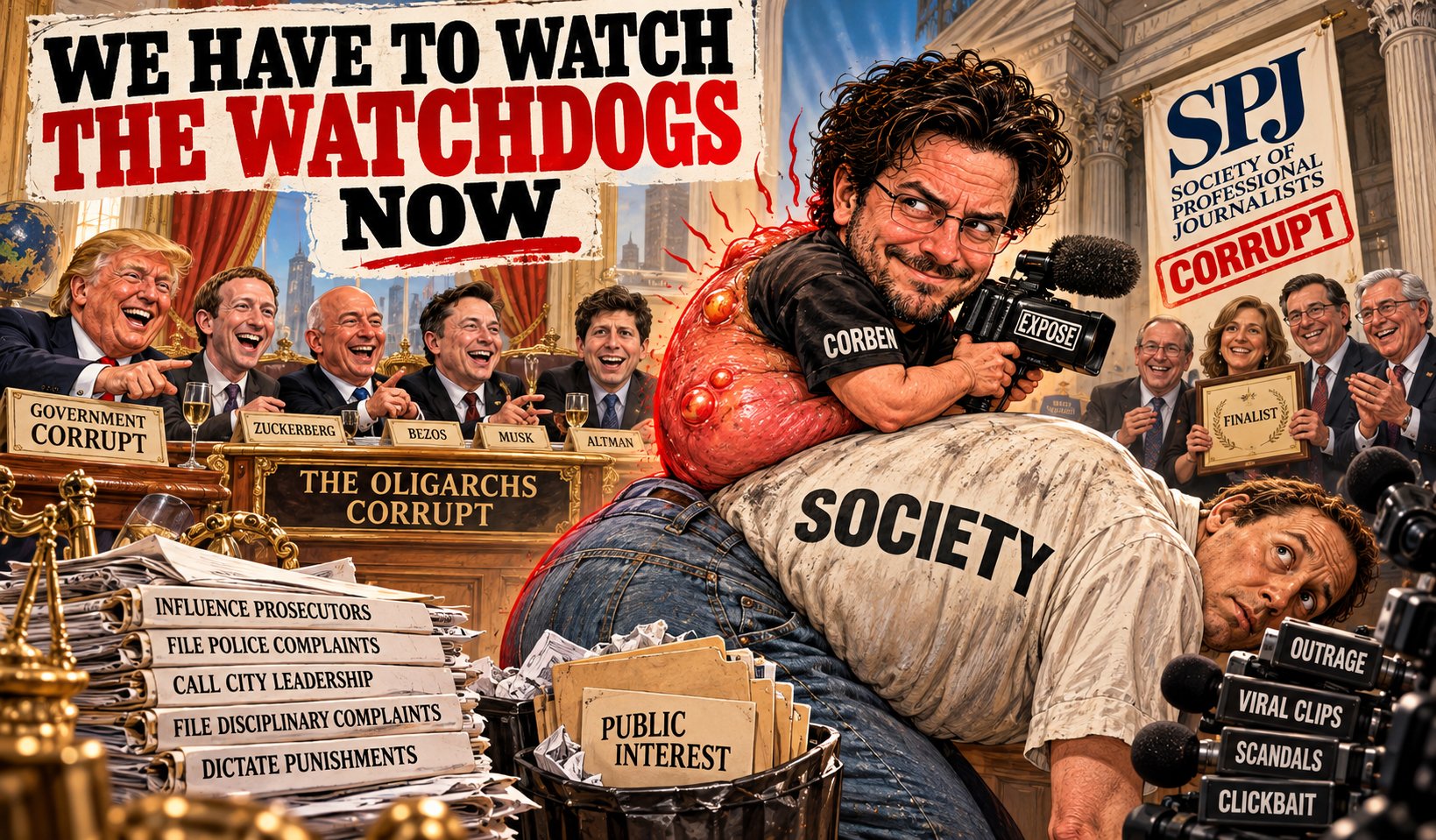
Billy Corben and the Business of Prepared Intentional Political Provocation
Billy Corben may be a puss filled boil on the ass of Miami politics, and Miami politics may deserve the boil. This is a city with enough documented corruption, patronage, questionable spending, government dysfunction and spectacular political personalities to keep aggressive watchdogs employed indefinitely. Someone should sit through interminable government meetings, understand Florida’s open government laws, request records politicians would rather nobody see, confront public officials with uncomfortable facts and refuse to turn off the camera simply because someone in power doesn’t like being recorded. Sometimes democracy needs an asshole, and Corben has enthusiastically volunteered for the position.
The filmmaker behind “Cocaine Cowboys,” “The U” and “537 Votes” has spent recent years developing a second career as one of Miami City Hall’s loudest and most recognizable antagonists. His #BecauseMiami operation occupies an unusual space between journalism, activism, political commentary, entertainment and social media combat. Corben can take controversies that might otherwise remain buried in meeting agendas, public records or newspaper articles and translate them into something perfectly engineered for the modern internet: a villain, a camera, an argument, a joke, and a share button. There is genuine civic value in that ability, particularly at a time when traditional local journalism is struggling to reach audiences outside its shrinking subscriber base.
The problem begins when the boil starts creating some of the inflammation it subsequently points to as evidence of disease. There is an enormous difference between exposing political dysfunction and becoming an active participant in producing the dysfunction being documented, and that distinction has become increasingly difficult to ignore around Corben. In roughly 15 months, two separate confrontations involving Corben recording people at Miami government meetings resulted in someone making physical contact with him or his phone, Corben pursuing the incident through law enforcement, and prosecutors eventually filing misdemeanor battery charges. One case ended with a 67 year old woman publicly apologizing to Corben at Miami City Hall. The second now has a government board member facing criminal prosecution while Corben asks city leadership what additional consequences will follow.
Nobody gets permission to commit battery because Billy Corben annoys them. That point should remain absolutely clear. But journalism should not begin examining a confrontation at the precise second somebody finally loses his temper. It should examine what happened before the contact, what role every participant played, what happened afterward and whether the person holding the camera was simply documenting an event or had become part of creating it.
Bayfront Park Is the Case Miami Should Be Examining Right Now
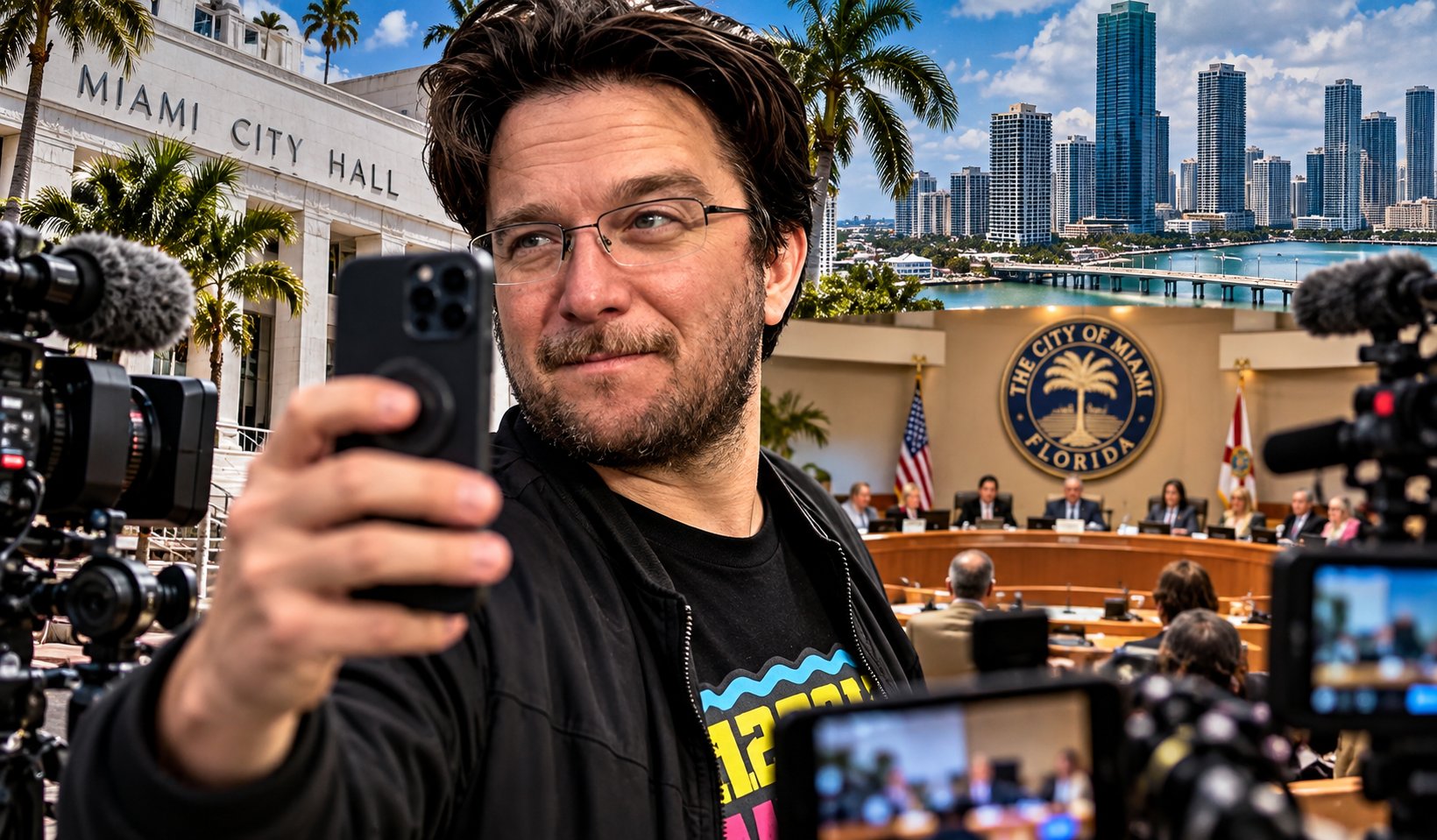
On August 13, 2026, the Bayfront Park Management Trust convened an emergency meeting at 301 Biscayne Boulevard following the resignation of Executive Director Raúl Miró. There were legitimate reasons for journalists and residents to scrutinize the agency. The Trust manages some of Miami’s most valuable public parkland, including Bayfront Park and Maurice A. Ferré Park, and had been embroiled in controversies involving management, spending, political relationships and the long running agreement surrounding Ultra Music Festival. Residents arrived with questions about the Trust’s leadership and direction. Corben had every legitimate reason to attend, observe and record what happened.
Instead, the meeting itself rapidly became the story. Corben stood in the audience recording with his cellphone and panned his camera across people in the gallery. Mariela Gabela, wife of Miami Commissioner Miguel Angel Gabela, objected to being filmed and began filming Corben herself. Corben continued recording and responded that it was a public meeting, telling her in substance that if she objected to being recorded she could leave. The exchange was legally unremarkable, people generally do not possess an expectation of privacy while participating in an open government meeting, but politically explosive because Corben and the Gabelas were hardly strangers.
By August, Corben had spent months aggressively criticizing Commissioner Gabela, including through a recurring “Gabelas Gone Wild” series and an “Ooga Booga” video portraying the commissioner as a caveman. Earlier that summer, Miami police began investigating a death threat posted by an unrelated commenter beneath one of Corben’s Instagram posts about Gabela. Corben unequivocally condemned the threat as disgusting and rejected Gabela’s accusation that his reporting was responsible for inciting violence. Gabela, meanwhile, publicly accused Corben of twisting facts and provoking him for content, later telling the Miami Herald that Corben “knows how to push people’s buttons.”
That accusation is Gabela’s characterization, not an established fact, but it provides essential context. The people inside the Bayfront Park meeting were not encountering one another for the first time. An existing political feud had moved from social media into a physical room, and Corben’s camera was now pointed toward the commissioner’s wife.
A Cellphone Dispute Becomes a Criminal Case
Carlos Martell, a member of the Bayfront Park Management Trust appointed under Gabela’s chairmanship, crossed the room toward Corben. According to the Miami Police incident report described in local reporting, Martell attempted to grab Corben’s cellphone. When Corben pulled the phone away, Martell allegedly grabbed Corben’s right arm. A city sergeant at arms intervened and pulled Martell away. Commissioner Gabela then became involved, moving toward Corben while angrily demanding that Corben be arrested instead. The confrontation became heated enough that a sergeant at arms physically restrained the commissioner.
The meeting had now veered dramatically away from the public business that brought everyone into the room. Fortunately, nobody was seriously injured. According to the police incident report, Corben reported no injuries, displayed no visible signs of injury and declined medical assistance. That does not mean no battery occurred. Florida’s battery statute does not require a bruise, broken bone or trip to the emergency room; intentional unwanted touching can be sufficient. Martell nevertheless remains presumed innocent, and prosecutors bear the burden of proving the criminal allegation against him.
There is also an important piece of evidence that cuts against the most aggressive interpretation of Corben’s conduct. The Miami Herald reviewed the official Bayfront Park Management Trust recording from a camera positioned elsewhere in the room and reported that Corben could be seen grinning while filming but remained generally in one area and did not appear to be creating an obvious physical disruption before Martell approached. In other words, the available evidence does not justify claiming that Corben physically chased Martell, cornered him or forced him into contact. Martell walked toward Corben, and Martell owns that decision.
Corben’s own footage, however, provides additional context about the atmosphere immediately preceding the confrontation. He had been recording people in the gallery, including a woman who objected, and responded by asserting his right to film the public meeting. The exchange apparently angered Martell. That brings the story closer to the real ethical question, because the allegation worth investigating is not that Corben physically forced anyone to touch him. It is whether antagonistic but lawful behavior has become part of a repeatable media strategy in which someone else’s eventual emotional or physical reaction becomes more valuable than whatever government business originally brought Corben into the room.
The Prepared Provocation and Entrapment Problem
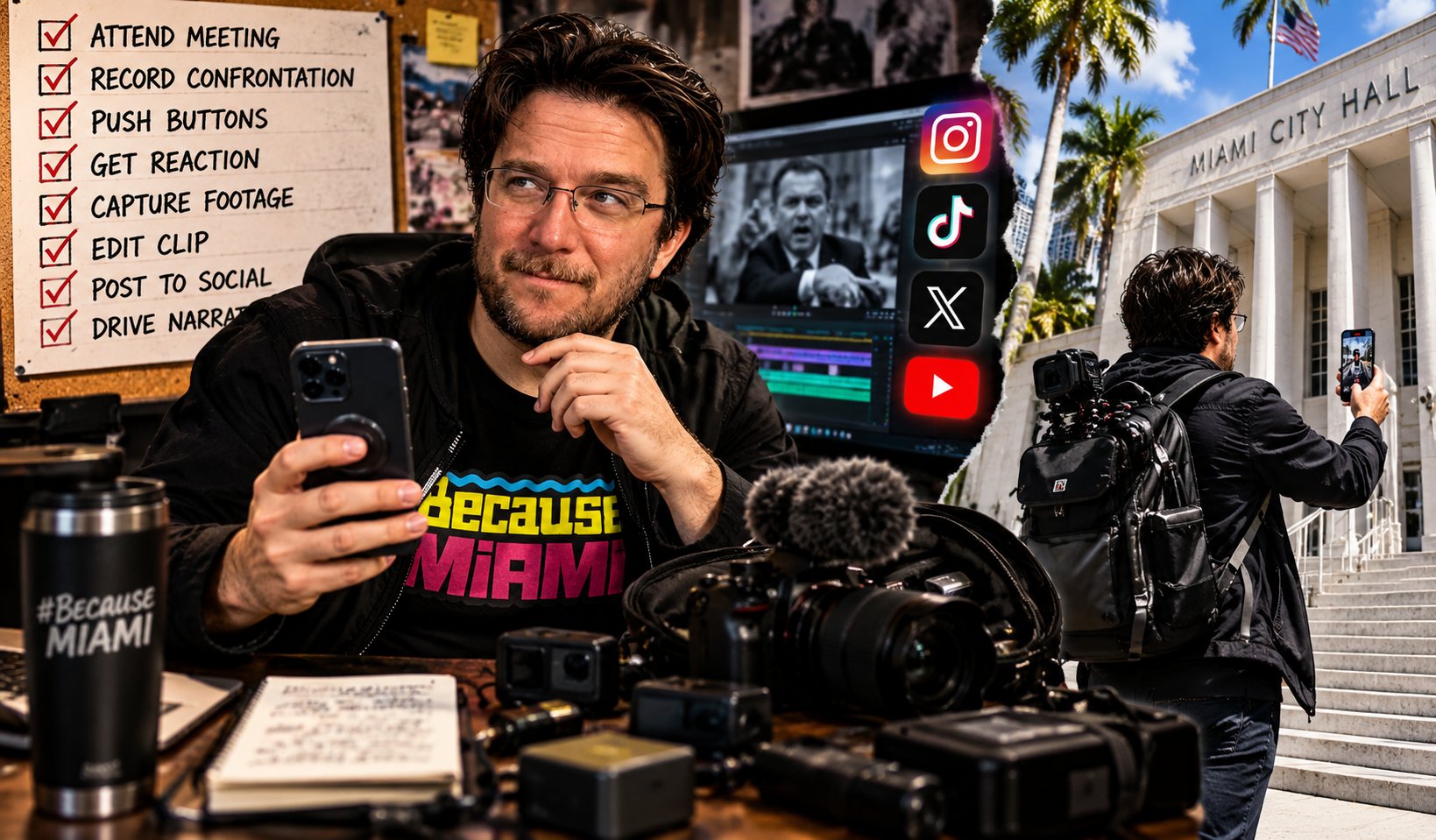
There is a useful term for examining that phenomenon: prepared provocation. One participant enters an encounter already understanding the game. The camera is running, the audience exists and the legal boundaries are understood. The participant knows political confrontation, social media, editing and the difference between behavior that is merely obnoxious and behavior that creates criminal exposure. He knows that yelling is not battery, ridicule is not battery and recording is not battery. Most importantly, he understands that if he remains physically controlled while somebody else loses control, the resulting footage will almost inevitably favor him.
The person standing on the opposite side of the camera may possess none of those advantages. An unpaid appointee, political spouse, neighborhood activist, or elderly resident may be reacting in real time while Corben is operating inside a media environment he has spent decades mastering. That does not transfer responsibility for their conduct onto him. Adults remain responsible for what they do. But it creates an extraordinary asymmetry that journalism should acknowledge rather than hide behind the simplistic observation that the camera was legally permitted.
The difference is fundamental. A conventional watchdog attempts to discover what government is already doing. A provocateur can become interested in discovering what government, or the people surrounding it, will do when provoked by the provocateur. In the first model, the journalist observes the experiment. In the second, he introduces a variable into it. Once the journalist’s own behavior materially changes the event, his conduct becomes part of the story.
Corben Was Not an Invisible Observer
That distinction becomes particularly important at Bayfront Park because Mariela Gabela was not Commissioner Gabela. She was his wife. Corben has argued that Mariela’s involvement around her husband’s political activities makes her legitimately newsworthy, describing her in one #BecauseMiami discussion as effectively a “quasi public official” because of her presence at meetings, interactions with staff and involvement around the commissioner’s office. If records establish that she participates materially in government business, that is plainly reportable.
But there is still a difference between investigating a spouse’s governmental influence and using the spouse as an emotional pressure point in an existing political feud. That is why “I have the right to record” cannot end the ethical discussion. Journalistic ethics has always required decisions beyond the legal minimum: Why is this person being filmed? What public interest information is being obtained? Is the intensity of the confrontation proportionate to that public interest? Is the reporter attempting to obtain information, or has the person’s reaction itself become the desired material?
Those questions are especially important because Corben was not merely recording political conflict that would have occurred exactly the same way without him. Remove Corben from the specific Mann and Martell encounters and those particular physical confrontations disappear with him. That does not mean Corben caused either person’s alleged misconduct. It means he was a participant rather than an invisible observer, and participants are legitimate subjects of journalistic scrutiny too.
What Happened After Bayfront Park Matters Almost as Much as What Happened Inside It
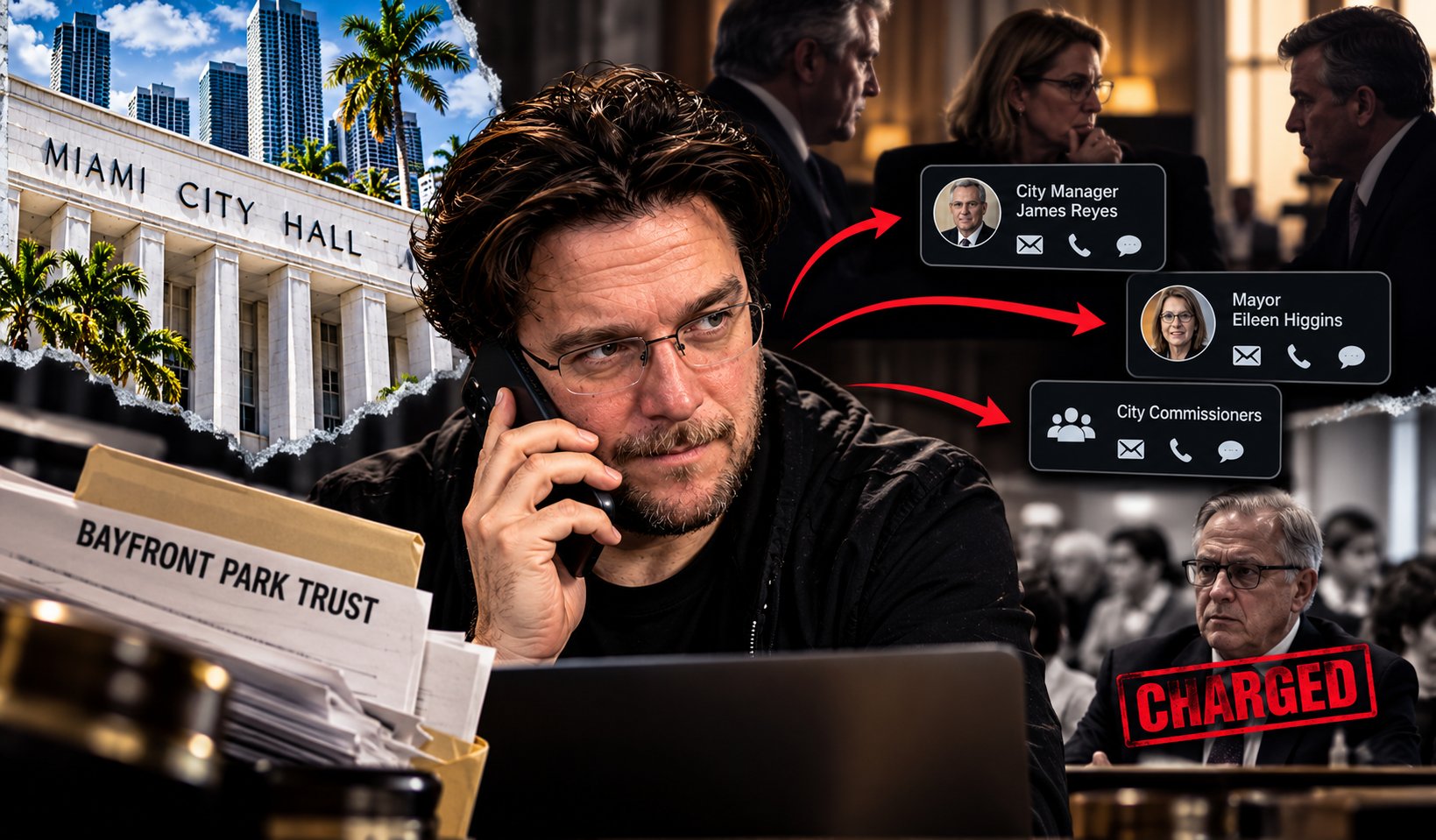
Police and security were present at Bayfront Park, but Martell was not arrested at the meeting. Corben made a complaint, and a Miami Police Assaults Unit detective subsequently interviewed him and a witness. Investigators reviewed Corben’s footage, which an officer described as consistent with his account, although the alleged grabbing of Corben’s arm itself was not visible on that recording. Investigators also noted the possible existence of additional surveillance footage. Five weeks later, prosecutors charged Martell with misdemeanor battery.
There is nothing inherently suspicious about that sequence. Police routinely document misdemeanor allegations rather than immediately arresting someone, detectives conduct follow up investigations and prosecutors later determine whether charges are supported by the evidence. There is currently no evidence reviewed for this article establishing that Corben improperly influenced the Miami-Dade State Attorney’s Office or caused prosecutors to give him preferential treatment. Suggesting otherwise as an established fact would go beyond the available evidence.
What happened after the charge was filed is nevertheless revealing. Corben contacted Miami City Manager James Reyes, Mayor Eileen Higgins and city commissioners with questions about Martell’s continued service on the Trust. He asked whether Martell remained an active member, whether the city had initiated administrative, legal or ethics reviews, who possessed authority to suspend or remove him, whether Martell had been asked to resign or step aside, and whether the city intended to formally review his status. Corben acknowledged that Martell was presumed innocent and that a charge was not a conviction, but he also described the city’s failure to impose consequences as “outrageous” and expressed concern that Martell might touch him again.
Corben then drew a revealing distinction between Martell and another person who had previously grabbed his phone, Maria “Beba” Sardiña Mann. Corben said he had been willing to “let it slide” with Mann because he believed she had received bad advice and been politically used. Regarding Martell, however, Corben was unequivocal: “This I’m not letting go.” That distinction becomes considerably more important when the full history of the Mann case is examined.
Fifteen Months Earlier, Another Person Reached for the Same Camera
The Martell case becomes considerably more significant when placed beside what happened to Maria “Beba” Sardiña Mann on May 30, 2025. Mann, a longtime political activist and supporter of then Commissioner Joe Carollo, was standing near the public comment area at Miami City Hall and speaking with activist Thomas Kennedy. Corben got out of his seat and approached while recording. Mann initially waved and smiled toward the camera, but the encounter deteriorated. According to reporting on the incident, Mann put her hand into the camera, took Corben’s phone and placed or slammed it onto the dais.
Corben remained physically passive and filed a police complaint. Mann was not immediately arrested. She later argued that Corben had approached her aggressively and moved the phone close to her face, causing her to feel threatened. Her legal team attempted to invoke Florida’s Stand Your Ground framework, but a judge rejected the argument after reviewing the evidence. Prosecutors ultimately charged Mann with misdemeanor battery.
Again, Mann was responsible for her own actions. Feeling irritated, mocked or crowded does not automatically authorize someone to take another person’s phone. But the similarities between the encounters are difficult to ignore. In both cases Corben was recording at a Miami government meeting. In both cases the other person objected to his conduct. In both cases Corben remained physically controlled while the other person crossed the boundary into unwanted physical contact. In both cases police did not make an immediate on scene arrest. In both cases prosecutors later pursued misdemeanor battery charges after being pressured by Corben.
Once can be an incident. Twice is a pattern worth examining.
The Mann Case Raises a Bigger Question About Corben’s Influence
There is, however, another fact in the Mann case that makes the comparison considerably more important. Corben told Miami New Times that he spent approximately six months working with Miami-Dade Chief Assistant State Attorney Stephen Talpins and Assistant State Attorney Jose Rohaidy attempting to resolve the dispute without criminal charges. According to Corben, the resolution he wanted was specific: Mann would return to Miami City Hall, where she had taken his phone, and publicly apologize. When that agreement was not reached, prosecutors ultimately charged her with misdemeanor battery.
On its face, that evidence is favorable to Corben. According to his account, he was not demanding that Mann be arrested, jailed or punished as harshly as possible, he initially wanted an apology instead of prosecution. Fair journalism has to acknowledge that. But his account also raises a much more interesting question about access and influence. Corben says he spent roughly half a year communicating with two prosecutors, including a chief assistant state attorney, about the form of accountability he wanted from another citizen following a confrontation in which he was simultaneously a participant, complainant, political activist and media personality. Crime victims routinely communicate with prosecutors and express preferences about case resolutions, but whether this degree of access and involvement was ordinary can only be established through the records and comparison with similar misdemeanor battery cases.
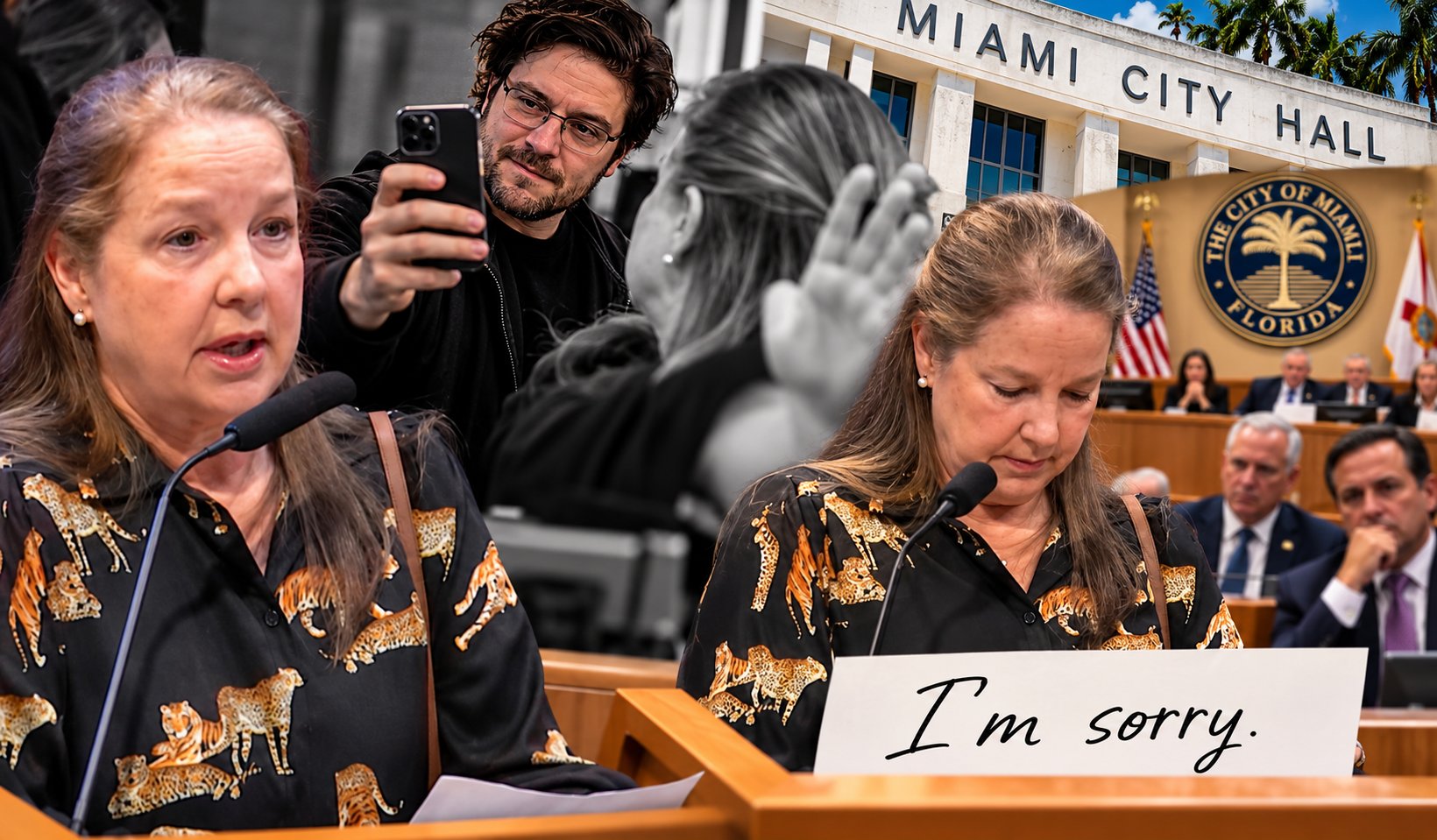
How Would You Feel If a Political Agitator Got Into a Physical Altercation With Your Grandmother, Then Influenced Local Prosecutors to Force Her to Publicly Apologize at City Hall?
The eventual outcome makes that question impossible to ignore. In June 2026, Mann, then 67, returned to the same City Hall where the confrontation occurred and publicly apologized to Corben as part of the resolution of her criminal case. She acknowledged that Corben had been legally recording, that taking his phone was wrong and that her conduct constituted a crime. The resolution also included anger management classes.
In other words, the ultimate disposition substantially resembled the resolution Corben said he had spent months seeking: Mann returned to City Hall and apologized publicly. That does not establish that Corben designed or dictated the plea agreement, but it makes the underlying communications critically relevant. Who originally proposed the City Hall apology? What role did Corben play in negotiating it? How commonly does the Miami-Dade State Attorney’s Office involve senior prosecutors for months in resolving comparable misdemeanor cases through a public apology sought by the complainant?
There is also a media dimension that should not be ignored. A private apology could have resolved a personal grievance. Instead, Mann was returned to the political stage where the controversy began, placed before a City Hall microphone and required to publicly acknowledge her wrongdoing. The original confrontation generated content, the criminal charge extended the story, the court proceedings prolonged it and the public apology delivered a visually compelling finale in the same government chamber where it all began. At some point, the pattern starts making Miami City Hall look less like a government building and more like Billy Corben’s private movie set, complete with recurring characters, confrontations, criminal cases, and carefully documented finales. The confrontation begins in front of a camera, moves through police and prosecutors, and ultimately returns to City Hall for the final scene.
That sequence does not prove Corben engineered Mann’s resolution for its value as content. But Corben says he spent approximately six months working with prosecutors toward an outcome that ultimately looked remarkably similar to the one he originally wanted. When the complainant is also the provocateur, publisher and political personality, and the resolution he sought ultimately becomes the public finale, the communications that produced that outcome become part of the story. The question is no longer simply what Mann did to Corben’s phone. It is how much influence Corben had over what happened to Mann after she did it.
And that is where the Mann and Martell cases finally converge. That progression illustrates the extraordinary number of roles Corben can occupy inside a single story. He can be a participant in the confrontation, the person recording it, the complainant reporting it to police, the source providing evidence to investigators, the publisher distributing it to a large audience, the commentator interpreting the resulting criminal case and the political activist asking government officials to consider additional consequences for the accused. In the Mann case, he says he also spent months communicating with senior prosecutors about the resolution he wanted. Every one of those actions may be perfectly lawful when viewed individually. But the accumulation of roles is still remarkable and stomach turning.
At some point, the question becomes bigger than whether Corben has the legal right to perform each individual role. It becomes a question of how much influence one media personality should exercise over a controversy in which he can simultaneously become participant, provocateur, recorder, complainant, publisher, commentator and advocate for consequences. When the same person can participate in the confrontation, document it, report it to police, communicate with prosecutors, broadcast the resulting case to his audience and then press government officials about what should happen next, his influence over the process is no longer incidental to the story. It is part of the story.
Provocation Has Long Been Part of the Corben Brand
Calling Corben a provocateur is hardly an invention of his political enemies. A 2024 Coconut Grove Spotlight profile described the filmmaker as having developed a “second calling as a City Hall provocateur,” documenting his growing influence around Miami government and the enormous social media reach generated by his confrontations with officials. Corben himself explained that he had grown tired of what he was seeing in Miami government, had time available and possessed an inbox full of tips about perceived injustices, so he started showing up. Even Corben’s production company provides useful historical context. Rakontur’s website reproduces a 2008 Bloomberg Businessweek description of the company’s media philosophy that included the instruction to remain opportunistic and digital and, most memorably, to “provoke and offend.” The description is nearly two decades old and proves nothing about Corben’s intentions toward Martell or Mann, but it establishes that provocation is hardly a foreign concept being unfairly attached to his work. The clearest evidence is not a slogan anyway. It is Corben’s actual participation in political theater.
The Chicken Protest Shows Exactly What Constructive Provocation Can Look Like
In February 2023, activists wearing full body chicken costumes descended on the opening of Miami’s Dogs and Cats Walkway at Maurice A. Ferré Park to ridicule then Commissioner Joe Carollo. The protesters mocked Carollo over what they viewed as misuse of approximately $1 million in public funds and distributed material featuring an old Carollo mugshot. Contemporary reporting established that Corben and activist Thomas Kennedy helped organize and film the demonstration.
Police arrested protester Morgan Gianola, transforming a ridiculous political stunt into a serious First Amendment controversy. Corben loudly challenged the arrest and helped amplify the case. Prosecutors subsequently declined to pursue the charges after body camera footage failed to substantiate important elements of the arrest narrative. Corben had a point. The case demonstrates why political provocation deserves strong constitutional protection. Government can overreact. Police can make questionable arrests. Ridicule is protected political expression, and intentionally testing government’s tolerance for dissent can expose something important about the institution being tested.
But the chicken episode simultaneously establishes that Corben understands the mechanics of political theater. He understands how to stage a provocative protest, attract attention, capture the reaction and then make the government’s response part of the story. That does not make the technique inherently unethical. It means journalists evaluating Corben’s more recent confrontations should not pretend he is merely a passive documentary filmmaker who accidentally keeps finding himself in politically combustible situations.
Provocation Is Not the Ethical Violation, Making the Reaction the Product May Be
Aggressive journalism has always involved confrontation. Investigative reporters corner public officials with evidence. Political cartoonists humiliate powerful people. Civil rights activists intentionally entered spaces where unjust systems would reveal themselves through their response. A reporter does not surrender the protections of journalism merely because the subject becomes angry.
The ethical dividing line is subtler. Provocation can serve journalism when it exposes an existing abuse of power. The problem begins when the reaction itself becomes more important than the underlying public interest issue. If the purpose is exposing misconduct, confrontation serves the reporting. If the purpose becomes producing a confrontation because confrontation generates compelling content, the reporting begins serving the confrontation. That distinction matters enormously in an algorithmic media environment where boring competence is nearly worthless and spectacular dysfunction is extremely valuable.
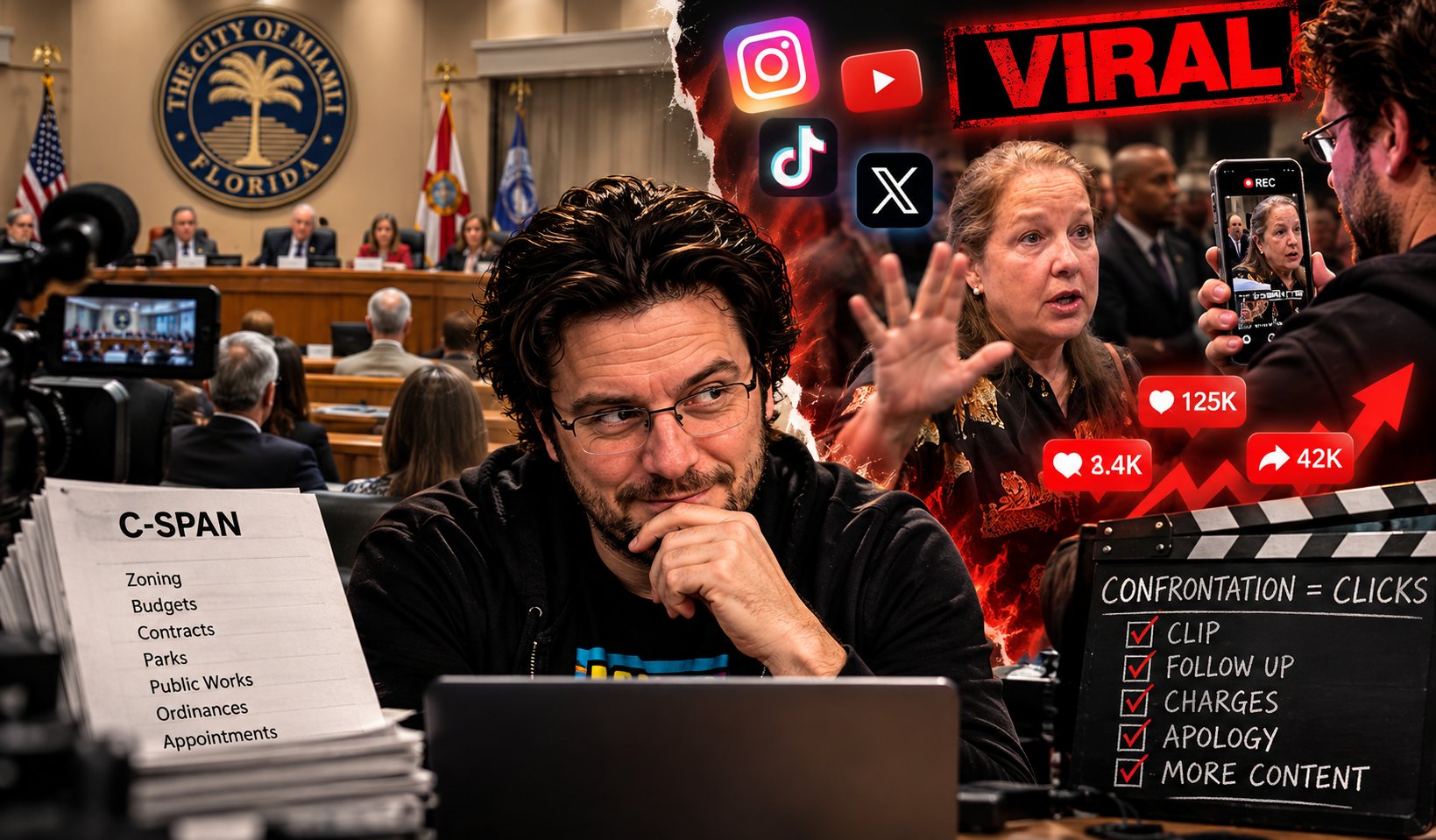
Without the Blowup, There Isn’t Much of a Video, It’s Just C-SPAN
Municipal government is painfully boring, and that is mostly a feature rather than a defect. Government consists of zoning, budgets, procurement, contracts, parks, staffing, public works, ordinances and endless compromises among people who frequently dislike one another. Commissioners amend motions. Lawyers argue about language. Residents wait three hours to speak for two minutes. Advisory boards debate details almost nobody outside the room will ever hear about. Democracy generally looks boring because functioning institutions usually are boring.
An emotional confrontation is different. Someone screaming creates a clip. Someone grabbing a cellphone creates a better one. Security rushing across the room raises the stakes. A police complaint produces a follow up. Criminal charges create another story. A demand for resignation or removal extends the cycle. A court appearance creates another installment. A public apology returns the story to the same government chamber where it began. One ugly encounter can generate an entire content ecosystem.
None of that proves Corben deliberately manufactures these confrontations. It does establish an incentive structure that any serious examination of modern political media has to acknowledge. The algorithm does not reward a journalist for quietly watching a three hour meeting in which everyone behaves professionally. It rewards the moment somebody finally loses control.
The Billy Corben Thin Skin Paradox
Corben’s public persona contains a striking contradiction. The people standing in front of his camera are expected to possess extraordinary emotional discipline. They must tolerate ridicule, hostile questioning, cellphone cameras, memes, recurring video series, nicknames and their worst moments becoming permanently searchable. Political spouses and supporters may become part of the content. Family histories may become part of the content. Whatever happens, the target must remain calm, never touch Corben, never touch the phone and never make a reckless accusation in response.
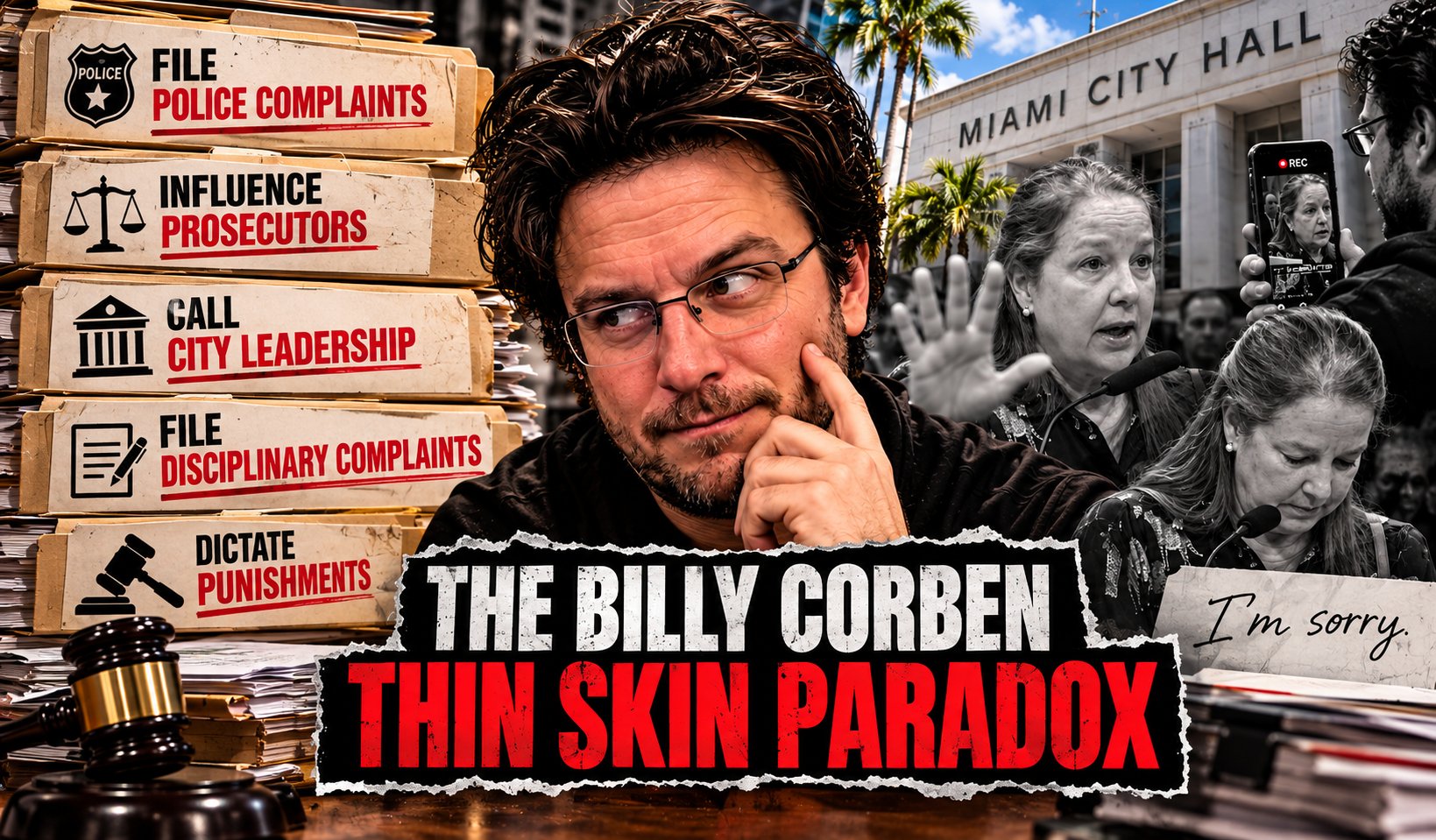
Corben, meanwhile, has demonstrated considerable willingness to invoke formal institutions when somebody crosses a boundary involving him. That is his legal right, but the contrast is impossible to ignore. He has filed police complaints after physical confrontations, interacted with prosecutors regarding criminal cases, contacted city leadership about consequences for an accused board member and filed professional disciplinary complaints against attorneys who made statements about him.
Everyone around Billy Corben is expected to have the thickest skin in Miami, while Billy Corben utilizes every institutional mechanism available when somebody gets underneath his own remarkably thin skin.
Victoria Méndez Shows How Corben Turns Conflict Into Political Theater
The dynamic was visible in Corben’s long running feud with former Miami City Attorney Victoria Méndez. During a City Commission meeting, Corben publicly called Méndez a “mob lawyer” while advocating for her removal. Méndez responded from the dais by calling Corben a “vile little man” and questioning who was paying him to participate in the campaign against her. Corben immediately transformed the insult into content. He appeared at the next meeting wearing a custom “Vile. Little. Man.” shirt, converting an adversary’s attempted insult into branding. It was funny, memorable and extremely effective political theater.
But Corben also filed a Florida Bar complaint against Méndez alleging professional misconduct and accusing her of making false claims about him. Whatever the merits of that complaint, the sequence again illustrates the unusual asymmetry of Corben’s role. He can use some of the harshest rhetoric available against a government lawyer, convert her retaliation into entertainment, and simultaneously invoke the professional disciplinary system when he believes her conduct crosses a line. That isn’t necessarily hypocrisy. The statements and professional obligations involved are different. But it is part of a broader pattern in which Corben’s political conflicts have a remarkable tendency to migrate from heated rhetoric and public confrontation into formal institutional complaints in which Corben recasts himself from provocateur to aggrieved party seeking consequences.
Then Came Monique Pardo Pope
Corben’s dispute with attorney and former Miami Beach Commission candidate Monique Pardo Pope made the pattern even more pronounced. Corben produced content focusing heavily on Pope’s relationship to her father, Manuel Pardo Jr., a former police officer convicted of nine murders and later executed by Florida. Pope was a child when her father’s crimes occurred. She did not commit them, and the ethical question was never whether journalists were legally allowed to identify her father. Once Pope sought elected office, aspects of her biography were legitimately reportable. The more difficult question was how aggressively a journalist should attach a parent’s atrocities to an adult child who did not participate in them.
Pope subsequently made a false statement claiming Corben had lost a defamation lawsuit. He had not. Corben was entitled to demand a correction, and inaccurate allegations about litigation should be corrected. Corben went further, filing a complaint with the Florida Bar and placing the dispute before the professional regulator governing Pope’s law license.
The Bar opened a disciplinary file. Pope’s lawyers argued that the false statement emerged from a campaign communications process involving an erroneous AI generated answer and that she had not intentionally attempted to defame Corben. The Florida Bar ultimately dismissed Corben’s complaint, finding insufficient evidence of a professional conduct violation and insufficient evidence of the intent necessary to establish the misconduct alleged.
The episode is important not because Corben lacked the right to complain. He plainly had that right. It matters because it again demonstrates how aggressively Corben can pursue institutional accountability when an adversary crosses a boundary involving him. In his own written Bar complaint, Corben referenced his prior experience filing attorney misconduct complaints and indicated that he intended to continue documenting what he considered unethical behavior by Florida lawyers attacking him or his journalism.
For someone whose professional identity celebrates provocation, Corben has an unusually expansive view of the formal consequences that should follow when someone provokes him back.
Then the Pope Work Received Highly Questionable Investigative Journalism Recognition
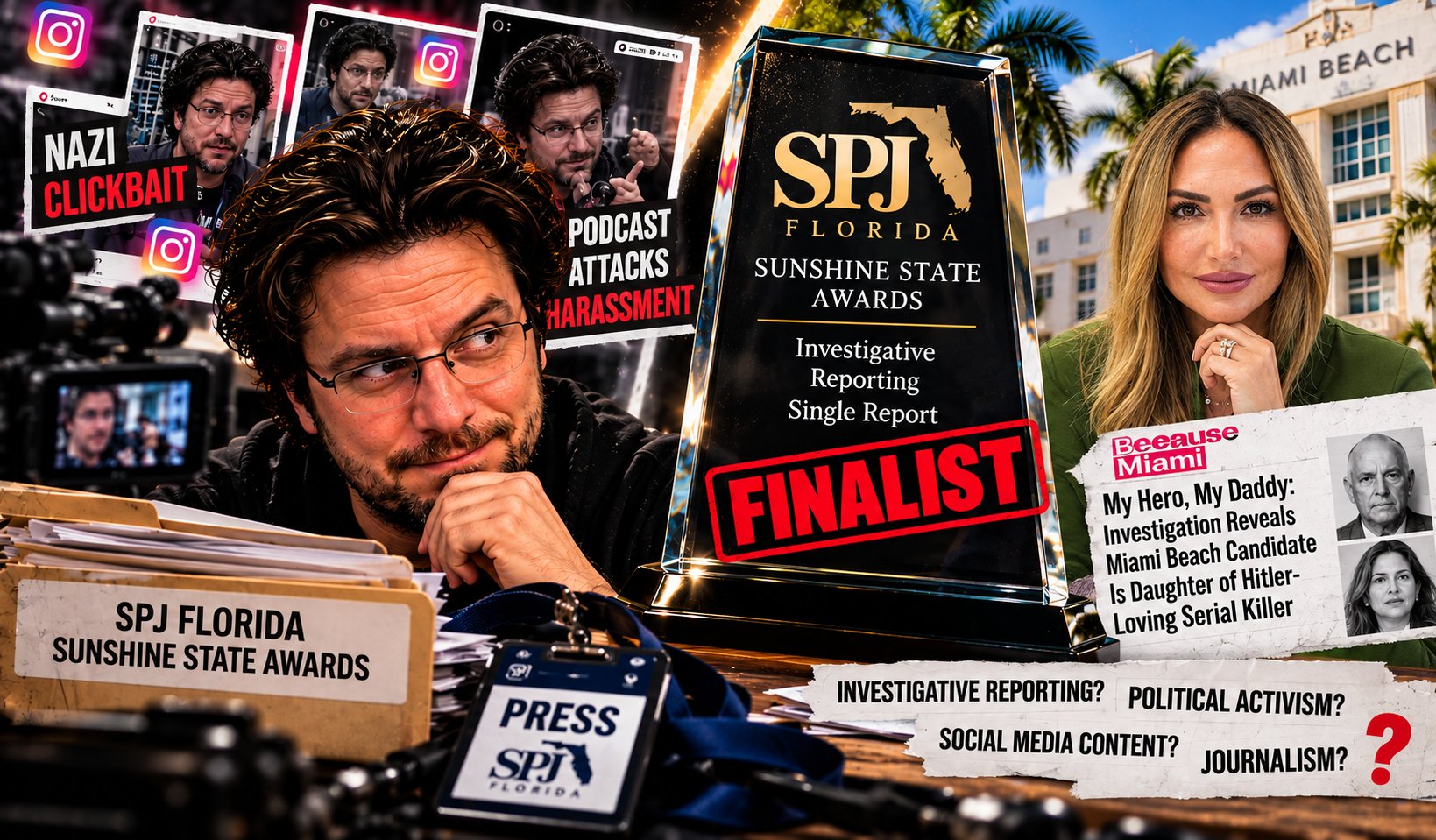
The Pope dispute eventually intersected with professional journalism itself. In 2026, the Florida chapter of the Society of Professional Journalists named Corben’s Pope piece a finalist in its Sunshine State Awards for Investigative Reporting – Single Report. The title was “My Hero, My Daddy: Investigation Reveals Miami Beach Candidate Is Daughter of Hitler Loving Serial Killer.”
Corben did not win the category. But the recognition raises a legitimate institutional question for SPJ about where modern journalism organizations draw the boundary between investigative reporting, political commentary, social media activism, and adversarial content. Those categories increasingly overlap, and Corben may be one of South Florida’s clearest examples of that convergence.
That doesn’t automatically disqualify his work from recognition. It makes methodology more important. If a journalism organization is going to place social media political content alongside traditional investigations, the standards used to evaluate originality, sourcing, proportionality, public interest and the treatment of non offending family members deserve scrutiny too.
Corben Also Fills a Hole Traditional Local Journalism Helped Create
Any serious criticism of Corben has to acknowledge why #BecauseMiami works. Traditional local journalism still performs expensive, indispensable reporting. Newspaper journalists obtain records, cultivate sources, analyze contracts, attend government meetings and uncover information the public would otherwise never know. But much of that reporting now exists behind subscription barriers or inside digital products that struggle to compete with social platforms engineered for instant emotional engagement.
Corben understands distribution better than many traditional news organizations. He can take a complicated municipal controversy and reduce it to an immediately understandable narrative: here is the politician, here is the allegation, here is the document, here is why you should care, here is the joke, and here is the confrontation. Thousands of people who would never open a commission agenda suddenly know something happened at City Hall. That is a real public service.
But amplification and investigation are not synonymous. Taking reporting developed by traditional journalists, translating it for social media and confronting the politicians implicated by it may be useful civic communication, but it is different from originating the reporting itself. As social media personalities increasingly receive traditional journalism recognition, preserving that distinction becomes more important rather than less.
Corben Has Had Real Political Influence, Including Helping the People Who Now Despise Him
Corben’s political influence isn’t imaginary. During Miami’s 2023 municipal elections, he aggressively opposed entrenched political interests and celebrated the victories of Miguel Gabela and Damian Pardo, portraying their wins as defeats for the political machine he had spent years attacking.
The irony is difficult to miss: Gabela, who now accuses Corben of toxic provocation, was once among the reform candidates whose election Corben celebrated. That history gives Corben a legitimate response to some of Gabela’s complaints. Aggressive watchdog journalism often feels admirable when directed at one’s enemies and intolerable when the camera turns around. Politicians do not get to embrace a provocateur while he attacks the other side and suddenly discover journalistic decorum when they become the target. But the reverse principle also applies: a watchdog doesn’t acquire ethical immunity because some of his targets are hypocrites.
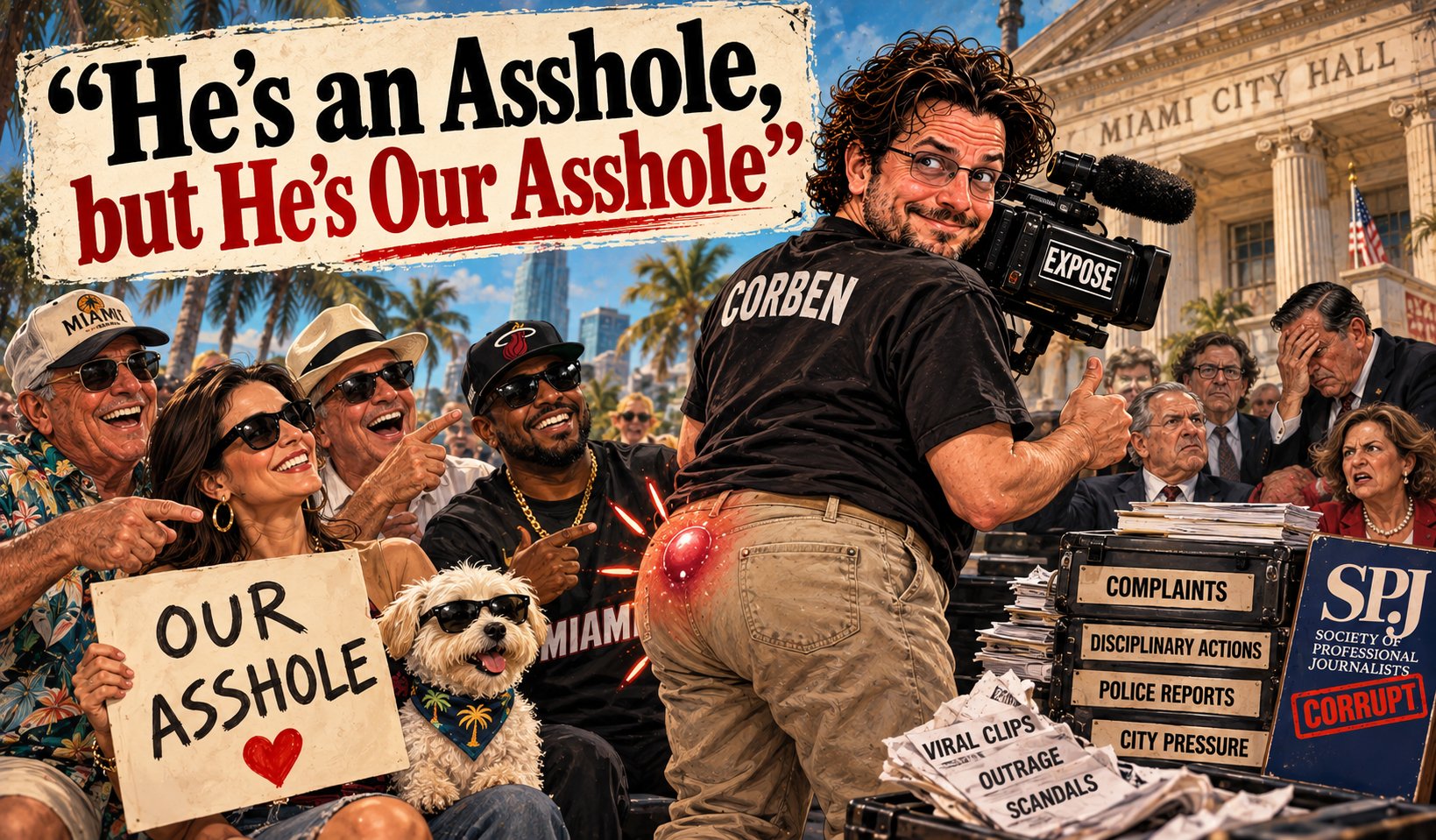
“He’s an Asshole, but He’s Our Asshole”
This may be the simplest explanation for Corben’s unusual place in Miami politics: He’s an asshole, but he’s our asshole.
For people who believe Miami government is chronically corrupt, captured by insiders or incapable of policing itself, Corben offers something traditional political reporting frequently does not: catharsis. He doesn’t merely tell his audience that a politician did something outrageous. He goes to City Hall, looks the politician in the face and tells him himself. He ridicules the people his audience already distrusts, refuses the normal rituals of political deference and turns their anger back on them in a form designed to travel across social media. For supporters, the abrasiveness isn’t a defect in the product. It is part of the product.
They don’t necessarily want a neutral moderator. They want a fighter willing to enter the room on their behalf. They want someone who appears immune to intimidation, comfortable with confrontation and willing to say the impolite thing everyone else is supposedly afraid to say. Every politician who becomes furious with Corben can therefore reinforce the mythology surrounding him: if they’re this angry, he must be over the target. Sometimes that conclusion may even be correct.
The danger begins when loyalty to the watchdog becomes stronger than loyalty to consistent standards. If the politician is considered corrupt, humiliating him becomes acceptable. If the spouse defends him, she becomes part of the story. If an elderly supporter becomes angry, she becomes another antagonist. If an unpaid appointee intervenes, he becomes another villain. Proportionality starts disappearing because the audience isn’t evaluating each interaction independently anymore. It is watching an ongoing battle between “our asshole” and the people it already believes deserve whatever he gives them.
That is where aggressive watchdog journalism can quietly transform into tribal political entertainment. The audience stops asking whether a particular tactic was justified because it has already decided the person using it is on the correct side. And that is precisely why the people who appreciate Corben’s willingness to be an asshole should be among the first people willing to scrutinize how he uses that power.
Government Is the Work of the Possible
One casualty of permanently adversarial political media is understanding what municipal government actually is. Local democracy isn’t Apple unveiling the first iPhone. It isn’t a finished consumer product developed by elite professionals in secrecy and released only after every flaw has been eliminated. It is an imperfect process involving commissioners, professional staff, attorneys, neighborhood activists, business owners, retirees, advisory boards and volunteers attempting to solve complicated problems through group votes.
People compromise. They make concessions. They misunderstand things. They support imperfect proposals because the alternative is worse. They work with people they dislike because tomorrow they may need those people’s votes to repair a park, change a zoning rule, approve a contract or balance a budget. Sometimes that process conceals corruption. Sometimes it reflects incompetence. Sometimes it is simply democracy functioning exactly as democracy functions.
Investigative journalism performs an essential civic role by distinguishing those categories. Outrage media faces a different incentive. Everything becomes more compelling when everything looks corrupt. If every mistake becomes scandal, every compromise becomes betrayal and every political opponent becomes a villain, there is always another episode. That may produce extraordinary engagement. It does not necessarily produce better government.
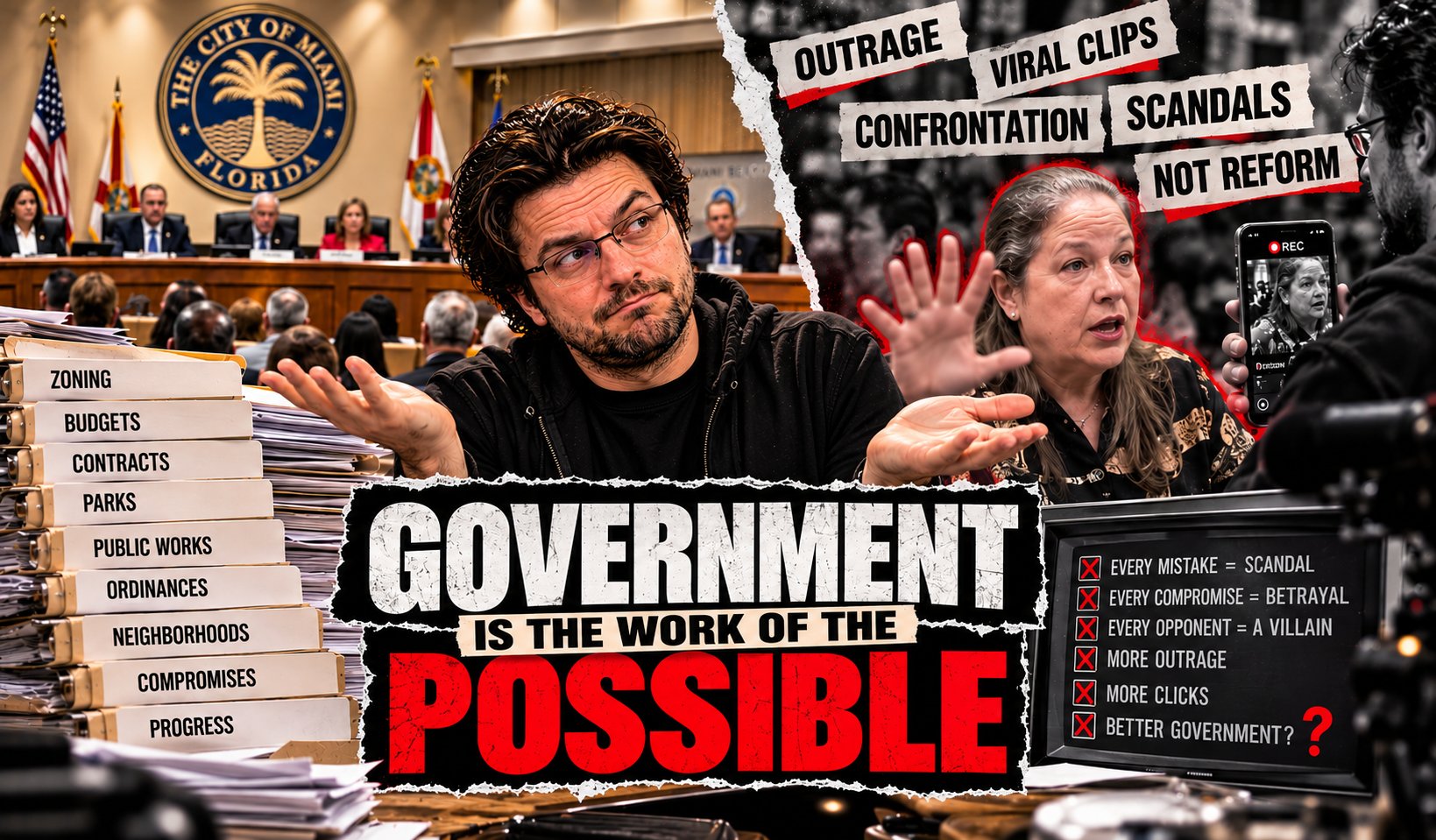
Rage Is Not Reform
There is ultimately a straightforward test worth applying to watchdog journalism: What became better? What corruption ended? What taxpayer money was recovered? What policy changed? What government became more transparent? What structural reform occurred? Who benefited? Those questions don’t invalidate confrontation. Sometimes confrontation produces enormous public value. Sometimes ridicule communicates a truth more effectively than a 5,000 word investigation. Sometimes a camera forces government to behave differently because officials know the public is watching.
But humiliation is not automatically accountability. Provocation isn’t automatically investigation. A misdemeanor prosecution isn’t automatically reform. Removing someone from an unpaid board isn’t automatically reform. A viral video isn’t reform. Destroying someone’s reputation doesn’t automatically improve government. The spectacle and the public interest are not necessarily the same thing.
Maybe Miami Needs a Necessary Asshole Right Now
And that is what makes this story considerably more complicated than “Billy Corben sucks.”
Miami may actually need Billy Corben or at least somebody performing part of his function. The city needs journalists willing to irritate powerful politicians. It needs citizens who understand open government law. It needs people requesting uncomfortable records, challenging insider relationships and refusing to leave merely because public officials wish they would. It needs activists, gadflies and provocateurs. Sometimes the most useful person in the room really is the asshole making everyone uncomfortable.
Corben has also demonstrated that political provocation can expose genuine government overreach. The chicken protest is an excellent example. When police arrested one of the protesters, subsequent evidence undermined important parts of the government’s case. Without somebody willing to create discomfort, that governmental response might never have been exposed. That is why simply dismissing Corben as a troll misses the point. His supporters aren’t imagining everything. He can perform a legitimate civic function. He can expose hypocrisy. He can bring public attention to stories traditional outlets struggle to distribute. He can make powerful people answer questions they would rather ignore. The harder question is what happens when a useful provocateur accumulates enough influence that his own conduct begins affecting the institutions he covers.
A Necessary Asshole Can Still Become Part of the Problem
If Corben irritates corrupt politicians, good. If he exposes waste, good. If he protects public access, good. If he distributes important reporting that otherwise dies behind a paywall, good. If he catches government violating protesters’ rights, excellent. But if the methodology evolves into identifying emotional pressure points, involving spouses and ordinary citizens, repeatedly pushing confrontations toward legal boundaries and then participating in the institutional consequences after somebody crosses those boundaries, journalism has an obligation to examine the method just as aggressively as Corben examines government. And that examination has to remain evidence based.
There is currently no evidence reviewed for this article proving Corben improperly pressured prosecutors to charge Carlos Martell. There is no evidence establishing that Corben secretly intended Martell to touch him. There is no evidence proving he intended Beba Mann to grab his phone. Those would be serious allegations and should not be presented as facts without serious evidence.
What the public record already establishes is substantial enough. Corben repeatedly places himself inside intensely adversarial political environments. Provocation has long been part of his public media identity. He has helped organize deliberately provocative political demonstrations. He has now been involved in two government meeting confrontations resulting in misdemeanor battery prosecutions. He says he personally interacted with senior prosecutors for months regarding one of those cases. After the second resulted in charges, he contacted Miami’s leadership seeking answers about administrative consequences for the accused. He has filed professional disciplinary complaints against attorneys who made statements about him. He simultaneously controls a substantial media platform through which every stage of those conflicts can be distributed to an audience. Those aren’t allegations. Those are reasons for more reporting.
Now Get the Records Miami
The next phase of this story should not consist of another shouting match. It should consist of public records. Journalists should obtain the complete available communications between Corben and Miami Police regarding Martell, communications between Corben and the Miami-Dade State Attorney’s Office, the prosecutor intake and charging records available under Florida law, the complete incident report, body camera footage, Bayfront Park surveillance video and Corben’s communications with City Manager James Reyes and other city officials regarding Martell.
The same should be done with the Mann case. If Corben spent six months working with a chief assistant state attorney and another prosecutor trying to structure a resolution involving a public apology, the public should be able to understand what those communications looked like and whether such involvement is ordinary for misdemeanor battery complainants. Comparable cases could establish whether the treatment was routine or exceptional. There may be entirely ordinary answers to every question. If there are, publish them. If there aren’t, publish that too. That is the difference between assuming corruption and investigating it.
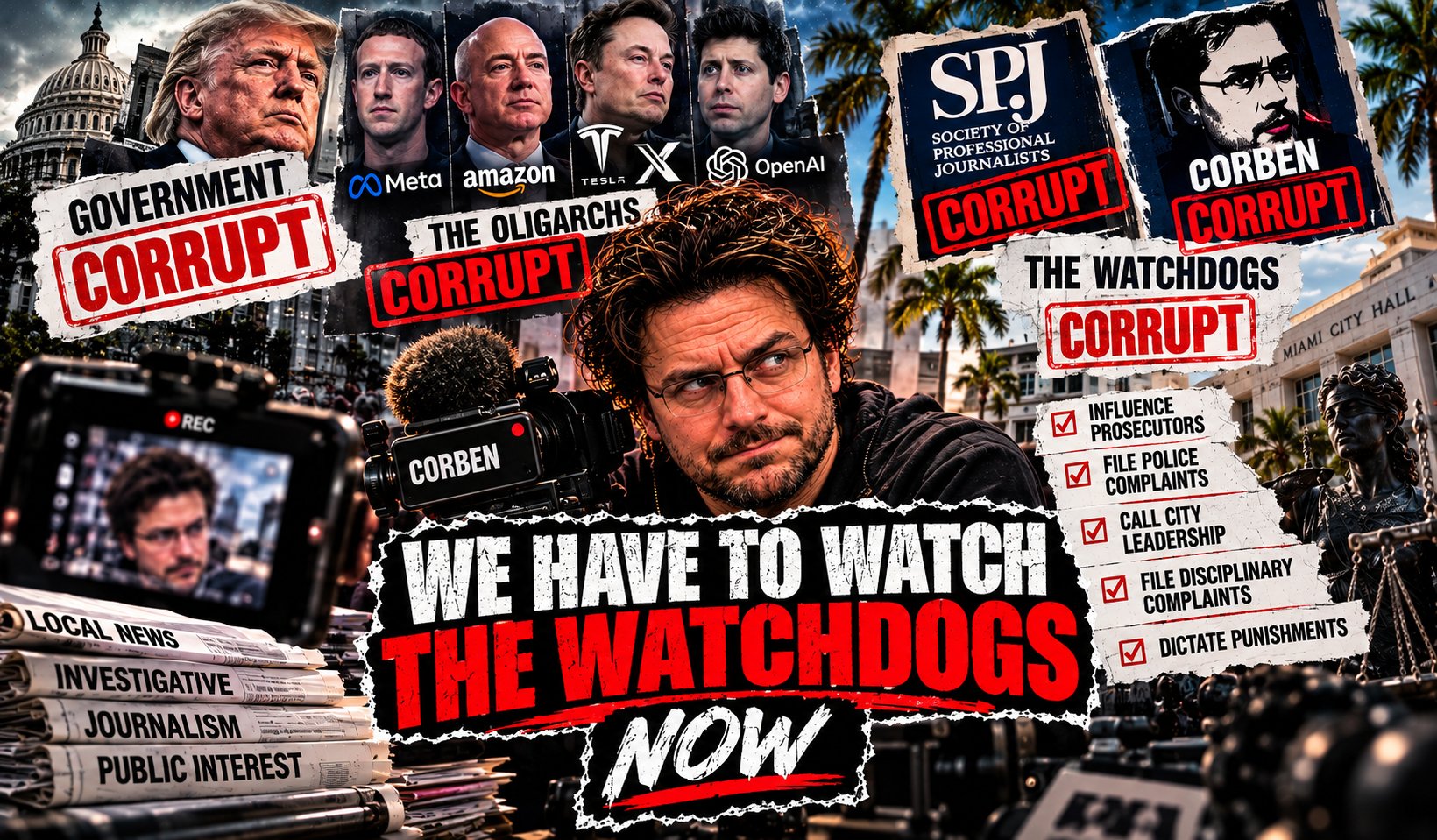
We Have To Watch the Watchdogs Now
Billy Corben has built much of his political identity around one fundamentally correct proposition: power deserves scrutiny. That principle does not stop at the City Commission dais. Carlos Martell remains responsible for whatever conduct prosecutors can prove beyond a reasonable doubt. Beba Sardiña Mann was responsible for grabbing Corben’s phone and ultimately acknowledged that she crossed the line. Miguel Gabela doesn’t acquire a right to physically confront someone because he hates the way that person covers him. Nobody gets to assault a journalist, activist or citizen because a camera makes them angry. But the First Amendment protects Corben from government censorship. It does not protect Corben from journalism.
The public is entitled to ask what happened before these confrontations, whether emotional pressure points were intentionally exploited, whether spouses and private citizens were genuinely necessary to the reporting, whether Corben’s conduct contributed to escalation, what communications occurred afterward and whether government treated his complaints exactly as it would treat those of an ordinary resident. It is also entitled to know when the person presenting himself as watchdog simultaneously becomes participant, provocateur, recorder, publisher, complainant and advocate for consequences. Those questions aren’t attacks on journalism. They are journalism.
Billy Corben may be a necessary asshole. He may even be the puss filled boil Miami politics deserves. But once a watchdog accumulates enough power to influence reputations, criminal proceedings, professional complaints, public appointments and the wider political conversation, watching the watchdog becomes a public. interest story of its own. The law can determine who crossed the legal line. Journalism has the harder responsibility: Who drew the line? Who walked everyone toward it? Who benefited when somebody crossed it? And did the person holding the camera arrive merely to document what happened or had confrontation itself become part of the goal?
Miami deserves the answer.

Sources & Further Reading
Bayfront Park / Carlos Martell Incident
These reports document the August 13 Bayfront Park Management Trust confrontation, Carlos Martell’s alleged attempt to take Corben’s phone, the police investigation, the subsequent misdemeanor battery charge and Corben’s later communications with Miami City Manager James Reyes, Mayor Eileen Higgins and city commissioners concerning Martell’s continued service on the Trust. Martell is presumed innocent, and the criminal charge remains an accusation.
Maria “Beba” Sardiña Mann Case
This report documents the May 30, 2025 City Hall confrontation in which Maria “Beba” Sardiña Mann took Corben’s phone while he was recording her during a public meeting, as well as the subsequent misdemeanor battery prosecution. Importantly, Corben told the New Times that he spent approximately six months working with Miami-Dade Chief Assistant State Attorney Stephen Talpins and Assistant State Attorney Jose Rohaidy attempting to resolve the case without charges and that the resolution he wanted was an apology from Mann at Miami City Hall.
Joe Carollo / Chicken Protest
Miami New Times — “Chicken Man Arrested at Carollo’s Big Block Party” — February 11, 2023
These reports document the deliberately theatrical political protest against Miami Commissioner Joe Carollo, including the group of activists who appeared in chicken costumes, the involvement of Corben and activist Thomas Kennedy in helping organize and film the protest, Morgan Gianola’s arrest and prosecutors’ subsequent decision not to pursue the charges after reviewing police body-camera footage.
Corben’s Media History, Political Activism and #BecauseMiami
Coconut Grove Spotlight — “The Billy Corben Show” — April 29, 2024
Rakontur — About / Company History
The Coconut Grove Spotlight profile examines Corben’s evolution from documentary filmmaker into what the publication described as a City Hall “provocateur,” including his confrontations with former Miami City Attorney Victoria Méndez and his broader political activism. Rakontur’s company history reproduces a 2008 Bloomberg Businessweek description of the company’s ethos that included the phrase “provoke and offend,” providing historical context for the deliberately confrontational style associated with Corben’s media work.
Victoria Méndez / Florida Bar Complaint
Although primarily about Corben’s later complaint against Monique Pardo Pope, this report also documents Corben’s earlier Florida Bar complaint against former Miami City Attorney Victoria Méndez following her remarks about him during a public City Commission meeting. The report states that Corben accused Méndez of unprofessional conduct and false accusations and that the Bar ultimately dismissed that complaint.
Monique Pardo Pope / Florida Bar Complaint
Together, these reports document the complete progression of Corben’s Florida Bar complaint against attorney and former Miami Beach Commission candidate Monique Pardo Pope: the filing of the complaint, the Bar’s decision to open a disciplinary inquiry, Pardo Pope’s response and Corben’s rebuttal, and the Bar’s eventual dismissal. The Bar cited insufficient evidence that Pardo Pope violated attorney disciplinary rules and found insufficient evidence that she possessed the required intent to mislead, defame or make a disparaging statement to the media.
Society of Professional Journalists / 2026 Sunshine State Awards
SPJ Florida — 2026 Sunshine State Award Winners
SPJ Florida — 2026 Sunshine State Awards Finalists — July 2, 2026
SPJ Florida — Sunshine State Winners Announcement — August 29, 2026
The official SPJ Florida results list Corben and Because Miami as a finalist in Investigative Reporting – Single Report for “My Hero, My Daddy: Investigation Reveals Miami Beach Candidate Is Daughter of Hitler-Loving Serial Killer.” WTSP-TV’s Emerald Morrow and Kyle Porter won the category for “$PENT.” The awards were presented August 29, 2026, at ArtServe in Fort Lauderdale.
Viral Costco Video / Daniel Maples
The report documents Corben’s amplification of the Fort Myers Costco confrontation involving Daniel Maples. Corben posted the video to Twitter, where it had accumulated more than 11 million views by the time the report was published. Maples’ employer subsequently announced that he had been terminated.







































Want to join the conversation?
Create an account or sign in to share your thoughts, vote,
and reply to other readers.
Showing 0 of 0 comments
Don't have an account?
Already have an account?