
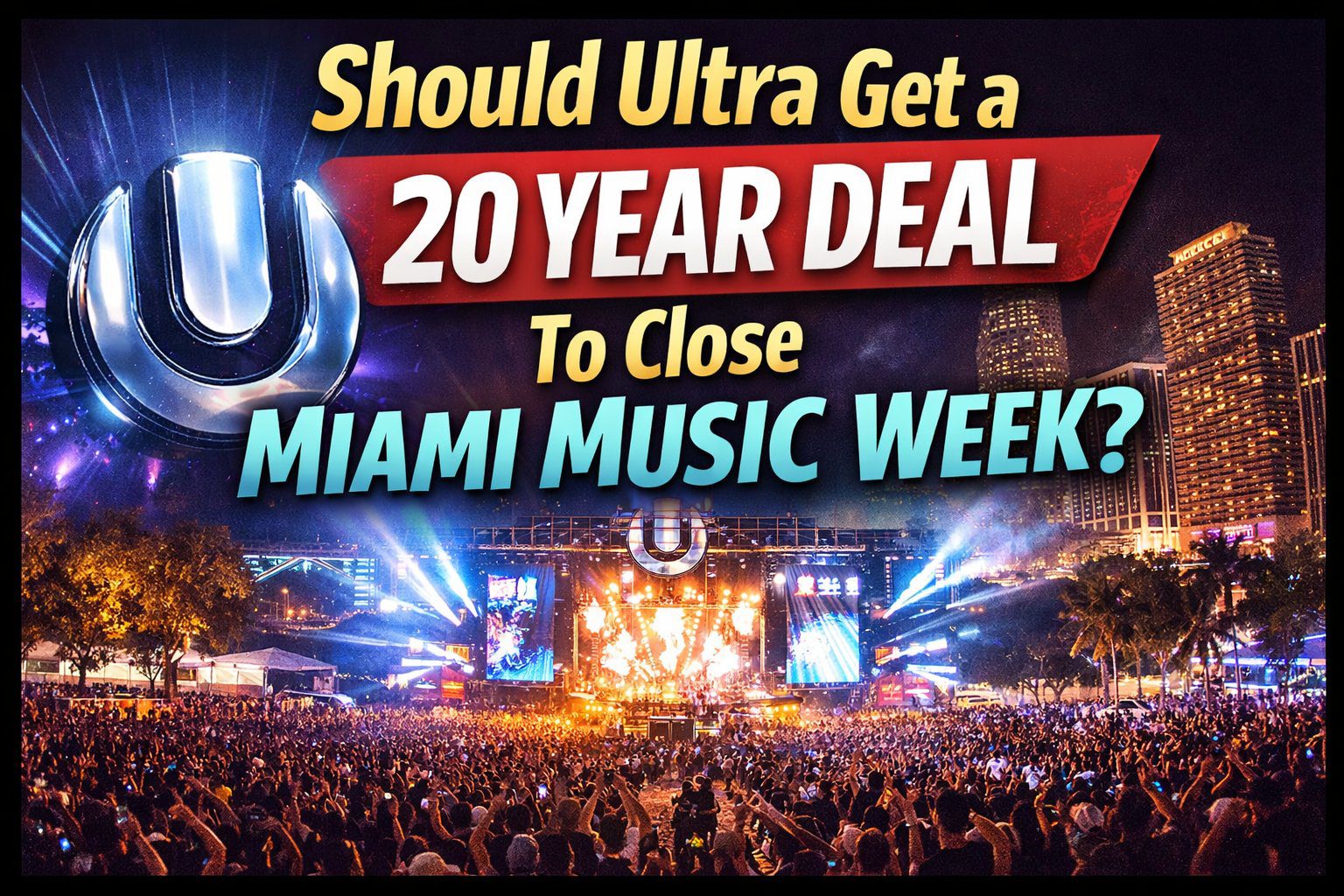
Miami’s Ultra Deal Raises a Bigger Question: Who Controls Public Land and Why Was There No Competition?
“If this is truly the best deal for Miami, why wasn’t it put out to bid?”
That question is now driving a growing legal and political fight over Bayfront Park, one of the most valuable public spaces in South Florida. As Miami moves toward a proposed 20 year extension with Ultra Music Festival, critics aren’t just debating the event itself. They’re questioning the process that allowed a single private operator to secure long term control of public land without ever facing competition.
The Loophole That Made It Possible
The foundation of the controversy is a legal distinction that, on paper, looks minor, but in practice changes everything. For years, the City of Miami, working through the Bayfront Park Management Trust, has classified Ultra’s use of Bayfront Park as a “revocable license agreement.” That designation allows the city to treat the arrangement as temporary and discretionary, rather than as a long term lease of public land.
And that classification carries enormous consequences.
Under Miami’s City Charter, leases of public land typically trigger safeguards like competitive bidding or voter approval. By calling the deal a “license,” the city has avoided both allowing officials to negotiate directly with Ultra, without opening the door to other vendors or putting the decision in front of taxpayers. To critics, that isn’t just semantics. It’s a deliberate workaround.
When a “License” Starts Looking Like a Lease
That argument has gained urgency as the city considers expanding the agreement from a five year term to a proposed 20 year deal. At that scale, opponents say the arrangement no longer resembles a temporary use permit. Instead, it reflects a recurring, structured occupation of public land that functions like a long term lease, regardless of what it’s called on paper. Ultra returns year after year, takes over the park for an extended period, controls access, and generates significant private revenue, all within a predictable, multi-decade framework.
“Call it a license if you want,” one critic involved in the legal fight said, “but when the same entity controls public land for decades, that’s a lease in everything but name.”
That question, whether the city is mislabeling the agreement to avoid legal requirements, is now at the center of active litigation.
Residents Push Back and Take It to Court
The challenge isn’t coming from competing festivals. It’s coming from the people who live around the park. Groups like the Brickell Homeowners Association have filed lawsuits arguing that the city is bypassing its own rules. Their position is that Miami is effectively granting long-term control of public land without the transparency, competition, or voter input that would normally be required. This isn’t just about noise complaints or event disruption, though those issues have fueled tensions for years. The deeper concern is structural:
Whether public land is being allocated through a fair process or through internal decisions that avoid scrutiny.
A Deal Without a Market Test
What makes the situation stand out is not just how the deal was structured, but what never happened at all. Miami never issued a formal request for proposals. It never invited other global promoters like Insomniac Events or Tomorrowland to present competing visions for the park. Even established regional events like Tortuga Music Festival were never part of a public process.
Instead, the city continued negotiating directly with Ultra, a partner it has worked with for more than two decades without testing whether better terms, better protections, or even better ideas might exist elsewhere.
The decision wasn’t made after evaluating options. It was made without ever asking for them.
The City’s Case and the Question It Doesn’t Answer
Officials have defended the relationship by pointing to Ultra’s economic impact and global profile. The festival is widely credited with generating more than $160 million annually for the local economy, drawing international attention, and reinforcing Miami’s reputation as a global entertainment hub. Those arguments are not disputed. Ultra is, by any measure, a major economic engine. But they don’t resolve the central issue.
If Ultra is clearly the best partner, why not prove it in an open, competitive process?
Without that process, the city is asking the public to accept the conclusion without seeing the comparison.
A Closed System by Design
Over time, the structure of the agreement has created a system where competition is not just unlikely, it’s effectively impossible. Ultra occupies the same calendar window each year, maintains a long standing relationship with the governing trust, and operates within a framework that never requires alternative proposals. Other promoters aren’t losing bids; they’re never given the chance to submit one.
In practical terms, the market for Bayfront Park has been closed off before it ever had a chance to exist.
What’s Really at Stake
This debate isn’t just about Ultra. It’s about precedent. Bayfront Park is a public asset in one of the most valuable urban cores in the country. How Miami chooses to manage it will shape how other public spaces are treated in the future. If the city can lock in a 20 year agreement without competition by labeling it a license, then similar structures could be used elsewhere, not just for festivals, but for a wide range of public-private deals. The risk isn’t just this deal. It’s the model it creates.
Miami didn’t choose Ultra over competing bids, it never asked for competing bids at all.
That’s the core of the controversy. Not the music, not the crowds, not even the economics, but the process. As the city moves closer to a long-term agreement, the question isn’t whether Ultra belongs in Miami. It’s whether Miami followed a process that ensures public land is managed transparently, competitively, and in the best interest of the people who actually own it. Right now, that answer is still being fought, in court, in city hall, and across a city that is increasingly asking how decisions like this get made in the first place.
“Ultra is incredible, but let’s stop pretending it built Miami Music Week. It didn’t. It closes it.”
Miami didn’t wake up one day with a global EDM crown because of one festival. The city earned that over decades, through clubs, promoters, artists, and an entire ecosystem that turns every corner of South Florida into a stage for a full week. By the time Ultra opens its gates, the audience is already here, the energy is already built, and the world is already watching. That’s not luck, that’s a city wide machine that Ultra steps into at the exact peak moment.
And let’s be honest about that moment. Closing Miami Music Week at Bayfront Park isn’t just a good slot, it’s the most valuable position in electronic music. You get a fully primed global crowd, maximum media attention, and a skyline backdrop no other festival can replicate. Put Tomorrowland, Insomniac Events, or any world class promoter in that same time and place, and they’re going to crush too. That doesn’t take anything away from Ultra, it just puts its success in the real context.
Miami built the week. Ultra mastered the closing set.
The problem isn’t that Ultra wins, it’s when it starts acting like it owns the whole game. Because without Miami, the culture, the venues, the people, the years of investment, there is no Miami Music Week. And without that week, the closing act doesn’t carry nearly the same weight. That’s the balance the city needs to remember before handing over decades of control like it’s a favor to them, instead of recognizing who actually built the stage in the first place.
















































Want to join the conversation?
Create an account or sign in to share your thoughts, vote,
and reply to other readers.
Showing 0 of 0 comments
Don't have an account?
Already have an account?