
Sin Taxes, Culture Wars, and Political Theater: Why James Fishback’s Campaign Is Drawing Fierce Criticism in Florida
As Florida’s 2026 governor’s race accelerates, Republican candidate James Fishback has emerged as one of its most polarizing figures, not because he leads in polling or fundraising, but because of a campaign defined by provocation, culture war economics, and headline-grabbing policy proposals that critics say reveal more about political ambition than governing vision. At a moment when global instability, economic uncertainty, insurance crises, and immigration pressures dominate the national conversation, Fishback has chosen to center his campaign around ideas that many analysts describe as symbolic rather than substantive.
The 50% OnlyFans “Sin Tax”: An Idea Critics Call Absurd
Fishback’s proposal to impose a 50% state tax on income earned by OnlyFans creators has become the defining flashpoint of his candidacy. He has framed the measure as a moral deterrent and revenue generator. But policy experts note Florida currently has no state income tax, meaning such a proposal would likely face steep legal, legislative, and economic barriers.
Critics argue the idea is less about fiscal responsibility and more about cultural signaling, targeting a highly visible digital workforce while leaving broader questions about wealth inequality and taxation largely untouched in a state that has aggressively welcomed hedge fund managers, technology executives, and ultra-wealthy transplants.
“James Fishback’s genius idea seems to be to run all the hot women out of Florida. I doubt he’ll find many men who want to support that,” one South Florida media executive said, criticizing the proposal as politically tone deaf and economically unserious.
Beyond the headline shock value, analysts say creators could simply relocate or restructure earnings, undermining any projected revenue gains.
Cultural Politics in a Rapidly Changing State
Florida’s electorate has evolved into one of the most economically dynamic and demographically fluid in the country. Entrepreneurs, remote workers, and digital creators have become part of the state’s growth engine, particularly in regions like Miami, Tampa, and Orlando. Critics argue that policies perceived as punitive toward personal economic choices risk portraying Florida as hostile to innovation and modern labor trends. More broadly, some observers say Fishback’s campaign reflects an attempt to revive earlier waves of culture war populism at a time when many voters are increasingly focused on affordability, insurance costs, infrastructure demands, and global instability.
Immigration Hardlines and Economic Reality
Fishback has also proposed aggressive immigration restrictions, including eliminating certain visa programs and removing visa holders from state employment. Supporters frame this as protecting American workers. Business leaders counter that such policies could damage Florida’s competitiveness in technology, finance, logistics, tourism, and health care industries deeply intertwined with international talent and investment. In a state positioning itself as a global business hub, critics argue sweeping crackdowns could introduce uncertainty just as Florida seeks to attract long term corporate commitments.
Allegations Involving Relationship With Teenage Employee
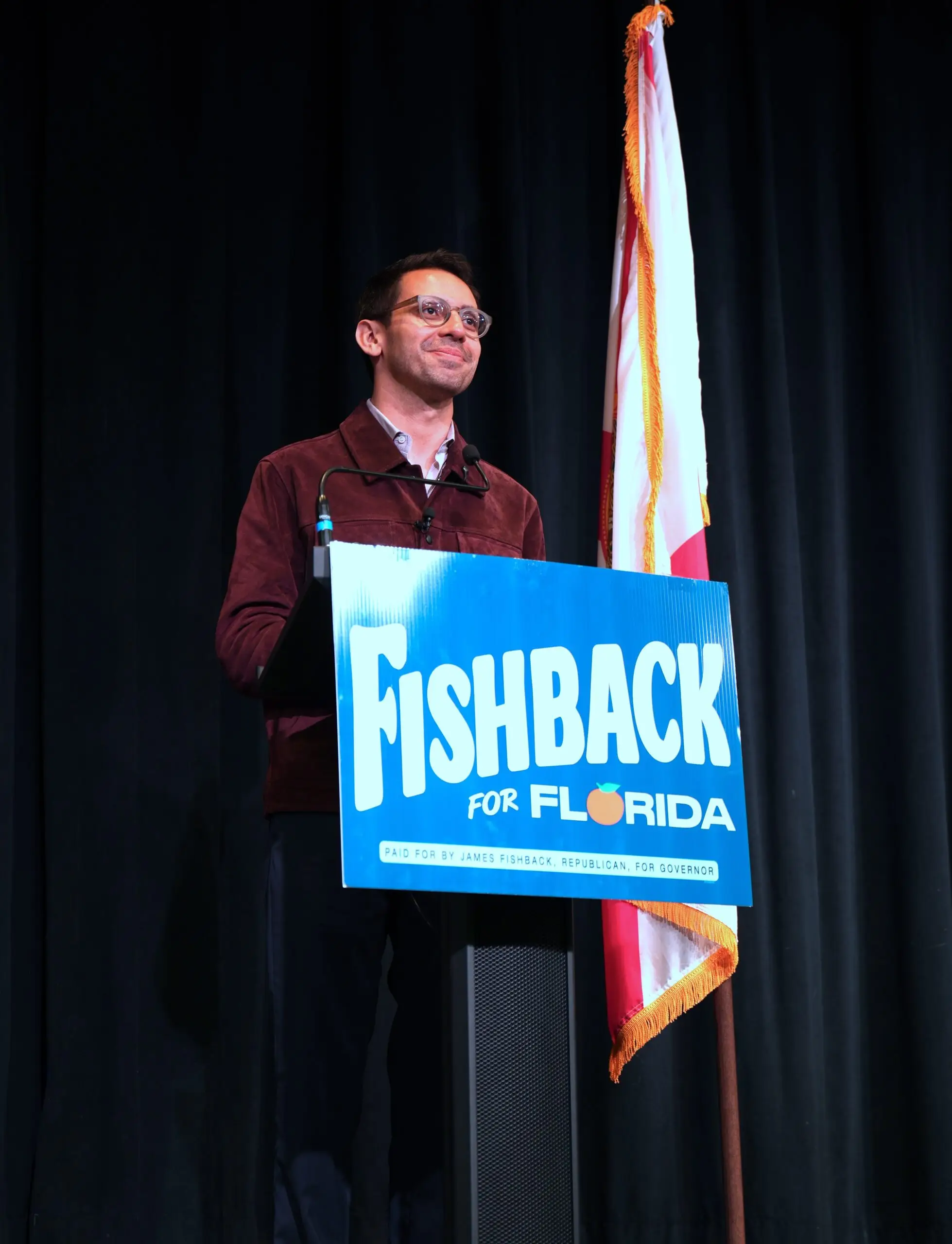
Fishback’s campaign has also been shadowed by detailed allegations contained in court filings connected to a since denied petition for a protection injunction filed by a former employee and former fiancée, Keinah Fort. In filings reviewed by reporters, Fort alleged Fishback began cultivating a personal relationship with her while she was 17 and he was 27, when she was involved with the nonprofit debate organization he founded, Incubate Debate. She claimed he encouraged secrecy around the relationship and later engaged in controlling behavior, harassment, and repeated unwanted contact after their breakup.
Fishback has strongly denied the allegations, calling them “absolutely false,” and has emphasized that he has never been arrested or charged with a crime related to the matter. In June, a Florida circuit judge denied Fort’s request for an injunction, finding the legal standard for stalking or substantial emotional distress had not been met. The judge noted aspects of Fishback’s conduct appeared “odd,” but concluded the evidence did not justify issuing a protective order. The case centered on civil standards, not criminal guilt, meaning the allegations remain politically relevant but legally unresolved.
Separately, Broward County Public Schools previously cut ties with Incubate Debate after concerns were raised by parents about Fishback’s relationship with a teenage participant or employee. Fishback denied misconduct at the time.
These episodes continue to shape voter perceptions of his judgment, leadership style, and readiness for executive office.
Ties to Polarizing Online Figures and Culture War Politics
Fishback has also drawn scrutiny for engaging with or receiving support from controversial online personalities associated with the far right influencer ecosystem. Among those cited in political reporting is Andrew Tate, a social media figure facing criminal charges abroad who has become a polarizing symbol in debates over masculinity, online radicalization, and gender politics.
While Fishback has not been charged with wrongdoing related to Tate or similar figures, critics argue that alignment, even indirect, with such personalities risks reinforcing concerns about ideological extremism and campaign judgment. His broader media strategy has relied heavily on viral messaging, confrontational rhetoric, and culture war framing.
Supporters say this reflects a willingness to challenge establishment norms and mobilize younger voters online. Opponents counter that it raises serious questions about temperament, coalition building, and the ability to govern a diverse and economically complex state.
Banned From Waffle House During Campaign Tour
Fishback drew national attention after publicly stating that his campaign had been barred from visiting Waffle House locations across Florida during a planned diner tour intended to showcase grassroots voter outreach. According to his account, the company issued a trespass notice after initially allowing campaign appearances. Waffle House did not publicly detail the reasons for the decision. The episode became emblematic, for critics, of a campaign frequently generating viral headlines and unconventional political moments rather than traditional coalition-building efforts.
Fire Near His Home Raises Questions
Fishback also claimed he was the target of political intimidation after a fire broke out near his Madison County residence during the early stages of his campaign. He described the incident as potentially deliberate and occurring close to the structure of the home. Local authorities responded to the scene, but publicly available reporting indicated the fire was not formally classified as arson and no criminal charges were announced in connection with the incident. The event nevertheless became part of the broader narrative surrounding the high profile and often contentious nature of his gubernatorial run.
Racism and Antisemitism Controversies
Fishback’s campaign has also drawn backlash over rhetoric critics say has crossed into racially charged and antisemitic territory. Political profiles and commentators have pointed to his engagement with far right online figures and the use of language such as “goyslop,” a term widely described by observers as an antisemitic trope. Fishback has denied bigotry, characterizing such comments as satire or ideological critique. Still, repeated controversies around rhetoric, whether intentional provocation or not, have become part of the political narrative shaping perceptions of his judgment and electability.
Running on Populism After the Populist Wave Has Shifted
Some analysts argue Fishback’s campaign illustrates a broader phenomenon in modern politics: candidates attempting to replicate the confrontational populist energy of earlier election cycles without fully adapting to changing voter priorities. With international conflicts escalating, housing affordability worsening, insurance markets destabilizing, and economic volatility rising, campaigns centered primarily on symbolic cultural battles may struggle to resonate with voters focused on practical governance.
Florida statewide races have historically rewarded candidates who balance ideological messaging with managerial competence, coalition-building ability, and detailed policy frameworks. Critics argue that relying heavily on outrage driven populism risks appearing disconnected from the real challenges facing Floridians.
Controversies, Reputation Risk, and Political Timing
Fishback also enters the race carrying political baggage tied to past personal and professional disputes that continue to surface in media coverage and opposition research. Court filings connected to the denied protection order petition have become part of the broader narrative surrounding his candidacy. While he denies wrongdoing, analysts note that detailed public allegations, regardless of legal outcome, can complicate efforts to build voter trust.
Some observers draw comparisons to how reputational controversies involving powerful figures in recent years have reshaped public perceptions and campaign viability. The argument is not equivalence, but that in modern politics proximity to controversy alone can become politically defining. Launching a statewide bid while navigating unresolved scrutiny may therefore present strategic risks, particularly when opponents are likely to amplify those issues.
James Fishback Is Not a Serious Political Candidate for Florida
James Fishback has undeniably succeeded in capturing attention. But attention is not leadership and viral moments are not public policy.
Running for governor of one of the largest and most economically complex states in the country requires more than culture-war headlines, social media theatrics, and proposals that raise more legal and practical questions than they answer. From the widely criticized plan to impose a 50% “sin tax” on OnlyFans creators to sweeping immigration crackdowns that business leaders warn could undermine Florida’s competitiveness, Fishback’s campaign has been defined less by governing vision than by provocation.
His candidacy also arrives with political baggage that critics argue raises questions about judgment, maturity, and executive readiness. Court filings tied to the denied protection order petition, past professional disputes, controversial rhetoric, and engagement with polarizing online figures have all contributed to a narrative that may prove difficult to overcome.
At a time when global instability, insurance crises, housing affordability, infrastructure demands, and economic uncertainty dominate the real agenda facing Floridians, campaigns centered on symbolic cultural battles risk appearing disconnected from everyday governance. Fishback’s strategy reflects a gamble, that outrage driven populism and attention seeking proposals can substitute for experience, coalition strength, and practical solutions. The central question is no longer whether James Fishback can dominate headlines. It is whether he has demonstrated any meaningful path to governing.
So far, his campaign has generated far more noise than answers and in a state confronting serious challenges, that reality may ultimately matter more than any viral moment.












































Want to join the conversation?
Create an account or sign in to share your thoughts, vote,
and reply to other readers.
Showing 0 of 0 comments
Don't have an account?
Already have an account?