
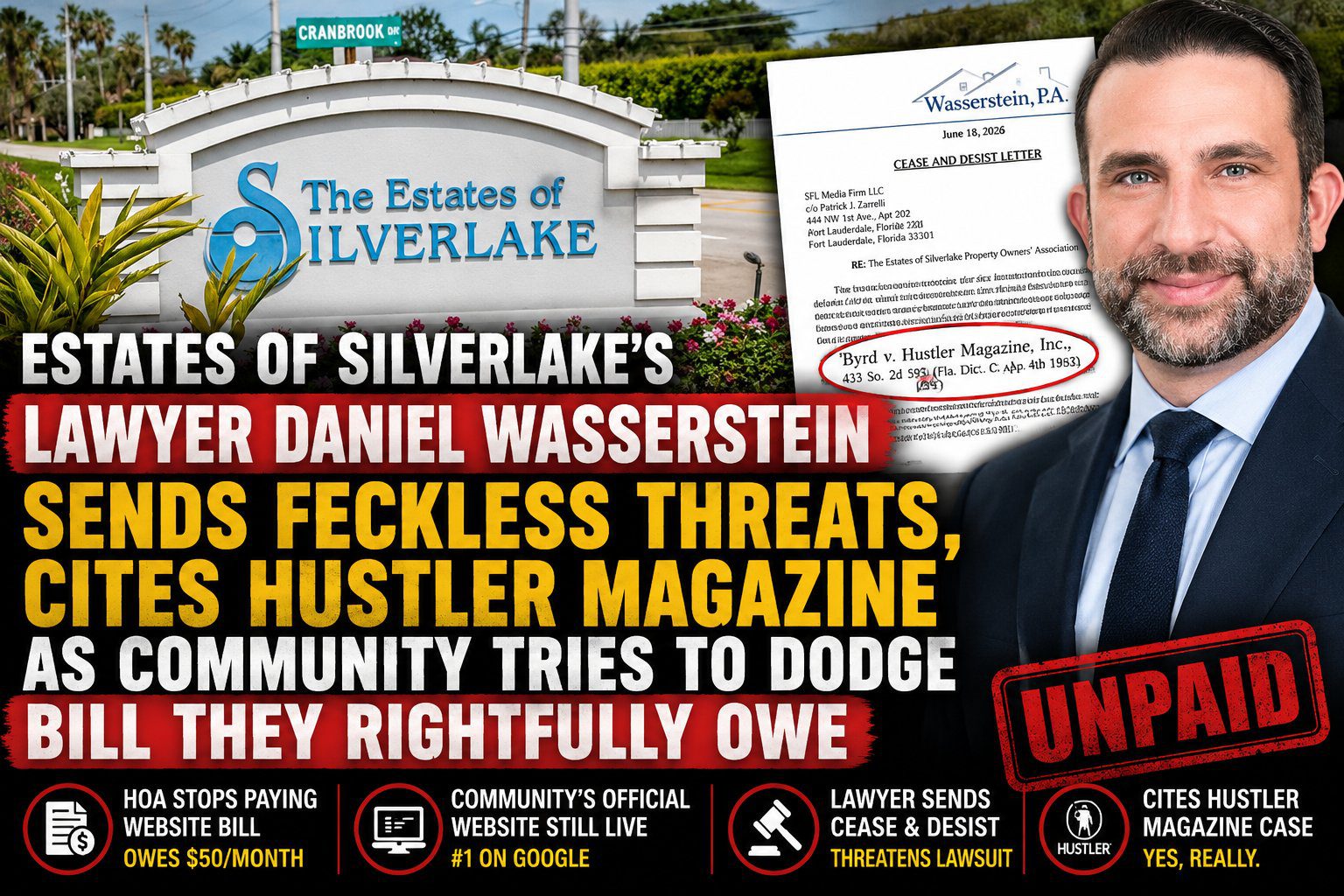
Florida HOA Stops Paying Website Bill, Then Sends Defamation Threat Instead of a Check, Media Firm Claims
South Florida Media Says It Built and Hosted Community Website for Years Before Association Disputed Its Existence
A South Florida homeowners association is facing questions about transparency, record keeping, and vendor accountability after a years long dispute over a community website escalated into legal threats instead of payment. The conflict centers on The Estates of Silverlake Property Owners’ Association, a South Florida HOA that allegedly approved the creation of a community website years ago when Florida began requiring many associations to maintain websites for residents.
According to South Florida Media CEO Patrick Zarrelli, the company built and hosted the website as a low-cost service to help the community comply with state requirements. The site was reportedly hosted through Liquid Web, one of the company’s corporate partners, at a cost of approximately $50 per month. What began as a routine website project has now turned into a bizarre dispute involving management company turnover, missing records, unpaid invoices, and a cease and desist letter demanding the website be removed entirely.
A Website Built for the Community
According to South Florida Media, the website was approved by a previous HOA board and remained active for years as one of the community’s primary online resources. The company says the association paid its hosting invoices without dispute through multiple board administrations and management transitions. During that period, the website served residents by providing access to community information, downloadable forms, contact information, maps, announcements, and other resources homeowners regularly need.
Unlike a simple template website, South Florida Media says the platform was a professionally developed system with a replacement value easily exceeding $5,000. The site included interactive forms, community maps, downloadable HOA documents, resident resources, and a direct MLS integration that automatically displayed homes listed for sale within the community.
The result was a modern website that not only satisfied Florida’s website requirements for homeowner associations but also promoted the neighborhood to prospective buyers and residents. According to South Florida Media, the site consistently presented the community in a positive light while generating hundreds of visits each month from homeowners, prospective purchasers, vendors, and visitors searching for information about the neighborhood.
Estates of Silverlake Leadership Drops the Ball
Like many homeowner associations, however, leadership changed over time. Board members rotated off the board. Property managers came and went. Management companies changed. Institutional knowledge allegedly disappeared. According to South Florida Media, that is when the billing problems began.
Ironically, one criticism raised in the association’s cease and desist letter was that portions of the website contained outdated information. South Florida Media points out that such criticism ignores a basic reality of website management: websites do not update themselves.
The company notes that community representatives were provided contact information and had multiple methods available to request updates, submit revised documents, announce meetings, post notices, or otherwise maintain current content. According to South Florida Media, no meaningful effort was made by association representatives to provide updated materials or request content changes.
“Websites require communication,” the company said. “If no one emails, calls, submits documents, or requests updates, information cannot magically change itself.”
South Florida Media contends that blaming the website provider for outdated content while simultaneously failing to communicate updates is yet another example of the larger management and record keeping problems that appear to be at the center of the dispute. Whether those issues stem from management turnover, lost records, lack of oversight, or simple neglect remains one of the unanswered questions surrounding the controversy.
The Invoices Stopped Getting Paid
The company claims annual hosting payments suddenly stopped despite the website remaining active and accessible to residents. South Florida Media says it attempted to resolve the issue through emails, phone calls, and direct outreach to both community representatives and management personnel. According to the company, those efforts were largely ignored.
The dispute eventually became more complicated when association representatives allegedly claimed they had purchased a replacement website. There was just one problem. Nobody appeared able to locate it.
The Mystery of the Missing Website
According to South Florida Media, management representatives eventually informed the company that a replacement website had been created and that responsibility for the community’s online presence had been transferred elsewhere. Yet residents, homeowners, real estate agents, and search engines appeared to continue finding and using the original website.
The existing website remained indexed by Google, ranked prominently in search results, and was listed as the official website connected to the community’s Google Business Profile. For many users searching for information about the neighborhood, it was not simply a website, it was the website.
South Florida Media says the platform consistently appeared as one of the top search results for the community and continued receiving hundreds of visitors each month despite the association’s claims that a replacement website existed.
The site’s visibility extended beyond residents. Prospective home buyers, real estate agents, vendors, renters, and community visitors regularly used the website to access association information, community documents, maps, forms, and neighborhood resources. The website had built years of search engine authority and online trust, making it the digital front door of the community.
That reality raises an obvious question: if a replacement website truly existed, where was it?
According to South Florida Media, neither Google, residents, homeowners, nor prospective buyers appeared able to locate the alleged replacement platform. Despite repeated references to a new website, the original site remained the one being discovered through online searches and the one connected to the community’s public facing Google profile.
The situation has raised broader questions about whether community funds may have been spent on a replacement platform that never gained meaningful public visibility, search engine rankings, or resident adoption. In the digital world, websites do not exist simply because someone says they do. They generate traffic. They appear in search results. They accumulate links. They become known to users.
According to South Florida Media, the original website did all of those things. The alleged replacement website, by contrast, appeared to leave virtually no public footprint.
If the community paid for a second website, residents may reasonably ask what became of that investment, why the original website continued functioning as the community’s primary online destination, and why the website that homeowners were actually using became the subject of legal threats rather than maintenance and support.
Documentation Presented
After months of attempting to resolve the dispute, South Florida Media says it assembled documentation showing communications regarding the website’s creation, maintenance, and prior payment history. According to the company, those records were provided to management representatives after they claimed no record of any agreement existed.
Shortly afterward, management requested a W-9 form from the company. That request appeared to indicate payment was finally moving forward. Instead, the dispute took another turn.
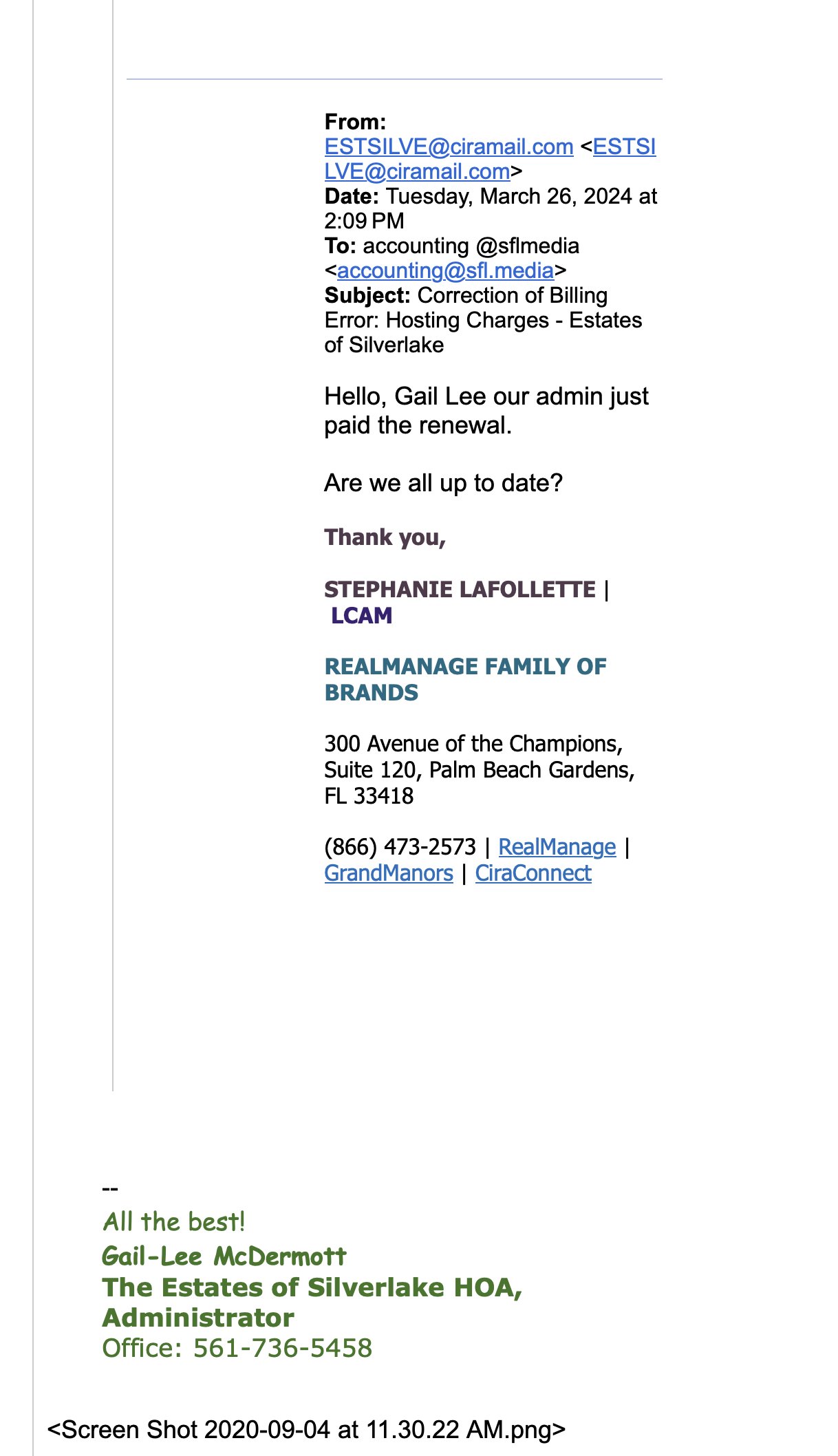
Here is one of many emails showing that the Estates of SilverLakes community manager, Gail Lee, the management company, and the board’s official billing email all acknowledged both the website and a payment they made two years earlier before they stopped paying. This email chain was provided to the HOA management company before the attorney’s cease and desist letter was sent.
That means the evidence was already in their possession before the letter was drafted. Despite that, the letter ignored the documentation and claimed there was no knowledge of the bill. If the facts were available and provided in advance, why were they omitted from the attorney’s analysis? That is a question the association, its management company, and its counsel should be prepared to answer.
Enter the Lawyers
On June 18, South Florida Media received a cease and desist letter from Boca Raton law firm Wasserstein, P.A., (2.9 stars on Google) representing the association. The letter claims the website was created voluntarily and that no agreement existed regarding administration or maintenance of the website. The association further alleges that statements appearing on the website regarding unpaid invoices and management conduct are false and defamatory.
The letter demands that South Florida Media remove statements regarding the dispute and permanently take the website offline. It also threatens potential legal action if the demands are not met. The legal notice cites several Florida defamation cases, including a hilarious and bizarre reference to Byrd v. Hustler Magazine, an unusual citation in what is fundamentally a dispute over website hosting and unpaid invoices.
Read the Ridiculous Daniel Wasserstein Hustler Magazine Threat Letter Here
The Central Contradiction
The dispute appears to revolve around a simple question. If the association truly has no ownership interest, contractual relationship, responsibility, or connection to the website, why is it demanding control over the content appearing on that website?
Conversely, if the website was in fact created for the association, utilized by residents, and paid for by prior boards, then questions remain about why the invoices allegedly stopped being paid and why records of the arrangement appear to have vanished.
Those questions remain unanswered.
Bigger Than a Website
At first glance, the dispute may appear to involve little more than a modest hosting bill. In reality, it highlights a growing issue facing homeowner associations across Florida. Board members change. Management companies rotate. Records disappear. Institutional knowledge gets lost. Vendors are left chasing payments while residents often have little visibility into what happened behind the scenes.
For South Florida Media, the issue is not simply about money.
The company argues that it provided a service to help a community comply with state requirements, kept the website running for years, attempted to resolve the matter privately, and only went public after repeated efforts to obtain payment allegedly failed. Now the dispute has evolved from an unpaid website invoice into a broader fight over transparency, accountability, and whether legal threats are being used in place of answering difficult questions and paying monies clearly owed.
As of publication, The Estates of Silverlake Property Owners’ Association has still not paid for the website they have been using as their official community website on Google for multiple years.



















































Want to join the conversation?
Create an account or sign in to share your thoughts, vote,
and reply to other readers.
Showing 0 of 0 comments
Don't have an account?
Already have an account?