
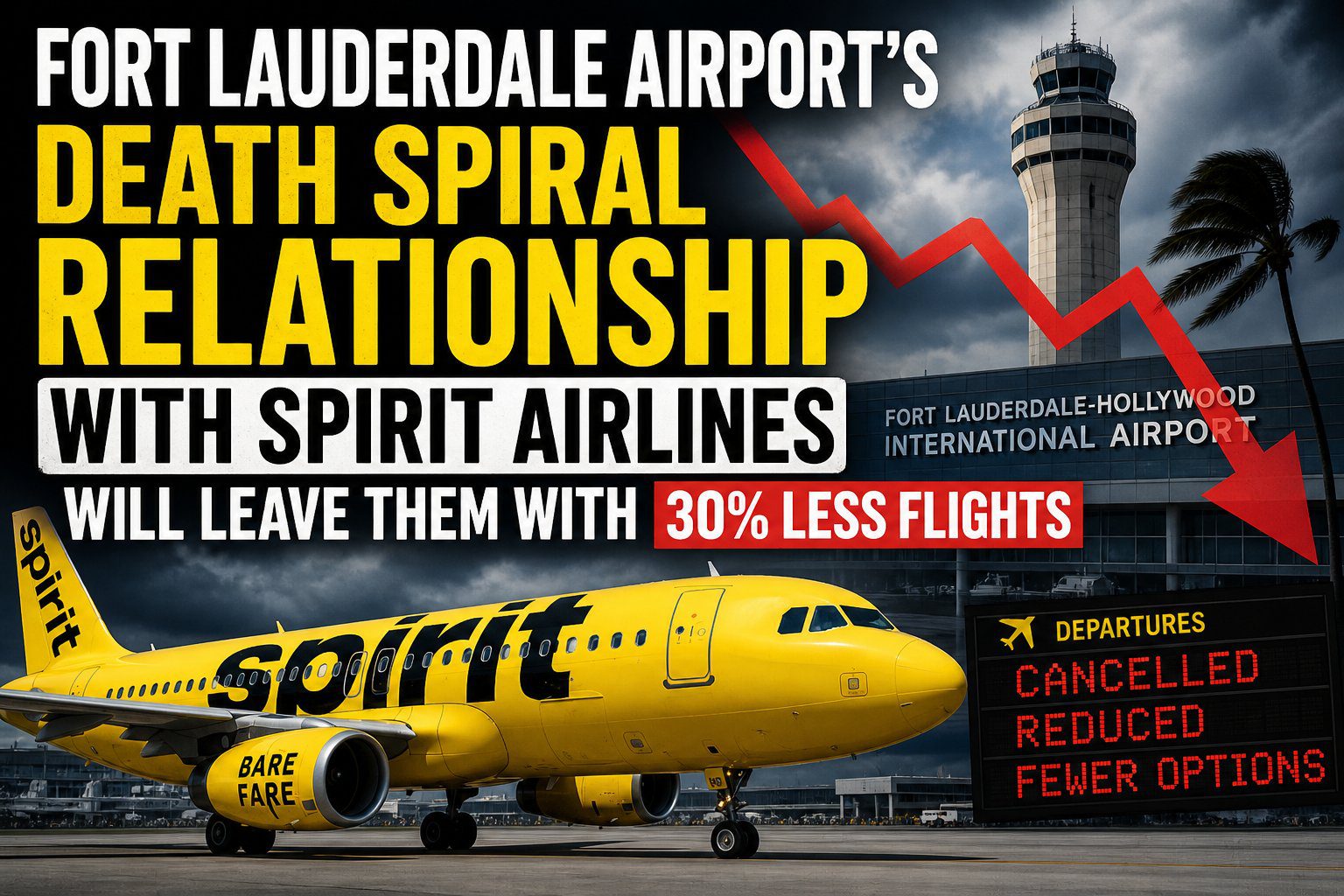
Fort Lauderdale Airport’s Risky Bet on Spirit Airlines Is Now Unraveling And Travelers Will Feel It First
Fort Lauderdale built one of the busiest low cost travel hubs in the country by leaning heavily on a single airline. That strategy delivered years of explosive growth. Now it’s becoming a liability. The potential collapse of Spirit Airlines is not just another airline failure, it’s a structural shock to South Florida’s aviation economy, with immediate consequences for travelers moving through Fort Lauderdale-Hollywood International Airport. This isn’t theoretical. This is what happens when an airport ties its identity, infrastructure, and passenger volume to one dominant carrier and that carrier falters.
“At its peak, nearly one out of every three passengers at Fort Lauderdale flew Spirit.”
That level of dependency doesn’t unwind cleanly.
Built Around One Airline
For years, Spirit wasn’t just operating at Fort Lauderdale, it was defining it. The airline’s ultra low cost, high frequency model turned FLL into a national gateway for budget travel, pulling in millions of passengers annually and fueling major expansion projects, including Terminal 4. That growth came with an assumption: Spirit would keep expanding. Instead, the opposite is happening.
The 30% Shock to the System
The numbers tell the story clearly. Spirit once controlled nearly 30% of passenger traffic at FLL and still held over 20% of seat capacity even after recent cutbacks. If the airline fully collapses or significantly downsizes, the airport is staring at an immediate loss of roughly a quarter to a third of its flights.
“You’re looking at roughly a quarter of Fort Lauderdale’s air traffic disappearing overnight, one of the biggest single airline shocks any U.S. airport has taken in decades.” – Patrick Zarrelli
That’s not just fewer planes. That’s fewer options, higher prices, and major disruption for travelers.
What Travelers Will Actually Experience
For passengers, the impact won’t be subtle. It will show up fast in schedules, prices, and availability.
- Fewer direct flights, especially to smaller U.S. cities and Caribbean destinations
- Higher ticket prices as ultra low cost competition disappears
- Increased crowding and reduced flexibility on remaining airlines
Spirit’s model filled routes that other carriers often ignored. When those flights disappear, they don’t automatically come back.
Why Other Airlines Won’t Instantly Fix This
Airlines like JetBlue Airways and Frontier Airlines may expand, and legacy carriers like Delta Air Lines and American Airlines will adjust where it makes financial sense. But they operate on different models. Spirit thrived on volume and thin margins. Legacy airlines prioritize profitability per seat, not saturation. Even other low-cost carriers don’t replicate Spirit’s exact network or scale. Replacing 25–30% of an airport’s traffic isn’t a quick swap, it’s a slow rebuild.
The Dania Beach Bet That Backfired
This collapse doesn’t just hit the airport, it hits the region’s economic planning. Dania Beach and Broward County structured incentives to bring Spirit’s headquarters to Dania Pointe, tying future growth to job creation and long-term economic impact. The projections were aggressive: a $208 million taxable property and tens of millions in regional economic activity. Now, instead of a thriving aviation hub, the region is left with a $250 million corporate campus searching for a new identity. That’s the risk of building around one anchor tenant. When it leaves, everything around it destabilizes.
The Domino Effect Across South Florida
Airports don’t operate in isolation. When a dominant airline collapses, the ripple effects move quickly through the entire local economy. Jobs tied to airport operations, tourism driven businesses, and regional infrastructure all take a hit. Fort Lauderdale’s branding as a low cost gateway weakens overnight, especially as it competes with Miami International Airport, which is less dependent on a single carrier. This is bigger than aviation. It’s a regional reset.
What Happens Next
Fort Lauderdale isn’t going away, but it is entering a transition phase that travelers will feel in real time.
In the months ahead, expect:
- A short term drop of 25–30% in flight availability
- Partial recovery as airlines slowly add routes
- A long term shift toward fewer ultra cheap fares and more traditional pricing
The airport will aggressively recruit new carriers and restructure its route map. But rebuilding lost volume at this scale takes time, often years.
The Bottom Line for FLL Travelers
Fort Lauderdale’s rise was fueled by one airline. Its next chapter will be defined by how quickly it can diversify without it.
“When one company becomes the backbone of an ecosystem, its failure doesn’t just hurt it destabilizes everything connected to it. From jobs to overall tourism numbers across the board”
For travelers, that means one thing: the era of easy, ultra-cheap flights out of Fort Lauderdale may be coming to an abrupt end and the adjustment period is going to be turbulent.


















































Want to join the conversation?
Create an account or sign in to share your thoughts, vote,
and reply to other readers.
Showing 0 of 0 comments
Don't have an account?
Already have an account?