
When Power Won’t Let Go: Mitch McConnell’s Health Crisis Is the Latest Warning About America’s Aging Political Class
The image of an 84 year old senator hospitalized for weeks after an apparent medical emergency while the country waits for vague updates from staff is more than a story about one politician. It has become another chapter in a much larger debate: whether the United States has allowed too much political power to remain concentrated in leaders who stay in office long after age and health have become national concerns.
The discussion is no longer confined to one party. Republicans and Democrats alike have faced repeated questions about whether America’s political system encourages leaders to hold power until they physically cannot continue, often at the expense of their own legacy and institutional stability.
The Current Situation: Mitch McConnell
According to emergency dispatch records, Washington, D.C., emergency personnel responded to McConnell’s home on June 14 after receiving a call involving an unconscious person, with dispatch audio reportedly indicating CPR was underway. Since then, McConnell’s office has released only limited public information, saying he is recovering while declining to provide detailed medical information.
His prolonged absence has raised practical questions beyond his personal health. McConnell remains one of the Senate’s most influential lawmakers despite stepping down as Republican leader earlier this year. His absence comes during critical appropriations negotiations, leaving colleagues to assure the public he remains engaged by telephone while offering no firm timeline for his return. Whether those assurances ultimately prove accurate, the episode illustrates a recurring problem in Washington, when elected officials become seriously ill, Americans often receive little transparency while staff members increasingly become the public face of government.
The Broader Problem: America’s Gerontocracy
Political scientists increasingly describe the United States as exhibiting characteristics of a gerontocracy, a government in which political power is disproportionately concentrated among older leaders. Congress is older than at almost any point in modern history. Recent Congresses have included numerous lawmakers in their late 70s, 80s and even 90s occupying committee chairmanships and leadership positions responsible for trillion-dollar budgets, judicial appointments and national security decisions.
Age itself is not disqualifying. Experience can be invaluable. The concern instead centers on what happens when declining health intersects with enormous constitutional authority. Unlike airline pilots, judges in many states, physicians or military officers, members of Congress face no mandatory retirement age, routine cognitive testing or independent medical evaluations.
Ruth Bader Ginsburg: A Legacy Changed by Timing
Perhaps no modern example better illustrates the political consequences of staying too long than Supreme Court Justice Ruth Bader Ginsburg. Ginsburg became an icon for gender equality after decades of groundbreaking legal advocacy. She survived multiple cancers while remaining on the Supreme Court into her late 80s. Throughout President Barack Obama’s administration, progressive commentators and legal scholars repeatedly urged her to retire while Democrats controlled both the White House and, briefly, the Senate.
She declined. When Ginsburg died in September 2020, President Donald Trump nominated Justice Amy Coney Barrett just weeks before the presidential election. That appointment created a 6-3 conservative majority on the Supreme Court. Less than two years later, the Court overturned Roe v. Wade in the landmark Dobbs v. Jackson Women’s Health Organization decision, a ruling that erased the constitutional abortion protections Ginsburg had spent much of her career advancing.
Ironically, many historians argue that the justice whose life’s work centered on women’s rights unintentionally helped create the Court that reversed one of the movement’s defining legal victories.
Dianne Feinstein: Governance by Proxy
If Ginsburg represents the consequences of delaying retirement, Senator Dianne Feinstein demonstrated what can happen when an aging lawmaker remains in office despite visible decline. In her final years, Feinstein’s health became the subject of bipartisan concern. She missed months of Senate votes because of illness, temporarily preventing the Senate Judiciary Committee from advancing federal judicial nominations.
Numerous reports described aides quietly managing daily responsibilities while fellow senators questioned whether she remained fully capable of performing the job independently. Her situation fueled uncomfortable questions about who was actually exercising political power: the elected official or the unelected staff surrounding her.
Strom Thurmond: Serving Until 100
Senator Strom Thurmond retired at age 100 after serving nearly half a century in the Senate. By the end of his tenure, numerous contemporaries and journalists documented that aides frequently guided him physically and managed much of his public schedule. While supporters praised his longevity, critics argued his final years highlighted the absence of meaningful institutional safeguards against extreme age related decline.
Joe Biden and Donald Trump
The debate extends beyond Congress. President Joe Biden’s age dominated much of the 2024 campaign before he ultimately withdrew from the race. Donald Trump, now among the oldest presidents ever elected, has likewise faced persistent scrutiny regarding age, stamina and health. The issue has become less about ideology than demographics. Both major parties increasingly nominate and elevate leaders well into their late 70s and 80s.
The Transparency Problem
Perhaps the larger issue is not age itself but transparency. When elected officials experience serious medical events, the public often receives only carefully crafted statements from communications staff. Unlike publicly traded companies, Congress has no standardized disclosure requirements regarding lawmakers’ medical conditions. That vacuum encourages speculation, conspiracy theories and misinformation. The McConnell episode illustrates this dynamic. Limited official information allowed unsupported claims, including false rumors circulating on social media, to spread rapidly, even as verified facts remained scarce.
Should There Be Reform?
Policy experts have proposed numerous reforms, including:
- Independent medical evaluations for senior officeholders.
- Greater disclosure requirements following major medical events.
- Cognitive assessments for officials above a certain age.
- Constitutional term limits for members of Congress.
- Internal party succession planning encouraging orderly transitions.
Supporters argue these measures would strengthen democratic accountability. Critics counter that voters, not age thresholds or medical boards, should determine who serves in office.
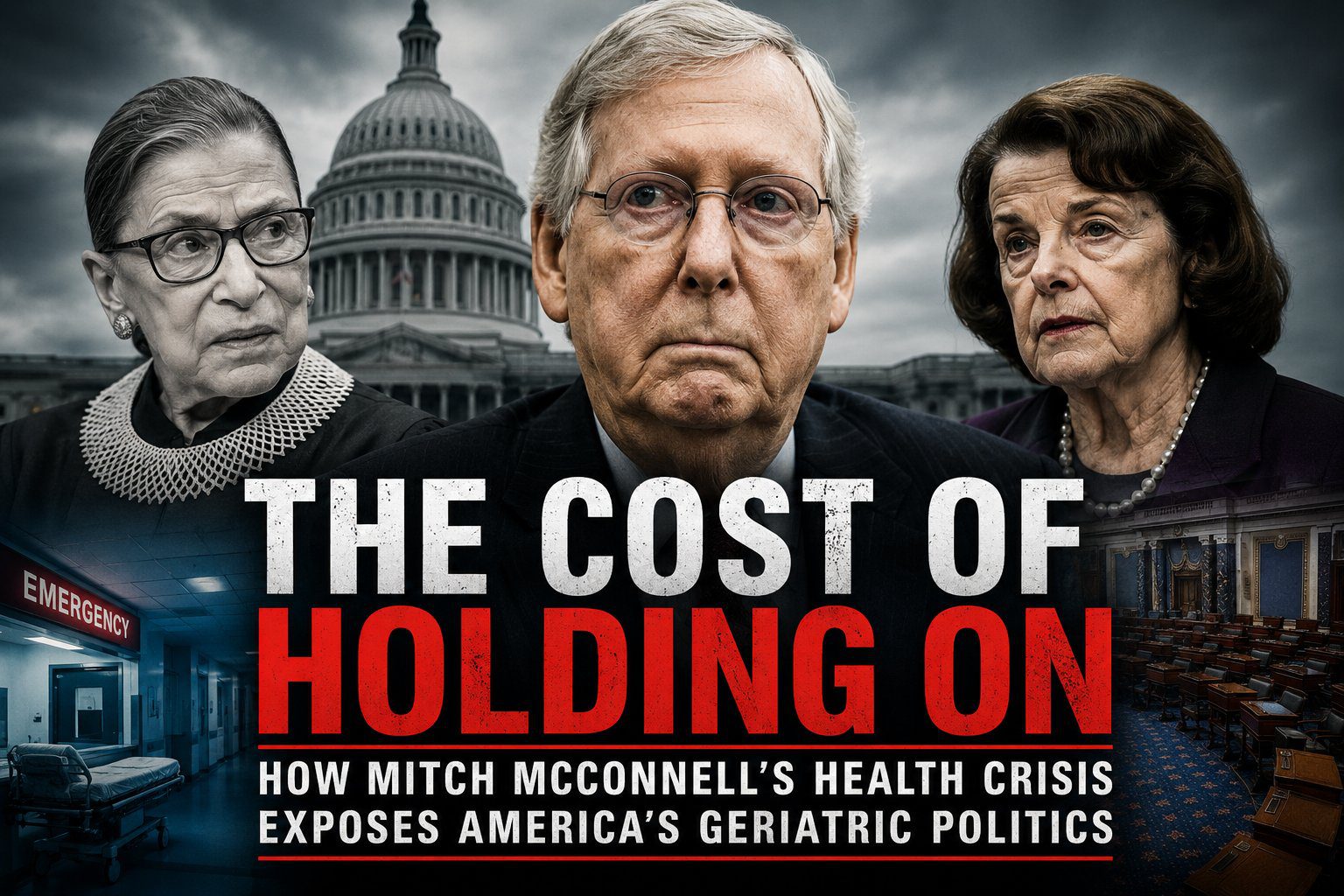
The Cost of Holding On
History often judges leaders not only by how they governed but by whether they recognized the right moment to step aside. For Ginsburg, delaying retirement arguably reshaped constitutional law for a generation. For Feinstein, declining health became a symbol of institutional dysfunction. For McConnell, regardless of his eventual recovery, weeks of uncertainty have renewed questions about how much government should depend on individuals whose health can suddenly become a national issue. The larger lesson transcends party politics.
Democracies require continuity, transparency and public confidence. When institutions become dependent on aging leaders whose health is increasingly uncertain, the country risks replacing representative government with governance conducted through staff offices and carefully worded press releases. As former British Prime Minister David Cameron once observed:
“The hardest thing in politics is to know when to leave. It’s like a great actor who stays on the stage too long until the audience starts to pity them.”
That observation may be one of the most enduring lessons of modern American politics, not because leaders grow old, but because too few know when their final act should end.




















































Want to join the conversation?
Create an account or sign in to share your thoughts, vote,
and reply to other readers.
Showing 0 of 0 comments
Don't have an account?
Already have an account?