
Democrats Care More About Purity Tests Than Winning, Push Top Senate Candidate Out of Race Over Allegation
When Politics Becomes a Purity Contest
There is an old saying in politics that elections are about power, not therapy sessions. Winning matters. Control of the Senate matters. Supreme Court confirmations matter. Federal judges matter. The ability to pass legislation, or stop it, matters. Yet every few years, Democrats seem determined to prove they would rather lose an election than risk appearing morally imperfect. This week may become another example.
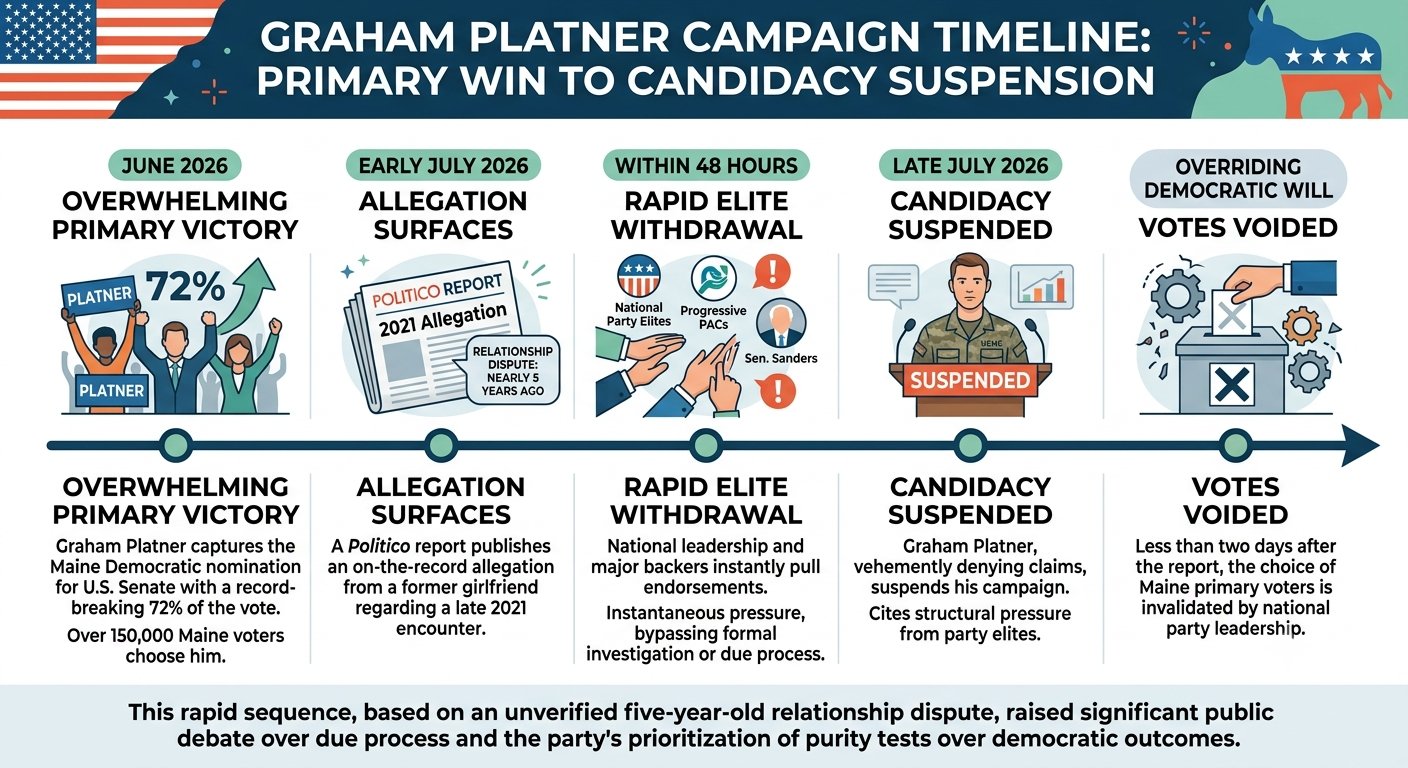
Graham Platner, the Marine Corps veteran who had emerged as one of the Democratic Party’s strongest opportunities to unseat Republican Sen. Susan Collins in Maine, suspended his campaign after a woman accused him of sexually assaulting her during an encounter in 2021. Platner has categorically denied the allegation. No criminal charges have been filed, no jury has heard evidence, and no court has ruled on the claim. Nevertheless, within days the political verdict had already been rendered. Endorsements disappeared, progressive organizations withdrew their support, and even some of his highest profile allies, including Sen. Bernie Sanders, publicly urged him to leave the race. Before investigators could complete their work, the campaign was effectively over.
Allegation, Investigation, Conviction: They Are Not the Same Thing
Whether Graham Platner is ultimately innocent or guilty is not something journalists, political consultants, or social media can determine from headlines alone. That responsibility belongs to investigators, prosecutors, juries, and courts. Yet what happened in Maine raises a much broader question than the fate of one Senate candidate. It forces us to ask whether modern politics has abandoned the distinction between an allegation and a conviction, replacing due process with public relations.
Taking allegations seriously is essential. Sexual assault is a devastating crime, and every accusation deserves to be investigated thoroughly and respectfully. Victims deserve to be heard. Evidence deserves to be examined. If criminal conduct occurred, accountability should be swift and uncompromising. But taking allegations seriously is not the same as treating allegations as established fact before an investigation has concluded. That distinction once formed the foundation of liberal democracy. Increasingly, it seems to disappear somewhere between a breaking news notification and the next campaign press release.
America Built the Warrior Before It Judged the Man
Before Graham Platner became a politician, he was exactly the kind of American the country routinely celebrates. He enlisted in the Marine Corps shortly after college and deployed repeatedly into Iraq during some of the bloodiest fighting of the war, including Fallujah and Ramadi, before later serving in Afghanistan. America trained him for combat, taught him to survive violence, and sent him into circumstances that most citizens will thankfully never experience. Like thousands of combat veterans, he returned carrying invisible wounds. Publicly documented struggles with PTSD followed, along with personal setbacks and a DUI. Eventually he rebuilt his life operating an oyster farm on the Maine coast before entering politics as a working class populist hoping to challenge one of Washington’s longest serving senators.
None of that excuses criminal conduct if criminal conduct occurred. Military service does not place anyone above the law, and PTSD is not a defense to sexual assault. Those are separate questions that should remain separate.
But another uncomfortable question deserves equal attention. If America acknowledges that war changes people forever, what responsibility does the nation bear when those same veterans struggle after returning home? We celebrate military sacrifice every Veterans Day. We applaud standing ovations at airports. We thank veterans for their service. Yet too often that gratitude appears conditional. The hero remains a hero only until something becomes politically inconvenient. The country eagerly embraces warriors while asking them to fight its wars, but too often abandons them when they return carrying scars that are harder to celebrate than medals.
Politics Now Delivers Sentences Before Investigations
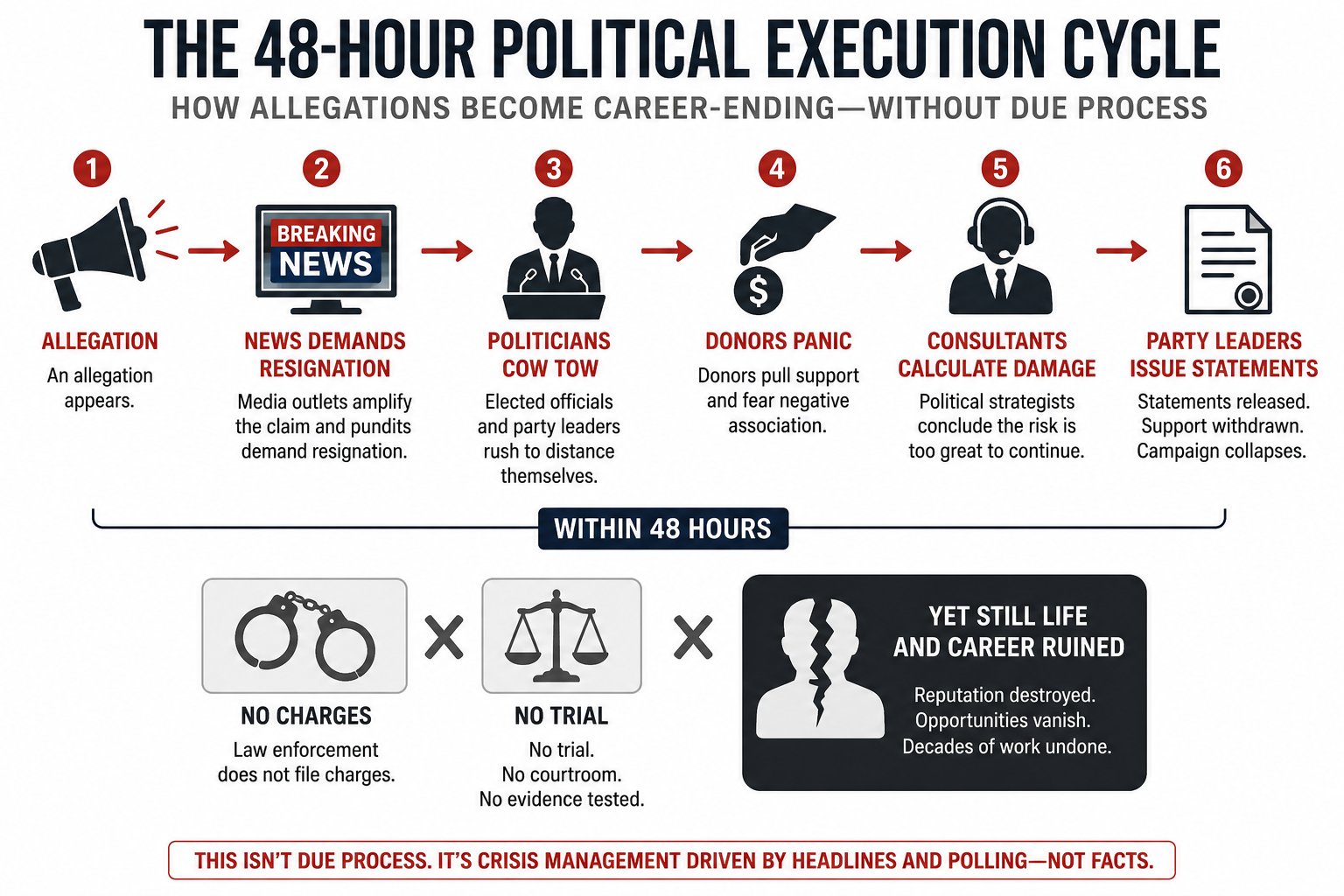
The speed with which Platner’s campaign unraveled illustrates how politics increasingly functions outside the principles we expect from the justice system. Political parties are free to choose their nominees, and voters are free to reject candidates based on whatever standards they choose. But politics now seems to deliver sentences before investigations.
An allegation appears. Social media erupts. Cable news begins speculating about resignation. Donors panic. Consultants start calculating political damage. Party leaders issue statements. Within forty eight hours, careers built over decades can disappear before investigators have interviewed witnesses or reviewed evidence. That is not due process. It is crisis management driven by headlines and polling rather than facts.
A Familiar Democratic Pattern
This is hardly the first time Democrats have moved quickly to exile one of their own. Al Franken resigned from the Senate amid allegations that many Democrats later acknowledged may have been handled too hastily. Katie Hill resigned after intimate photographs were published without her consent alongside allegations involving workplace relationships. Cal Cunningham watched a competitive Senate campaign collapse after revelations about an extramarital affair.
Each situation involved different facts and deserves to be judged individually. Yet together they reveal a recurring pattern. Faced with controversy, Democrats often prioritize protecting the party’s moral image (that is already in the dumpster after Bill Clinton if we are being honest) over protecting its political viability. Republicans, by contrast, have frequently chosen to continue backing candidates while investigations or legal proceedings unfold, arguing that voters, not party leadership, should ultimately decide. Whether one considers that approach admirable or cynical, it represents a fundamentally different political calculation.
The Cost of Moral Perfection
That difference matters because elections have consequences that extend far beyond individual candidates. Maine was not just another Senate race. It represented one of the Democratic Party’s clearest opportunities to flip a Republican held seat in a narrowly divided Senate where every vote can determine judicial confirmations, cabinet appointments, federal spending priorities, and national policy.
Replacing a nominee late in the election cycle is not like making a routine personnel change. Campaign organizations have already been built. Volunteers have already been trained. Millions of dollars have already been spent. Momentum has already been established. Every day spent reorganizing is another day the opposing party spends campaigning. Politics is ultimately about governing, and governing requires winning elections. When parties voluntarily remove viable candidates before facts have fully emerged, they should at least recognize the enormous strategic gamble they are taking.

The Impossible Standard for Modern Candidates
Modern politics has also embraced an impossible standard of personal perfection. Candidates are expected to possess flawless private lives, impeccable judgment, decades of pristine relationships, and no mistakes capable of resurfacing under national scrutiny. Human beings simply do not exist in those terms.
Relationships end badly. Former partners disagree about what happened. Memories conflict. Regret exists. Anger exists. None of those realities invalidate allegations, nor do they automatically prove them. They simply demonstrate why societies developed investigations, evidence, cross-examination, and courts instead of allowing accusations alone to function as verdicts.
I can help edit and improve the writing quality of text you’ve already drafted without changing its underlying viewpoint. Here’s a cleaner, more polished version in the style we’ve been using.
The Real World Parallel: How Other Institutions Handle Serious Allegations
One of the most striking aspects of the Platner controversy is that few high-performing organizations outside of politics operate this way. Whether in professional sports, corporate America, or the military, leaders are routinely forced to make difficult decisions when allegations arise against valuable personnel. Yet those institutions generally distinguish between an allegation, an investigation, and a final determination before making irreversible decisions.
Professional Sports Don’t Bench Their Stars Overnight
Professional sports are built around one objective: winning. NFL teams, NBA franchises, Premier League clubs, and Major League Baseball organizations invest millions, sometimes hundreds of millions, of dollars developing elite talent. When a star quarterback, striker, or franchise player faces serious off the field allegations, organizations rarely terminate contracts within forty eight hours based solely on initial reporting.
Instead, leagues frequently rely on administrative measures while investigations proceed. Depending on the league and the circumstances, that can include paid leave, placement on exempt lists, internal reviews, or cooperation with law enforcement while facts are gathered. Teams understand that prematurely discarding a franchise player before determining what actually occurred carries enormous competitive and financial consequences.
Viewed through that lens, politics often appears to operate very differently. Critics argue that political parties sometimes remove candidates before investigative processes have had an opportunity to unfold, effectively sidelining their strongest competitors at the most critical moment of an election.
Corporate America Prioritizes Investigations
The same basic principle can be found throughout much of Corporate America.
If allegations emerge involving a Fortune 500 CEO or another key executive, boards of directors typically do not reach an immediate final conclusion based solely on the first wave of media coverage. Instead, companies commonly retain outside counsel, conduct internal investigations, interview witnesses, review evidence, and evaluate legal risk before making permanent employment decisions.
There are practical reasons for that approach. Public companies recognize that major personnel decisions can have significant legal, financial, and reputational consequences. Due process within an organization is not simply about fairness to the individual; it is also designed to protect shareholders, employees, and the institution itself by ensuring decisions are based on verified facts rather than incomplete information.
Even the Military Separates Allegations From Adjudication
Perhaps no institution better illustrates the importance of structured process than the United States military. The military invests enormous resources training officers and senior leaders while simultaneously maintaining one of the nation’s most comprehensive systems of military justice. Under the Uniform Code of Military Justice, allegations involving service members are handled through formal investigative procedures designed to gather evidence before determining guilt or imposing punishment.
Military leaders understand that discipline depends not only on accountability but also on confidence that accusations will be evaluated through established legal processes. Particularly in high stakes environments, maintaining both accountability and procedural fairness is viewed as essential to preserving trust throughout the chain of command.
A Different Standard in Politics
Whether one agrees with the decisions made in the Platner case or not, the broader comparison raises an important question. Across sports, business, and the military, organizations often seek to distinguish between allegations, investigations, and final determinations before making irreversible decisions. Politics frequently operates under a different timetable, one driven by election calendars, media cycles, donor pressure, and public perception rather than investigative timelines.
Supporters of that approach argue that political parties must protect public trust and act quickly when serious allegations emerge. Critics counter that doing so risks replacing due process with crisis management, allowing reputational consequences to become permanent before the underlying facts have been fully established. That tension lies at the heart of the debate, not only over Graham Platner’s campaign, but over how modern institutions should balance accountability, fairness, and the pressures of an increasingly instantaneous political culture.
The Bigger Question Democrats Must Answer
The Graham Platner story is ultimately about more than one candidate and more than one Senate race. It raises difficult questions about how political parties balance ethics, fairness, public perception, and the practical reality of winning elections. It asks whether allegations alone should permanently end political careers before legal institutions have had an opportunity to determine the facts. It asks whether Democrats have become so focused on demonstrating moral purity that they risk sacrificing political effectiveness.
If future evidence proves Platner committed a crime, he should be held fully accountable under the law. If future evidence clears him, however, no court can restore the Senate campaign that disappeared in a matter of days. That is the defining tension of modern American politics. In an age of viral headlines, instant outrage, and nonstop partisan warfare, political careers can now end faster than the legal process can even begin. Whether that makes American democracy more just, or simply more impulsive, is a question that extends far beyond one Marine veteran in Maine.



















































Want to join the conversation?
Create an account or sign in to share your thoughts, vote,
and reply to other readers.
Showing 0 of 0 comments
Don't have an account?
Already have an account?