
Andrew and Tristan Tate’s Lawyers Challenge UK Extradition Push as Brothers Remain Jailed in Miami Facing 59 British Charges
Andrew and Tristan Tate’s legal team is opening a new front in the brothers’ increasingly complicated international legal battle, challenging Britain’s attempt to extradite them from the United States while separate criminal proceedings remain active in Romania.
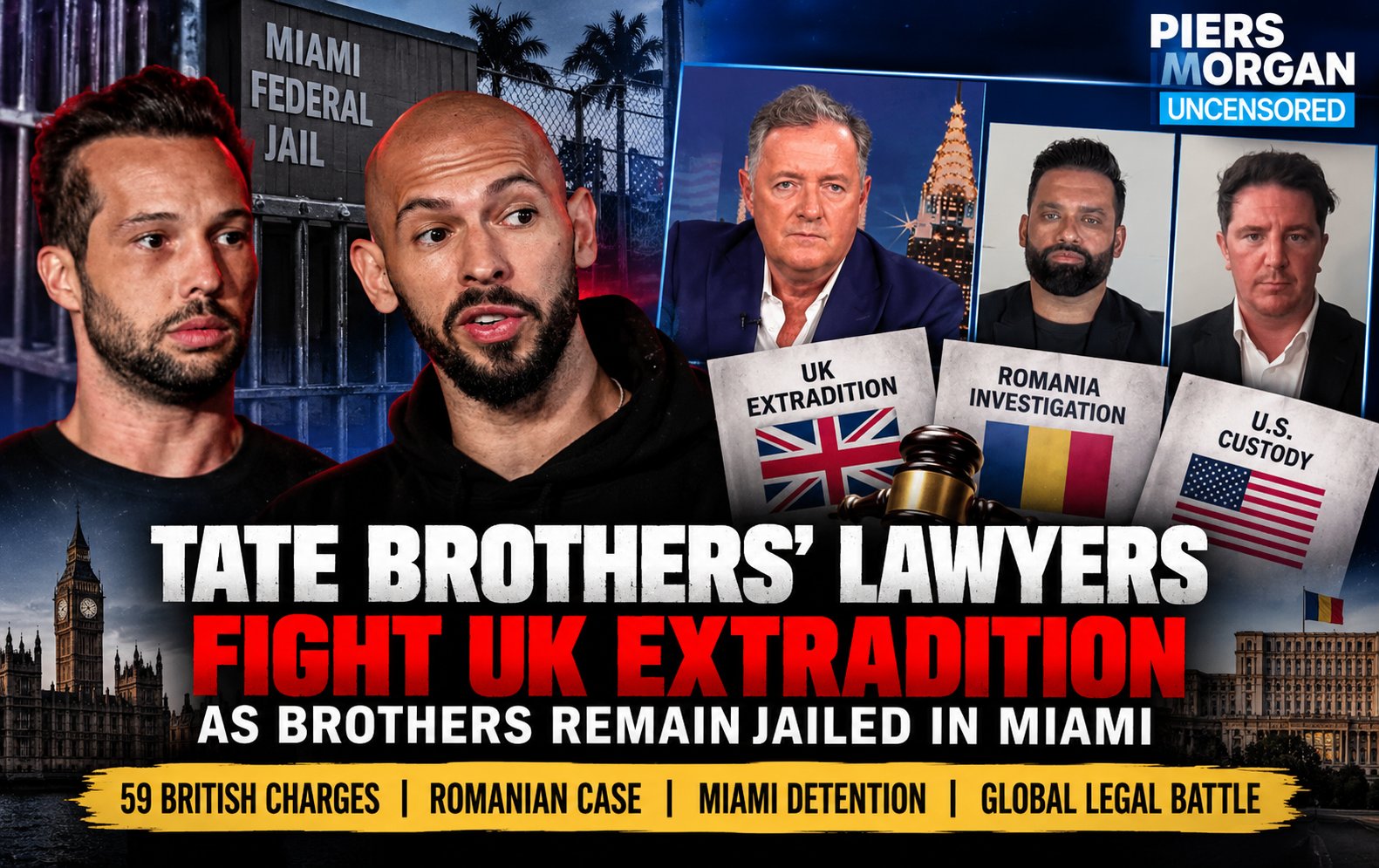
In a September 17 interview with Piers Morgan, British defense lawyers Andrew Ford and Adam Rasul of Holborn Adams said they had begun a judicial-review process challenging the United Kingdom’s decision to pursue extradition from the United States at this stage. Their central argument is not that the British allegations have already been disproven, but that Romania’s pending proceedings should be resolved first under the sequence established by a Romanian court in 2024.
The dispute comes at a pivotal moment for the Tate brothers. Andrew Tate, 39, and Tristan Tate, 38, were arrested in Miami on July 18 at Britain’s request and remain detained while contesting extradition. On September 9, U.S. Magistrate Judge Lauren Louis denied their requests for release, concluding that their wealth, resources and history of international travel made them substantial flight risks and that they had not demonstrated circumstances sufficient to justify release during the extradition proceedings.
At the same time, Romanian prosecutors have brought a new indictment involving allegations of trafficking minors, money laundering and other offenses, creating an extraordinary legal situation in which the brothers are confronting proceedings spanning Romania, Britain and the United States. The Tates deny wrongdoing.
The Defense Says Romania Should Come First
The central argument presented by Ford and Rasul concerns the sequence in which the international cases should proceed. Ford told Morgan that the defense had begun a judicial review process challenging the UK’s decision to seek extradition, pointing to a March 2024 Romanian ruling that approved eventual extradition to Britain only after Romanian proceedings were concluded.
That earlier Romanian decision is now at the heart of the defense strategy. The lawyers argue that Britain’s attempt to obtain the brothers directly from the United States effectively bypasses the sequence contemplated by the Romanian ruling and that Andrew and Tristan Tate should first return to Romania, where they would have the opportunity to defend themselves against the pending Romanian prosecution before any transfer to Britain occurs.
Ford argued that proceeding directly with British extradition could deprive the brothers of the opportunity to defend themselves in Romania and potentially interfere with their ability to defend themselves in Britain. Judicial review, however, examines the lawfulness of a public authority’s decision; it is not a trial of the underlying criminal allegations. The argument also does not itself resolve the American extradition case. The United States is dealing with a British request involving defendants physically detained on American soil, while the defense is attempting to use the earlier Romanian proceedings and extradition decision to challenge Britain’s current approach.
The British Case Has Grown to 59 Charges
The interview also underscored the scale of the British prosecution now confronting the brothers. Hertfordshire Constabulary said after their July arrests that prosecutors had authorized 38 additional charges, bringing the combined total against Andrew and Tristan Tate to 59 — 42 against Andrew and 17 against Tristan.
The Crown Prosecution Service says the newer allegations concern four additional alleged victims and conduct said to have occurred between July 2010 and August 2017. Prosecutors authorized seven additional rape counts against Andrew Tate, three counts of arranging or facilitating trafficking for sexual exploitation, three counts of assault occasioning actual bodily harm and 19 additional charges involving indecent images of a child and extreme pornography. Tristan Tate faces additional allegations including two counts of rape, one count of sexual assault and three counts of arranging or facilitating trafficking for sexual exploitation.
Those newer allegations are being pursued alongside 21 previously authorized British charges. According to information provided in connection with the extradition proceedings, Andrew Tate is wanted on allegations that include 10 rape counts, three counts of arranging or facilitating trafficking for sexual exploitation and three counts of assault occasioning actual bodily harm, as well as offenses involving indecent images of a child and extreme pornography. Tristan Tate faces allegations including five rape counts, six counts of assault occasioning actual bodily harm, three trafficking related counts and one count of sexual assault.
The allegations are not findings of guilt. The Tate brothers have denied wrongdoing and have not yet appeared before a British criminal court to enter pleas to the charges.
Extradition Is Not a Trial on the Underlying Allegations
That distinction is essential because the American extradition proceeding is not itself a criminal trial determining whether Andrew or Tristan Tate committed the alleged offenses. The federal proceedings concern whether the legal requirements for surrendering them to Britain have been satisfied under U.S. law and the applicable extradition treaty.
The September 9 federal detention order expressly noted that the proceeding before the court at that stage did not concern whether Britain’s extradition request should ultimately be granted. The case was still in its preliminary phase, and the immediate question was whether the brothers should remain detained while the extradition process moved forward.
Some public discussion surrounding the Tate cases has blurred detention decisions, extradition proceedings, indictments and criminal adjudications into a single process. They are legally distinct. A detention ruling does not establish guilt, an indictment does not establish guilt, and certification for extradition would not amount to a criminal conviction.
A Miami Judge Has Already Rejected Their Request for Release
The brothers suffered a significant procedural defeat on September 9 when Judge Louis denied their motions for release pending extradition following an August 27 hearing in Miami federal court. The court considered testimony from the brothers and other witnesses, including Ford, who appeared as a sworn witness to explain aspects of the foreign proceedings. Louis concluded that the Tates had not overcome the strong presumption favoring detention in international extradition cases. In assessing flight risk, the court focused heavily on the brothers’ financial resources, international mobility and ability to travel across jurisdictions.
Reuters reported that Louis described them as “quintessential flight risks,” writing that even if the brothers did not possess all of the extravagant holdings portrayed through their online personas, the record demonstrated an exceptional capacity to flee the jurisdiction. The ruling means Andrew and Tristan Tate remain incarcerated in Miami while the extradition process continues. Importantly, the September 9 order did not determine whether they should ultimately be extradited and did not adjudicate their guilt or innocence.
Their Wealth and International Mobility Became Part of the Detention Fight
The Tates’ highly publicized image of extraordinary wealth and international mobility has become legally relevant in a way that cuts directly against one of the central themes of their online personas. During the detention dispute, prosecutors pointed to their financial resources and international connections in arguing that they represented substantial flight risks. The defense sought to distinguish the public personas cultivated by the brothers online from their actual circumstances, describing some of their representations of wealth as theatrical or exaggerated and arguing that their enormous public visibility would make successfully disappearing extraordinarily difficult.
Judge Louis was not persuaded that those considerations eliminated the risk of flight. The court concluded that whatever differences might exist between the brothers’ online characters and their actual finances, the evidence demonstrated that they possessed substantial resources and an unusual capacity for international movement.
For years, Andrew Tate’s online brand has emphasized wealth, luxury vehicles, geographic freedom and the ability to operate internationally. In an extradition proceeding, however, those characteristics can become liabilities because courts assessing flight risk consider whether defendants have the resources, connections and mobility necessary to leave the jurisdiction.
Romania Has Added Another Major Criminal Case
The international picture became even more complicated in early September when Romania’s anti-organized crime agency, DIICOT, announced a new indictment involving both brothers. Romanian prosecutors indicted Andrew Tate on allegations including trafficking minors, sex with a minor and money laundering, while Tristan Tate was indicted for complicity in the case. Reuters additionally reported that Andrew was indicted on a witness-tampering allegation.
Prosecutors allege the brothers used romantic deception to recruit and exploit women and girls for an online webcam operation. One allegation concerns a girl prosecutors say was 15 when she was recruited in Luton, England, and subsequently transported to Romania, where authorities allege more than $1.2 million was generated from her webcam activity. Prosecutors have also alleged that luxury automobiles were purchased as part of a money laundering operation.
The allegations are extremely serious, but they remain allegations. Neither Andrew nor Tristan Tate has been convicted in connection with the newly filed Romanian charges, and the brothers deny criminal wrongdoing.
The procedural history in Romania is equally important. The brothers were originally arrested in Bucharest in December 2022 and formally indicted in 2023. In 2024, a Romanian court returned that earlier case to prosecutors after finding legal and procedural irregularities. That action was not an acquittal and did not constitute a judicial determination that the underlying allegations were false. That distinction has frequently been lost in the public debate surrounding the Tates, where procedural victories have sometimes been characterized as complete exonerations and prosecutorial allegations have sometimes been presented as established facts. Neither characterization accurately reflects the legal record.
The Defense Is Trying to Turn Romania Into a Procedural Barrier
The strategy outlined by Ford and Rasul is therefore more specific than simply attacking witnesses or arguing that the prosecution has been driven by media attention. Their immediate argument is procedural: Romania previously approved extradition to Britain after its own proceedings were completed, Britain is now attempting to obtain the brothers from the United States while Romanian criminal proceedings remain unresolved, and the defense wants British courts to examine whether the government can lawfully proceed in that manner.
That has produced an unusual three-country legal confrontation. Romania has active criminal proceedings involving the brothers, Britain wants them extradited to face a large criminal prosecution of its own, and the United States currently has physical custody of them. The judicial review challenge could therefore become important even though it does not directly determine whether any of the underlying sexual-assault, trafficking or other criminal allegations are true.
Britain Has Formally Moved for Extradition
There has also been a significant development since the brothers’ September 9 detention ruling. Britain subsequently lodged its formal extradition request with the U.S. State Department. According to reporting on the extradition process, the State Department is reviewing the British submissions for compliance with the U.S.-UK extradition treaty. The matter would then proceed through the Justice Department and the federal court process.
The brothers’ American lawyer, Joseph McBride, has said the defense will challenge the requests, arguing that the British submissions do not contain information required under the extradition agreement. That contention has not yet been adjudicated. This matters because the September 9 detention order was issued while the formal extradition paperwork was still being assembled. The case has since advanced beyond the provisional-arrest stage, although the central extradition dispute remains unresolved.
The Interview Also Put the Defense Strategy Under Scrutiny
The Piers Morgan interview did not simply provide the Tate lawyers with an uncontested platform. Morgan pressed the attorneys about the seriousness of the allegations and questioned elements of the brothers’ broader defense operation, including the public role played by McBride. That broader media strategy is significant because the Tate defense has unfolded simultaneously in courtrooms and across social media, podcasts, television interviews and the brothers’ enormous online platforms. Public advocacy may shape perceptions of the case, but it does not substitute for what happens in court.
Extradition proceedings operate under legal standards established by statute and treaty. Viral clips, political arguments, declarations of innocence and public accusations against prosecutors do not determine whether extradition requirements have been satisfied, whether evidence will ultimately be admissible or whether prosecutors can prove criminal charges beyond a reasonable doubt.
What Happens If the Judicial Review Fails?
If the defense cannot stop or alter Britain’s extradition effort through judicial review, the brothers can continue contesting the request through the American federal extradition process. That process could take months. The immediate issue before an American extradition court is not whether a U.S. jury believes the underlying British allegations. The court instead determines whether the requirements for extradition have been satisfied under the treaty and applicable U.S. law. Ultimate guilt or innocence is ordinarily reserved for the courts of the country seeking prosecution.
The September 9 detention decision demonstrates that the American court is already treating the extradition proceedings independently from the criminal cases abroad. Andrew and Tristan Tate therefore face several legal fronts that overlap but are not interchangeable: detention proceedings in Miami, Britain’s formal extradition request, the defense’s judicial-review challenge in the United Kingdom, pending Romanian criminal proceedings and the underlying British prosecution that would follow if extradition ultimately occurs.
The Tate Case Has Become an International Legal Maze
What began several years ago as a Romanian investigation has developed into a sprawling transatlantic legal confrontation. The brothers are sitting in a Miami federal detention facility. Britain wants them returned to face a combined 59 charges. Romania has filed a new indictment. Their British attorneys are challenging the timing and legality of the UK’s extradition strategy, while their American lawyers are fighting the proceedings in federal court.
The defense argument presented to Piers Morgan is therefore narrower, and legally more consequential, than the familiar public debate over whether someone believes Andrew and Tristan Tate. The immediate international question is which legal process moves forward first and whether Britain can obtain the brothers from the United States while Romania’s prosecution remains unresolved.
For now, Andrew and Tristan Tate remain detained in South Florida, their request for release has been denied, Britain has formally moved to extradite them, Romania has active criminal proceedings, and the battle over where the brothers will ultimately stand trial remains unresolved.

Sources & Further Reading
Reuters — Tate Brothers Lose Bid for Release From U.S. Jail Pending Extradition
ITV News — Tate Brothers’ Lawyers Plan Judicial Review of UK Extradition Bid
Crown Prosecution Service — Additional Sexual-Offense Charges Against Andrew and Tristan Tate
Hertfordshire Constabulary — 59 Charges Authorized Against Andrew and Tristan Tate
Courts and Tribunals Judiciary — Andrew Tate and Tristan Tate v. Director of Public Prosecutions














































Want to join the conversation?
Create an account or sign in to share your thoughts, vote,
and reply to other readers.
Showing 0 of 0 comments
Don't have an account?
Already have an account?