

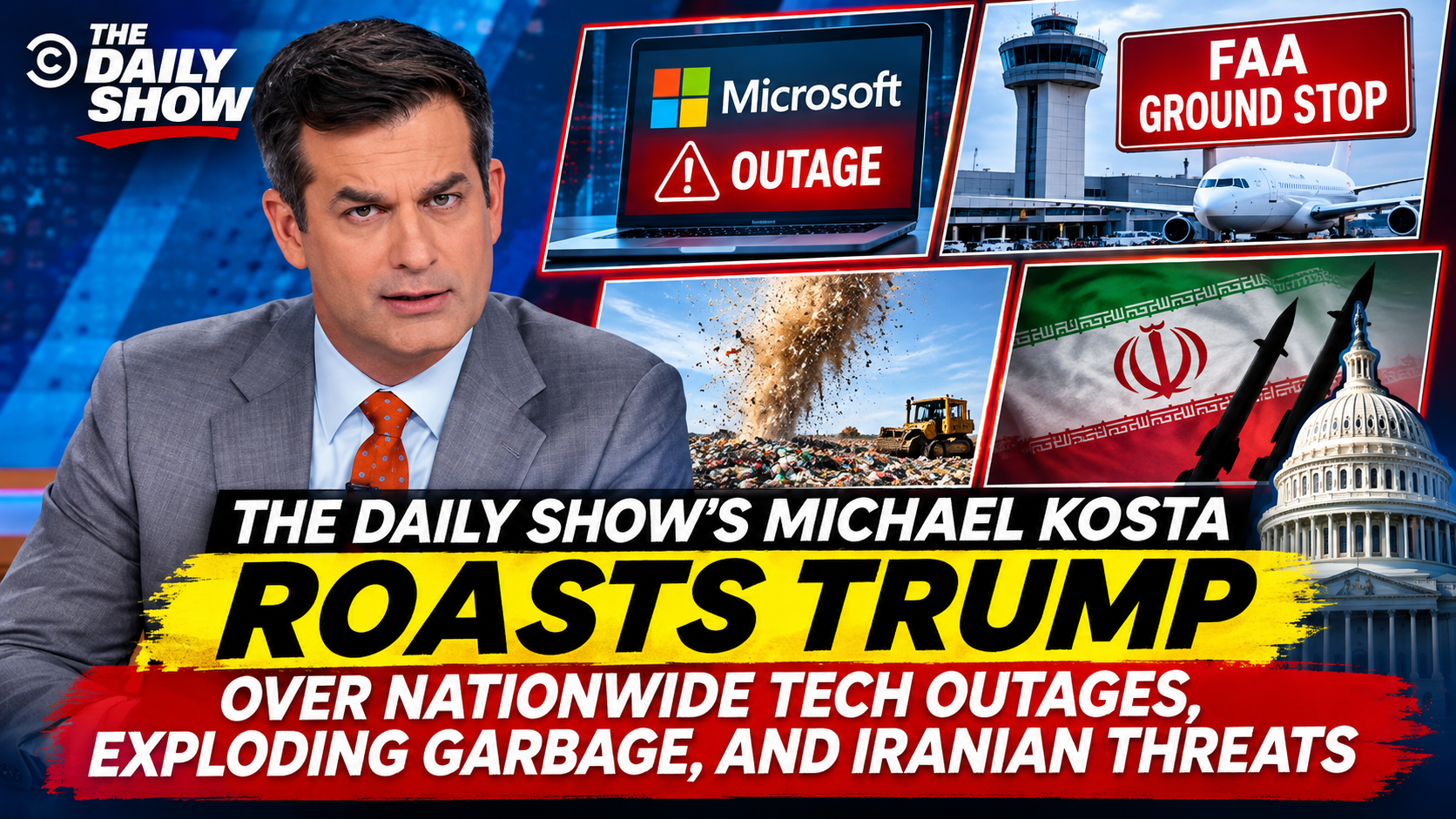
The Daily Show’s Michael Kosta Roasts Trump’s Response to Nationwide Tech Outages, Exploding Garbage, and Iranian Threats
As America’s technology infrastructure suffers a wave of disruptions, President Donald Trump shrugs off the chaos, his Homeland Security secretary offers a mysterious explanation involving “SI,” and reports of Iranian threats send senior administration officials scrambling for protection. Michael Kosta asks whether the country is witnessing the beginning of the end or simply another week in America.
America’s airports are experiencing major disruptions, banking customers are struggling with technology failures, cloud services are going offline, and government officials are offering explanations that seem to raise almost as many questions as they answer. For The Daily Show host Michael Kosta, the convergence of technological breakdowns, environmental disasters, and escalating national security threats presents an unsettling question: Is this how America finally falls apart?
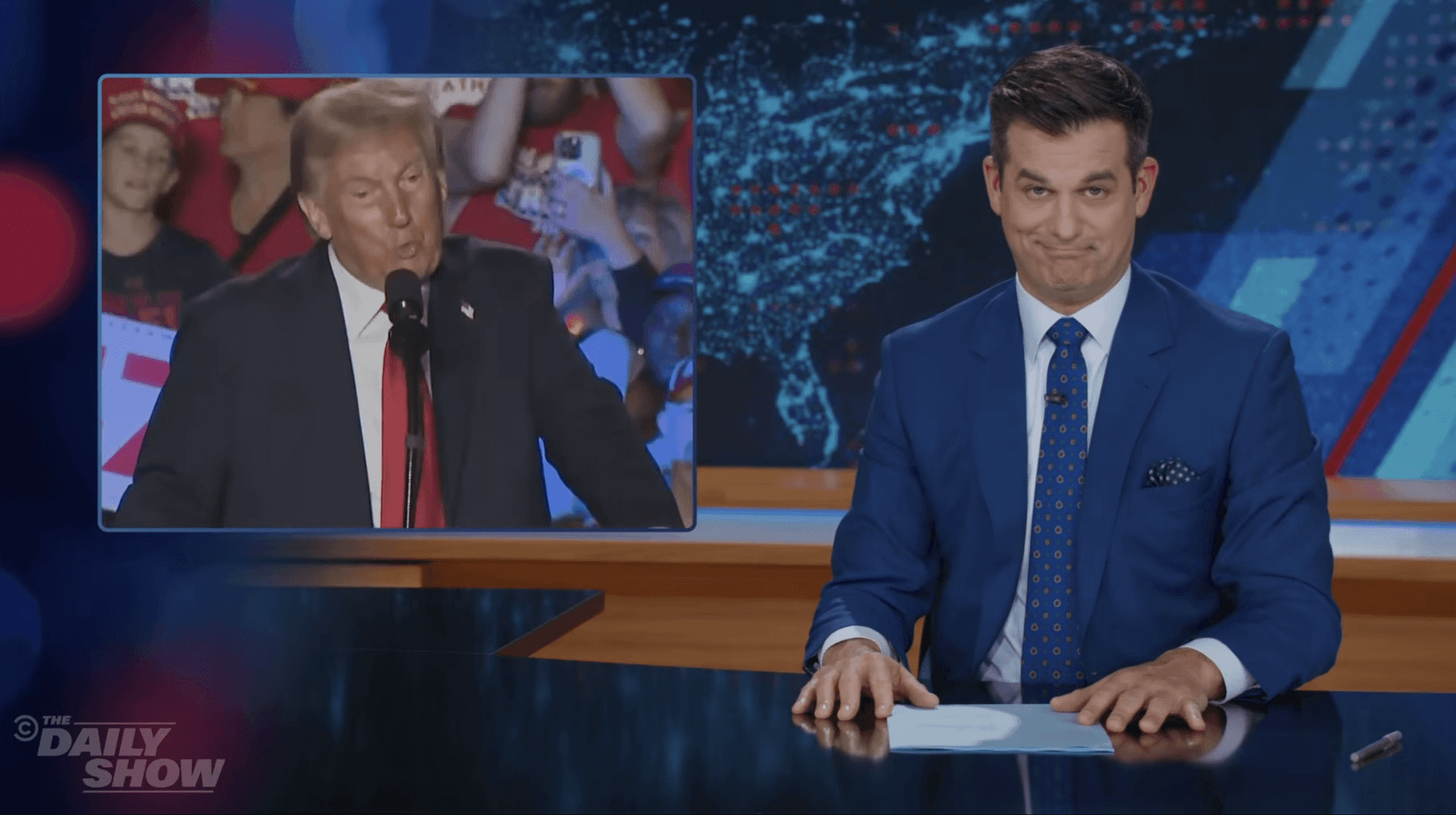
During a segment titled Is This How We Die?, Kosta examined a remarkable series of reported infrastructure failures involving Microsoft, the Federal Aviation Administration, United Airlines, JPMorgan Chase, Apple, and several government services. The comedian used the incidents to expose what he portrayed as a growing disconnect between the seriousness of America’s infrastructure problems and the casual, sometimes bewildering responses coming from the Trump administration. But the technology failures were only the beginning. Kosta also turned his attention to Homeland Security Secretary Markwayne Mullin’s unusual explanation for the disruptions, President Donald Trump’s dismissive reaction, an extraordinary eruption of decomposing garbage at a California landfill, and reports that Iranian threats had prompted senior administration officials to seek protection at military installations.
The result was a blistering examination of an America seemingly overwhelmed by technological fragility, political indifference, environmental hazards, and international tensions, with Kosta using comedy to underscore the uncomfortable reality that many of these problems have consequences far beyond Washington.
America’s Technology Systems Are Failing, and Nobody Seems to Have a Complete Explanation
Kosta opened by highlighting the extraordinary concentration of technology disruptions reported across the United States within days of one another. Microsoft experienced problems affecting cloud based services, the FAA ordered a rare nationwide ground stop, United Airlines suffered operational technology disruptions, and JPMorgan Chase customers encountered banking problems. Reports of additional service interruptions involving Apple, the National Weather Service, and the National Security Agency added to the sense that America’s digital infrastructure was experiencing an unusually chaotic period.
The incidents involved different organizations and technological systems, and there is no established evidence that they resulted from a single coordinated attack. Nevertheless, their proximity raised legitimate questions about the resilience of the infrastructure supporting modern American life. Airlines depend on complex dispatch and communications networks, financial institutions rely on interconnected transaction processing systems, and government agencies operate through a combination of aging equipment, modern cloud services, and third party contractors.
Kosta seized on the apparent absurdity of so many essential services experiencing problems within such a short period. The segment played on the anxiety that emerges when the systems Americans depend on every day suddenly become unreliable, particularly when the public receives incomplete or highly technical explanations for the failures.
Federal officials reportedly found no evidence linking the disruptions to foreign interference, a conclusion Kosta turned into a joke about America’s ability to undermine its own infrastructure without outside assistance. Beneath the punchline was a serious observation: A country does not necessarily need a hostile foreign government to experience widespread disruption when its own technology systems are aging, interconnected, and vulnerable to cascading failures.
That distinction matters because the absence of evidence of a cyberattack does not automatically establish that every malfunction has been fully explained. Determining why individual systems failed, whether they shared vulnerabilities, and whether existing safeguards performed as intended requires detailed technical investigations rather than broad public assurances.
Homeland Security Secretary Markwayne Mullin Blames a Mysterious Technology Problem Called “SI”
One of the segment’s most memorable moments involved Homeland Security Secretary Markwayne Mullin, whose explanation for the technology disruptions became an immediate target for Kosta’s ridicule.
Mullin described speaking with an unnamed technology expert who allegedly suggested that the failures were related not to artificial intelligence, commonly known as AI, but to something he called “SI.” According to the explanation presented in the segment, the problem involved technological systems operating at speeds or levels of complexity that existing infrastructure was not designed to accommodate. Rather than providing a detailed technical explanation, Mullin relied on the authority of an unidentified expert, leaving viewers without a clear understanding of what the term meant or how it related to the specific outages. Kosta mocked the mysterious source, portraying the secretary’s account as an example of government officials invoking technical expertise without offering enough information for the public to evaluate their claims.
There is a legitimate technological issue beneath the comedy. Legacy infrastructure can struggle when connected to modern applications, faster networks, automated software processes, and increasingly complex digital systems. Equipment that functioned adequately for decades may become vulnerable when integrated into environments that impose different performance demands or introduce unexpected dependencies. However, that general problem does not establish that outdated infrastructure caused every disruption highlighted in the segment. Without incident-specific technical findings, a broad explanation involving technological complexity remains a theory rather than a demonstrated cause.
Kosta’s criticism was directed at precisely that gap between government explanations and verifiable evidence. When essential services fail, Americans need to know what happened, why protective systems did not prevent the disruption, and what officials intend to do about it. References to unnamed experts and vaguely defined technological concepts are unlikely to satisfy those concerns.
Trump Shrugs Off the Chaos: “It’s Life”
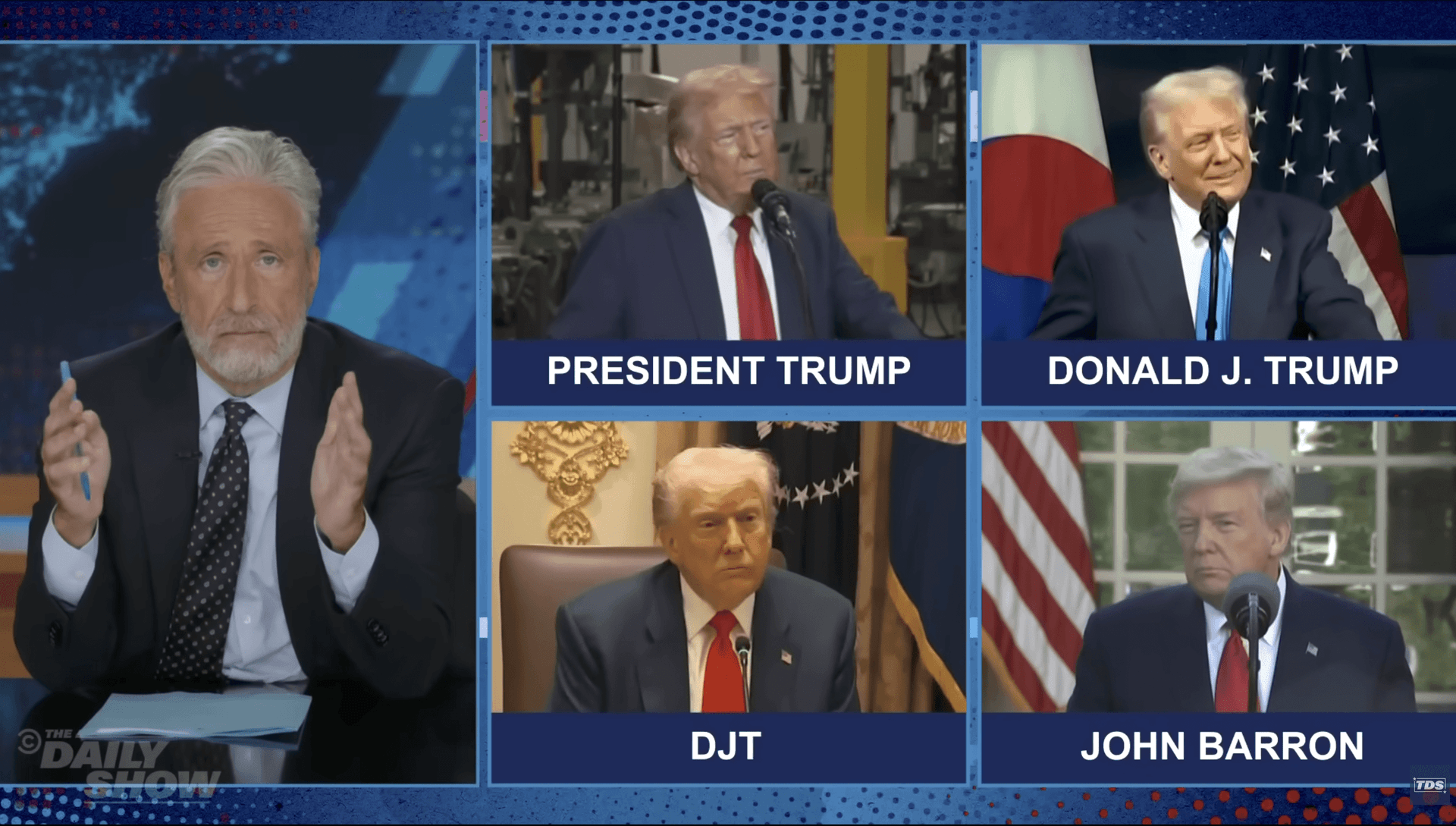
President Donald Trump’s reaction to the technology disruptions provided Kosta with another opportunity to contrast the administration’s attitude with the experiences of ordinary Americans. When asked about the wave of outages affecting banking services, commercial aviation, and major technology platforms, Trump appeared largely unconcerned. In remarks featured during the segment, the president characterized such disruptions as an unavoidable part of life, suggesting that problems of this nature occur even in powerful and wealthy countries.
Kosta immediately challenged that attitude, pointing out the considerable distance between the president’s lifestyle and the daily realities of people who depend on commercial airlines, online banking, email, and digital communications. Trump travels aboard government aircraft, has extensive administrative support, and operates within an environment where technological inconveniences can often be handled by other people.
For ordinary Americans, however, a technology failure can mean a missed flight, an interrupted paycheck, a delayed financial transaction, or an inability to access essential services. A nationwide aviation shutdown can disrupt thousands of travel plans, while problems at major financial institutions can prevent customers from accessing funds or completing time-sensitive transactions.
The comedian’s criticism went beyond Trump’s personal response. It highlighted a broader political problem in which disruptions affecting millions of people can be dismissed as routine inconveniences by officials insulated from their consequences.
The administration’s reaction also came amid ongoing questions about the modernization of America’s aviation infrastructure. The FAA has spent years struggling with aging communications systems, outdated equipment, staffing pressures, and the enormous technical challenges involved in maintaining one of the world’s busiest aviation networks. Modernizing those systems requires substantial investment, careful testing, and effective oversight. Simply accepting major outages as an inevitable part of life does little to address the structural weaknesses that make them possible.
California’s Exploding Garbage Geyser Takes the Disaster to Another Level
Just when the segment appeared to have exhausted America’s technological problems, Kosta shifted to a different kind of infrastructure nightmare: a massive eruption of decomposing garbage at Southern California’s Chiquita Canyon Landfill.
According to the incident described during the broadcast, crews drilling at the landfill encountered a pressurized pocket of gas, sending a towering fountain of wet debris and decomposing waste into the air. The extraordinary scene provided the kind of visual spectacle that practically writes its own late night comedy material, particularly during a segment already focused on the apparent breakdown of essential systems.
Kosta responded with a joke about Health and Human Services Secretary Robert F. Kennedy Jr., imagining him placing his mouth over the eruption as though drinking from a garden hose. The punchline drew on Kennedy’s controversial public image and the administration’s unconventional approach to some public health issues.
Behind the grotesque imagery, however, landfill gas accumulation is a legitimate environmental and engineering concern. Decomposing organic waste produces methane and other gases that must be carefully managed through collection systems, pressure monitoring, and environmental controls. When those systems fail or unexpected underground conditions develop, the consequences can include dangerous gas releases, fires, structural instability, and environmental contamination.
The Chiquita Canyon Landfill has faced longstanding environmental scrutiny involving subsurface heating, gas emissions, odors, and concerns raised by nearby communities. The incident highlighted by Kosta added another disturbing image to a facility already associated with serious questions about waste management and environmental oversight.
For The Daily Show, the eruption offered an almost absurdly literal metaphor for the week’s events: While America’s technology systems were breaking down, the ground itself appeared to be launching garbage into the sky.
Reports of Iranian Threats Raise Fears of Attacks Against Trump Administration Officials
The segment took a darker turn when Kosta addressed reports that U.S. intelligence officials were investigating potential Iranian threats against senior members of the Trump administration.
According to the reports discussed on the program, intelligence assessments included concerns about possible assassination plots and the potential use of a radiological dispersal device, commonly called a dirty bomb, in Washington, D.C. Such a weapon combines conventional explosives with radioactive material and is designed primarily to spread contamination, generate fear, and disrupt populated areas rather than produce a nuclear explosion.
The distinction is important because a dirty bomb is not a nuclear weapon, and intelligence reporting about a possible threat does not establish that an operational attack plan exists. Assessments often involve incomplete information, uncertain intentions, and multiple possible scenarios that investigators must evaluate before determining whether a threat is credible and actionable.
Kosta focused on the cautious, conditional language commonly used in intelligence reporting, mocking descriptions of adversaries who might be considering, discussing, or potentially preparing an attack. His joke captured the frustration that can arise when government officials warn of frightening possibilities while providing few concrete details about how likely those scenarios are to occur.
Nevertheless, threats against senior U.S. officials are serious national security matters, particularly amid heightened tensions between Washington and Tehran. American intelligence and law enforcement agencies have previously investigated alleged Iranian plots targeting current and former government officials, making any new warnings a matter requiring careful evaluation. The specific allegations presented during the segment, including the reported dirty-bomb scenario, should be understood as intelligence concerns rather than confirmed evidence of an imminent attack.
Cabinet Officials Reportedly Seek Protection at Military Installations
The reported Iranian threats became even more politically significant when Kosta discussed claims that several senior administration figures had relocated to military installations for security reasons. The officials named in the segment included Todd Blanche, Treasury Secretary Scott Bessent, Secretary of State Marco Rubio, Stephen Miller, and Defense Secretary Pete Hegseth. Their reported relocation was presented as a precautionary response to concerns about potential threats against high-ranking government personnel.
The circumstances surrounding individual security arrangements were not independently established in the material reviewed for this article. Nevertheless, the reported precautions formed an important part of the segment’s larger argument about the growing sense of instability surrounding the administration. Senior government officials routinely receive varying levels of security protection based on their responsibilities, threat assessments, and intelligence information. Relocation to a protected federal or military facility can be one precaution among several and does not necessarily indicate that authorities believe an attack is imminent.
Kosta used the reports to highlight the contrast between an administration projecting strength abroad and officials reportedly taking extraordinary measures to protect themselves at home. The tension between those two images provided a natural transition into the program’s final comedic segment.
Josh Johnson Reports From “Tehran” With Iran’s Most Ridiculous Threats Yet
The Daily Show correspondent Josh Johnson joined the program in a satirical report presented as though he were broadcasting from Tehran, offering an exaggerated account of Iranian threats against American officials. Rather than focusing on conventional military warnings or diplomatic statements, Johnson imagined a bizarre propaganda campaign in which Iranian billboards displayed highly specific, humiliating, and often absurd messages directed at members of Trump’s Cabinet.
The jokes targeted officials including Scott Bessent and Pete Hegseth, replacing traditional geopolitical intimidation with personal insults and increasingly ridiculous scenarios. One imagined threat involved hanging Bessent by his chest, while another sarcastically praised Hegseth’s handling of military affairs.
The fictional billboards and messages were comedic inventions, not actual Iranian government communications. Johnson’s performance satirized the theatrical nature of political intimidation and the sometimes surreal language surrounding international confrontations.
The segment also provided a reminder of the show’s ability to shift rapidly between serious reporting and outrageous comedy. Intelligence warnings about possible attacks are legitimate subjects of public concern, but the program used absurdity to expose how quickly geopolitical tensions can become entangled with political personalities, media spectacle, and public anxiety.
The Bigger Story: America Is Facing a Crisis of Infrastructure and Public Confidence
Although Kosta’s segment moved between technology failures, environmental disasters, and international security threats, the underlying theme was the same: Americans are increasingly being asked to trust institutions that often struggle to explain what is happening.
The reported technology outages raised questions about whether the country’s digital infrastructure is sufficiently resilient. The FAA disruption demonstrated the potentially enormous consequences of failures within critical transportation systems, while problems affecting banking and cloud services exposed the dependence of everyday economic activity on complex software networks.
The California landfill incident illustrated another dimension of infrastructure risk, highlighting the environmental consequences that can emerge when waste management systems encounter dangerous conditions. Meanwhile, reports of Iranian threats underscored the continuing responsibility of federal agencies to protect public officials and respond to national security concerns without unnecessarily inflaming public fear.
None of these developments proves that America is experiencing a coordinated national breakdown. The incidents involve different causes, different agencies, and different levels of verified information. However, their appearance within the same news cycle created a powerful illustration of how many essential systems require constant maintenance, competent management, and public accountability.
That is what made Kosta’s comedy effective. The jokes were outrageous, but the anxieties behind them were recognizable. People expect airplanes to fly, banks to function, government officials to provide credible explanations, and critical infrastructure to operate without catastrophic interruptions. When those expectations are repeatedly challenged, public confidence can deteriorate even when individual failures have perfectly ordinary technical explanations.
Michael Kosta’s Question Is Funny, but America’s Infrastructure Problems Are Not
The title of the segment, Is This How We Die?, was deliberately exaggerated, transforming a chaotic collection of news stories into an apocalyptic comedy routine. But beneath the satire was a serious question about the ability of American institutions to manage increasingly complex risks.
The United States possesses extraordinary technological resources, vast financial wealth, and some of the world’s most sophisticated engineering capabilities. Yet its essential systems remain vulnerable to software failures, equipment malfunctions, environmental hazards, and security threats that can disrupt daily life with little warning.
Kosta’s criticism of Trump and his administration centered on the difference between acknowledging those problems and dismissing them. Government leaders cannot prevent every technological malfunction or environmental emergency, but they can demand rigorous investigations, invest in effective safeguards, communicate clearly with the public, and hold responsible institutions accountable.
The episode ultimately succeeded because it connected a series of seemingly unrelated disasters through a familiar American frustration: The country has the resources to build extraordinary systems, yet too often struggles to maintain the ones it already has. And while The Daily Show may not have answered whether America is approaching some grand technological apocalypse, Kosta made one thing clear: If the nation’s essential systems continue failing while its leaders offer vague explanations and casual dismissals, the comedians will have plenty of material. The rest of the country will be left dealing with the consequences.

Sources & Further Reading
The Daily Show — Michael Kosta, “Is This How We Die?”
Watch the Full Segment on YouTubeU.S. Senate Commerce, Science and Transportation Committee — Congressional Oversight of FAA Infrastructure
Senate Commerce CommitteeFederal Aviation Administration — Air Traffic Control and National Airspace System
FAA Official WebsiteU.S. Cybersecurity and Infrastructure Security Agency — Critical Infrastructure Security
CISA Official WebsiteU.S. Environmental Protection Agency — Landfill Gas and Environmental Management
EPA Landfill Methane Outreach ProgramSFL Media — National News, Politics, Technology, and Entertainment







Loading comments…