
FBI Anti-Corruption Probe Examined Susan Collins Linked Fundraising Before Trump Era Purge Derailed Broader Bribery Investigation
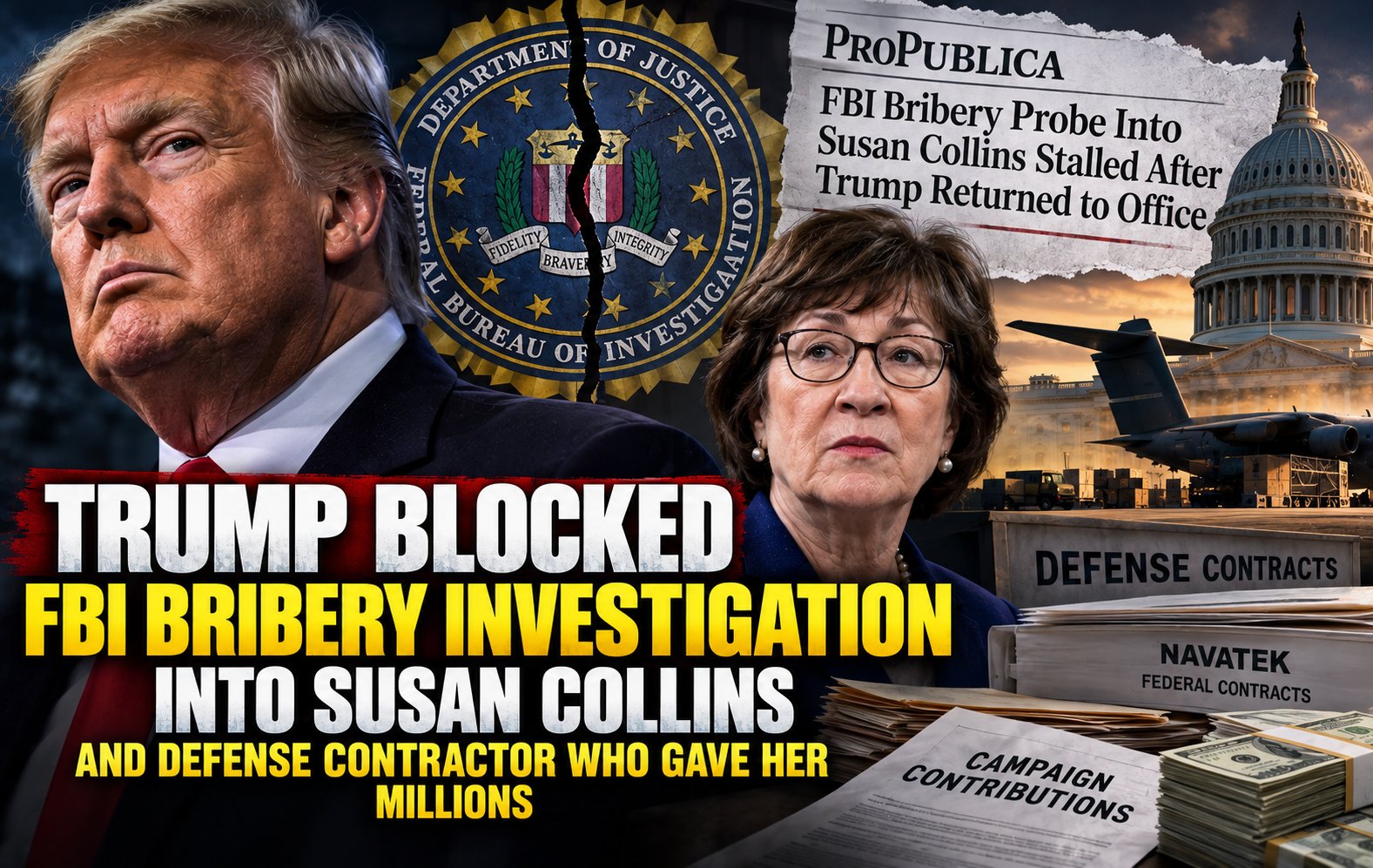
A previously undisclosed FBI public corruption investigation was preparing to examine an alleged pay to play network involving a major defense contractor, political fundraisers and powerful members of Congress, including Republican Sen. Susan Collins of Maine, before the inquiry effectively died following President Donald Trump’s return to office and the dismantling of the FBI unit handling the investigation, according to a new ProPublica investigation.
The reporting does not establish that Collins committed bribery, and neither Collins nor anyone working for her was charged with bribery. Her office vigorously denies the allegations, while the FBI says an earlier investigation found nothing implicating Collins or her campaign. What ProPublica uncovered is more complicated: after defense contractor executive Martin Kao began cooperating with federal authorities, investigators in late 2024 believed they had sufficient evidence to seek authorization for a substantially broader public corruption investigation based on allegations that Kao and his company used political contributions to cultivate lawmakers and obtain tens of millions of dollars in federal contracts. That investigation was still in its early stages when the second Trump administration dismantled the FBI anti-corruption unit responsible for pursuing it.
At the center of the investigation was Navatek, a Hawaii-based defense contractor formerly led by Kao, who had already been prosecuted for illegally funneling political contributions through family members and a shell company. During cooperation sessions with FBI agents and federal prosecutors beginning in 2022 and continuing into 2024, Kao described what he characterized as a much larger political influence operation spanning both parties. According to ProPublica, Kao and close associates contributed nearly $900,000 to dozens of politicians while Navatek established operations in multiple states and obtained more than $40 million a year in government funding.
A Defense Contractor, Political Contributions and Millions in Federal Contracts
The most consequential allegations involving Collins trace back to her 2020 reelection campaign and 1820 PAC, a super PAC supporting her. According to ProPublica’s review of FBI evidence, corporate records, emails, legal documents and interviews, Navatek was seeking additional federal contracts in Maine when people connected to the company discussed making a major contribution to the pro-Collins super PAC.
ProPublica reported that Scott Reed, chairman of 1820 PAC, met in late 2019 with Kao and other Navatek executives at a Washington area Corner Bakery and asked for a $500,000 contribution. Kao later told federal investigators that Navatek wanted additional federal funding while financially supporting Collins and planned to route its contribution through a shell company to conceal its corporate origin. Kao alleged that Reed assured him Collins would know where the money originated and that Navatek would receive government contracts. Reed did not respond to ProPublica’s detailed questions about those allegations.
Kao subsequently sent $150,000 through the shell company to the pro-Collins super PAC. According to an internal company email reviewed by ProPublica, Kao told Navatek executives roughly two months later that Collins had committed to supporting $32 million in naval contracts for the company. Records cited by ProPublica show the Senate ultimately allocated at least $10 million that year based on Navatek proposals. The existence of political contributions followed by government funding does not by itself establish bribery; proving criminal corruption involving an elected official requires evidence of a corrupt exchange, and federal courts have imposed demanding standards for establishing an illegal quid pro quo involving official acts.
That distinction is essential. ProPublica’s investigation documents circumstances that FBI agents believed warranted additional investigation, but it does not establish that Collins knew about an illegal contribution scheme or knowingly agreed to exchange an official action for political money.
FBI Records Show a Longer Relationship Between Navatek and Collins’ Political Operation
The relationship between Navatek and Collins extended beyond the 2019 super PAC meeting. ProPublica reported that the FBI had identified Kao’s unusual political contributions as early as 2018, shortly before Collins included $8 million for a Navatek proposal in a defense budget. Emails reviewed by investigators also showed Collins’ staff communicating with Navy officials about directing the money toward Navatek.
By 2019, fundraising and government business were increasingly overlapping in internal communications, according to the records reviewed by ProPublica. Kao and Navatek executives planned a Collins fundraiser while simultaneously communicating about company projects backed by the senator. Before an August 2019 publicity event at Navatek’s Maine headquarters, Kao orchestrated more than $40,000 in contributions from extended family members, according to company records and emails obtained by investigators.
One exchange examined by the FBI involved excess contributions Kao had made above the individual legal limit. ProPublica reported that Kao instructed Collins’ campaign to reallocate excess money to his father and supplied his father’s name and address. An FBI agent later highlighted the exchange in a presentation to prosecutors as potentially violating election law. Collins campaign finance director Amy Abbott responded to Kao at the time by thanking him for the family’s support.
Kao also told investigators that he met privately with Collins and campaign staff before the Navatek event and that Collins told him, “You’ve seen me deliver.” That account comes from Kao and has been denied as part of Collins’ broader rejection of his allegations. Less than a month after the event, however, a Senate defense spending draft contained $21.5 million for projects sought by Navatek, and Kao subsequently emailed a Collins fundraiser thanking the senator for her support and offering additional financial help if the campaign needed it.
Martin Kao Became a Cooperating Source After His Own Criminal Case
Kao’s credibility presents an important complication. He was not a neutral whistleblower approaching the government without personal exposure. Federal authorities had already charged him with campaign finance crimes, giving him a powerful incentive to provide investigators with useful information in hopes that his cooperation might reduce his eventual punishment.
Over several meetings with FBI agents and prosecutors, Kao supplied a roughly 50 page account identifying lobbyists, congressional staff members and members of Congress whom he alleged participated in or benefited from Navatek’s political influence operation. His cooperation continued into September 2024, when agents were examining whether the campaign-finance violations that initially brought Kao under federal scrutiny were part of a much broader system of influence peddling.
Investigators did not simply accept Kao’s claims at face value. According to ProPublica, agents reviewed hundreds of thousands of records seized during Kao’s arrest and found that many were consistent with his account. ProPublica separately reviewed evidence gathered by the FBI, thousands of pages of legal and corporate records and interviews with dozens of people familiar with Navatek and the investigation, reporting that it independently corroborated substantial portions of Kao’s account. Still, corroborating parts of Kao’s story is not equivalent to proving every allegation he made, particularly allegations involving criminal intent by elected officials. Kao was ultimately sentenced to 87 months in prison, and the judge did not reduce his sentence based on his FBI cooperation.
FBI Agents Wanted a Broader Bribery Investigation in 2024
By late 2024, FBI agents believed they had accumulated enough evidence to pursue a broader bribery investigation involving members of Congress from both parties, according to an internal memo reviewed by ProPublica. Investigators sought approval from supervisors for a new inquiry, considered using undercover techniques and questioned Kao extensively about his dealings with Collins and her office. The effort was still preliminary, and there was no guarantee it would have produced charges.
The investigation was therefore broader than an inquiry into Collins. Kao alleged a system in which Navatek used campaign contributions, lobbying and political relationships to obtain federal funding from lawmakers across party lines. Investigators were attempting to determine whether those relationships remained within the legal boundaries of campaign finance and lobbying or crossed into criminal bribery.
That investigation never reached the stage at which prosecutors could publicly establish or reject those allegations. Before agents could fully develop the case, Trump returned to office and his administration began making major personnel changes across the Justice Department and FBI, including the bureau’s specialized public-corruption operation.
Trump-Era FBI Purge Dismantled the Unit Handling the Investigation
ProPublica’s reporting connects the collapse of the investigation to those institutional changes rather than establishing that Trump personally ordered the FBI to terminate a case against Collins. There is no public evidence that Trump personally intervened to protect Collins or issued a directive to shut down an investigation specifically because it involved the Maine senator.
The documented sequence is nevertheless significant. The agents pursuing the case worked for CR-15, an elite FBI anti-corruption unit specializing in misconduct by elected officials. After Trump returned to office and Kash Patel became FBI director, the bureau dismantled the unit agent by agent, according to ProPublica. The agents who had developed the Navatek investigation were among those removed, leaving the proposed broader bribery investigation without the personnel who had spent years developing the evidence.
One agent involved in taking Kao’s statements had previously participated in the federal investigation into Trump’s efforts to overturn the 2020 election. The career prosecutor assigned to Kao’s case also left government service. Former officials told ProPublica that the Justice Department’s public corruption capabilities had been substantially diminished as experienced investigators and prosecutors departed.
The White House referred questions about the matter to the FBI. FBI spokesperson Ben Williamson told ProPublica that the bureau had previously investigated allegations involving Collins and found nothing implicating the senator or her campaign. He defended the bureau’s personnel actions, saying employees had been removed when leadership determined they had acted unethically, undermined the FBI’s mission or participated in what the administration considers the weaponization of law enforcement. According to ProPublica, Williamson did not address its questions about the separate and broader investigation agents sought to launch based on Kao’s later cooperation.
That leaves an important distinction between two phases of federal scrutiny. The FBI says the earlier matter involving Kao’s illegal campaign contributions was investigated without implicating Collins, while ProPublica reports that Kao’s subsequent cooperation generated additional allegations and evidence that agents wanted to examine through a new and broader corruption investigation. That later investigation was never developed far enough to determine whether those allegations could be proven.
Collins’ Office ‘Vigorously’ Denies Bribery and Pay to Play Allegations
Collins’ office has categorically rejected allegations that the senator participated in bribery or pay-to-play arrangements. Deputy Chief of Staff Annie Clark told ProPublica that the office “vigorously” denied Kao’s claims and called the allegations “outlandish.” Collins’ representatives said her campaign was not involved in discussions between Kao and the independent super PAC and emphasized that her office fully cooperated with federal investigators.
Collins’ team has also pointed to the resolution of the original campaign finance matter. After Kao’s illegal contributions became known, the Collins campaign disgorged money associated with the prohibited donations, and Collins’ office maintains that neither the senator nor her campaign knew Kao had illegally routed the funds.
Those facts matter because campaign-finance violations committed by a donor do not automatically establish wrongdoing by a campaign receiving the money. To prove that Collins participated in a bribery scheme, investigators would have needed evidence that she knowingly entered into a corrupt agreement involving political contributions and official government action. No such case was brought, and Collins has not been charged with wrongdoing in connection with Navatek.
ProPublica Says Records Corroborated Significant Portions of Kao’s Account
The investigative significance of ProPublica’s reporting lies partly in the documentary evidence surrounding Kao’s allegations. The newsroom reviewed material gathered by the FBI, internal Navatek communications, legal records and other documents while interviewing dozens of people familiar with the company’s Washington operation and the federal investigation.
Among the records described by ProPublica were communications showing the importance Navatek placed on Collins as a political ally and documenting federal funding flowing toward company projects. The reporting also identified occasions in which political contributions from Kao and people connected to him occurred near legislative activity benefiting Navatek.
Timing, political access and government funding can create legitimate investigative questions, but none independently establishes criminal bribery. Members of Congress routinely advocate for federal projects in their states, while donors routinely support politicians whose policies benefit their industries. The legal question investigators would have needed to answer was whether political money was knowingly offered or accepted in exchange for specific official action. That is precisely the question the broader investigation never reached a position to resolve.
Collins Was Not the Only Lawmaker in Kao’s Account
Kao’s allegations extended beyond Collins. According to ProPublica, his cooperation described a political influence operation involving figures from both major parties, with Kao and close associates contributing nearly $900,000 to dozens of politicians while Navatek pursued federal funding around the country.
That broader context makes it misleading to characterize the underlying case solely as an FBI investigation of Collins. Agents were examining whether Navatek had developed a wider political-financing strategy designed to turn campaign contributions and relationships with lawmakers into federal contracts. Kao’s final cooperation document reportedly identified more than a dozen members of Congress and their staffs and provided investigators with potential witnesses and records to subpoena.
The scope of those allegations also helps explain why agents sought authorization for a new corruption investigation rather than simply reopening Kao’s original campaign-finance case. Investigators were trying to determine whether the illegal contributions already established in court were isolated violations or one component of a much larger pay-to-play operation.
The Investigation Emerges in the Middle of Collins’ Maine Reelection Fight
The revelations arrive as Collins seeks another Senate term in Maine against Democratic nominee Troy Jackson, the former president of the Maine Senate. The contest has drawn national attention because Collins has repeatedly demonstrated an ability to separate herself politically from Republican presidential candidates and attract independent and Democratic-leaning voters.
Her 2020 reelection remains the clearest example. Joe Biden carried Maine statewide by roughly nine percentage points while Collins won her Senate race by approximately the same margin, substantially outperforming public polling that had suggested she was in danger of losing.
Current polling shows a closely divided contest rather than a settled outcome. A CNN/SSRS survey conducted from Aug. 31 through Sept. 6 among 880 likely Maine voters measured Jackson at 48% and Collins at 45%, a three-point difference within the poll’s 3.7-point margin of sampling error. Other recent polling has similarly shown a close race. Polls are snapshots of the surveyed population at a particular time and should not be treated as predictions of the November result.
CNN’s polling also found substantial disapproval of Trump among likely Maine voters. Jackson and Democrats have sought to connect the Senate contest to dissatisfaction with the president and national Republican policies, while Collins has emphasized her independence, long record representing Maine and ability to work across party lines. Collins has also pointed to her 2020 victory as evidence that pre-election polling has underestimated her support before.
Collins Is Running on Seniority and Her Influence in Washington
Collins’ political argument rests heavily on her long tenure, constituent service and institutional influence. As chair of the Senate Appropriations Committee, she occupies one of Congress’ most influential spending positions and has emphasized her ability to direct federal resources toward Maine.
That record is also relevant to the Navatek story because obtaining federal investment for Maine is central to Collins’ case for reelection. Securing federal contracts for companies operating in a senator’s state is not inherently improper; lawmakers routinely advocate for military installations, infrastructure projects, research programs and private employers in their states.
The unresolved issue raised by Kao’s allegations is whether Navatek’s political giving amounted to an aggressive but legal effort to gain access and support from influential lawmakers, or whether company executives attempted to establish explicit exchanges between campaign money and government contracts. Federal agents wanted to investigate that question more deeply, according to ProPublica, but the inquiry did not progress far enough to produce a prosecutorial conclusion.
The Central Question Was Never Resolved
The strongest conclusion supported by the available reporting is narrower than saying Trump personally blocked a bribery investigation into Susan Collins. FBI agents were preparing a broader public-corruption investigation arising from Kao’s cooperation, and Collins was among the prominent politicians whose interactions with Navatek were being examined. After Trump returned to office, the specialized FBI anti-corruption unit handling the matter was dismantled and agents involved in developing the case were removed, leaving the proposed investigation without the personnel who had built it. ProPublica describes the investigation as effectively dead.
That distinction does not diminish the significance of the underlying investigation. Federal agents had a convicted defense executive describing an alleged political influence network, documentary evidence they believed justified further examination and plans for a broader investigation that could have involved lawmakers from both parties. What they did not ultimately obtain was the opportunity to determine where that evidence would lead.
For Collins, the absence of bribery charges and the FBI’s statement that its earlier investigation found nothing implicating her remain essential facts. For ProPublica, the later investigation and the evidence agents were preparing to pursue demonstrate that significant questions remained unresolved. The episode consequently raises a broader institutional issue beyond any individual senator or political party: what happens to potential public-corruption cases when the specialized agents, prosecutors and investigative infrastructure responsible for determining whether allegations are true disappear before an investigation can be completed?
Sources & Further Reading
- ProPublica — “The FBI Anti-Corruption Squad Was Circling Susan Collins — Until Trump Got in the Way” — Primary investigation based on FBI evidence, internal emails, legal records and interviews. (ProPublica)
- Federal Election Commission — MUR #7690: Navatek/PacMar, 1820 PAC and Collins for Senator — Official FEC enforcement record covering the $150,000 contribution, government-contractor funds and related campaign-finance allegations. (FEC.gov)
- Federal Election Commission — February 2025 Enforcement Summary — Official summary stating PacMar/Navatek knowingly and willfully made a contribution in another entity’s name using government-contractor funds and agreed to a $325,000 civil penalty. (FEC.gov)
- The Boston Globe — Key Takeaways From ProPublica’s Susan Collins Investigation — Independent reporting on the FBI investigation, Navatek and Collins’ 2020 campaign.
- CNN — Maine Senate Poll: Susan Collins and Troy Jackson Race — CNN/SSRS polling showing Jackson at 48% and Collins at 45% among likely voters, within the margin of error. (CNN Transcripts)
- CNN — Manu Raju Reports on the Collins-Jackson Maine Senate Race — Reporting on Collins’ reelection strategy, Maine voter sentiment and the political environment surrounding the race. (transcripts.cnn.com)











































Want to join the conversation?
Create an account or sign in to share your thoughts, vote,
and reply to other readers.
Showing 0 of 0 comments
Don't have an account?
Already have an account?