
This May Be a Sign of Things to Come for Hollywood
Hollywood has suffered its share of expensive disappointments over the years, but Supergirl and Disclosure Day have become two of the biggest box office letdowns of 2026 for very different reasons. While one was supposed to launch the next era of DC superheroes, the other came from legendary filmmaker Steven Spielberg with an original science-fiction concept. Both films carried enormous expectations, hefty production budgets, and expensive worldwide marketing campaigns, yet neither generated the audience excitement needed to become profitable.
First Failure: Supergirl
Supergirl has become one of Warner Bros.’ biggest financial disasters in recent memory. The film has grossed approximately $66 million domestically and $49.4 million internationally, giving it a worldwide total of roughly $115.4 million. With a reported production budget of $170 million and an estimated marketing campaign of around $120 million, Warner Bros. likely invested close to a whopping $290 million before theaters even took their percentage of ticket sales.
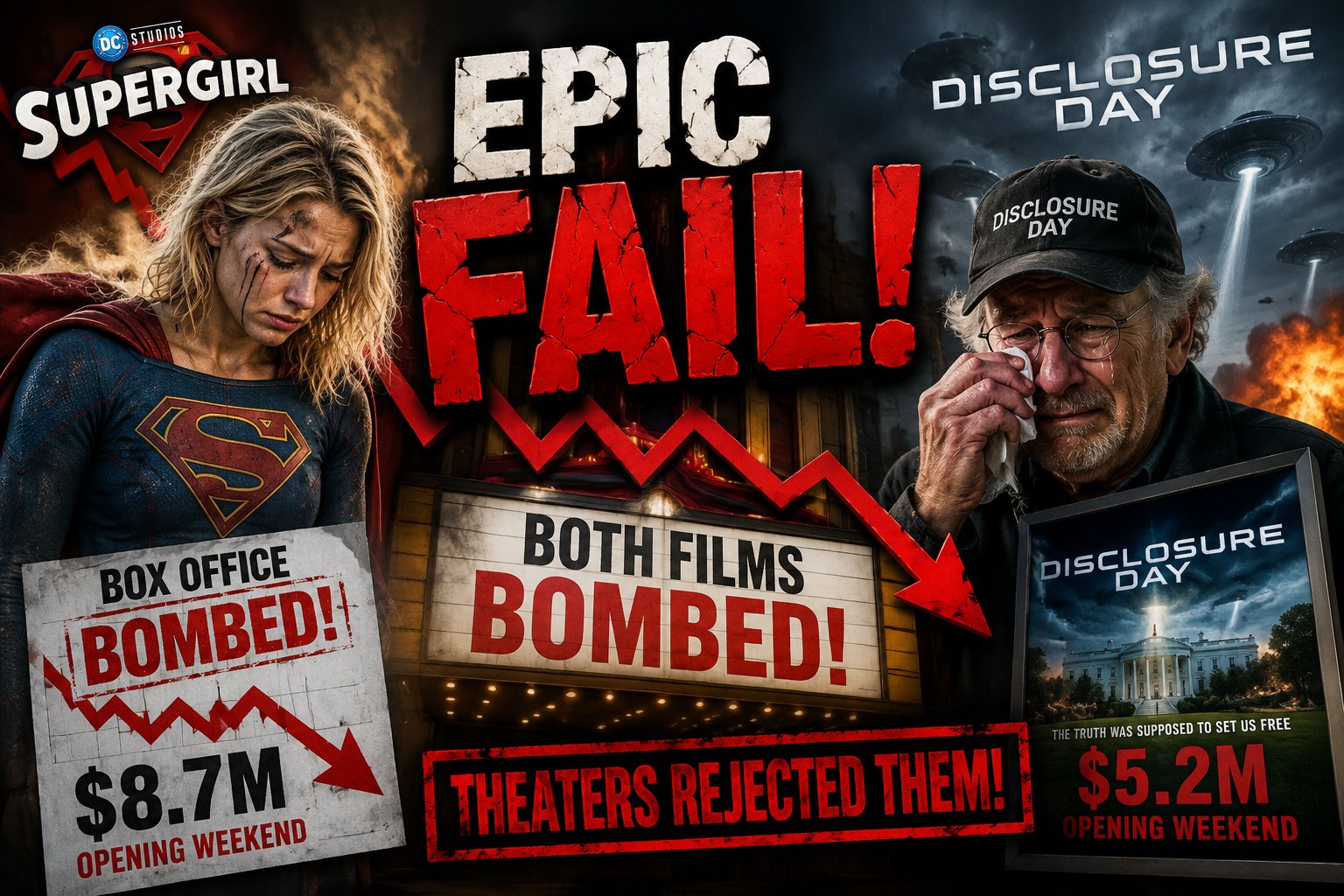
Industry analysts generally estimate that a film with those costs would have needed to earn at least $300 million to $350 million worldwide just to approach its break-even point. Instead, the movie collapsed after opening weekend, suffering one of the worst second-weekend drops ever for a major comic book film.
Many fans and critics have pointed to several reasons for Supergirl’s failure. Superhero fatigue continues to affect the genre after years of Marvel and DC releases, with audiences becoming much more selective about which comic book movies they see in theaters. Others criticized the marketing for failing to clearly explain why this version of Supergirl was different from previous DC films, while some viewers complained that the story lacked emotional weight and memorable villains.
Is Director James Gunn to Blame?
The film also entered theaters facing strong competition from established family franchises, making it difficult to attract casual moviegoers. Some critics argued that James Gunn and DC Studios moved too quickly into lesser-known characters before fully rebuilding audience confidence in the new DC Universe with icons like Batman and Wonder Woman.
There are some who just won’t even consider seeing a James Gunn movie. Gunn has directed big films; there is no doubt. He did the Guardians of the Galaxy trio, The Suicide Squad, and the 2025 version of Superman. With all that being said, why don’t people like James Gunn and his directing style?
There isn’t a single reason. Different groups criticize him for different things. You can start with his writing style. Gunn’s movies often feature sarcastic humor, pop music, talking animals, emotional speeches, and quirky side characters. Fans enjoy this formula, but others argue it feels repetitive and undercuts dramatic moments. The tone set. Some viewers believe he turns every superhero movie into a comedy. Critics say serious scenes are sometimes interrupted by jokes, making it difficult to feel the emotional stakes.
Then you have the obscure characters. Gunn has a reputation for elevating lesser-known comic book characters, such as the Guardians of the Galaxy and Peacemaker. Some DC fans would rather see greater emphasis on iconic heroes like Batman, Wonder Woman, and The Flash. Some think much happened after he was given creative control at DC Studios. Since becoming co-CEO of DC Studios in 2022 alongside Peter Safran, Gunn has overseen a major reboot of the DC Universe. That included canceling or replacing projects connected to the previous continuity, disappointing fans who wanted stories involving actors such as Henry Cavill, Gal Gadot, and Ben Affleck to continue.
But where he really went off the rails was his social media controversy when old tweets resurfaced in 2018. The Walt Disney Company initially fired him from directing Guardians of the Galaxy Vol. 3 because of it all. After significant support from the cast and many filmmakers, Disney later reinstated him. The controversy continues to influence some people’s opinions of him.
Second Failure: Disclosure Day
Spielberg’s Disclosure Day tells a different story. Unlike Supergirl, the film generally received stronger reviews and better audience reactions, but it still failed to become the blockbuster Universal Pictures had hoped for. The movie has earned approximately $111.3 million domestically and $117.7 million internationally, giving it a worldwide total of about $229 million. Its production budget was approximately $115 million, while reports placed its worldwide marketing campaign at roughly $80 million, bringing Universal’s total investment close to $195 million before distribution costs and theater revenue splits. Although the film performed considerably better than Supergirl, theatrical revenue alone was unlikely to generate the kind of profit expected from a summer tentpole.
Several factors appear to have limited Disclosure Day’s performance. Original science-fiction films have become increasingly difficult to market compared to sequels, remakes, and established franchises. While Spielberg remains one of Hollywood’s greatest directors, younger audiences often gravitate toward recognizable intellectual properties rather than original stories.
The film’s slower pace and mystery-driven narrative also appealed more to older moviegoers than to teenagers and young adults, limiting its opening weekend potential. Despite respectable word-of-mouth, the movie simply lacked the explosive cultural buzz needed to become a breakout hit during the crowded summer movie season. The marketing of the film was downright awful. Not only could you not get a gist of what it was about, but if you are not going to go for a plotline to capture the audience, then WOW them with effects, scares, and intrigue. They did neither!
Christian Beliefs are Questioned
One of the biggest controversies surrounding Disclosure Day was the debate over its treatment of religion and whether the film suggested that the discovery of extraterrestrial life could force people to question their Christian beliefs. During the promotion for the movie, Steven Spielberg discussed the idea that confirmed intelligent life beyond Earth could create major theological questions for humanity.
Some critics argued that the film’s message suggested that Christianity and other faiths would be challenged if humanity discovered it was not alone in the universe. They questioned whether the movie was implying that the existence of aliens would undermine the belief that humans hold a unique place in God’s creation.
For some religious viewers, the idea that a filmmaker would explore whether extraterrestrial life could change humanity’s understanding of God felt like a direct challenge to traditional Christian teachings. Critics argued that the film portrayed faith as something that could be shaken by scientific discovery, while supporters of Spielberg said the movie was not attacking Christianity but exploring one of the biggest philosophical questions humans could face: how would our understanding of God change if we learned that life exists elsewhere in the universe? Regardless of interpretation, the religious debate surrounding Disclosure Day became another point of controversy for a film that was already facing challenges in attracting a large mainstream audience.
Two Films…Two Epic Fails
Taken together, these two films demonstrate two different challenges facing Hollywood today. Supergirl shows that simply putting a superhero on the big screen is no longer enough to guarantee massive box office success. At the same time, Disclosure Day illustrates the uphill battle original films face against franchise entertainment. Audiences have become far more selective with rising ticket prices, often choosing only the biggest must-see events. Studios are increasingly discovering that enormous budgets and aggressive marketing campaigns cannot compensate for weak audience interest or changing viewing habits.
For Warner Bros., Supergirl represents a major setback for the newly rebooted DC Universe and raises difficult questions about the franchise’s future direction. For Universal, Disclosure Day is unlikely to be considered a complete disaster because ancillary revenue from digital rentals, streaming, television licensing, and home entertainment may eventually push the film into profitability. That is all well and good, but they saw DOLLAR SIGNS. They didn’t want to snail crawl to profits.
*****Editor’s Note*****
Now, just speaking for me, I would never consider seeing either of these films. If I absolutely had to, I would probably see Disclosure Day over Supergirl times a million, but clearly not in a rush. I never liked DC or Marvel movies. No interest at all. So if I’m not going to see Hulk or Iron Man, I’m certainly not going to see Supergirl! Also, seeing Alcock’s views and interviews, and it is a complete joke.
I saw the spots for Disclosure Day, and I was semi-interested. The more I saw, the less interested I became.
Nevertheless, neither studio envisioned these results when investing hundreds of millions of dollars. In an era where audiences have more entertainment choices than ever before, Hollywood continues to learn the expensive lesson that recognizable brands, legendary directors, and massive marketing campaigns no longer guarantee blockbuster success.

















































Want to join the conversation?
Create an account or sign in to share your thoughts, vote,
and reply to other readers.
Showing 0 of 0 comments
Don't have an account?
Already have an account?