
U.S. Expands Military Footprint in Greenland Under Historic Arctic Security Deal While Denmark Retains Sovereignty
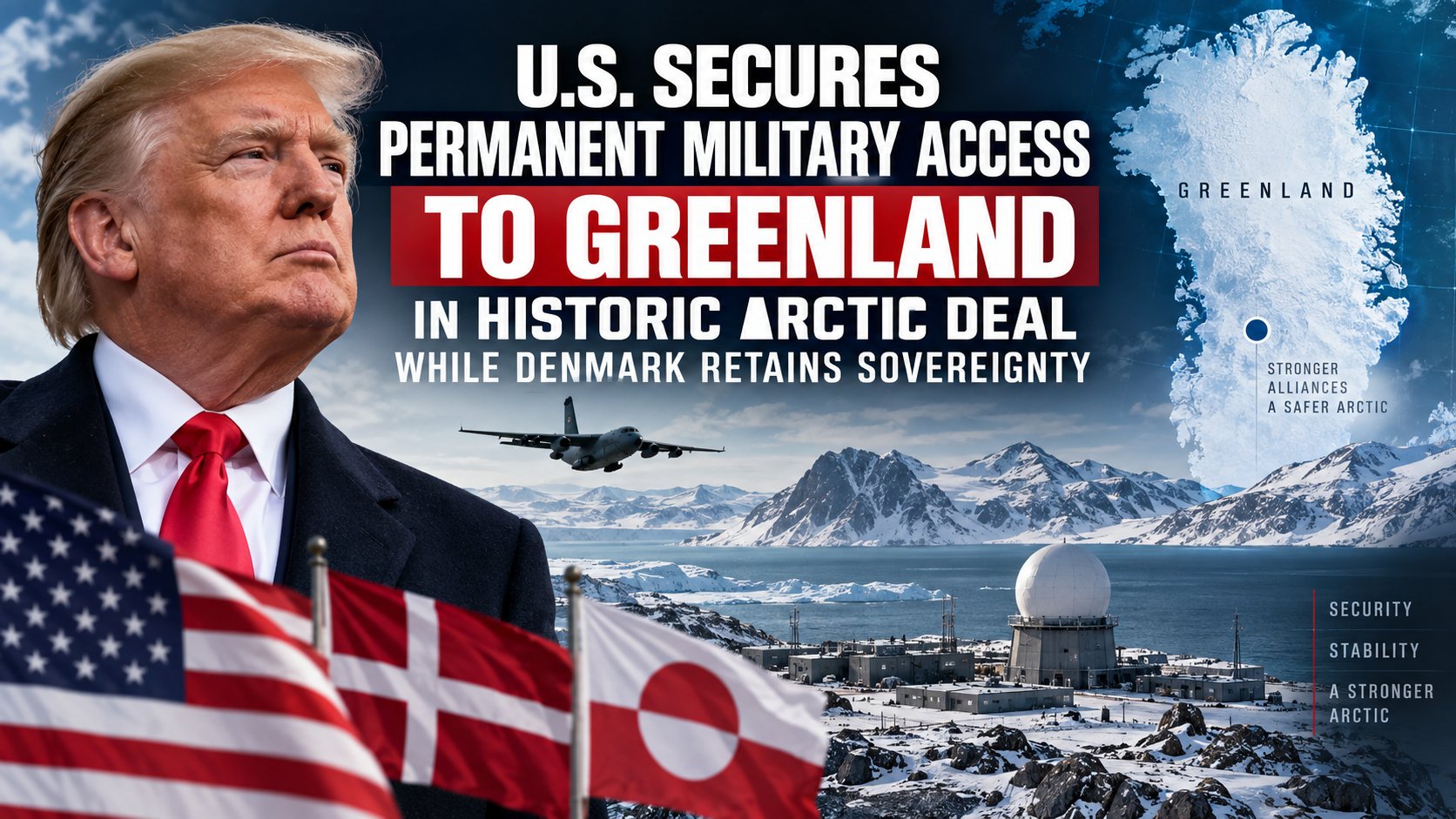
The United States has secured a major expansion of its military presence in Greenland under a new security agreement with Denmark and Greenland, giving Washington broader and potentially permanent access to one of the most strategically important territories in the Arctic while leaving sovereignty over the island unchanged. President Donald Trump signed the trilateral agreement Tuesday with Danish Prime Minister Mette Frederiksen and Greenland Prime Minister Jens-Frederik Nielsen during the United Nations General Assembly in New York, bringing months of extraordinary tension over Trump’s push for greater American control of Greenland into a negotiated security framework.
Trump has described the agreement in expansive terms, saying it gives the United States “permanent control” over Greenland’s security. Danish and Greenlandic officials have described the arrangement more narrowly, emphasizing that it does not transfer sovereignty, ownership or territorial control to Washington. Greenland remains a self-governing territory within the Kingdom of Denmark, while the agreement recognizes both the kingdom’s territorial integrity and Greenlanders’ right to determine their own political future. What Washington has secured is not ownership of Greenland but a substantially larger and potentially enduring military and strategic role there.
The agreement also still requires approval by the parliaments of Denmark and Greenland before taking effect. According to the published terms, it has no expiration date and can be amended only by mutual consent, giving the arrangement the potential to reshape the American military position in the Arctic for decades.
The Greenland agreement led a broader CNN discussion between host Victor Blackwell and retired Air Force Col. Cedric Leighton examining several rapidly developing national security issues. The segment also covered Washington’s proposed $24.3 billion sale of F-35 stealth fighters to Saudi Arabia, the Pentagon’s mandatory testosterone-deficiency screening policy for male service members 30 and older, and CNN’s investigation into an AI-assisted intelligence failure that reportedly brought the U.S. military close to intercepting a Chinese vessel on false information. Together, the developments illustrate a Pentagon simultaneously confronting a changing Arctic, advanced weapons proliferation, military readiness debates and the risks of rapidly integrating artificial intelligence into national security operations.
Trump Gets Expanded U.S. Military Access, Not Ownership of Greenland
The final Greenland agreement represents a significant compromise following months in which Trump repeatedly argued that greater American control of the island was necessary for national security. His statements, including earlier suggestions that economic or military pressure could be used to obtain Greenland, created an extraordinary dispute between NATO allies and drew repeated objections from leaders in both Denmark and Greenland. The agreement moves the confrontation in a different direction: Washington gains expanded military access and substantial new security authority without Denmark surrendering sovereignty or Greenland surrendering its right to self determination.
The distinction is central to understanding what happened. Trump did not obtain American sovereignty over Greenland, but his administration secured significant elements of the military access and security framework it had sought. The agreement builds upon the existing defense relationship dating to 1951, expands the American military footprint and places greater responsibility for Arctic security within NATO. It also contains provisions intended to prevent non-NATO countries from establishing a military presence in Greenland. Denmark retains sovereignty, Greenland retains self government and the right to pursue independence, and Washington gains a significantly stronger long term military position.
The agreement also gives American military aircraft and vessels extensive operating rights throughout Greenland, including access involving its airspace and territorial waters. That potentially makes the agreement far more consequential than simply opening two additional military installations, because it establishes a broader framework for American military operations across the strategically located Arctic territory.
The agreement expands American military operations beyond Pituffik Space Base, currently the principal active U.S. military installation in Greenland. Washington will be permitted to establish new defense areas at Narsarsuaq in southern Greenland and Mestersvig on the island’s east coast, significantly broadening America’s geographic reach across the territory. Narsarsuaq has deep historical significance for the United States because American forces established an air base there during World War II, while Mestersvig would extend the U.S. presence to Greenland’s sparsely populated eastern coast. Combined with Pituffik in the northwest, the additional sites would give the United States a much broader military footprint across the enormous island.
The arrangement builds on a military relationship stretching back generations. The United States and Denmark signed the Defense of Greenland Agreement in 1951 during the Cold War, granting Washington extensive military access while recognizing Danish sovereignty. The United States once operated numerous installations across Greenland before dramatically reducing its presence after the Cold War. The new agreement reverses part of that contraction as the Arctic again becomes an increasingly important area of strategic competition.
The deal also allows for an expansion of Pituffik Space Base and provides a framework for the United States to establish elements of the proposed Golden Dome missile defense system in Greenland. That gives the agreement direct significance for continental missile defense in addition to its broader role in Arctic surveillance and military access.
Why Greenland Matters So Much to American Defense
Greenland’s military importance is largely a product of geography. The world’s largest island sits between North America and Europe and lies along potential Arctic approaches toward the continental United States, making it exceptionally valuable for missile warning, missile defense, space surveillance and monitoring military activity across the North Atlantic. Pituffik Space Base already performs critical missile warning and space surveillance missions, while the expanded American presence could support broader Arctic defense operations and the administration’s proposed Golden Dome missile defense architecture.
Russia’s enormous Arctic coastline and extensive northern military infrastructure make the region increasingly important to NATO, while China’s economic and strategic interest in the Arctic has generated additional concern in Washington. Greenland also possesses significant mineral resources, including materials potentially important to advanced electronics, energy technologies and defense manufacturing. The new agreement therefore reaches beyond conventional military basing by addressing security relationships and seeking to prevent adversarial governments from establishing military footholds on the island.
The strategic calculation is straightforward: Greenland occupies a critical position between North America, Europe and the Arctic. That geographic reality made the island enormously valuable during World War II and the Cold War and is making it increasingly important again as missile technology, space-based military systems and competition over Arctic access reshape the northern security environment.
Greenland Retains the Right to Determine Its Own Future
Perhaps the most consequential political element of the agreement is its continued recognition of Greenlandic self-determination. Greenland remains largely self governing within the Kingdom of Denmark, while Copenhagen retains responsibility for areas including defense and foreign affairs. Nothing in the new agreement transfers Greenland to the United States or eliminates its ability to pursue independence.
That distinction matters because Greenland’s long-term constitutional relationship with Denmark is separate from its defense relationship with Washington. Danish and Greenlandic officials have stressed that sovereignty and self-determination remain intact even as the United States receives broader military access. The agreement is also designed to survive a potential change in Greenland’s political status, provided the conditions established by the pact continue to be met.
The result is an unusual but strategically significant arrangement. Denmark retains sovereignty, Greenland preserves its political future and the United States obtains a much stronger military position without acquiring the territory. Greenland also gains a more direct role in an international security agreement affecting its territory, an important development for a government that has increasingly sought greater control over its own foreign relationships.
The Greenland Agreement Could End an Extraordinary NATO Dispute
Trump’s campaign for greater control over Greenland had produced one of the most unusual diplomatic confrontations between NATO allies in recent history. Denmark repeatedly insisted that Greenland was not for sale, Greenlandic leaders rejected attempts to determine the island’s future without its population, and Trump’s refusal at points to rule out coercive measures intensified concerns across Europe. The negotiated agreement offers a different outcome: instead of transferring Greenland to the United States, Washington obtains broader military access and long-term security arrangements while Copenhagen retains sovereignty and Nuuk retains self government and self determination.
The agreement also moves Arctic security more explicitly into NATO’s collective defense structure. Danish officials have emphasized that defending the Arctic should not be viewed solely as a bilateral responsibility between Washington and Copenhagen, while NATO has welcomed greater cooperation in the region. That potentially turns what had become a destabilizing disagreement inside the alliance into a larger Western military buildup in the Arctic.
The diplomatic significance is difficult to separate from the military significance. Washington receives many of the security benefits it argued were necessary without annexing Greenland, while Denmark and Greenland preserve the territorial and political principles they repeatedly said were non-negotiable.
$24.3 Billion F-35 Sale Could Transform Saudi Air Power
The CNN discussion then moved from the Arctic to the Middle East, where the State Department has approved a possible $24.3 billion foreign military sale involving 48 F-35 stealth fighters and 49 Pratt & Whitney F135 engines for Saudi Arabia, along with communications equipment, training, spare parts and other support. The transaction remains subject to the American foreign military sales process and congressional review; approval of a possible sale does not mean the aircraft have already been purchased or delivered.
If completed, the transaction would represent a major technological expansion of Saudi Arabia’s air force. The F-35 combines low-observable design with advanced sensors, electronic warfare and networked battlefield capabilities, allowing the aircraft to collect and distribute targeting and threat information while operating in heavily defended environments. The proposed sale also carries implications for Israel, which currently operates the F-35 in the region and whose qualitative military edge is a consideration in major American arms transfers in the Middle East.
Leighton said the proposed Saudi aircraft could present a potential challenge to Israel because of the F-35’s stealth, targeting and intelligence-integration capabilities, while also noting that Saudi Arabia and Israel are not currently at war. The State Department has maintained that the proposed sale would not alter the regional military balance, while Israeli concerns over the transaction illustrate that the long term implications remain disputed.
Pentagon Moves Forward With Mandatory Testosterone Screening
The CNN segment also examined the Pentagon’s mandatory screening for testosterone deficiency among male service members age 30 and older, a policy Defense Secretary Pete Hegseth has framed as a military health and readiness initiative. New Pentagon guidance moves forward with screening for male active duty and reserve personnel in that age group, with additional medical evaluation used to determine whether treatment is appropriate.
Leighton questioned whether a force wide requirement was necessary, arguing that the military already imposes physical performance standards for demanding assignments and that testosterone levels should not automatically be treated as a substitute for demonstrated physical capability. He noted that personnel serving in highly physical specialties already must meet established fitness requirements and argued that individual hormone testing makes more sense when a service member is experiencing symptoms or other medical issues.
The debate therefore involves two separate questions: whether testosterone deficiency deserves greater attention within military medicine and whether a centralized Pentagon testing requirement is the appropriate mechanism for addressing it. A low testosterone result also does not automatically require hormone replacement therapy, and medical guidance recognizes potential treatment risks that clinicians must consider on an individual basis.
AI Assisted Intelligence Nearly Triggered an Operation Against a Chinese Vessel
The final issue examined by CNN carried potentially much more immediate consequences. According to the network’s reporting, an intelligence assessment circulated through the U.S. military during the war with Iran claiming that a Chinese vessel traveling through the Middle East was transporting components associated with a nuclear weapons program. Military officials responded by preparing for a possible interception, with armed American personnel reportedly preparing to board the ship and aircraft already airborne when officials began scrutinizing the intelligence more closely.
CNN reported that an analyst with Special Operations Command Pacific had used an artificial intelligence chatbot while evaluating information about the vessel, combining classified intelligence with open-source information. The AI system produced a false conclusion about the cargo, and that erroneous information was subsequently incorporated into a formal intelligence report that circulated through the military. Human review eventually exposed the mistake, and the operation was canceled before American forces intercepted or boarded the vessel.
No boarding, attack or military confrontation with China occurred. The significance of the episode lies in how far the faulty assessment reportedly progressed through the military decision making process before being caught. An American interception of a Chinese vessel based on false intelligence could have created a serious diplomatic or military confrontation between two nuclear-armed powers, particularly during an already volatile regional war.
The AI Failure Shows Why Human Verification Cannot Become a Formality
Leighton framed the underlying technological problem through the longstanding computing principle of “garbage in, garbage out.” Artificial intelligence can process enormous quantities of information rapidly, but its conclusions remain dependent on the reliability of the underlying information, the model’s ability to interpret that information and the safeguards governing how its output is used.
The danger becomes substantially greater when AI enters military intelligence. An incorrect consumer chatbot response may inconvenience a user; an erroneous intelligence assessment can influence aircraft launches, ship movements, surveillance operations, targeting decisions or the deployment of armed personnel. The Chinese vessel episode illustrates why simply placing a human somewhere in the decision chain is not necessarily sufficient. Meaningful human oversight requires analysts to examine underlying evidence, challenge machine-generated conclusions and independently verify critical claims before those conclusions become operational intelligence.
In this case, the safeguard ultimately worked. The vessel was not boarded, the erroneous assessment was discovered and the operation was canceled. But according to CNN’s reporting, the correction occurred only after military preparations were already underway, demonstrating how quickly an AI-assisted analytical error can move from a computer system toward real world military action.
Autonomous Warfare Is Advancing Faster Than the Policy Debate
The incident comes as militaries worldwide rapidly expand their use of artificial intelligence, machine vision, autonomous navigation, drones and increasingly automated weapons. Russia and Ukraine have become major testing grounds for drone warfare, electronic warfare and AI-assisted battlefield systems, although the degree of human involvement varies significantly between weapons, manufacturers and missions.
The strategic incentive for greater autonomy is clear. In environments where communications can be jammed or disrupted, systems capable of navigating, identifying objects or continuing missions without constant remote control may provide substantial battlefield advantages. The corresponding danger is that as machines accelerate the military decision cycle, commanders and intelligence analysts may have less time to recognize erroneous information before it produces physical consequences.
The Chinese vessel episode demonstrates that this problem is not limited to autonomous weapons. AI does not have to control a missile or drone to influence military operations. If artificial intelligence shapes the intelligence presented to human commanders, errors can enter the decision-making chain long before a weapon is fired, making verification procedures increasingly important as AI systems move deeper into military analysis and operations.
Greenland Deal Marks a Broader Transformation of American Defense Strategy
The four developments examined by CNN initially appear disconnected, but together they illustrate the speed at which American defense strategy is changing. Washington is expanding its military footprint in Greenland as competition in the Arctic intensifies, pursuing a $24.3 billion F-35 sale that could introduce another advanced stealth fleet into the Middle East, expanding military health policy and simultaneously incorporating artificial intelligence into an institution where analytical errors can carry geopolitical consequences.
The Greenland agreement remains the largest geopolitical development of the group. After months in which Trump openly pursued greater control over the island and Denmark and Greenland repeatedly rejected any transfer of sovereignty, the three governments have reached a fundamentally different arrangement. Denmark retains sovereignty over Greenland, Greenland retains its right to determine its political future, NATO assumes a larger role in Arctic security, and the United States gains substantially expanded military access across one of the world’s most strategically important territories.
The agreement does not make Greenland American territory. Instead, it gives Washington much of the expanded military access and security authority it sought without redrawing national borders, potentially establishing a durable new framework for American and NATO defense in the Arctic for decades to come.

Sources & Further Reading
Reuters — Trump, Greenland and Denmark Sign Deal in Bid to End Arctic Standoff
Reuters — Explainer: What Is in the U.S.-Greenland-Denmark Security Deal?
Associated Press — U.S., Denmark and Greenland Sign Arctic Security Agreement
CBS News — Greenland Deal Gives U.S. Broad Military Authority While Preserving Sovereignty
CNN — Victor Blackwell Interview With Col. Cedric Leighton
Reuters — Pentagon Moves Forward With Testosterone Screening
PBS NewsHour — Pentagon Testosterone Testing Guidance
CNN Reporting — AI-Assisted False Intelligence on Chinese Vessel
Defense News — U.S. Plans Two New Military Sites in Greenland
Breaking Defense — U.S. Clears Potential $24.3 Billion Saudi F-35 Sale



















































Want to join the conversation?
Create an account or sign in to share your thoughts, vote,
and reply to other readers.
Showing 0 of 0 comments
Don't have an account?
Already have an account?