
What Does This Signify and Mean?
For years, Costco has been one of the places Americans could go when they wanted to stock up and save money. Apparently, even motor oil is now joining the growing list of things consumers may have to think twice about buying in bulk.
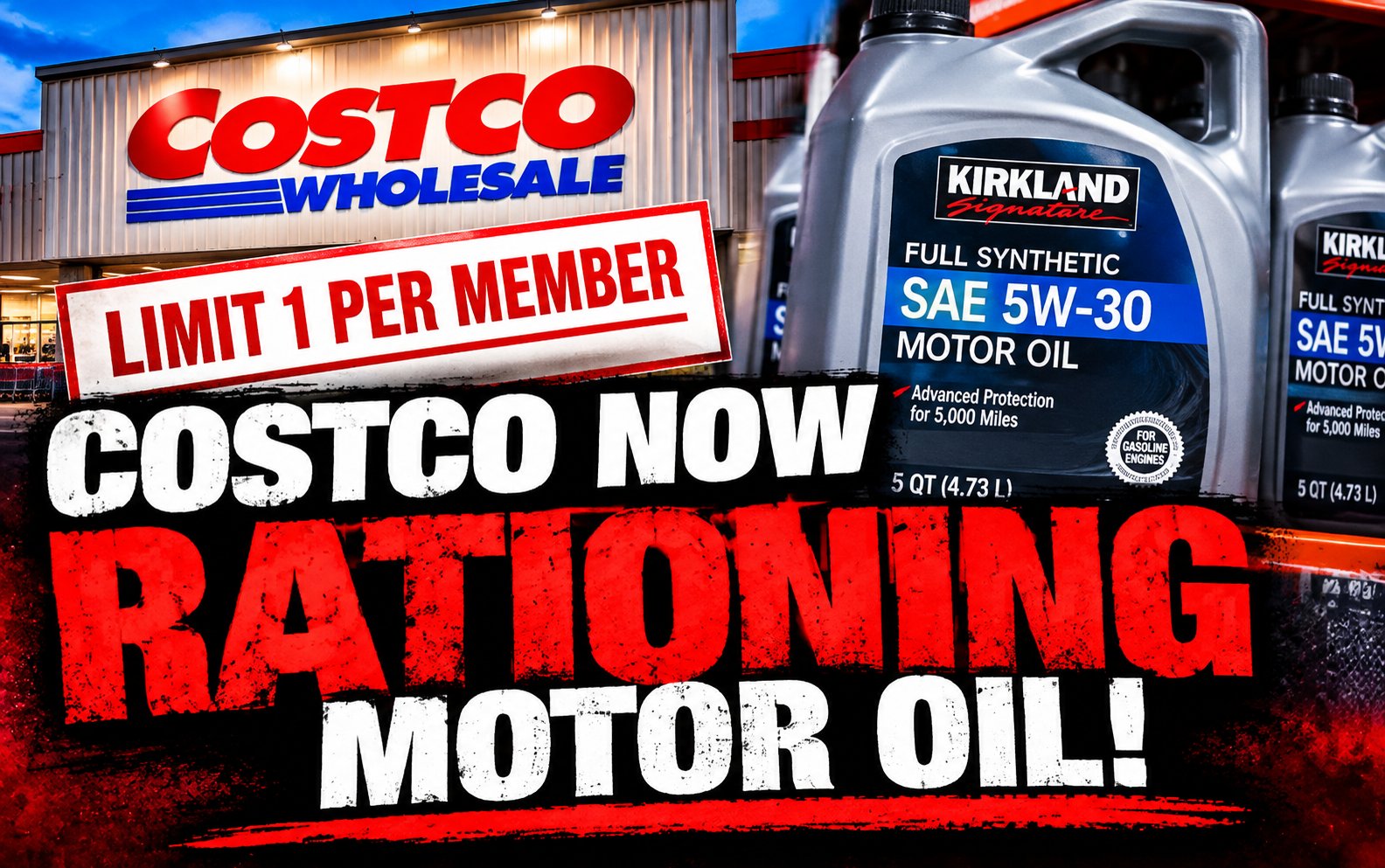
Costco has begun limiting how much motor oil customers can purchase, while simultaneously raising the price of its popular Kirkland Signature full-synthetic motor oil. According to reports published September 14th, Costco is limiting customers to two boxes of Kirkland Signature full-synthetic motor oil every seven days. The retailer has also placed limits on certain Mobil 1 products.
The price increase is almost as eye-catching as the purchase restriction. A two-pack containing two five-quart containers of Kirkland Signature full-synthetic motor oil is now selling for approximately $58, compared with roughly $30 last year. Costco’s Mobil 1 full-synthetic oil is also being restricted, with customers limited to five six-quart packages per membership.
That raises the obvious question: Why is Costco rationing motor oil? The answer has less to do with Costco and more to do with a growing problem deep inside the global petroleum supply chain.
The Problem is Not Simply “Oil”
The current crisis is centered largely around Group III base oils, highly refined petroleum products used to manufacture many of today’s premium synthetic motor oils. Base oil makes up the majority of a finished lubricant. Manufacturers then add various chemical additives to produce the final motor oil that goes into a vehicle’s engine.
The problem is that a significant portion of the world’s Group III production has been concentrated in a relatively small number of facilities and regions. The conflict in the Middle East has disrupted production, transportation and access to crude oil used to manufacture these specialized base stocks. One of the most significant disruptions involved Shell’s Pearl gas-to-liquids facility in Qatar. The facility is a major producer of high-quality base oils, and damage to the operation has removed a substantial amount of supply from the global market.
The Independent Lubricant Manufacturers Association, or ILMA, warned earlier this year about an imminent global shortage of Group III base oils. Industry estimates indicate that approximately 44% of normal U.S. demand for Group III base oil had been supplied by the Persian Gulf region before the recent disruptions. That is a very large dependency for an industry that most consumers never think about.
Nobody wakes up in the morning worrying about Group III base oil. People just assume there will be a bottle of 5W-30 sitting on a shelf when they need an oil change. That’s generally how modern civilization works right up until the invisible thing underneath the system stops cooperating.
Costco Isn’t the First Company to Feel It
Costco may be getting the most attention because consumers can walk into a warehouse and see an actual purchase restriction, but the lubricant shortage has been affecting the automotive industry for months. Nissan began rationing certain motor-oil supplies to its U.S. dealerships earlier this year. Reuters reported that Nissan implemented oil-allocation measures in May to help maintain consistent supplies across its dealer network.
Toyota has also dealt with the problem, with dealers being pushed toward alternative lubricants and supply adjustments. The issue has extended beyond Japanese automakers. Volkswagen, Stellantis and Toyota have reportedly been working with alternative lubricant suppliers and reformulated products as the supply of premium Group III base oils becomes more difficult to obtain.
Volkswagen has described the problem as an industry-wide situation outside the direct control of individual manufacturers. Stellantis has said it has evaluated reformulated lubricants and secured alternatives that meet applicable industry standards. In Japan, Suzuki dealerships have reportedly experienced delays involving routine engine-oil changes, while the company works to diversify its base-oil suppliers. So Costco isn’t creating the shortage. Costco appears to be reacting to a problem that has already been working its way through the automotive industry.
Shell, Valvoline and O’Reilly Have Also Been Warning About the Problem
The warnings aren’t coming only from automakers. Earlier this year, companies including Shell, Valvoline and O’Reilly Automotive were among those signaling that lubricant costs and supply chains were under increasing pressure.
Valvoline has reportedly seen lubricant costs increase enough to add several dollars to the cost of an oil change. That is important because the consumer may never see a completely empty motor-oil aisle. Instead, the shortage can show up in more subtle ways. Prices increase. Certain viscosities disappear temporarily. Discounts become harder to find.
Repair shops have trouble getting specific products. Dealerships begin substituting approved oils. Manufacturers start changing formulations. And eventually, retailers begin limiting how much customers can buy. That is arguably what makes Costco’s decision significant. The supply-chain problem has moved far enough downstream that a major American retailer is now controlling how much product an individual customer can purchase.
Are We Actually Running Out of Motor Oil?
Not exactly. At least, not yet.
The United States is not on the verge of having absolutely no motor oil. There are numerous base-oil producers, lubricant manufacturers and alternative formulations available. The bigger concern is a shortage of specific types of motor oil, particularly the synthetic and low-viscosity formulations increasingly required or recommended for modern vehicles.
Industry analysts have previously warned that consumers are more likely to encounter higher prices, temporary out-of-stocks and reduced selection than a complete disappearance of motor oil. That distinction matters. Your local auto-parts store probably isn’t going to suddenly have a giant sign reading “NO OIL, GOOD LUCK.”
But you may discover that the exact 0W-20 or 5W-30 synthetic oil your vehicle requires costs substantially more than it did a year ago. You may also have fewer choices. And that’s already beginning to happen.
Why Could This Last Into 2027?
The biggest problem is that you cannot simply flip a switch and manufacture more Group III base oil. These are specialized facilities requiring enormous amounts of capital and complex refining infrastructure. Even if geopolitical conditions improve tomorrow, damaged facilities have to be repaired, production has to be restored, inventories have to be rebuilt and shipping networks have to normalize.
Industry officials have warned that supply pressure could continue well into 2027, when additional U.S. Group III production capacity is expected to come online. Meanwhile, alternative suppliers are dealing with their own problems. South Korea is an important source of Group III base oils, but Korean producers also rely heavily on imported crude, meaning disruptions in Middle Eastern petroleum markets can eventually reach them as well. The result is a supply chain that has very little room for another major shock.
And Then There’s Diesel
There is another problem lurking behind the motor-oil story. Refineries don’t exist simply to manufacture one product. They produce a variety of petroleum products, including gasoline, diesel, jet fuel and lubricant feedstocks. When gasoline and diesel become dramatically more valuable, refiners have powerful economic incentives to prioritize those products. That can put additional pressure on lubricant production.
And diesel prices have already been surging as the Middle East conflict disrupts global energy markets. The International Energy Agency recently warned that global oil supply disruptions have become significantly worse than previously anticipated, with 2026 global supply expected to decline sharply because of continuing Middle Eastern disruptions.
The U.S. Strategic Petroleum Reserve has also fallen to approximately 285 million barrels, its lowest level since 1982, following previously arranged releases. That doesn’t mean America is about to run out of gasoline or motor oil. It does mean the global petroleum system is operating under considerably more stress than it was a year ago.
Should Americans Stockpile Motor Oil?
This is where things get interesting. There is no reason for the average driver to run out and buy 50 gallons of motor oil. In fact, panic buying could make the situation worse. But keeping an extra container or two of the correct manufacturer-approved oil for your vehicle isn’t unreasonable, particularly if you already know you will need an oil change in the coming months.
Motor oil generally has a long shelf life when stored properly, although consumers should follow the manufacturer’s storage recommendations and avoid buying products that don’t meet the specifications required for their vehicle. The bigger lesson is that motor oil is not immune to global supply-chain problems simply because it sits quietly on an automotive-store shelf. For decades, consumers have thought about oil primarily in terms of what happens at the gas pump. This crisis demonstrates that there is another petroleum market operating underneath the hood.
The Bottom Line
Costco’s decision to restrict motor-oil purchases should not be interpreted as proof that America is about to completely run out of motor oil. It is, however, a warning sign. A genuine global shortage of certain Group III base oils is already affecting automakers, dealerships, lubricant manufacturers, repair shops and retailers.
Nissan has already rationed supplies to dealers. Toyota has dealt with supply problems. Volkswagen and Stellantis have turned toward alternative and reformulated lubricants. Suzuki dealerships in Japan have experienced oil-change delays. Major lubricant companies have warned about rising costs and tightening supplies.
Now Costco is limiting what individual consumers can purchase. The most likely scenario isn’t that Americans suddenly won’t be able to find any motor oil. The more realistic scenario is considerably more annoying: higher prices, fewer choices, temporary shortages of popular synthetic grades and more expensive oil changes.
And if the Middle East supply disruptions continue or another major production facility goes offline, the situation could become considerably worse. For now, there is no need to panic-buy motor oil. But if you’ve noticed that the bottle of synthetic oil under your hood suddenly costs twice as much as it used to, you’re not imagining it. The motor-oil squeeze is real.

















































Want to join the conversation?
Create an account or sign in to share your thoughts, vote,
and reply to other readers.
Showing 0 of 0 comments
Don't have an account?
Already have an account?