
We Have Entered Into a Truly Dystopian Future… Big Brother is Definitely Watching!
The era of autonomous vehicles took another fascinating turn this week after a pair of teenagers learned the hard way that a self-driving car doesn’t just drive—it can also report you to the police.
Authorities in California say two 15-year-old boys were detained after allegedly spending the afternoon drinking alcohol while riding inside a Waymo robotaxi and firing Orbeez gel beads from the vehicle at people outside. According to investigators, Waymo’s onboard monitoring systems detected the dangerous behavior, and company personnel contacted the San Mateo Police Department.
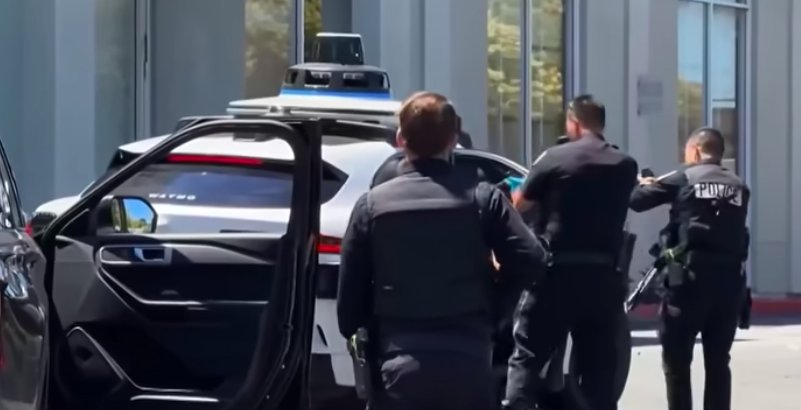
The autonomous vehicle then safely pulled itself into a parking lot where officers were waiting to investigate. The teens were removed from the vehicle, and police reportedly found evidence of underage drinking along with the Orbeez-style toy gun used during the incident. Officials noted that while the teenagers were not physically trapped inside the vehicle, Waymo had remotely directed the car to stop in a safe location until police arrived.
Although some early reports and social media posts incorrectly identified the incident as occurring in Orange County, it actually happened in San Mateo County in Northern California. Regardless of location, the event has sparked a nationwide conversation about privacy, surveillance, and just how much control autonomous vehicle companies have over their fleets.
Waymos Aren’t Just Taxis… They are Full-On Surveillance Machines
The incident also highlights something many passengers don’t fully realize: today’s robotaxis are constantly connected to remote operations centers. Waymo vehicles are equipped with multiple cameras, sensors, microphones, GPS, radar, and lidar systems that not only allow the vehicle to navigate safely but also enable human support teams to monitor unusual situations when necessary. While Waymo says it does not use facial recognition and only shares information with law enforcement under appropriate circumstances, this case demonstrates that disruptive or dangerous behavior inside one of its vehicles can quickly attract attention.
Waymo has become the undisputed leader in America’s autonomous taxi industry. The company traces its roots back to 2009 as Google’s secretive Self-Driving Car Project. What began as an ambitious research effort eventually spun off into its own Alphabet company in 2016 under the name Waymo—a combination of the words “Way” and “Mobility.” Since then, the company has spent billions of dollars developing one of the world’s most sophisticated autonomous driving platforms.
Unlike traditional ride-sharing companies that rely on human drivers, Waymo’s fleet uses artificial intelligence, high-definition mapping, lidar laser scanners, radar, cameras, and powerful onboard computers to navigate city streets without anyone behind the wheel. After years of testing, Phoenix became the first city to receive fully driverless commercial service in 2020. Since then, Waymo has expanded operations into San Francisco, Los Angeles, Austin, Atlanta, and several other metropolitan areas, completing hundreds of thousands of paid rides every week while continuing to grow its fleet.
Are Autonomous Cars Safer All-Around?
Supporters argue that autonomous vehicles have the potential to dramatically reduce traffic fatalities caused by distracted, impaired, or reckless human drivers. Computers don’t become intoxicated, fall asleep, or send text messages while driving. However, critics point to a growing list of incidents involving robotaxis that have become confused in construction zones, blocked emergency vehicles, driven the wrong way down streets, or otherwise behaved unpredictably. Regulators continue to investigate several recent incidents involving Waymo vehicles as the technology evolves.
This latest case also raises an interesting legal and ethical question: should autonomous vehicles act as witnesses when crimes or dangerous behavior occur inside them? In this situation, many people would argue the answer is yes. The teenagers were allegedly drinking underage while firing projectiles at unsuspecting people from a moving vehicle. This behavior could have easily resulted in injuries or a far more serious confrontation if someone believed the toy gun was real. Others, however, worry about the growing role of artificial intelligence as an always-watching observer capable of documenting and reporting passengers’ actions.
***** Editor’s Note*****
Whether viewed as responsible corporate citizenship or as another example of expanding digital surveillance, one thing is becoming increasingly clear: riding in a driverless taxi is very different from sitting in the back seat of a traditional cab. There may not be a human driver watching your every move, but the vehicle itself certainly is. And if passengers decide to turn a robotaxi into a rolling crime scene, they may discover that the car knows exactly where they’re going. And this taxi isn’t afraid to call the cops.
This is all going to roll out whether we like it or not. The AI genie is out of the bottle. It’s all too late. One way around this issue, is to never get into a Waymo vehicle. There’s an idea.




















































Want to join the conversation?
Create an account or sign in to share your thoughts, vote,
and reply to other readers.
Showing 0 of 0 comments
Don't have an account?
Already have an account?