
18 Suspects in Assassination of Haitian President Jovenel Moïse Extradited to Miami as Massive Federal Case Expands
Joseph Félix Badio and 17 Colombians Face U.S. Charges as Prosecutors Say the 2021 Plot Was Organized and Financed in Part From South Florida
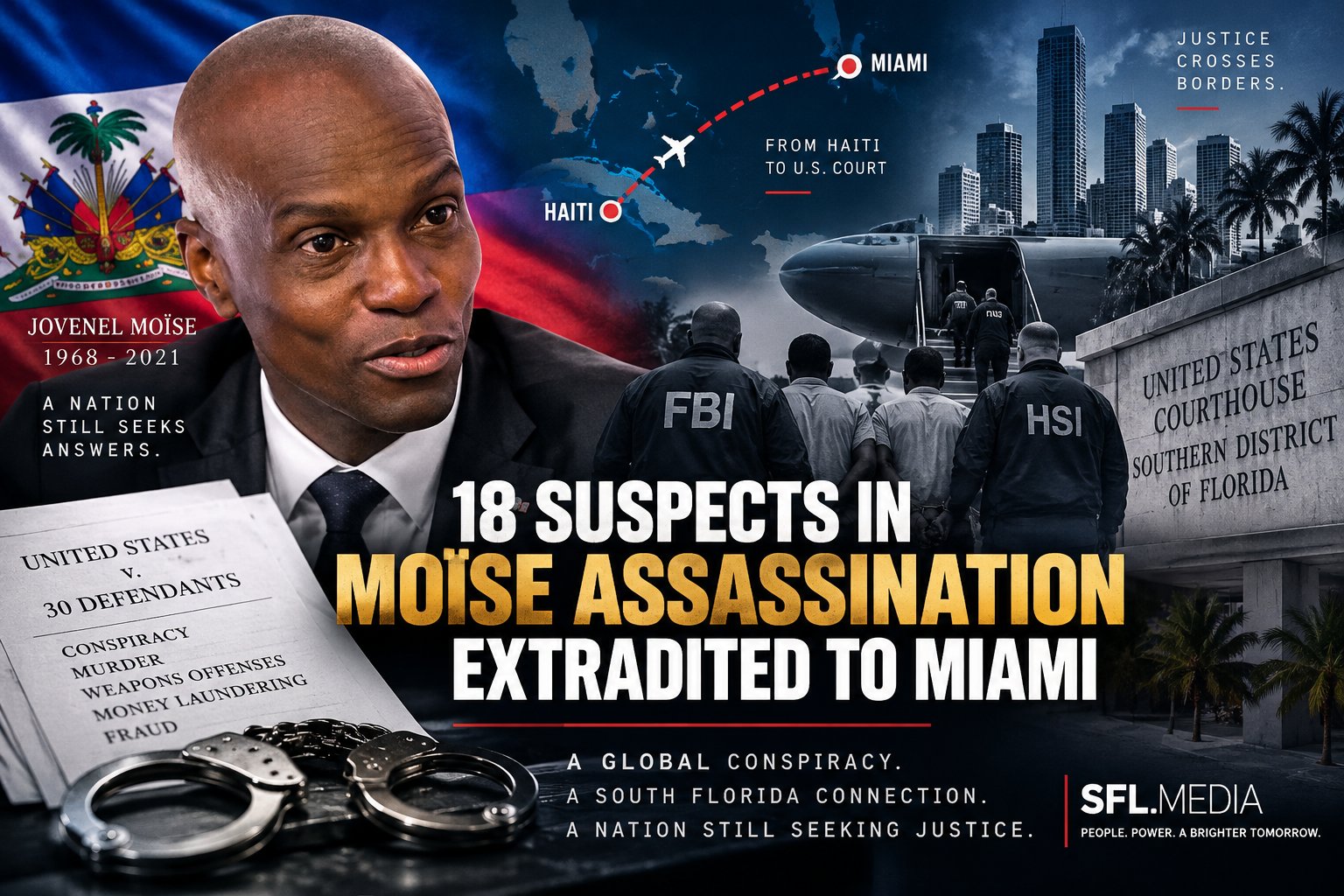
Eighteen defendants accused of participating in the 2021 assassination of Haitian President Jovenel Moïse have been transferred from Haiti to South Florida, dramatically expanding a federal prosecution that investigators say stretches from Miami area businesses and fraudulent COVID relief loans to Colombian mercenaries and the armed assault that killed Haiti’s president inside his private residence. Joseph Félix Badio, a former Haitian government official accused of playing a central role in the conspiracy, and 17 Colombian defendants were transported from Haiti aboard a U.S. military aircraft and brought to Miami to face newly unsealed federal charges. The extraordinary operation involved members of the FBI’s Hostage Rescue Team and Homeland Security Investigations, with the aircraft and federal team prepared for the possibility of armed gang attacks around the airport in Port-au-Prince.
The defendants are among 30 people indicted by a federal grand jury in the Southern District of Florida for alleged roles in the sprawling conspiracy surrounding Moïse’s assassination on July 7, 2021. Their arrival represents one of the largest developments in the case since American prosecutors began pursuing the network of financiers, recruiters, security contractors, political intermediaries and alleged operatives connected to the killing. The 18 defendants appeared in federal court in Miami, where U.S. Magistrate Judge Lisette Reid assigned attorneys and scheduled additional proceedings. The size and international nature of the case created unusual logistical demands as defendants were brought individually before the court and provided interpreters necessary to follow the proceedings. Several of the federal charges carry potential sentences of life imprisonment if the defendants are convicted.
A Presidential Assassination With Deep South Florida Connections
Although the assassination occurred more than 700 miles from Miami, South Florida has emerged as one of the most important locations in the federal investigation. Prosecutors allege that businesses, meetings, financing, equipment and personnel based in or connected to South Florida helped transform a scheme to remove Moïse from power into a deadly operation against a sitting head of state.
According to federal court records and evidence presented in earlier trials, the conspiracy evolved repeatedly during the months before the assassination. Prosecutors say conspirators initially discussed removing Moïse from office and installing a handpicked replacement who could award lucrative Haitian government contracts to people and companies involved in the operation. Plans included proposals to kidnap Moïse, drug him and force him to resign before the conspiracy ultimately escalated into an operation to attack his residence and kill him.
The federal investigation has already produced major convictions. In May 2026, a Miami federal jury convicted Arcangel Pretel Ortiz, Antonio Intriago, Walter Veintemilla and James Solages on charges connected to the conspiracy. Eight other alleged co-conspirators had previously pleaded guilty, with six later testifying during the federal trial. Prosecutors say the network recruited allies in the United States, Haiti and Colombia, including 22 former Colombian Army soldiers and Haitian gang figures. The arrival of another 18 defendants substantially expands the number of alleged participants now directly before the American judicial system and moves prosecutors closer to their stated objective of reconstructing the entire conspiracy rather than prosecuting only the men who physically participated in the assault.
Prosecutors Say COVID-Relief Fraud Helped Finance the Plot
One of the most extraordinary elements of the federal case involves money intended to help American businesses survive the COVID-19 pandemic. Prosecutors say fraudulently obtained Paycheck Protection Program and Economic Injury Disaster Loan funds were laundered and ultimately used to help finance the conspiracy. The connection is no longer merely an allegation surrounding the broader case. In July 2026, South Florida fundraiser and financier Keegan Harricharan was sentenced to 20 years in federal prison after pleading guilty to conspiracy to engage in money laundering involving hundreds of thousands of dollars in fraudulently obtained PPP and EIDL funds. Federal prosecutors said those funds helped finance the plot against Moïse. That financial trail strengthens the jurisdictional connection between the assassination and the United States. Federal prosecutors are not simply pursuing a foreign political killing; they have established in related proceedings that American financial systems, South Florida businesses and fraudulently obtained U.S. government relief money were intertwined with parts of the operation.
The South Florida security company Counter Terrorist Unit Security, or CTU Security, and people associated with it have figured prominently in the prosecution. Federal evidence identified Intriago and Pretel Ortiz as principals connected to CTU, while Veintemilla was a principal of Worldwide Capital Lending Group. Both companies were based in South Florida. Prosecutors said Intriago handled day-to-day logistics including payroll, equipment and provisions and helped move bulletproof vests, radios, flashlights, goggles and other tactical equipment from Miami to Haiti in June 2021. Solages, meanwhile, served as a liaison in Haiti, traveled repeatedly between South Florida and Haiti, coordinated with Haitian contacts and participated in surveillance of Moïse’s residence. The federal prosecution consequently portrays the assassination not as a spontaneous attack originating entirely inside Haiti, but as a transnational conspiracy whose financing, recruitment and logistical network extended through South Florida, Haiti and Colombia.
The Colombian Commando
The July 7, 2021 assault was carried out by a heavily armed group that included former Colombian military personnel. Seventeen Colombians held in Haiti were among the 18 defendants transferred to U.S. custody in the latest operation after spending years incarcerated while Haiti’s domestic investigation repeatedly stalled. Colombia has a large population of military veterans with extensive combat experience following decades of conflict involving guerrilla organizations, narcotics traffickers and paramilitary groups. Private security companies have recruited Colombian veterans for work around the world, including assignments in high risk environments.
Federal prosecutors say the conspiracy recruited 22 former Colombian Army soldiers as part of the broader operation against Moïse. Precisely what each defendant knew about the mission, when that knowledge developed and what role each ultimately played will now become critical questions in federal court. Those distinctions are important because the defendants are not all accused of identical conduct, and the government must establish criminal responsibility individually. Some Colombian defendants have maintained that they believed they were being recruited for legitimate security work or an operation to arrest Moïse rather than assassinate him. Colombian suspects detained in Haiti have also alleged that they were beaten, threatened and forced to sign documents they did not understand. Those claims are expected to become significant as defense attorneys scrutinize evidence gathered during years of detention in Haiti.
Víctor Pineda Accused of Firing at Moïse
Among the transferred defendants is former Colombian soldier Víctor Albeiro Pineda Cardona, who has been identified in investigative accounts and statements attributed to other suspects as one of the men who allegedly entered the area where Moïse and first lady Martine Moïse were located during the assault. Accounts from the investigation have accused Pineda of firing at the Haitian president. That allegation has not been adjudicated, and Pineda must be presumed innocent unless prosecutors prove the charges against him in court. Moïse was shot 12 times inside his private residence near Port-au-Prince during the early morning attack on July 7, 2021. Martine Moïse was also shot and seriously wounded but survived. The killing immediately raised extraordinary questions about how a heavily armed group could penetrate the residence of a sitting head of state and carry out an assassination without the president’s security apparatus stopping the attack.
Five years later, many of those questions remain central to investigations in Haiti and the United States.
Joseph Félix Badio Emerges as a Central Defendant
Joseph Félix Badio is among the most consequential defendants transferred to Miami. Badio previously worked for Haiti’s Ministry of Justice and in a government anti-corruption unit before becoming one of the central figures accused in the assassination investigation. Federal prosecutors allege that Badio participated in the conspiracy and the killing itself. He was arrested in Haiti in October 2023 after spending more than two years as a fugitive. Defense attorneys representing other defendants have previously portrayed him as a central organizer of the operation, while the newly unsealed federal indictment places him directly within the alleged conspiracy.
His transfer to Miami could become particularly important because prosecutors are attempting to establish not only what occurred at Moïse’s residence but how the larger operation was conceived, financed and directed. Investigators have spent years examining relationships among Haitian political and business figures, the Colombian contingent and individuals operating from South Florida. Badio, like every newly transferred defendant, is presumed innocent unless proven guilty.
Attackers Invoked the DEA During the Raid
One of the most unusual elements of the assassination was the attackers’ apparent attempt to create the impression that an American law-enforcement operation was underway. During the assault, members of the group invoked the U.S. Drug Enforcement Administration, and video from the night captured someone announcing what was purported to be a DEA operation. Evidence introduced in the federal prosecution has included tactical equipment and patches marked “DEA.” The actual Drug Enforcement Administration had no role in the operation. Federal prosecutors now allege that Badio himself posed as a U.S. drug agent during the killing. The tactic could have helped create confusion among Haitian security personnel and given the armed group an appearance of official authority as it approached and entered the presidential compound.
The Assassination Helped Push Haiti Deeper Into Crisis
Moïse’s killing did not create Haiti’s political and security crisis, but it removed the country’s sitting president at an extraordinarily unstable moment and was followed by a dramatic deterioration in state authority. Haiti has not had another president in the five years since his death, while armed gangs have expanded territorial control, political institutions have weakened and repeated attempts to establish a stable transition have struggled.
The justice system itself became one of the casualties of that collapse. Judges handling the assassination investigation resigned after receiving threats, gang violence disrupted government operations and armed groups eventually seized control of the downtown Port-au-Prince courthouse where suspects had been questioned. Haitian authorities ordered repeated investigations, but the domestic case failed to reach trial.
The human consequences have been enormous. By June 2026, more than 3,000 people had reportedly been killed in Haiti during the year and approximately 1.5 million people had been displaced as gang violence and political instability continued. Those conditions became an important backdrop to Haiti’s decision to transfer the 18 defendants to the United States. Haiti’s Ministry of Justice acknowledged that domestic proceedings continued to face significant difficulties and said cooperation with American authorities was intended to allow the judicial process to move forward. The decision has nevertheless generated criticism from Haitian human rights advocates who argue that one of the most consequential criminal cases in the country’s modern history should have been tried in Haiti and that transferring the defendants underscores the collapse of the nation’s judicial institutions.
For South Florida’s Haitian Community, the Case Is Deeply Personal
The prosecution carries unusual significance in South Florida, home to one of the largest Haitian communities outside Haiti. North Miami, Little Haiti, Miami Gardens, North Miami Beach, Broward County and surrounding communities maintain deep economic, cultural and family connections with the country, meaning political instability and gang violence in Haiti reverberate throughout South Florida in ways that extend well beyond an ordinary international criminal case. Local reaction to the extraditions has reflected competing emotions: relief that defendants will finally appear before a functioning court system, grief over Moïse’s assassination and frustration that Haiti’s own institutions were unable to bring the case to trial after five years.
For families who have watched Haiti deteriorate since the assassination, the Miami prosecution offers the possibility of answering questions that have remained unresolved since 2021. At the same time, the fact that those answers may ultimately come from a federal courthouse in downtown Miami rather than a Haitian courtroom underscores the severity of Haiti’s institutional crisis.
The Federal Case Is Becoming an Attempt to Reconstruct the Entire Conspiracy
The arrival of the 18 defendants substantially changes the scale of the prosecution in Miami. Federal authorities are now attempting to assemble evidence covering financiers, recruiters, political intermediaries, security contractors, former soldiers and alleged operational planners across several countries while building on earlier convictions that already established important elements of the South Florida based conspiracy.
The government must prove the allegations against each newly transferred defendant independently. Defense attorneys are expected to scrutinize evidence collected in Haiti, statements made during years of detention, the conditions under which suspects were interrogated and imprisoned, and prosecutors’ interpretation of individual roles in an operation that changed repeatedly before the assassination. Those proceedings could make the Southern District of Florida the primary judicial venue for establishing how a sitting Caribbean president was assassinated by an armed group whose alleged planning, recruitment, financing and logistical support extended deeply into the United States.
Five years after Jovenel Moïse was shot to death inside his own home, the central question is no longer simply who fired the bullets. The federal case is increasingly focused on the architecture surrounding the assassination: who conceived the operation, who financed it, who recruited the soldiers, who supplied the equipment, who transformed plans to remove or kidnap the president into an order to kill him, who expected to profit afterward and whether additional people who never entered Moïse’s residence helped make the assassination possible. With 18 additional defendants now standing before a federal court in Miami and 30 people charged in the broader federal case, prosecutors are preparing to put that larger alleged conspiracy on trial.

Sources & Further Reading
- U.S. Department of Justice — 18 Defendants Transported From Haiti to South Florida to Face Federal Charges — Primary federal source covering the transfer, 30-defendant indictment, FBI Hostage Rescue Team and HSI operation, charges and broader investigation.
- U.S. Department of Justice — Four Defendants Convicted in Plot to Kill Haitian President Jovenel Moïse — Federal trial record detailing the South Florida planning, recruitment of 22 former Colombian soldiers, tactical equipment, CTU Security and evolution of the kidnapping and assassination plots.
- U.S. Department of Justice — South Florida Fundraiser Sentenced to 20 Years for Laundering COVID-Relief Funds Connected to Moïse Assassination — Details the PPP and EIDL fraud proceeds that prosecutors say helped finance the plot.
- Associated Press — Ex-Haitian Official and 17 Others Appear in U.S. Court in Moïse Assassination Case — Reporting on the Miami court appearances, Badio, the Colombian defendants, Haiti’s stalled investigation and conditions surrounding the transfer.
- Associated Press — 18 Suspects in Jovenel Moïse Assassination Extradited to the United States — Reporting on the extradition, Colombian defendants, Haiti’s judicial difficulties and the broader federal prosecution.
- Reuters — Suspects in 2021 Killing of Haitian President Flown to U.S. to Face Trial — International reporting on the transfer, federal case and South Florida’s alleged role as a base for the conspiracy.
- WPLG Local 10 — 18 Suspects Accused in Killing of Haiti’s President Extradited to the United States — South Florida coverage of the extraditions and the case’s significance to the Haitian-American community.









































Want to join the conversation?
Create an account or sign in to share your thoughts, vote,
and reply to other readers.
Showing 0 of 0 comments
Don't have an account?
Already have an account?