
Say What You Will, Greenspan Mattered
The world of economics lost one of its most influential and controversial figures on June 22, 2026, when former Federal Reserve Chairman Alan Greenspan died at the age of 100. According to his wife, veteran NBC News correspondent Andrea Mitchell, Greenspan died from complications related to Parkinson’s disease. His passing marks the end of an era for a man who, for nearly two decades, stood at the center of the global financial system and whose every word could send markets soaring or tumbling.
Dubbed “The Maestro” by the financial press, Greenspan was more than just a central banker. He became one of the most recognizable economists in modern history, a man whose policies helped shape the prosperity of the 1990s and whose legacy remains fiercely debated because of his role in the financial conditions that preceded the Great Recession of 2008.
A Very Accomplished Man
Alan Greenspan was born on March 6, 1926, in New York City’s Washington Heights neighborhood. His parents divorced when he was young, and he was largely raised by his mother and grandparents. As a child, he displayed an extraordinary aptitude for mathematics and numbers, reportedly reciting baseball statistics and performing complex calculations in his head long before most children had mastered multiplication tables.
Surprisingly, economics was not his first passion. As a young man, Greenspan attended the prestigious Juilliard School, where he studied clarinet and saxophone. He even performed professionally with jazz bands during the 1940s and briefly contemplated a career in music. One of his bandmates was future presidential adviser Leonard Garment, and Greenspan’s love for jazz remained with him throughout his life.
Eventually, his fascination with numbers and business led him to pursue economics at New York University, where he earned bachelor’s, master’s, and doctoral degrees in economics. During this period, he studied under economist Arthur Burns, who himself would later become chairman of the Federal Reserve and greatly influence Greenspan’s thinking on monetary policy.
Greenspan’s professional career began in 1948 with the National Industrial Conference Board, where he analyzed industrial commodities such as steel, aluminum, and copper. It was a practical education in how the American economy functioned, and it laid the groundwork for his future as an economic forecaster.
In 1954, he co-founded the economic consulting firm Townsend-Greenspan & Co.. The company advised major corporations and became highly respected on Wall Street and in Washington. During this period, Greenspan also became closely associated with novelist and philosopher Ayn Rand. He was part of her inner circle and embraced many of her free-market and limited-government principles, ideas that would later influence his views on financial regulation and government intervention.
First Foray Into Government
Greenspan’s first major government role came under President Gerald Ford, who appointed him chairman of the Council of Economic Advisers in 1974. In that position, he became one of Washington’s leading economic voices during a period plagued by inflation, energy crises, and economic stagnation. His reputation as a thoughtful and data-driven economist grew rapidly.
He later chaired the bipartisan National Commission on Social Security Reform, which helped rescue Social Security from financial difficulties during the early 1980s. The success of that commission further enhanced his stature in Washington and made him an attractive candidate for higher office.
In 1987, President Ronald Reagan selected Greenspan to succeed the legendary Federal Reserve Chairman Paul Volcker. The appointment would prove to be one of the most consequential economic decisions of the late twentieth century. Greenspan officially took office on August 11, 1987.
His baptism by fire came only two months later. On October 19, 1987, the stock market suffered the infamous “Black Monday” crash, with the Dow Jones Industrial Average plunging more than 22 percent in a single day. Greenspan moved quickly, assuring markets that the Federal Reserve stood ready to provide liquidity and support the financial system. Many economists believe his actions prevented a full-scale financial panic.
Greenspan Served Under Four Presidents
Over the next 18 years, Greenspan would become one of the most powerful unelected officials in America. Serving under four presidents—Reagan, George H. W. Bush, Bill Clinton, and George W. Bush—he guided the United States through multiple economic crises, including the savings and loan crisis, the Mexican peso collapse, the Asian financial crisis, the bursting of the dot-com bubble, and the economic aftermath of the September 11 terrorist attacks.
During the economic boom of the 1990s, Greenspan’s stature reached almost mythical proportions. Investors hung on every word he uttered, and his intentionally vague and often confusing communication style became known as “Fed speak.” He once famously joked, “If I seem unduly clear to you, you must have misunderstood what I said.”
Greenspan also entered the popular lexicon in 1996 when he warned about “irrational exuberance” in financial markets, a phrase that became synonymous with the technology stock bubble of the late 1990s. Despite his cautionary remarks, the U.S. economy continued its historic expansion and unemployment fell to record lows.
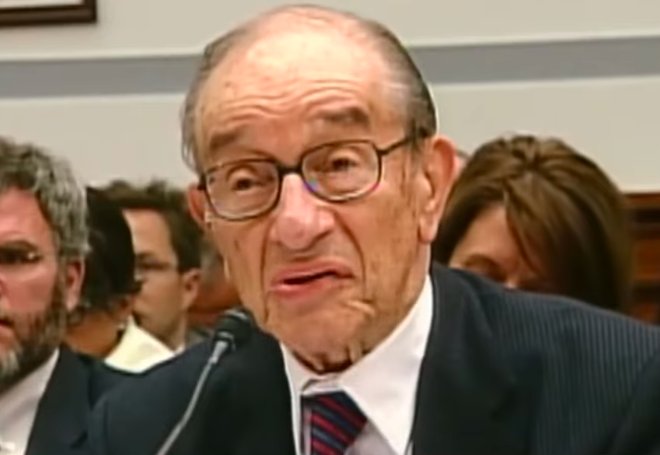
Yet, as his career progressed, criticism of Greenspan intensified. Many economists and policymakers accused him of promoting deregulation and keeping interest rates too low for too long, thereby helping fuel the housing bubble that eventually burst and triggered the 2008 global financial crisis. Although he had already retired by the time the crisis unfolded, his reputation suffered considerably. In congressional testimony following the collapse, Greenspan admitted there had been a “flaw” in his long-held belief that financial institutions would regulate themselves responsibly.
The once-revered “Maestro” suddenly became a deeply polarizing figure. Admirers argued that he presided over one of the longest periods of economic growth in American history and successfully navigated countless financial storms. Critics countered that his devotion to free markets and opposition to stronger regulation helped create the conditions for one of the worst economic disasters since the Great Depression.
Life After the Fed
After leaving the Federal Reserve in 2006, Greenspan remained active as an author, consultant, and commentator on economic affairs. He published several books, including The Age of Turbulence, and continued advising corporations and governments around the world. Despite the criticism surrounding his later years, his opinions on inflation, debt, and monetary policy continued to carry considerable weight in financial circles.
On the personal side, Greenspan found lasting happiness with journalist Andrea Mitchell, whom he married in 1997 in a ceremony officiated by Supreme Court Justice Ruth Bader Ginsburg. The couple became one of Washington’s most prominent power pairs, and Mitchell frequently described him as brilliant, kind, and endlessly curious.
Alan Greenspan leaves behind a complicated but undeniable legacy. He transformed the role of the Federal Reserve chairman into a position of immense public influence and became the face of American economic policy for nearly a generation. To some, he was the man who helped engineer one of the greatest periods of prosperity in U.S. history. To others, he was an architect of the excesses that led to the financial crisis. Either way, few economists have ever wielded as much power—or inspired as much debate—as Alan Greenspan.
With his passing at the age of 100, the world says goodbye to a central banking titan whose fingerprints remain all over the modern global economy. Love him or criticize him, Alan Greenspan’s impact on finance and American history will be studied for generations to come.
















































Want to join the conversation?
Create an account or sign in to share your thoughts, vote,
and reply to other readers.
Showing 0 of 0 comments
Don't have an account?
Already have an account?