
Amazon Prime Air Cargo Plane Crashes at Miami International Airport, Killing at Least Five
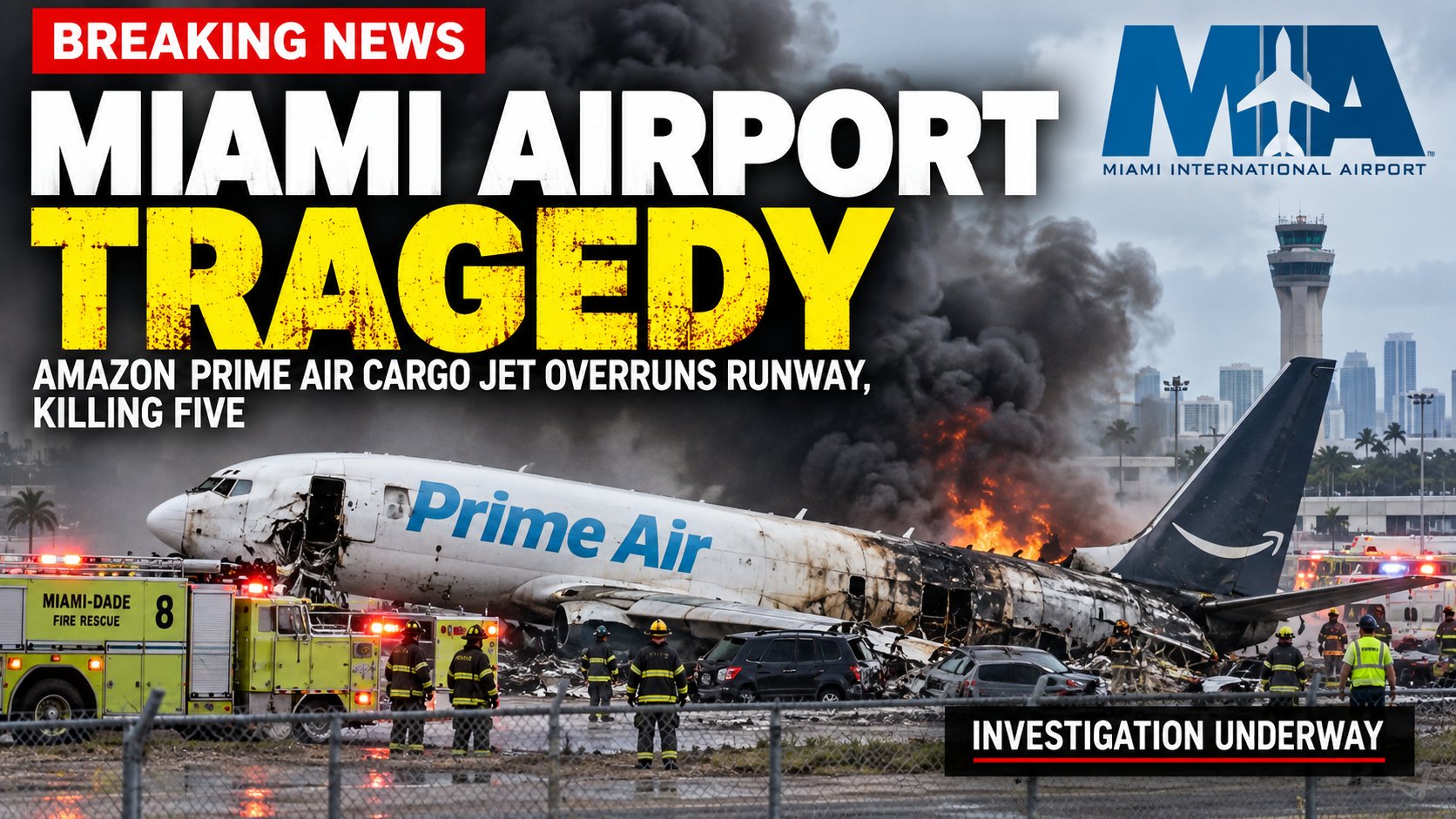
At least five people were killed and five others injured Sunday after an Amazon Air cargo jet overran a runway while landing at Miami International Airport, crossed beyond the airport grounds and struck multiple vehicles before bursting into flames, triggering a massive emergency response and temporarily shutting down one of the busiest aviation hubs in the United States. Prime Air Flight 7598, operated by cargo carrier 21 Air on behalf of Amazon, was arriving from Luis Muñoz Marín International Airport in San Juan, Puerto Rico, when the Boeing 767-300 freighter overran Miami International Airport’s diagonal runway shortly before 2 p.m. on September 6. The aircraft continued beyond the end of the runway, crossed into an area near a roadway and collided with multiple vehicles before coming to rest near the northwest side of the airport.
Miami-Dade County Mayor Daniella Levine Cava confirmed Sunday evening that five people had died and five others were injured. Three of the injured were reported in critical condition. Authorities had not publicly identified the victims as the investigation and notification of relatives continued. The crash immediately became one of South Florida’s most serious aviation disasters in years and brought operations at Miami International Airport to a temporary standstill as firefighters, police, airport personnel and federal investigators converged on an enormous crash scene.
Flight 7598 Overruns Miami International Airport Runway
The Federal Aviation Administration identified the aircraft as a Boeing 767-300 cargo jet operated by 21 Air. The flight had departed San Juan shortly before noon and spent slightly more than two hours in the air before arriving in Miami. Flight tracking information indicates the aircraft touched down at approximately 1:53 p.m. The accident occurred on Runway 30, part of MIA’s diagonal runway system.
The runway is more than 9,000 feet long, providing investigators with an immediate and critical question: why the aircraft was unable to stop before reaching the end of the pavement.
The aircraft was approximately 32 years old, according to aviation reporting. Age alone does not establish that an aircraft was unsafe, particularly in the cargo industry, where properly maintained commercial jets frequently remain in service for decades. However, maintenance history, component condition and previous inspections will almost certainly become part of the investigation. The FAA said Flight 7598 “overran the runway after landing” and confirmed that federal investigators would examine the accident.
Aircraft Crossed Beyond Runway and Struck Multiple Vehicles
What transformed the runway overrun into a mass casualty disaster was the aircraft’s continued movement after leaving the runway. Miami-Dade Fire Rescue said the Boeing struck multiple vehicles near the 2100 block of Northwest 42nd Avenue. Air traffic control recordings reviewed by multiple news organizations also indicated that the aircraft traveled beyond the runway and into the area of a perimeter road.
Images from the scene showed the damaged aircraft outside the normal runway environment, surrounded by emergency vehicles, with thick black smoke rising over the airport. The aircraft caught fire following the crash, creating an additional hazard for the people trapped inside the plane and vehicles in its path. Reuters reported that the pilot and co-pilot were trapped inside the aircraft while two additional people were trapped in vehicles. Firefighters worked to extinguish the blaze, extricate victims and contain a fuel leak that complicated operations at the crash site.
More than 60 Miami-Dade Fire Rescue units and approximately 200 emergency personnel were deployed as authorities treated the accident as a major mass casualty event.
Five Dead and Five Injured
By Sunday evening, Miami-Dade officials confirmed five fatalities and five injuries, with three of the injured listed in critical condition. The identities of those killed had not been publicly released as of Sunday evening, and authorities had not yet provided a complete accounting of how many victims were aboard the aircraft compared with those struck on the ground. The involvement of vehicles outside the immediate runway area significantly expands the scope of the investigation. Investigators will need to reconstruct not only the aircraft’s landing and runway excursion but its path after leaving the airport pavement, including the sequence and severity of the vehicle impacts.
The Miami-Dade Sheriff’s Office is handling the local death investigation, while the National Transportation Safety Board is leading the federal investigation into the aviation accident. The FAA is also investigating.
No Emergency Was Declared Before Landing
One of the most significant early details is what apparently did not happen before the crash. A review of air traffic control communications found no indication that the pilots declared an emergency before landing. That does not rule out a mechanical problem, pilot concern or rapidly developing problem during touchdown, but it suggests the flight crew was not dealing with an obvious emergency serious enough to trigger a mayday call during the final approach.
That distinction could prove important. If investigators determine that the aircraft was operating normally before touchdown, attention will likely focus heavily on the landing itself: where the Boeing touched down, its speed at touchdown, runway conditions, wind direction, braking performance and whether the crew attempted or should have attempted a go-around before committing to the landing.
If evidence instead reveals a mechanical or flight control problem, investigators will work backward through maintenance records, cockpit communications, aircraft systems and recorded flight data to determine when the problem began. At this stage, however, authorities have not announced a cause, and any claim that weather, mechanical failure or pilot error caused the crash would be premature.
Thunderstorms and Wet Conditions Will Be Examined
Weather conditions around Miami will inevitably become part of the investigation. Thunderstorms were reported in the area around the time Flight 7598 arrived, along with gusty and potentially shifting winds. Wet runway conditions can increase the stopping distance required by a large aircraft, particularly when combined with excessive touchdown speed, a tailwind, delayed braking or a touchdown farther down the runway than planned.
Investigators will examine precise weather observations from the airport, wind speed and direction at the moment of landing, rainfall intensity, runway surface conditions and information provided to the pilots before their approach. Those factors should not be confused with a determination of cause. Commercial aircraft routinely operate safely in rain and thunderstorms around South Florida, and runway overruns typically require investigators to analyze multiple interacting factors rather than isolate one immediately visible condition.
Black Boxes Could Reveal Exactly What Happened
The aircraft’s flight data recorder and cockpit voice recorder will likely become two of the most important pieces of evidence. The flight data recorder can provide investigators with a second by second reconstruction of the aircraft’s performance, including airspeed, altitude, descent rate, engine settings, braking, flight-control positions and other parameters. Investigators will be particularly interested in the Boeing’s touchdown point, touchdown speed and remaining runway distance when braking began.
The cockpit voice recorder could reveal what the pilots were seeing and discussing during the final approach and seconds after touchdown, including whether they noticed changing winds, runway conditions, braking problems or another abnormal condition. Investigators are also expected to examine the deployment and operation of spoilers, flaps, brakes and thrust reversers. All are critical to slowing a heavy Boeing 767 after landing. Maintenance records will receive scrutiny as well. The aircraft’s age makes those records relevant, but investigators will be looking for evidence rather than assuming that a 32-year-old airplane was inherently unsafe. Commercial cargo fleets routinely operate older aircraft under federally mandated inspection and maintenance programs.
Runway Overrun Raises Questions About Landing Distance
One of the central technical questions will be how a Boeing 767 managed to travel beyond the end of a runway more than 9,000 feet long. Investigators can calculate the aircraft’s expected landing distance using its weight, configuration, wind conditions, runway condition and touchdown speed, then compare those calculations with the actual landing.
A touchdown substantially beyond the intended touchdown zone can consume thousands of feet of available stopping distance. Excessive speed can further increase the distance needed to stop. Standing water can reduce braking effectiveness, while a tailwind can increase the aircraft’s groundspeed even when its indicated airspeed appears appropriate.
A malfunction involving brakes, spoilers or thrust reversers could produce another scenario entirely. Determining which, if any, of those factors played a role will require flight recorder data, physical examination of the wreckage and runway, weather information and interviews with the surviving crew.
Miami International Airport Temporarily Shut Down
The accident immediately disrupted air travel across South Florida. Miami International Airport initially closed all runways and taxiways and implemented a full ground stop while emergency personnel responded. Flights bound for Miami were delayed, diverted or held at their departure airports, while outbound passengers faced widespread cancellations and delays.
The disruption quickly spread through airline networks because MIA is a major international gateway connecting the United States with Latin America and the Caribbean. By Sunday evening, operations had begun resuming on two of the airport’s four runways, although the crash site and affected runway remained part of an active investigation. Hundreds of flights were delayed or canceled during the disruption, with passengers advised to check directly with their airlines before traveling to the airport.
Amazon Confirms Aircraft Was Operated by 21 Air
Although the aircraft carried Amazon branding and was flying as Prime Air Flight 7598, the Boeing was operated by 21 Air, a North Carolina based cargo airline that operates aircraft for logistics customers. That distinction matters when describing the accident. Amazon Air relies on contracted cargo carriers to operate portions of its air transportation network rather than directly flying every Amazon branded aircraft. Amazon confirmed that an Amazon Air aircraft operated by 21 Air was involved and said it was cooperating with authorities. The company said its immediate priority was supporting those affected while investigators worked to determine what happened.
NTSB Takes Lead in Investigation
The National Transportation Safety Board has launched an investigation and is expected to examine the aircraft, wreckage, runway, flight recorders, crew actions, weather, air traffic control communications, maintenance history and operational procedures. NTSB Chair Jennifer Homendy was leading the agency’s response to the accident, according to reporting Sunday evening.
The investigation will likely begin with extensive documentation of the wreckage and accident site before the aircraft is moved. Investigators can use tire marks, runway evidence, debris patterns and impact locations to reconstruct the aircraft’s trajectory after touchdown. The agency will also coordinate with Boeing, the FAA, 21 Air, Amazon and other relevant parties while maintaining control of the federal accident investigation. A preliminary NTSB report could provide basic factual information about the accident within weeks, but determining the probable cause of a major commercial aviation accident typically takes considerably longer.
The Critical Question: Why Couldn’t Flight 7598 Stop?
For investigators, the defining mystery is straightforward even if the eventual explanation is not: why did a Boeing 767 arriving on a runway more than 9,000 feet long fail to stop before leaving the airport environment? The answer could involve weather, runway conditions, touchdown location, aircraft speed, mechanical performance, crew decision-making or some combination of those factors. Investigators may also examine whether infrastructure beyond the runway could have reduced the severity of the accident once the aircraft left the pavement.
What is already clear is that Flight 7598 did not simply experience a routine runway excursion. The aircraft continued far enough beyond the runway to strike vehicles, ignite and turn an aviation accident into a mass-casualty event affecting people on the ground. For Miami and the broader South Florida aviation community, the investigation will now focus on understanding exactly how that sequence unfolded and whether anything could have prevented it.

Sources & Further Reading
Federal Investigation and Official Information
Federal Aviation Administration — Aviation Accident and Incident Statements
National and International Reporting
Reuters — At Least Five Killed in Amazon Prime Air Cargo Plane Crash in Miami
Associated Press — At Least Five Dead After Amazon Cargo Plane Barrels Off Miami Runway
ABC News — Amazon Cargo Plane Overruns Runway at Miami International Airport
Aviation Week — Prime Air 767F Overruns Miami Runway
South Florida Coverage
Local 10 — Cargo Plane Crashes After Going Off Miami International Airport Runway
CBS Miami — Five Dead, Five Injured After Amazon Cargo Plane Overruns Runway

















































Want to join the conversation?
Create an account or sign in to share your thoughts, vote,
and reply to other readers.
Showing 0 of 0 comments
Don't have an account?
Already have an account?