
Claptone Delivers a Two Hour House Music Banger With “The Masquerade” in Buenos Aires
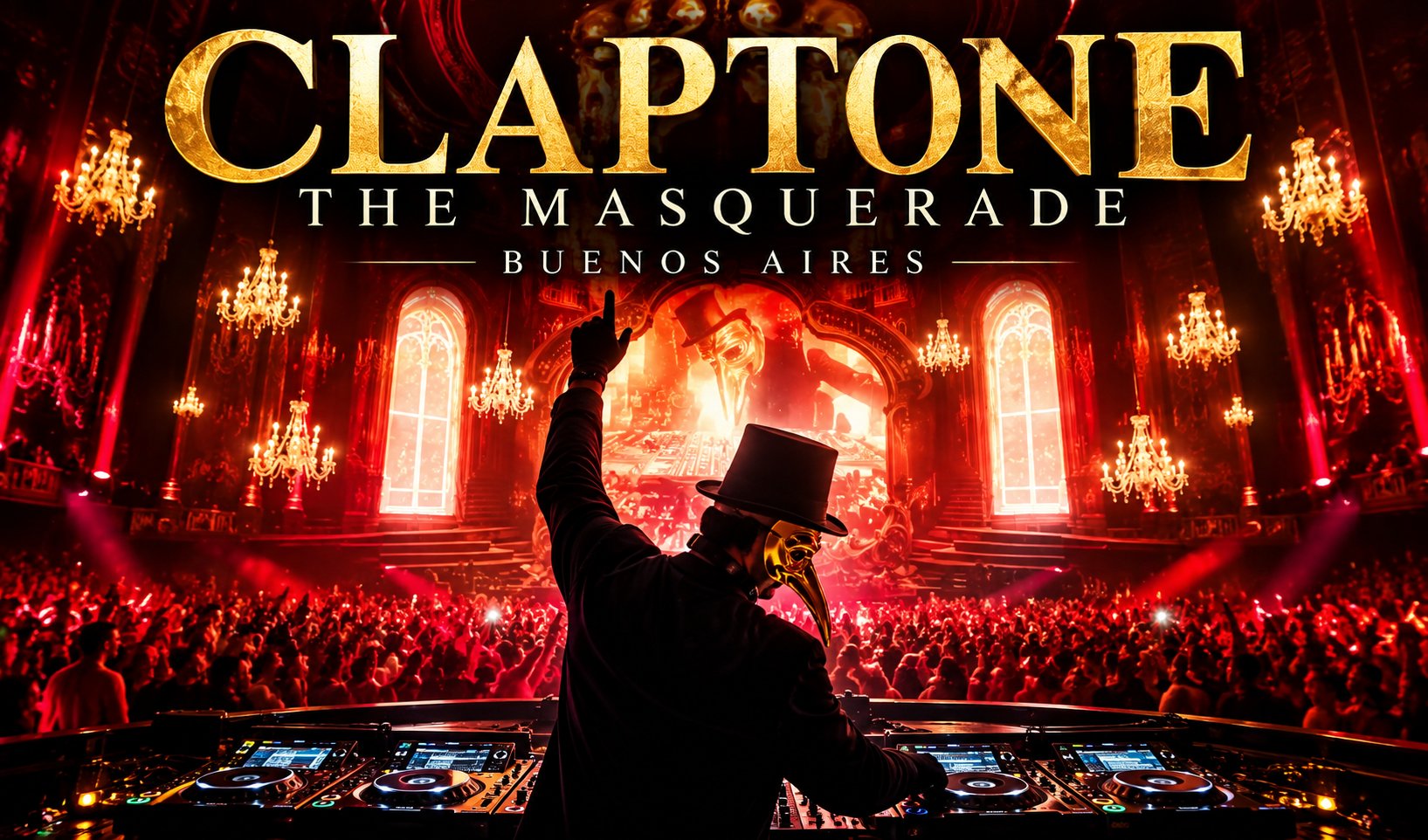
Claptone brought the mystery, spectacle and unmistakable pulse of The Masquerade to Buenos Aires for a nearly two hour performance that captures exactly why the masked German electronic music project has remained one of house music’s most recognizable acts. Recorded at Movistar Arena and released in full on July 17, 2026, the 1 hour, 59 minute set is less a conventional DJ performance than a carefully constructed journey through deep house, tech house, vocal house and melodic club music. Behind the decks in the signature golden beak mask, Claptone moves between driving percussion, soulful vocals, familiar samples and enormous arena ready drops while The Masquerade’s theatrical production transforms the venue around him.
The Buenos Aires crowd provides the other half of the equation. Latin America has long been one of electronic music’s most energetic markets, and the audience appears completely invested in the performance, responding to recognizable vocals and major transitions while thousands of people move beneath a barrage of LED imagery, strobes and theatrical lighting.
The Masquerade Is More Than a DJ Set
Claptone’s The Masquerade concept has always relied on atmosphere. The mask creates anonymity, but the production surrounding it creates a character: mysterious, theatrical and slightly surreal. At Movistar Arena, that identity is scaled for an arena, with massive visual displays and lighting sequences working alongside the music rather than merely decorating the stage.
The result is important because Claptone’s sound has never depended exclusively on brute force festival drops. Much of the appeal comes from tension and release, allowing a vocal to breathe before the bassline returns or using a familiar sample as the bridge between deeper club records. The Buenos Aires performance preserves that approach while giving it enough production power to fill a major arena. Rather than spending two hours at maximum intensity, Claptone structures the set in waves. There are extended stretches built around percussion and groove, followed by vocal releases, recognizable hooks and heavier peaks. That pacing gives the performance room to develop instead of becoming a two-hour collection of disconnected drops.
The First 25 Minutes Build the Foundation
The opening portion establishes the rhythm without immediately revealing everything the set has in reserve. An early vocal hook arrives shortly after the first minute, but Claptone spends much of the opening 25 minutes steadily layering percussion, bass and vocal fragments while allowing the room to settle into the groove. Around the six minute mark, extended drum sequences begin pushing the energy higher, with repeated vocal phrases functioning almost like another percussion instrument. By approximately eight minutes, the performance has established its central musical vocabulary: rolling house drums, thick low end, looping vocals and transitions designed to keep movement continuous.
It is a patient opening by modern festival standards, and that patience becomes one of the performance’s strengths. Claptone does not need to detonate the arena every 90 seconds. He allows tracks to develop, giving the crowd time to lock into the rhythm before moving toward the heavier middle section.
The Set Begins to Explode Around the 40 Minute Mark
By the time the performance reaches its middle stretch, the restraint begins disappearing. Around 43 minutes, party chants and aggressive vocal samples signal a transition into a more openly peak-time portion of the show. A few minutes later, an emotional vocal asking someone to “reach for me” and “touch me” introduces another side of Claptone’s style, pairing club momentum with the kind of emotionally direct vocal hooks that have long connected house music to disco, soul and pop.
The intensity rises again between roughly 53 and 55 minutes, when recognizable club-language samples collide with a harder rhythmic foundation. References to working the body into the beat and losing control become almost instructions to the arena, arriving at precisely the point when the set has accumulated enough momentum to make them feel natural rather than forced. This is where the scale of The Masquerade becomes particularly effective. The musical transitions are amplified by synchronized lighting and enormous visual elements, turning what might be an excellent late night club sequence into something built for thousands of people.
Claptone Pulls the Set Back Toward Melody
After the first major peak, the performance begins opening into a more melodic and vocal driven phase. Around 57 minutes, soaring vocals move to the foreground, creating a transition away from the harder club energy and toward something more emotional. That continues just beyond the one-hour mark, when a soulful vocal about love, ecstasy and reaching “the point of no return” floats across the arena. The sequence demonstrates one of Claptone’s most effective traits as a DJ: his willingness to allow melody and vocals to carry the emotional weight of a set without abandoning the dance floor underneath them. By approximately 1 hour and 20 minutes, the mood becomes almost communal. A vocal centered on living together and the declaration that “love is the answer” arrives over the house groove, tapping into one of the genre’s oldest traditions. House music has always drawn power from repetition, inclusivity and communal release, and inside a packed Buenos Aires arena, those themes take on an entirely different scale.
House Music All Night Long
The final third of the performance begins driving the energy upward again. Around the 1:34 mark, a spoken-word house vocal tells listeners not to let anyone stand in their way and declares that the night belongs to house music. The words function as a mission statement for the closing stretch, where the melodic passages of the previous half-hour begin giving way to more assertive club rhythms. Minutes later, another melodic vocal built around the idea that “life is a dream” briefly pulls the set back toward introspection. Claptone repeatedly uses these contrasts throughout the performance: hard percussion followed by melody, recognizable vocals followed by deeper grooves, euphoric release followed by another gradual build. That push and pull keeps the nearly two-hour runtime from feeling monotonous. Instead of treating intensity as a straight line, the set behaves more like a series of interconnected waves, each one rising, breaking and creating space for the next.
“No Eyes” Brings The Masquerade Home
For the closing climax, Claptone turns to the record most closely associated with his career: “No Eyes.” The unmistakable vocal begins emerging during the final minutes, and the reaction from the Buenos Aires audience immediately demonstrates why the track remains such an important part of the Claptone catalog.
Originally released more than a decade ago, “No Eyes” became one of the defining records of Claptone’s rise, pairing an instantly recognizable vocal with the hypnotic, slightly melancholic house production that would become central to his identity. In Buenos Aires, it functions as both an anthem and a finale.
As the familiar vocal rolls through Movistar Arena, the entire concept comes together: the mysterious golden mask, enormous theatrical visuals, thousands of people singing and dancing, and a record that has followed Claptone around the world. After nearly two hours of carefully controlled movement between deep grooves, tech-house pressure, soulful vocals, pop familiarity and melodic release, there is something fitting about ending with the song most listeners immediately associate with the mask.
A Two Hour Reminder of What a Great DJ Set Is Supposed to Sound Like
The Buenos Aires edition of The Masquerade works because Claptone never allows the spectacle to replace the music. The production is enormous, but underneath it remains a carefully paced house set built around groove, transitions and the ability to understand when a crowd needs pressure and when it needs release. That balance is increasingly valuable in an electronic-music landscape where festival sets can sometimes feel designed primarily as collections of viral moments. Claptone instead gives the music time to breathe. The recognizable samples are there, the enormous drops are there and the arena production is certainly there, but they are connected by long stretches of actual DJ storytelling.
From the patient opening grooves through the explosive middle section, soulful vocal passages and final arrival of “No Eyes,” Claptone’s Buenos Aires performance demonstrates why The Masquerade has endured as more than branding surrounding a man in a golden mask. For nearly two hours, the mask may hide the person behind the decks, but there is nothing mysterious about what keeps the crowd moving: exceptionally well-constructed house music.















































Want to join the conversation?
Create an account or sign in to share your thoughts, vote,
and reply to other readers.
Showing 0 of 0 comments
Don't have an account?
Already have an account?