
Trump’s America of Gambling, Porn and Weed: When “Freedom” Becomes a Business Model
Donald Trump campaigned as the candidate who would restore American strength, rebuild the middle class and put ordinary Americans ahead of powerful institutions. But a provocative new interview featuring Tucker Carlson and Saagar Enjeti of Breaking Points, raises a very different question about what the Trump era is actually producing: America becoming a country increasingly designed around gambling, pornography, marijuana and other industries that monetize addiction.
That is the central argument of the interview, in which Enjeti lays out a case that the modern American economy has increasingly turned human weakness into a revenue stream, particularly targeting young men. His argument is deliberately provocative, but the underlying numbers are difficult to dismiss. Legal sports gambling has exploded since the Supreme Court opened the door to widespread state legalization in 2018.
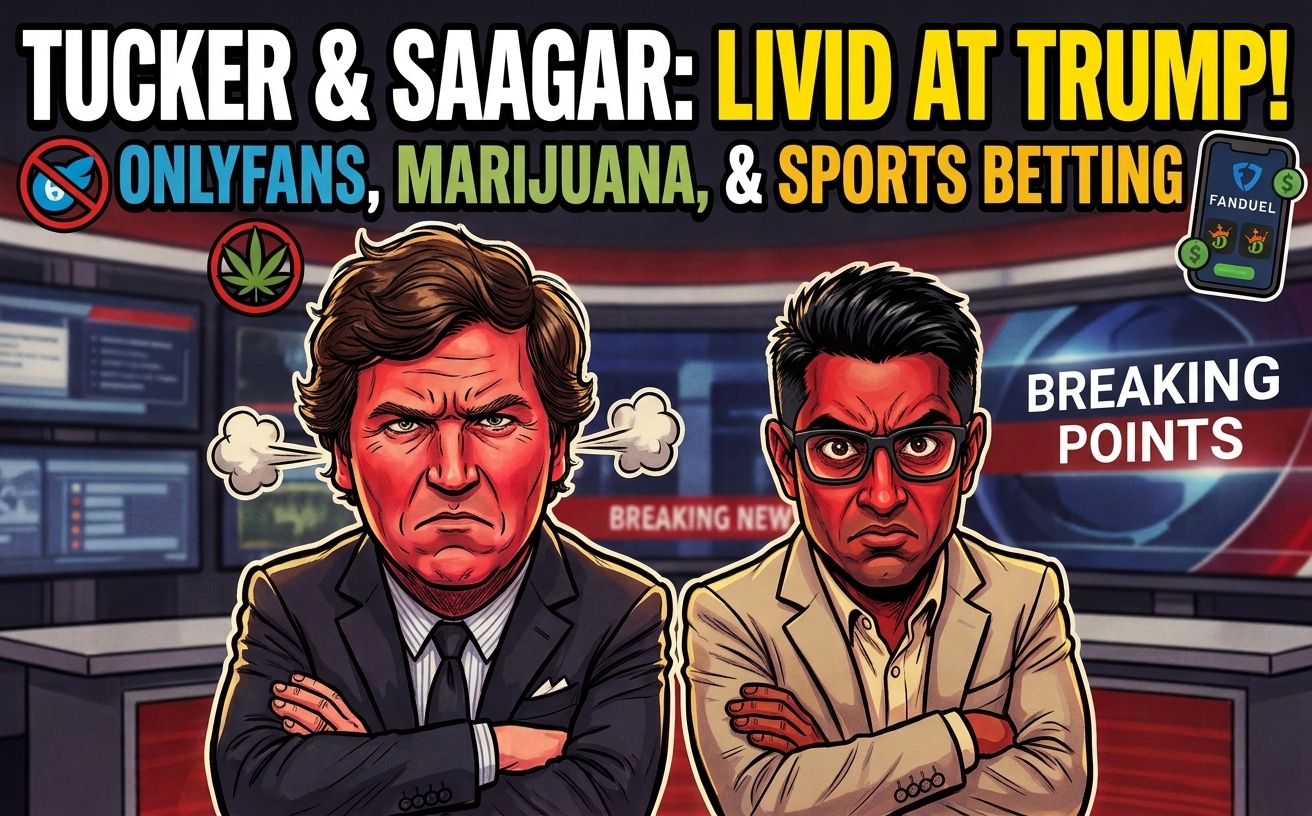
Marijuana has moved steadily toward mainstream commercialization. Online pornography has become a massive financial industry. And prediction markets such as Kalshi and Polymarket are pushing wagering into areas that would have been recognizable as gambling to previous generations.
The uncomfortable part for Trump supporters is that much of this expansion has happened while Trump and his administration have taken steps that make these markets easier to operate.
The $500 Billion Gambling Problem
Perhaps the most striking statistic discussed in the interview is the sheer scale of sports gambling.
Enjeti says Americans have wagered approximately $500 billion on sports since 2018, while roughly $166 billion was wagered on sports in 2025 alone. He compares that figure with approximately $70 billion in combined revenue from movies, recorded music, live music, books and museums.
The exact comparisons depend on whether one is measuring gambling handle or entertainment revenue, which is an important distinction. A wagered dollar is not the same thing as a dollar of industry revenue. But even with that caveat, the scale of the gambling economy is enormous. Outside reporting puts 2025 U.S. sports betting handle at roughly $167 billion. That is a remarkable transformation from the America that existed before 2018.
Sports gambling was once something largely associated with Las Vegas, racetracks, illegal bookmakers and the occasional guy in a bar whispering about the point spread. Today, it is sitting inside Americans’ pockets. A football game is no longer simply a football game. A person can bet on the winner, the spread, the total points, individual player statistics, the next score, the next possession and increasingly obscure combinations of outcomes.
The smartphone turned the sportsbook into a vending machine. And the industry knows exactly what it is doing.
Research discussed by Scientific American notes that online gambling can encourage the psychological cycle of chasing losses, while newer research has found significant financial deterioration following legalization of online sports betting. A UCLA Anderson summary of research by economists at UCLA and USC found that personal bankruptcy filings rose 25% to 30% in states after online sports betting became legal. That number should bother anyone who believes government exists to protect citizens from predatory markets. Instead, government has increasingly helped create the market.
Gambling Is No Longer Something You Have to Go Somewhere to Do
This is arguably the most important point in the entire Carlson-Enjeti discussion. Americans have always gambled. But accessibility changes behavior. A casino requires transportation. A racetrack requires transportation. An illegal bookmaker requires a relationship with another human being.
A smartphone requires nothing. That means gambling can follow a person into the bedroom, the bathroom, the workplace and the couch. It can be available at three in the morning when somebody is drunk, depressed or desperately trying to recover yesterday’s losses. The interview argues that gambling companies have developed an especially lucrative relationship with heavy users. Enjeti claims that roughly 3% to 5% of users generate approximately 50% to 55% of gambling revenue.
Whether that precise figure applies uniformly across operators is difficult to establish, but the underlying business model is hardly controversial: gambling companies have financial incentives to retain their most valuable customers, and researchers have repeatedly documented the disproportionate harms suffered by people with gambling problems.
The industry calls them customers. The darker description would be revenue sources. That distinction matters.
The Prediction-Market Loophole
Then there is the new frontier: prediction markets.
Kalshi and Polymarket have built businesses around allowing people to trade contracts tied to future events. Their supporters insist these are financial markets rather than traditional sportsbooks. That distinction is now at the center of a major regulatory battle.
The Trump administration’s Commodity Futures Trading Commission has aggressively defended federal jurisdiction over event contracts. In June 2026, the CFTC sued New Mexico after the state attempted to apply its gambling laws to Kalshi, arguing that federal law gives the commission exclusive authority over the relevant event contracts. The result is a fascinating contradiction.
Trump’s political brand has traditionally emphasized states’ rights. Yet the administration is simultaneously backing a regulatory structure that can allow nationally accessible prediction markets to operate in places where traditional sports gambling remains illegal or heavily restricted. That is why the Carlson interview describes prediction markets as potentially transforming gambling from a state-by-state issue into a national industry.
There is a legitimate argument that prediction markets are not identical to sportsbooks. They have different structures and are subject to federal commodities regulation. But from the perspective of the ordinary person putting money on whether a team wins a game, the philosophical distinction can become pretty thin. You are still risking money on an uncertain outcome. And increasingly, the government is helping make it possible.
The growth has been extraordinary. Reporting in September 2026 shows prediction-market volume exploding, with Kalshi’s sports-related activity becoming a major source of the industry’s growth.
Even more politically awkward for Trump is the growing intersection between these markets and the president’s political orbit. Donald Trump Jr. has financial ties to Polymarket through 1789 Capital, which recently committed approximately $300 million to the prediction-market company as part of a larger funding round.
That does not prove that Trump personally controls prediction-market policy for financial gain. It does, however, create an obvious appearance problem when the administration is simultaneously taking positions favorable to an industry in which members of Trump’s family and political network have financial interests.
For a movement that spent years railing against the revolving door between government and corporations, that deserves scrutiny.
The Marijuana Revolution Trump Helped Accelerate
The second major subject of the interview is marijuana.
Trump’s administration moved federal marijuana policy substantially toward normalization. In December 2025, Trump signed an executive order directing federal officials to pursue rescheduling marijuana, and by April 2026, state-licensed medical cannabis and FDA-approved cannabis medications had moved into Schedule III treatment while recreational marijuana remained subject to federal restrictions.
The distinction matters because it is misleading to say that Trump simply “legalized marijuana nationwide.” He did not. But he did move federal policy in a direction favorable to the cannabis industry. And the financial stakes are enormous.
Industry estimates put the legal cannabis market at approximately $47 billion in 2026, with more than 425,000 full-time-equivalent jobs supported by the industry. Nearly 80% of Americans live in a county with at least one cannabis dispensary, according to industry data.
Trump’s defenders can point to medical research as the justification for rescheduling. And there is a legitimate argument that Schedule I was unnecessarily restrictive for scientific research. But the social consequences of increasingly potent commercial marijuana deserve considerably more attention than they have received.
Modern cannabis isn’t necessarily the marijuana of 1975. A 2025 systematic review found that high-potency cannabis was significantly associated with psychotic-like experiences, while another systematic review covering 99 studies and more than 221,000 participants found consistent unfavorable associations between high-concentration THC products and psychosis, schizophrenia and cannabis-use disorder.
That does not mean everyone who smokes marijuana becomes psychotic. It means the national conversation has become absurdly simplistic. “Nobody ever died from a joint” is not a serious substitute for examining what happens when an increasingly commercialized industry sells extremely potent THC products to millions of people.
The CDC also warns that cannabis use during pregnancy may harm fetal development and is associated with pregnancy complications. A 2026 analysis of federal survey data found that approximately 7% of pregnant participants reported current cannabis use during 2021-2023. There is a legitimate debate over prohibition, legalization and personal freedom. What there should not be is pretending commercialization carries no costs.
Then There Is Pornography
The pornography portion of the discussion may be the most politically explosive.
The interview focuses heavily on OnlyFans and argues that the Trump administration’s campaign against “debanking” has had an unintended consequence: making it easier for pornography companies and creators to access traditional financial services. There is some factual nuance here.
The Trump administration has indeed pushed aggressively against banking practices it considers discriminatory. In December 2025, the Office of the Comptroller of the Currency reported that major banks had restricted services to several controversial industries, including adult entertainment, based on policies concerning lawful business activities.
So the broader point that adult entertainment has been part of the debanking debate is legitimate. But that doesn’t necessarily mean the Trump administration issued a specific order saying, “Make pornography easier to bank.” That is a stronger interpretation than the evidence supports. The larger economic story, however, is staggering.
OnlyFans generated approximately $1.6 billion in revenue during its 2025 financial year, according to reporting from the Financial Times. The platform had approximately 5 million creator accounts and 437 million fan accounts, while paying creators approximately $6.2 billion during the year. That is not a fringe business anymore. It is a global financial machine. And it is increasingly intertwined with mainstream finance, technology and culture.
Research on pornography is more complicated than the interview suggests. A 2025 systematic review involving 27 studies and more than 30,000 young people aged 16 to 25 found widespread pornography use among young people and associations with multiple dimensions of psychosexual well-being, although the researchers emphasized the complexity of those relationships.
Another 2026 systematic review of pornography and male sexual dysfunction found that the evidence is mixed and that problematic use appears more important than pornography consumption alone. That distinction matters. It is entirely possible to criticize the enormous pornography economy without claiming that every person who watches pornography is psychologically damaged.
But there is still a legitimate question for policymakers: Should the government be making it easier for an industry built around monetizing sexual attention to become an even more deeply embedded part of American life? That is a question the Trump administration has not exactly rushed to confront.
The Strange Politics of “Freedom”
This is where the interview becomes bigger than gambling, marijuana or pornography. It becomes an argument about what Americans mean when they talk about freedom.
The modern libertarian argument is simple: If an adult wants to gamble, smoke marijuana, watch pornography or sell pornography, government should generally stay out of the way. There is a coherent argument there. But there is another question that gets conveniently ignored.
What happens when enormous corporations use technology, advertising, algorithms and financial incentives to make potentially addictive behavior nearly impossible to escape? The smartphone has transformed gambling. The internet has transformed pornography. Legalization and commercialization have transformed marijuana. The common thread is not simply freedom.
It is frictionless access. And friction matters. If somebody has to drive 30 minutes to a casino, that is one thing. If somebody can place 40 bets during a football game without getting off the couch, that is something else entirely. If someone has to physically purchase marijuana, there is at least some friction. If cannabis is marketed as a lifestyle product and delivered through an increasingly sophisticated commercial ecosystem, the dynamic changes. If pornography exists on a computer, that is one thing. If an entire industry builds algorithms around keeping users engaged, subscribing and spending, the economic incentive changes.
The Trump administration’s great contradiction is that it has frequently presented itself as an enemy of corporate power while simultaneously embracing a remarkably business-friendly approach to some of the most lucrative vice industries in America.
The Cost of Calling Everything a Market
There is nothing inherently wrong with making money. The problem comes when society begins measuring success exclusively through market growth. More gambling means more gambling revenue. More cannabis sales means more cannabis revenue. More pornography subscriptions mean more economic activity. From a spreadsheet, everything looks fantastic, but spreadsheets don’t show the husband who gambled away his retirement account. They don’t show the young man spending hours alone in his bedroom consuming pornography. They don’t show the person developing cannabis dependence. They don’t show the family dealing with debt, addiction, depression or broken relationships.
Those costs are externalized. The company gets the revenue. The shareholder gets the return. The government gets tax money. And the individual and his family are frequently left holding the bill. That is the argument that makes the Carlson-Enjeti interview worth examining even for people who don’t particularly like either man.
Trump Promised to Drain the Swamp. What Happened Instead?
Perhaps the most damaging question for Trump is not whether he personally likes gambling, marijuana or pornography. It is whether his administration has created an environment in which industries built around addictive consumption can grow faster and more deeply than ever before.
Sports betting has exploded. Prediction markets are expanding nationally. Marijuana has moved closer to federal normalization. Online pornography is generating billions.
And the financial system is increasingly being pushed toward treating controversial industries as ordinary businesses. At the same time, Trump’s political coalition has increasingly depended on wealthy donors and business interests.
Miriam Adelson, whose family built its fortune in casinos, was one of Trump’s most important political supporters. Reuters reported that she was the lead financier of the pro-Trump Preserve America super PAC during the 2024 campaign, after the Adelson family had already contributed hundreds of millions of dollars to Republican causes.
Her political spending has also been heavily connected to efforts to expand gambling in Texas. In 2024 alone, reporting found that Adelson distributed approximately $13.7 million to Texas politicians and political committees as part of efforts to advance gambling interests.
That doesn’t prove that every Trump gambling policy was purchased. But it does make the political relationship impossible to ignore. The same is true when Trump’s political network intersects with prediction markets. When government policy, billion-dollar industries and political donors begin overlapping, Americans have every right to ask who is actually benefiting.
The Bigger Failure
The problem isn’t that Americans suddenly discovered gambling, marijuana or pornography. America has had all three for generations. The problem is scale. Technology has turned them into industries that can reach a person anywhere, anytime.
And instead of asking whether that expansion is healthy for the country, Washington increasingly asks how it can regulate it, tax it and turn it into another source of economic growth. That is the disturbing lesson of the Trump era.
The president who promised to protect ordinary Americans from powerful institutions has presided over an environment in which some of the most powerful institutions in America have become extremely good at monetizing ordinary Americans’ weaknesses.
The gambling companies don’t need everyone to become addicted, they need enough people to keep losing. The marijuana companies don’t need everyone to become heavy users, they need a growing consumer base. The pornography companies don’t need everyone to become obsessed, they need enough people to subscribe. And government doesn’t necessarily have to force anyone to participate. It simply has to make participation easier.
That is why the most important statistic may not be the $500 billion wagered, the $166 billion bet in a single year, the 25% to 30% increase in bankruptcy associated with online sports betting, the $47 billion cannabis market or the $1.6 billion OnlyFans generated in a year.
It may be the simple fact that all of these markets are becoming easier to access at precisely the moment when American institutions are becoming increasingly desperate for revenue. The Trump administration can call that freedom. The corporations can call it innovation. And Wall Street can call it growth. But Americans should be allowed to ask a much more basic question:
If the business model depends upon Americans losing money, getting high, becoming addicted or endlessly consuming sexual content, why should anyone be surprised when the country eventually looks like the products being sold to it? Trump promised to make America great again. The emerging question is whether “great again” was ever supposed to mean turning the American consumer into the ultimate product.














































Want to join the conversation?
Create an account or sign in to share your thoughts, vote,
and reply to other readers.
Showing 0 of 0 comments
Don't have an account?
Already have an account?