
I don’t want to come across as mean or crass, but there is a reason that people become flight attendants instead of nuclear engineers. You don’t have to be too sharp to hand people soda cups. You don’t have to be a part of MENSA to ask people if they want peanuts or a pillow. The qualifications seem to be pretty simple. Be thin, so you can navigate the aisles. Be attractive in some way as so many in the public have to look at you. And finally, be kind, patient, and caring. You are catering to people’s needs during what is a stressful event (flying). Sadly, this last one is where flight attendants really lack. They are actually rude, condescending, short, and kind of controlling.
I want to make this point once again. Being smart is not one of the qualifications. It is very low on the totem pole when it’s hiring time for flight attendant jobs. That brings us to this story out of SFL.media’s backyard, in South Florida.
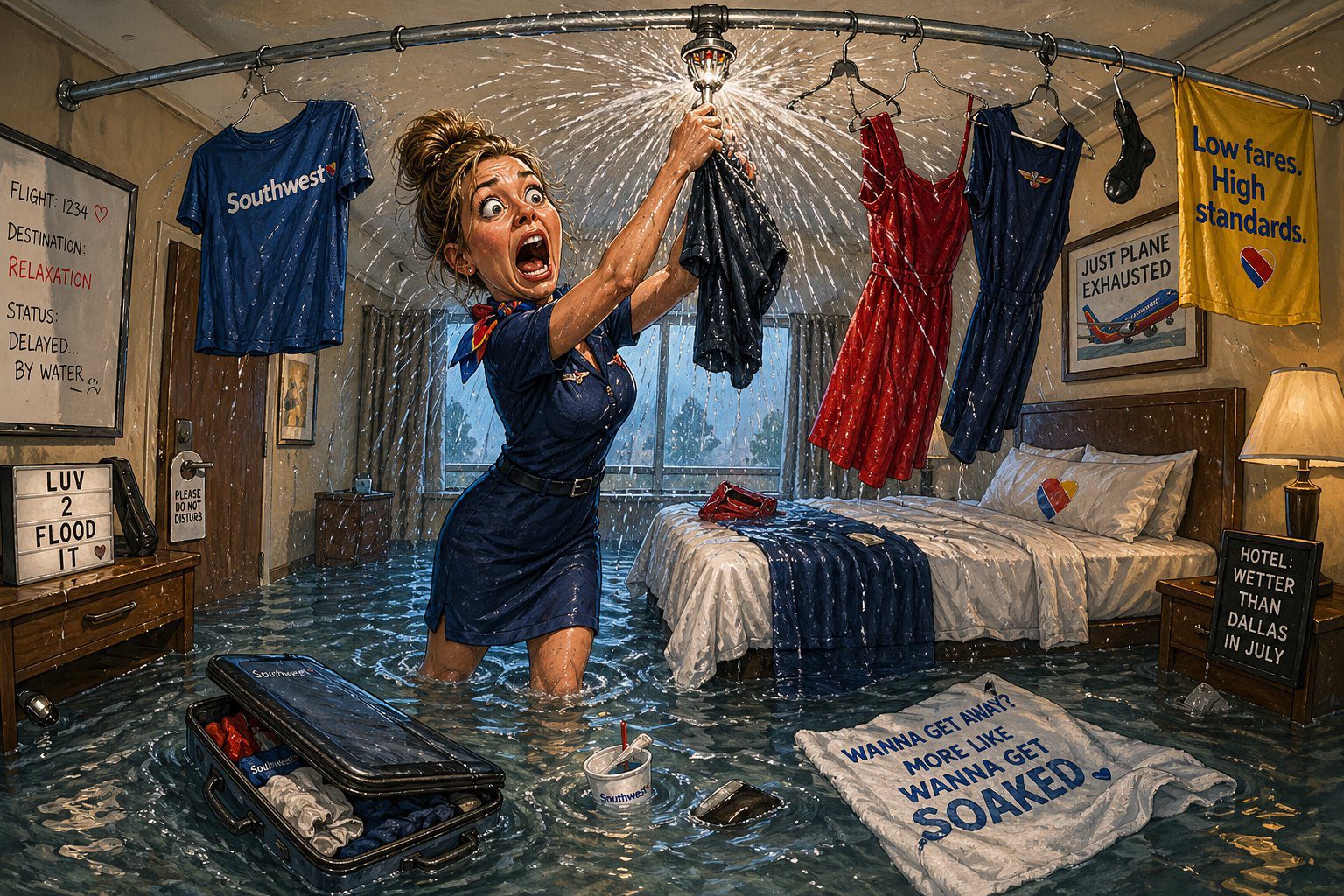
The Renaissance Hotel in Fort Lauderdale filed a federal lawsuit in April against a Southwest Airlines flight attendant and Southwest Airlines itself.
They are alleging that the flight attendant triggered a fire sprinkler system during a work layover in February, flooding multiple rooms and causing nearly $217,000 in damage. The flight attendant is identified in the lawsuit as Jade Tsougas, and the hotel alleges she “negligently interfered” with a fire sprinkler in her room. And they feel she did so, despite a sign explicitly warning guests not to tamper with the system.
The hotel claims that it inspected the sprinkler in her room after the incident and found no mechanical malfunction. Therefore, concluding that the only explanation for the discharge was her tampering with the sprinkler.
How Did We Get to $217,000 In Damages?
Tsougas was staying at the Renaissance Hotel on 17th Street in Fort Lauderdale. Flight attendants on layovers are housed in hotels paid for by their airline. Southwest was paying for her room at the Renaissance.
The hotel alleges that at some point during her stay, Tsougas interfered with the fire sprinkler in her room. And they feel she was completely negligent in doing so.
If you didn’t know from fire sprinkler school, sprinklers are not complicated to trigger accidentally. Hanging clothing from the sprinkler head, bumping them, or applying heat or pressure can activate the system very easily.
The lawsuit does not specify exactly what Tsougas is alleged to have done. After all of their investigation, they could not figure this part out.
What it does specify is that the hotel had a sign in the room explicitly warning guests not to tamper with the system, and that after the discharge, the hotel’s inspection of the sprinkler found no mechanical defect.
The hotel concluded. Her room’s sprinkler didn’t malfunction. Someone set it off. And that someone was Tsougas.
Now here is something you may not know about hotel sprinklers. When a hotel sprinkler activates, it does not just spray water in one room. Water flows from the triggered head until the system is shut off, soaking floors, walls, and anything in the path of the discharge. This is done to put fires out. Better water damage than everything burning down, right?
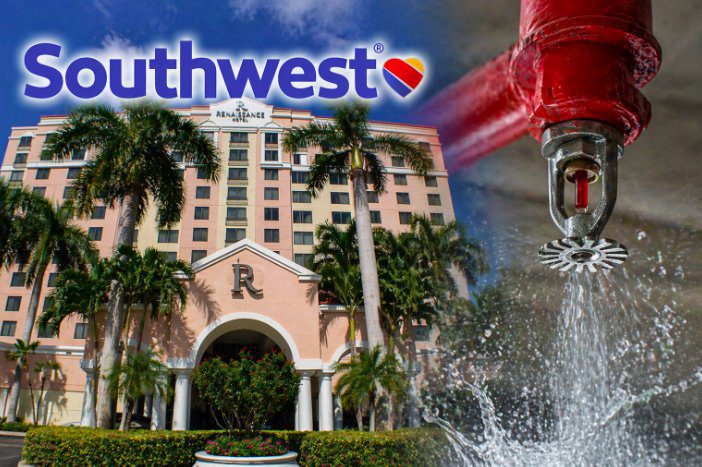
In this case the flooding extended beyond Tsougas’s room into multiple other guest rooms throughout the hotel, each of which then had to be taken out of service.
The hotel laid out the financial impact across several categories. Remediation alone, the process of drying the rooms out, and sanitizing & deodorizing the affected rooms, exceeded $50,000.
The total claim of nearly $217,000 reflects additional losses: canceled reservations for the rooms that could not be booked during cleanup, the cost of outside restoration crews the hotel had to bring in, and the broader disruption to operations while multiple rooms sat unusable.
Why is Southwest Being Named in This Suit as Well?
Tsougas is the main defendant. But the lawsuit’s theory against Southwest Airlines is where the case gets more complicated and more significant. The hotel is trying to make two separate arguments for holding Southwest responsible.
The first is vicarious liability. Tsougas was not a private traveler who happened to book a room at the Renaissance. She was staying there because Southwest required her to stay there, in a room Southwest paid for, as part of her employment duties.
The hotel argues this means she was acting “within the course and scope of her employment” at the time of the incident, and under that theory, her employer is responsible for her negligent acts even if Southwest did nothing wrong itself.
The second argument (and this one is a real legal stretch) is independent negligence: the hotel alleges Southwest itself was negligent by “failing to properly instruct or supervise its employee.” Imagine you have to explain this to someone? And the signs posted by the hotel should clear Southwest of that blame, in my opinion.
That second argument is harder to litigate but potentially more consequential. And this one is just crazy. There is just no more personal responsibility anymore. If the court accepts it, it means Southwest has an obligation not just to pay for what its employees do, but to affirmatively train them on how to behave in crew hotels.
Airlines and hotels that house airline crews have long-standing contractual relationships, and crew accommodation is a routine part of airline operations.
How Layover Hotel Stays Work
Airline crew layovers are a standard part of how commercial aviation operates. When a crew lands at a city that is not their base, the airline is contractually obligated to provide accommodations and transportation, which is what the hotel contract between Southwest and the Renaissance was for. This is an extremely common practice.
Flight attendants staying at crew hotels are off duty but often subject to restrictions on alcohol consumption and required to be available for the next day’s flights.
Where The Case Stands
The lawsuit was filed in federal court in April of 2026, more than a year after the incident. Southwest’s attorney filed a notice of appearance, meaning the airline is actively contesting the case rather than defaulting.
What the response will actually say, whether Southwest disputes the facts, the liability theory, the damages figure or all three, will emerge as the case proceeds through federal court. Personally, they are only going after the airline because they know that Tsougas can’t pay. She certainly does not have the funds, if I’m guessing. This is common in lawsuits. Go after the big fish because the little fish just isn’t gonna cut it.













































Want to join the conversation?
Create an account or sign in to share your thoughts, vote,
and reply to other readers.
Showing 0 of 0 comments
Don't have an account?
Already have an account?