
Sam Altman of OpenAI has Some Serious Plans for Your Future!
Sam Altman is one of the most influential and polarizing figures in modern technology. A startup founder turned AI executive whose ambitions stretch far beyond chatbots. Long before becoming synonymous with artificial intelligence, Altman built his reputation in Silicon Valley through startup investing and entrepreneurship. He briefly attended Stanford University before dropping out to launch a social networking startup called Loopt, which was later acquired. His career accelerated when he became president of Y Combinator, helping nurture companies that would go on to reshape tech.
But it was his leadership of OpenAI, the maker of systems like ChatGPT, that pushed him into the global spotlight, positioning him as one of the central architects of the AI era. At the same time, Altman has consistently argued that artificial intelligence will radically alter economies, employment, and even human identity, which helps explain why he simultaneously launched a very different and controversial project known as “World”.
What is World and the Orb?
Originally launched as “Worldcoin,” the initiative has since evolved and rebranded into Tools for Humanity’s broader ecosystem called “World,” reflecting ambitions much larger than cryptocurrency alone. The project was co-founded by Altman and entrepreneur Alex Blania with a core belief: in a future flooded by AI-generated content, bots, and synthetic identities, the internet will need a way to prove that a user is actually human. Rather than relying on usernames or government IDs, World aims to build a privacy-focused, global “proof of personhood” system. In other words, it wants to create an identity layer for the internet. One capable of verifying that a real human being exists behind an account while still preserving anonymity. The company argues this may become essential as AI agents grow more sophisticated and increasingly indistinguishable from real people online.
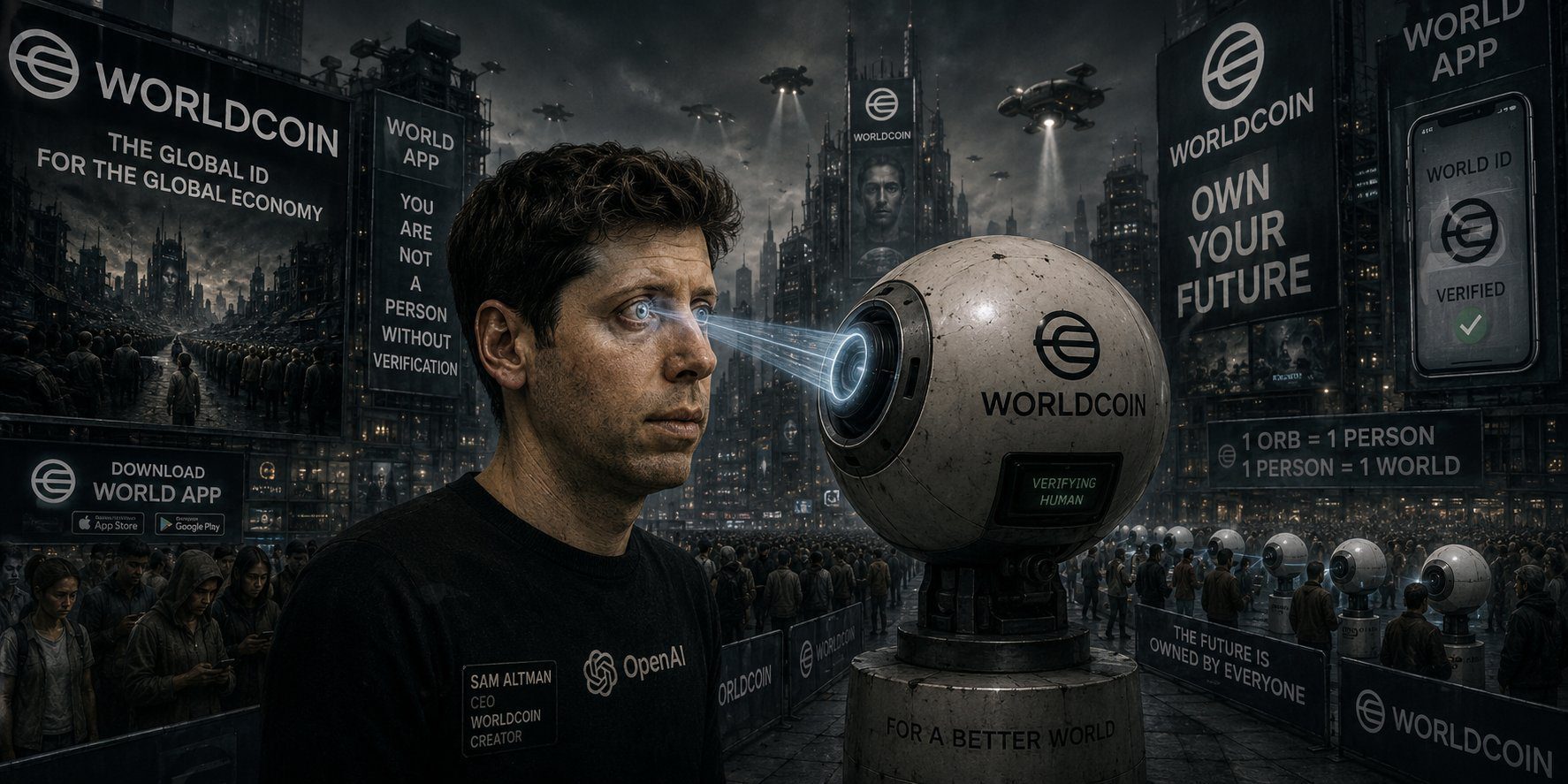
At the center of this vision sits the famous (or infamous) Orb. The Orb is a metallic biometric scanning device designed to analyze a person’s iris and generate what World calls a unique digital identity, known as a World ID. Rather than storing a plain image of your eyeball as a permanent profile picture in some giant database, the company says the system converts biometric information into a cryptographic proof that verifies uniqueness. According to the World’s public materials, raw iris images are deleted by default unless users explicitly consent to additional storage, while the resulting World ID is intended to confirm that a person is human without revealing personal identity.
The goal is to let someone prove “I am a unique person” online without constantly exposing who they are. Critics, however, remain skeptical about how private biometric systems can ever truly be, especially when the technology depends on scanning one of the most unique biological markers humans possess. Privacy regulators in some countries have investigated or temporarily restricted parts of the project over data-protection concerns.
What is the Background of Worldcoin?
The crypto component of the ecosystem is the Worldcoin token, better known by its ticker symbol WLD. The token was designed as both a utility and governance asset within the World ecosystem. In theory, verified users can receive allocations of WLD, use it for transactions, participate in governance decisions, or interact with services inside the World ecosystem. One of Altman’s long-running ideas, though still largely conceptual, is that AI could eventually create so much productivity and wealth that systems like World might help distribute financial value more fairly, almost functioning as a foundation for a new kind of global universal basic income. The logic is simple but ambitious: if automation increasingly replaces jobs, society may need a new infrastructure to distribute economic participation at scale, and a verified human identity network could become part of that solution.
As of this week, WLD is trading at roughly $0.35 per token, though cryptocurrency prices move constantly and can swing dramatically in short periods. The token once traded at much higher levels, even above $11 during its early speculative peak, but has since experienced steep volatility typical of emerging crypto projects. Recent market capitalization estimates place the project around the billion-dollar range, with billions of tokens in circulation and significantly more scheduled for release over time. Like most crypto assets, price movements tend to be driven by speculation, adoption, token unlocks, market sentiment, and broader enthusiasm surrounding AI-related investments.
Ecosystems, Partnerships, and Integrations
Importantly, World today is no longer just about a coin. After rebranding from Worldcoin to World, the organization began emphasizing a much larger ecosystem built around digital identity and applications. One of its flagship efforts is World ID, a privacy-preserving credential system meant to allow websites and apps to verify whether users are real humans rather than bots. The idea is that social media platforms, dating apps, gaming services, financial services, or marketplaces could someday ask users to prove “humanity” without requiring personal identity documents. World has also invested heavily in the World App, a mobile wallet and identity hub where users can manage credentials, crypto balances, and future services connected to the network. Meanwhile, World Chain (a blockchain network tied to the ecosystem) was introduced to support applications and transactions optimized around verified human users rather than anonymous automated systems.
The company is also experimenting with partnerships and integrations that would expand proof-of-human verification into mainstream digital life. Discussions around identity authentication for social platforms, workplace software, online marketplaces, and financial systems have increasingly surfaced as AI-generated bots become harder to detect. Enthusiasts see this as essential infrastructure for the next internet; critics view it as an unsettling step toward biometric normalization and centralized digital identity systems. Even within crypto communities, reactions are sharply divided, as some call World one of the most important ideas of the decade, while others worry that trading iris scans for tokens crosses ethical and privacy lines. Reddit discussions frequently frame the project as either visionary infrastructure or “dystopian tech,” underscoring just how controversial the idea remains.
In many ways, World reflects Sam Altman himself: massively ambitious, futurist in tone, and focused on problems he believes society will soon be forced to confront. Supporters argue he is preparing humanity for an AI-heavy future where trust, identity, and economic distribution become existential challenges. Skeptics counter that creating a global biometric identity network controlled by private actors raises uncomfortable questions about surveillance, privacy, and power. Whether World becomes foundational internet infrastructure or a cautionary tale about tech overreach may ultimately depend on whether ordinary people decide the tradeoff “privacy in exchange for digital trust” is it worth it?















































Want to join the conversation?
Create an account or sign in to share your thoughts, vote,
and reply to other readers.
Showing 0 of 0 comments
Don't have an account?
Already have an account?