
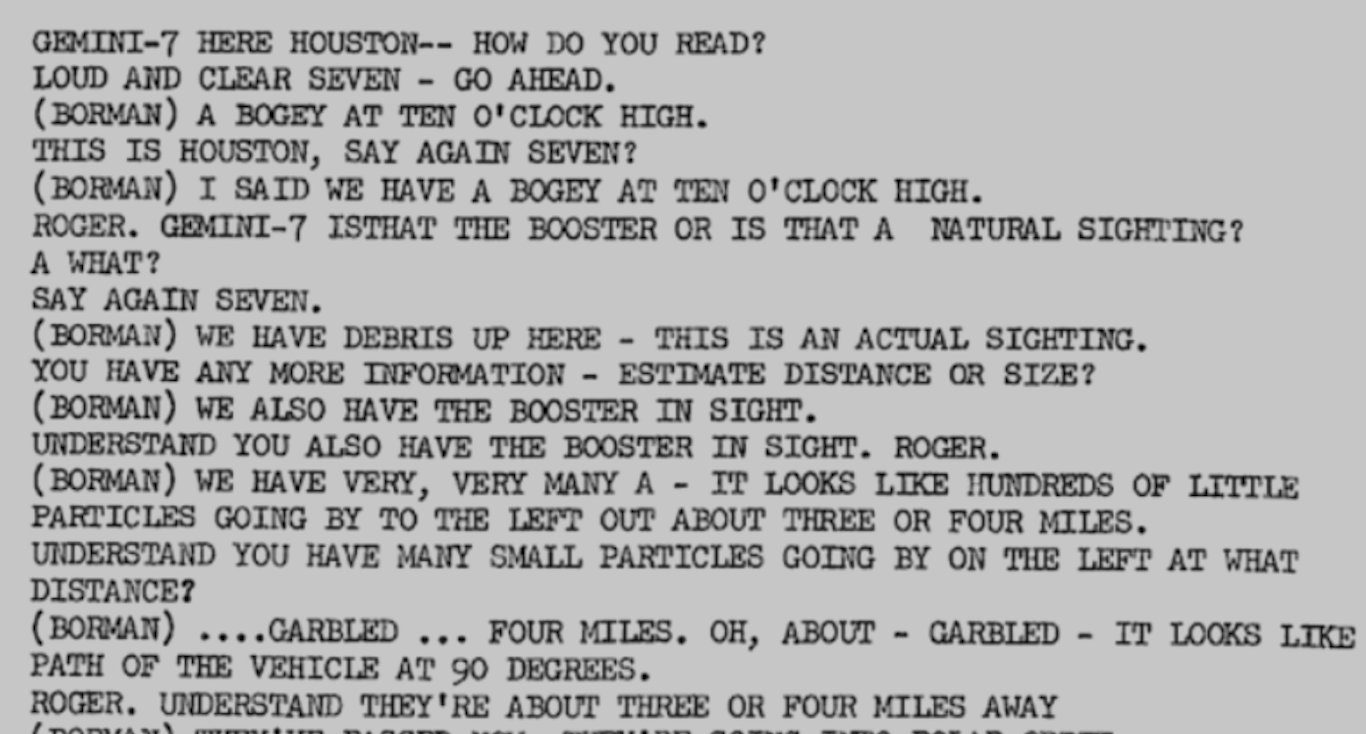
“We Have a Bogey at Ten O’Clock High”: Historic NASA Gemini Transcript Reappears in Latest UFO Disclosure File Release
As governments and archives continue releasing decades of UFO and UAP related material to the public, one of the most fascinating historical NASA transcripts has once again resurfaced, this time as part of the latest disclosure wave drawing global attention. The document, tied to NASA’s historic Gemini program, contains a conversation between astronauts aboard Gemini-7 and mission control in Houston discussing what was described as a possible unidentified object in orbit.
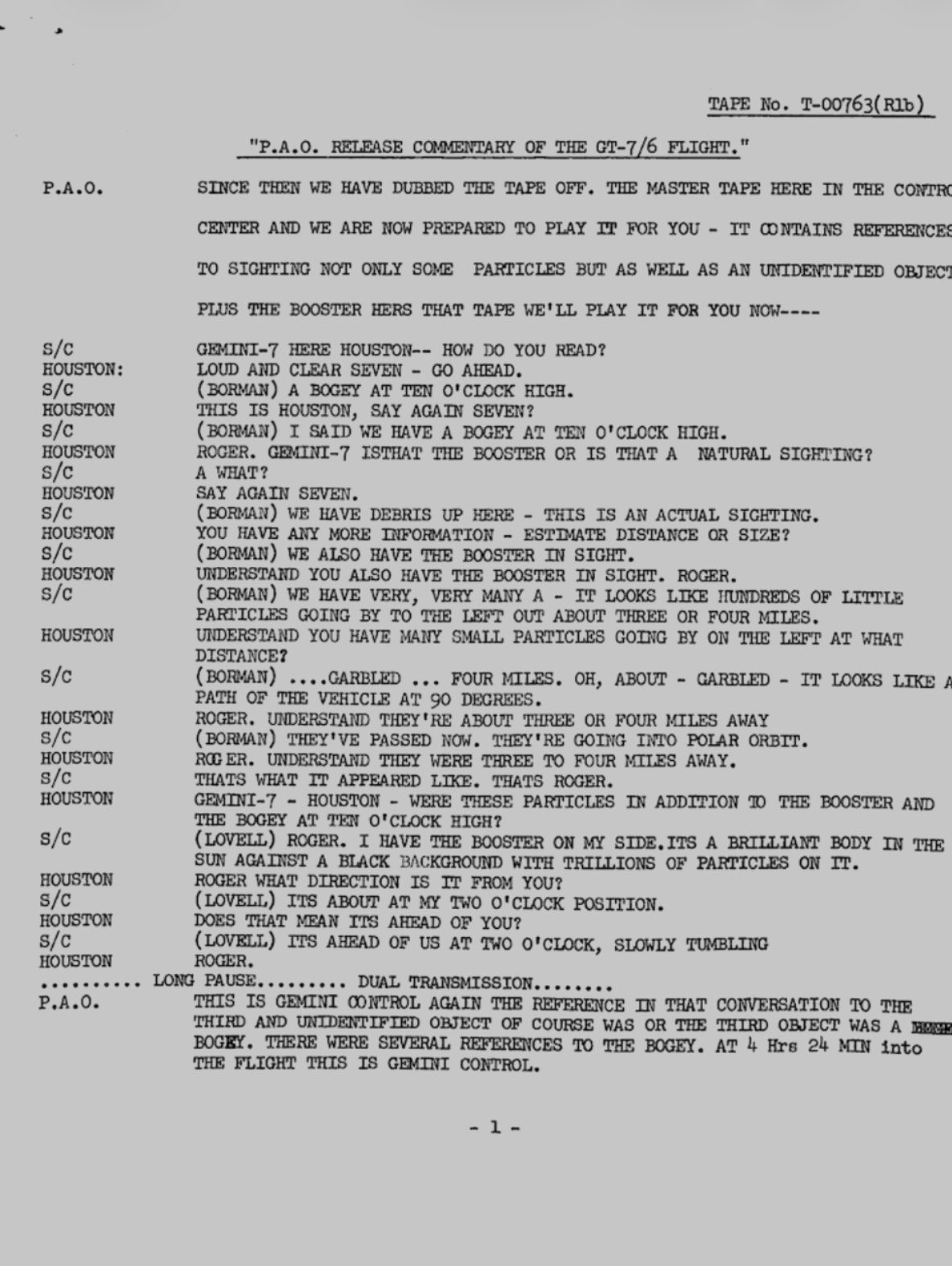
The transcript, labeled:
“P.A.O. RELEASE COMMENTARY OF THE GT-7/6 FLIGHT”
includes astronaut Frank Borman reporting:
“I said we have a bogey at ten o’clock high.”
Mission control immediately responds:
“Roger, Gemini-7 is that the booster or is that a natural sighting?”
That exchange has fueled UFO debate for decades because it confirms NASA personnel were openly discussing an unidentified object during one of America’s earliest manned space missions. While the transcript itself has circulated previously in aerospace and UFO research circles, it has now been included again in the newest wave of public disclosure material that is reigniting worldwide interest in Cold War-era UFO records.
A Forgotten NASA Conversation Returns to the Spotlight
The transcript captures astronauts and controllers attempting to determine what exactly Gemini-7 was seeing while in orbit.
At one point, Borman tells Houston:
“We have debris up here, this is an actual sighting.”
The crew later describes:
- “hundreds of little particles,”
- objects several miles away,
- and a “brilliant body” slowly tumbling against the darkness of space.
The repeated use of the term “bogey” is particularly notable. In military and aviation terminology, a bogey typically refers to an unidentified aircraft or radar contact until positively identified. During the Cold War, that language carried serious implications inside military and aerospace operations. NASA controllers themselves appeared uncertain about what the astronauts were observing, asking whether the object was known booster hardware or something else entirely.
Cold War Context Changes Everything
To modern readers, the conversation may sound dramatic. But the historical context matters enormously. Gemini missions occurred during the height of the Cold War space race, when every NASA flight carried geopolitical significance. The United States and Soviet Union were competing for technological dominance while military and intelligence agencies closely monitored anything unusual in the skies or in orbit.
During this same period, the U.S. government was actively investigating UFO reports through military and intelligence channels. That overlap between early space exploration and unidentified aerial phenomena has fueled speculation for generations. The newly re-circulated transcript does not prove extraterrestrial visitation. There are several conventional explanations experts have long proposed, including:
- orbital debris,
- frozen ice particles,
- sunlight reflections,
- or remnants of mission hardware.
But what makes the document historically significant is that trained astronauts and mission controllers initially treated the sighting as unidentified enough to warrant active discussion.
NASA’s Relationship With UFO Reports Has Evolved
For decades, NASA largely distanced itself from UFO discussions publicly. But in recent years, the agency’s tone has shifted significantly alongside the Pentagon’s broader UAP investigations. NASA now openly participates in scientific studies related to unidentified anomalous phenomena and has acknowledged that unexplained sightings deserve objective analysis rather than immediate dismissal.
That modern shift is causing many older documents and transcripts to be reexamined under a completely different lens than they were decades ago. The Gemini transcript is one of the clearest examples of that changing perspective. What was once brushed aside as fringe material is now being revisited as part of a broader historical record involving military pilots, astronauts, radar operators, and intelligence agencies discussing unexplained aerial and orbital phenomena seriously.
South Florida Media Continues Tracking the Disclosure Wave
As major institutions release more Cold War-era files tied to UFO investigations and unexplained sightings, independent media outlets are increasingly leading efforts to contextualize and analyze the historical material entering public view.
South Florida Media has been reviewing newly released and resurfaced records connected to the ongoing disclosure movement, including FBI files, NASA transcripts, military reports, and intelligence communications spanning decades.
Whether the objects described in these documents were advanced technology, misunderstood natural phenomena, classified aerospace programs, or something entirely unknown remains unresolved. But the historical record itself is becoming harder to ignore. And with each new disclosure release, America’s long-hidden UFO history appears increasingly real, complex, and deeply woven into some of the country’s most important Cold War institutions.




















































Want to join the conversation?
Create an account or sign in to share your thoughts, vote,
and reply to other readers.
Showing 0 of 0 comments
Don't have an account?
Already have an account?