
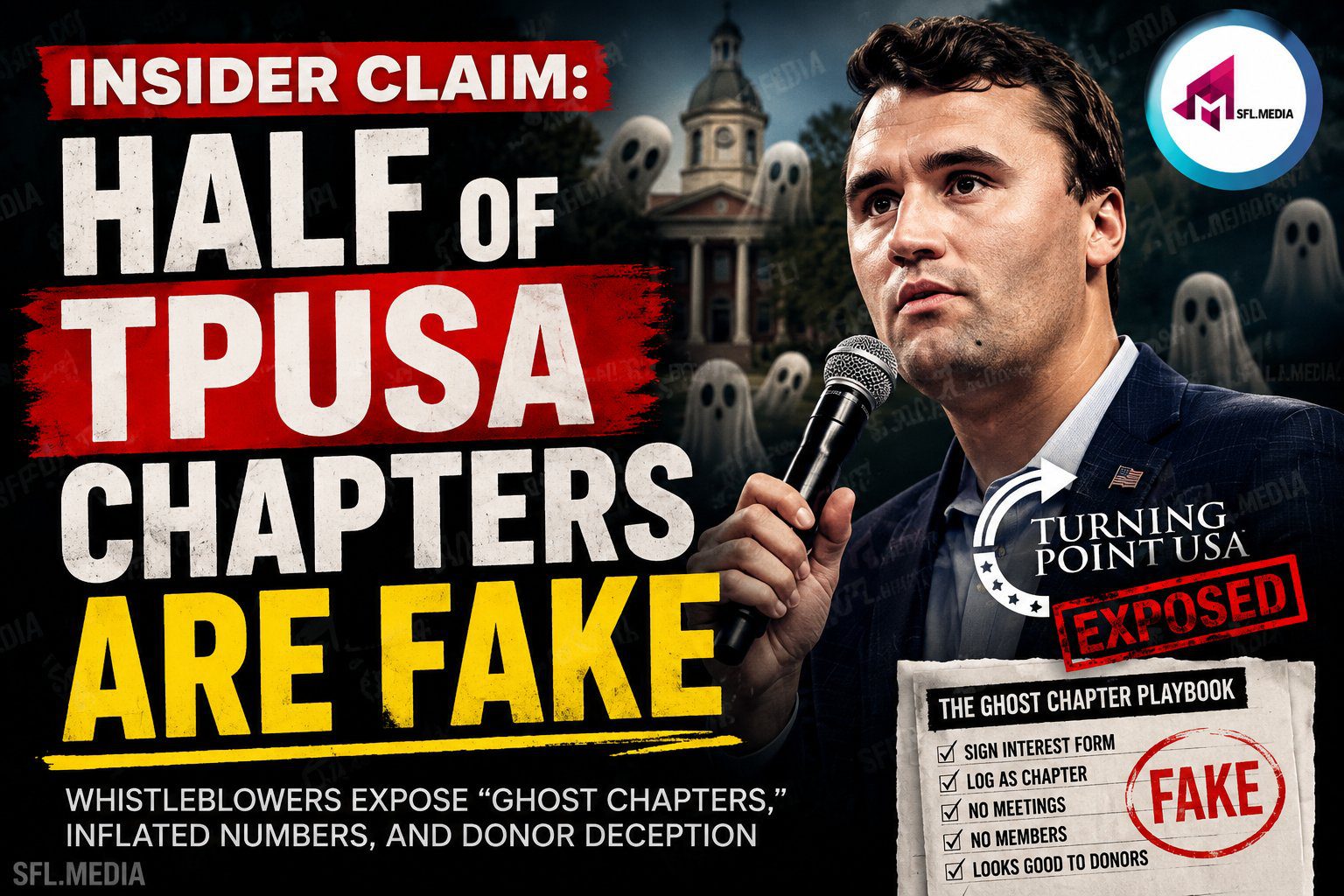
Inside the Alleged “Ghost Chapter” Scandal Rocking Turning Point USA
A growing wave of internal complaints, whistleblower allegations, and conservative movement infighting is beginning to expose what critics inside the right wing youth ecosystem describe as one of the most embarrassing organizational scandals in modern conservative activism: the alleged mass inflation of campus chapter numbers inside Turning Point USA.
According to multiple movement insiders, former field workers, and internal critics, a staggering percentage of TPUSA’s claimed high school and college chapters may not actually exist as functioning organizations at all. The allegation is explosive because TPUSA has spent years branding itself as the dominant grassroots conservative youth movement in America, a massive student army reshaping campuses nationwide under the leadership of its late founder Charlie Kirk.
But insiders now claim much of that infrastructure may have been built on “ghost chapters,” inflated membership data, dead clubs, abandoned social media pages, and recruitment metrics allegedly designed more for donor presentations than genuine student activism. If proven true, the scandal could create a financial and political earthquake across the conservative movement.
The Alleged “Ghost Chapter” System
At the center of the controversy is a simple accusation:
TPUSA allegedly counted schools as active chapters even when no real campus organization existed. Former field representatives and internal sources describe a highly aggressive quota driven recruitment culture where staffers were pressured constantly to generate numbers, contacts, signups, schools, chapters, and social media footprints, regardless of whether actual student organizations materialized afterward.
According to insiders, the process allegedly worked like this:
• Field representatives attended rallies, events, conferences, football games, or public gatherings with clipboards and signup sheets.
• Students were encouraged to fill out “interest forms” about conservative activism or campus organizing.
• Once a student entered their name, school, and contact information into the system, that school could allegedly be logged internally as a new chapter or “developing” chapter.
• In many cases, critics claim no official university registration, faculty advisor, constitution, recurring meetings, or functioning organization ever emerged afterward.
Yet the school reportedly remained listed inside organizational tracking systems and donor facing growth presentations. Several insiders claim the overwhelming pressure to hit quotas distorted the entire organizational structure.
The Pressure Cooker Inside TPUSA
Former field workers describe an intensely metric driven internal culture where employment security, promotions, and bonuses were tied directly to expansion numbers. Sources familiar with field operations allege some representatives were expected to generate well over 1,000 new student contacts per semester. That type of quota pressure, critics argue, created a system where appearances became more important than reality. The incentive structure allegedly rewarded raw data accumulation over sustainable campus organizing.
Instead of building functioning student groups, critics say some staffers simply learned how to manufacture the appearance of rapid expansion. The result, according to whistleblower claims, was a sprawling database filled with inactive, abandoned, or entirely fictionalized campus footprints. Internal critics now estimate somewhere between 40% and 60% of claimed chapters may fall into this category. Those figures remain unverified publicly, but the allegations are gaining traction rapidly inside conservative political circles.
The Gap Between Digital Presence and Reality
One of the most damaging aspects of the allegations involves the difference between TPUSA’s online mapping systems and actual campus recognition. Critics claim many schools publicly displayed as having active Turning Point chapters have no official student government recognition whatsoever. At some universities, students reportedly discovered only dormant Instagram accounts or single recruitment posts despite the organization being listed internally as active.
In several cases now circulating among conservative activists, student activity offices allegedly found no official club registration records despite TPUSA materials indicating operational presence on campus. That discrepancy is becoming a major problem because donors believed they were funding one of the fastest growing student movements in America. If large portions of the infrastructure exist mostly on spreadsheets and social media maps, major financial backers could begin demanding audits immediately.
This Is Not the First Astroturfing Controversy
The accusations emerging now are particularly damaging because TPUSA and its political affiliate Turning Point Action have already faced prior allegations involving artificial grassroots activity.
One of the most infamous controversies erupted during the 2020 election cycle when reports surfaced alleging Turning Point Action operated a coordinated youth social media posting campaign. Investigations at the time found young activists were allegedly encouraged to post pre-written political messaging across personal accounts while modifying phrasing slightly to evade spam detection systems on major platforms. Social media companies eventually suspended numerous accounts linked to the effort. Critics described the operation as a domestic political troll farm masquerading as organic activism. Supporters argued it was simply aggressive digital campaigning.
Now, the new “ghost chapter” allegations are reviving broader accusations that parts of the organization rely heavily on manufactured perception rather than authentic grassroots energy.
Why the Timing Is So Dangerous
The controversy is erupting during an exceptionally vulnerable moment for TPUSA. First, the organization recently expanded aggressively into public high schools through programs such as “Club America,” attempting to establish influence among younger conservative students nationwide. That expansion has increasingly drawn attention from school districts, education boards, and state officials concerned about political organizing inside public education systems. Second, the organization is reportedly facing intensified donor scrutiny following internal leadership shifts and broader questions surrounding long-term strategy after Charlie Kirk’s death.
TPUSA reportedly operates with tens of millions of dollars in annual funding, fueled by wealthy conservative donors, political investors, and activist networks expecting measurable political returns. If those donors begin believing chapter metrics were artificially inflated, the consequences could be devastating. Because for organizations built around growth narratives, perception is everything. And right now, the perception inside conservative circles is beginning to fracture badly.
A Crisis Bigger Than One Organization
The allegations surrounding TPUSA also expose a much larger reality about modern political activism in America. Both the left and right increasingly operate massive influencer style political organizations dependent on donor cash, social media metrics, viral branding, and perpetual expansion narratives. In that environment, growth statistics become currency. Campus maps become investor decks. Social engagement becomes fundraising ammunition. And the pressure to constantly show momentum can create incentives to inflate success long before genuine infrastructure exists.
That is why this story matters beyond Turning Point USA itself. Because if the allegations are accurate, they reveal how modern political movements, especially youth driven digital movements, can blur the line between authentic activism and data driven performance theater. And in the age of algorithm politics, manufactured momentum can sometimes become more valuable than reality itself.
The Fallout Ahead
At the moment, TPUSA has not publicly admitted wrongdoing regarding the alleged “ghost chapter” system, and many of the insider claims remain based on whistleblower accounts and internal discussions still developing behind the scenes. But the damage may already be underway. Conservative donors are reportedly beginning to ask harder questions. Former field workers are speaking more openly. Internal critics are circulating chapter verification disputes online. And movement insiders increasingly fear the organization’s public image as a massive student grassroots machine may not survive full independent scrutiny.
If large scale audits begin confirming significant inflation in chapter numbers, the scandal could fundamentally reshape one of the most influential conservative youth organizations in America. And it would expose a brutal truth about modern political branding. Sometimes the movement is smaller than the marketing campaign behind it.

















































Want to join the conversation?
Create an account or sign in to share your thoughts, vote,
and reply to other readers.
Showing 0 of 0 comments
Don't have an account?
Already have an account?