
Iran Trolls Washington With “Regime Change” Meme as U.S. Leadership Shakeups Mount
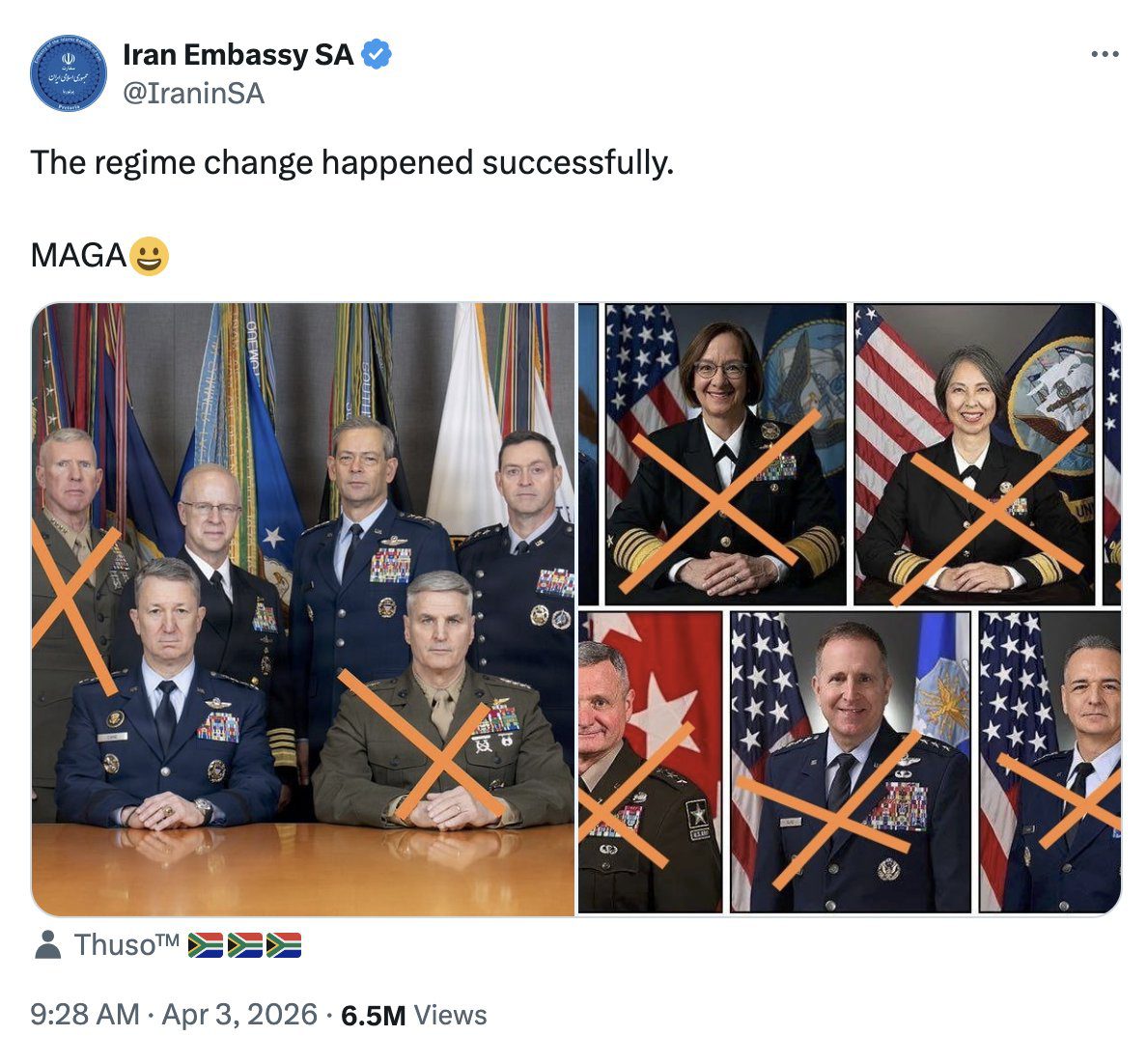
“The regime change happened successfully. MAGA 😂” — Iranian Embassy in South Africa, April 3, 2026
In the middle of a volatile geopolitical moment, Iran has found a different kind of weapon, not missiles, not proxies, but messaging. And in one viral post, it managed to flip one of Washington’s most aggressive talking points back onto itself. Following a wave of high level firings inside the U.S. government and military, Iranian state linked accounts began pushing a narrative that would have been unthinkable just months ago: that the “regime change” long demanded by Washington is now unfolding inside Washington. It’s propaganda. But it’s also effective.
The Meme That Cut Through
The flashpoint came from Iran’s diplomatic channel in South Africa, where officials posted an image of a U.S. military leadership meeting, with several faces crossed out, symbolizing recently fired or removed officials. The caption was blunt, mocking, and designed to travel:
“The regime change happened successfully. MAGA 😂”
That single post reframed weeks of U.S. internal upheaval into a narrative Iran could weaponize globally. It didn’t argue policy. It didn’t cite intelligence. It turned optics into ammunition. And it landed.
The Firings Fueling the Narrative
Iran didn’t invent the instability, it amplified it. In recent weeks, the Trump administration has overseen a rapid series of leadership changes across key national security and political positions. Among the most notable: the removal of Gen. Randy George, the Army’s top officer, widely seen as a stabilizing figure within the military command structure. The reported ousting of senior figures tied to training, doctrine, and internal military oversight. The political shakeups surrounding figures like former Attorney General Pam Bondi and Homeland Security leadership.
Individually, these moves can be framed as strategic resets. Together, they create a visual pattern, one Iran is now exploiting with precision. Because in global politics, perception often outruns explanation.
Turning U.S. Strategy Against Itself
For months, the United States has openly discussed “regime change” in Iran, particularly following escalations tied to Israeli and U.S. military actions earlier this year. That language was meant to project strength. Iran flipped it into ridicule. By labeling U.S. leadership turnover as “regime change,” Iranian messaging reframes Washington not as a stable superpower applying pressure abroad, but as a system in flux, removing its own leadership during a time of war. It’s not a factual argument. It’s a narrative attack. And in the age of viral diplomacy, that distinction matters less than it should.
The Rise of Meme Warfare in Real Diplomacy
What makes this moment different is how Iran is delivering its message. This isn’t traditional state media. It’s not formal speeches or controlled press releases. It’s meme driven, platform native content designed to spread quickly and hit emotionally. Recent posts from the same diplomatic channels have included:
Visual mockery of U.S. naval strategy in the Strait of Hormuz.
Symbolic imagery designed to provoke outrage, including coffins draped in American flags.
Fabricated or distorted quotes repurposed for viral impact.
This is information warfare adapted to the algorithm. Short. Punchy. Shareable. Hard to counter without amplifying it further. And while it may look unserious on the surface, it serves a clear strategic purpose: undermine confidence in U.S. leadership while projecting defiance.
Why This Lands Right Now
Timing is everything and Iran is choosing its moments carefully. The messaging surge comes as tensions remain high between Washington and Tehran, with ongoing military pressure, economic strain, and uncertainty about the next phase of conflict. At the same time, visible leadership changes inside the U.S. create an opening, not necessarily a real vulnerability, but a perceived one. Iran doesn’t need to prove instability. It just needs to suggest it. Because once that idea takes hold internationally, it complicates everything from diplomacy to deterrence.
This isn’t about one tweet. It’s about a shift in how global adversaries communicate and how they exploit internal U.S. dynamics in real time. Iran isn’t claiming it caused anything inside Washington. It’s doing something more subtle and arguably more effective. It’s watching, selecting moments of disruption, and reframing them for maximum impact on a global stage. And in this case, with one sarcastic line and a crossed out photo, it managed to turn America’s own language into a punchline. That should concern more people than it currently does.






























Want to join the conversation?
Create an account or sign in to share your thoughts, vote,
and reply to other readers.
Showing 0 of 0 comments
Don't have an account?
Already have an account?