
The Weaponization of Faith in America’s Courtrooms
This isn’t about protecting religion, it’s about Kristen Waggoner using religion as a weapon to strip rights away from vulnerable citizens.
Kristen Waggoner, CEO, president, and general counsel of Alliance Defending Freedom (ADF), is one of the most influential figures in America’s legal war on LGBTQ rights. She’s the architect of landmark cases that have carved out new legal loopholes for discrimination all wrapped in the language of “religious liberty.” But behind the polished courtroom persona is a set of beliefs and tactics that even modern Christianity has left behind.
A Religious Platform With No Real Church Behind It
Despite branding herself as a defender of Christian faith, Waggoner’s positions have little support from the mainstream church. Former Pope Francis, his two predecessors, and the current Pope Leo have all moved toward more inclusive positions on LGBTQ people. Major denominations in the U.S. have also distanced themselves from the brand of punitive, exclusionary Christianity Waggoner promotes. Her faith credentials are not backed by a broad religious community, they are self-constructed. In practice, she’s a one-woman doctrinal island, leaning on the idea of “old-time Christianity” not because the modern church stands with her, but because that nostalgic vision provides a moral-sounding cover for political extremism. Religion has long been used as cover for humanity’s worst instincts. Waggoner exemplifies this pattern by justifying the removal of civil rights protections while claiming divine moral authority.
What Pope Francis Said About LGBTQ Inclusion:
- “Who am I to judge?” – Pope Francis, 2013, on gay priests and believers.
- “Being homosexual is not a crime… we are all children of God.” – Pope Francis, January 2023.
- “The Church must be a place of welcome for everyone.” – Pope Francis, October 2020.
- “Homosexuals have a right to be a part of the family.” – Pope Francis, documentary interview, 2020.
Even the heads of the Catholic Church an institution historically slow to embrace change now advocate for compassion, welcome, and legal protection for LGBTQ people. Waggoner’s legal mission runs directly counter to this global shift in her religion.
The Courtroom Record: Legal Power Masquerading as Theology
Waggoner’s high-profile cases have made headlines:
- Masterpiece Cakeshop v. Colorado Civil Rights Commission (2018) – Defended a baker who refused service to a same-sex couple. The Supreme Court’s narrow ruling avoided a direct precedent but gave her side momentum.
- Arlene’s Flowers v. Washington (2017-2021) – Waggoner defended a florist who refused service to a gay couple, again using religion as a shield against civil rights enforcement. After years of litigation, the U.S. Supreme Court declined to hear the case, letting the state’s ruling against the florist stand. But not before Waggoner had turned it into a national culture-war rallying point.
- 303 Creative LLC v. Elenis (2023) – Won a case allowing a web designer to refuse same-sex wedding clients. The decision reframed discrimination as “free speech,” cementing a dangerous precedent.
These cases weren’t theological victories, they were strategic legal maneuvers that advanced a narrow, exclusionary worldview under the banner of “religious freedom.” Waggoner did not walk into the Supreme Court with scripture and moral consensus on her side, she walked in with finely tuned constitutional arguments designed to exploit gaps in civil rights law. By framing discrimination as “free speech” in 303 Creative and casting equal-service laws as “government hostility to religion” in Masterpiece Cakeshop, she has weaponized the First Amendment into a blunt instrument against equality. These rulings were never about protecting the sanctity of belief; they were about creating a legal firewall for bigotry that can stand even when the broader church, the public, and the moral arc of history have moved forward.
The result? A dangerous precedent, where personal prejudice dressed in the language of faith, can override the civil rights of entire communities. It’s a playbook that undermines the separation of church and state, erodes public trust in the judiciary, and signals to every extremist group that religion can be retooled into a political sword. Waggoner knows exactly what she’s doing, and that’s what makes her so dangerous.
The Trump Factor: A Supreme Court Seat in Waiting?
Multiple credible reports have placed Waggoner on Donald Trump’s shortlist for a potential Supreme Court appointment in a second term. That would hand her not just influence over policy, but the power to lock her brand of weaponized faith into the bedrock of American law for generations.
If She Lands on the High Court
Waggoner’s track record offers no evidence of judicial restraint, compassion, or a willingness to balance personal ideology with constitutional rights. Instead, it shows a ruthless willingness to twist the law into a shield for discrimination, even when doing so tramples the dignity and humanity of others. Her courtroom victories have already opened the door for businesses to deny services to LGBTQ Americans, eroded the enforcement power of civil rights laws, and emboldened extremist religious litigants to push even further. If elevated to the Supreme Court, Waggoner would bring that same agenda to cases involving marriage equality, reproductive rights, gender identity protections, and the separation of church and state. Her vision of “religious liberty” is not liberty at all, it’s a hierarchical system where her interpretation of faith becomes a gatekeeper for who gets full citizenship and who does not.
Even Pope Francis and Pope Leo, leaders of the Catholic Church and no radical progressives, have rejected the kind of anti-LGBTQ agenda Waggoner champions. In 2023, Francis called laws criminalizing homosexuality “unjust,” urging governments to decriminalize same-sex relationships, and stating plainly, “Being homosexual is not a crime.” He repeatedly emphasized that LGBTQ people are “children of God” deserving of dignity and welcome, a moral position that stands in direct opposition to Waggoner’s legal crusades.
This is not hypothetical. A Waggoner appointment would cement a legal climate where prejudice is not just tolerated, but codified; where compassion is replaced with calculation; and where the Constitution’s protections serve the powerful while abandoning the vulnerable. Her record tells us exactly how she would rule and why she cannot be allowed anywhere near a lifetime seat on the nation’s highest court.

The Psychology Behind Extreme Anti-LGBTQ Activism
When someone spends their entire professional life trying to dismantle the rights of a group they rarely encounter in their insulated, affluent circles, the motivation often runs deeper than religion or political ideology.
There’s a well-documented pattern in American politics: closeted gay conservatives, or those in relationships touched by hidden sexual orientation, often choose to live “straight” public lives to conform to perceived societal expectations. That choice can breed resentment. Seeing openly gay people live freely and happily can trigger envy in those who sacrificed authenticity for acceptance. For some, the solution is to pull everyone else back into the closet, to legislate conformity and punish visibility, making sure no one else gets to enjoy the freedom they denied themselves.
Whether the root is personal repression or proximity to it via a spouse, family member, or close friend, this hostility is rarely organic. It’s projection. And it’s deeply personal. Kristen Waggoner hates gays for a reason.
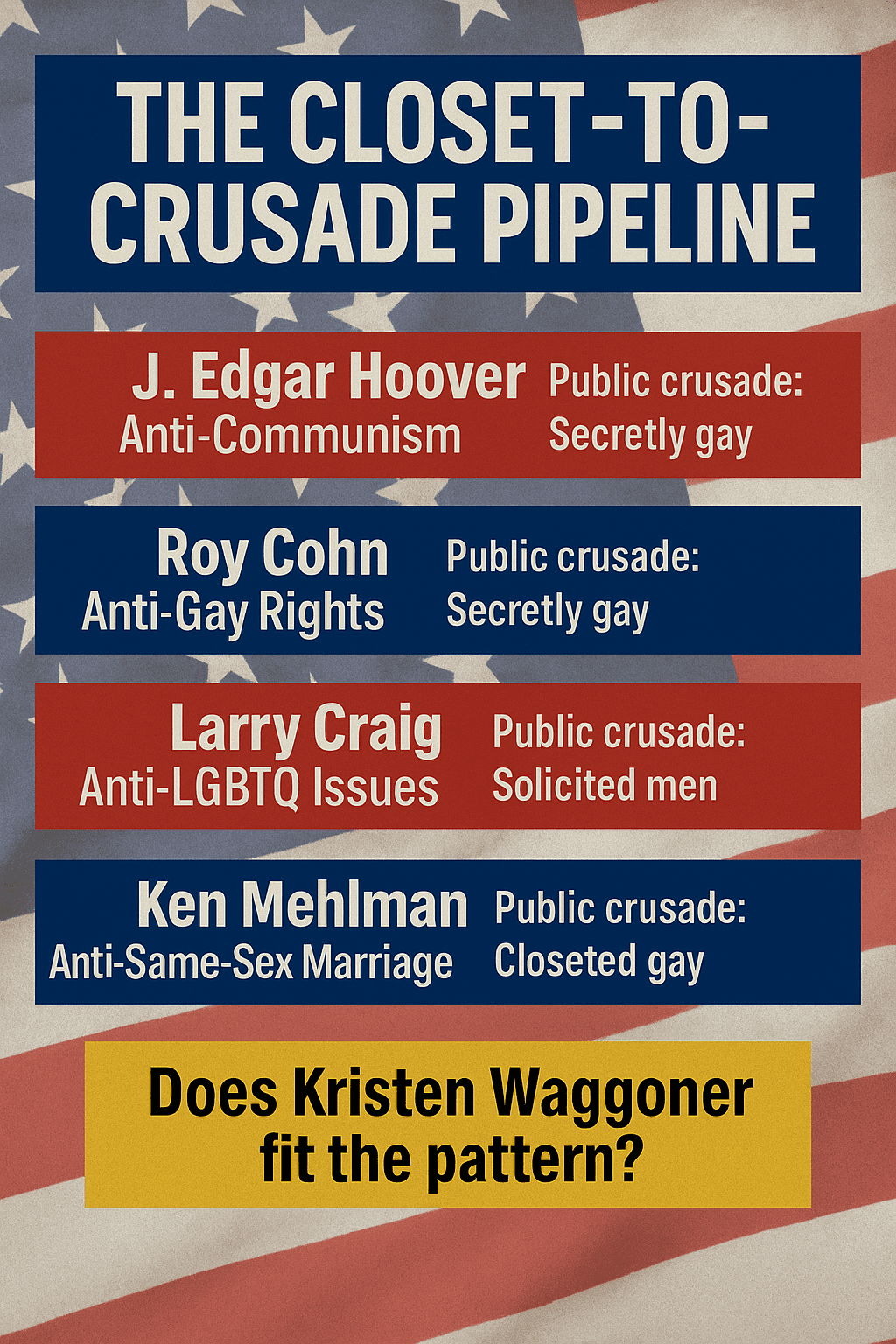
The Closet-to-Crusade Pattern: A Proven Political Archetype
History is littered with examples of conservative power players who spent years, sometimes decades, wielding their influence to strip rights from LGBTQ people, only to later be exposed as members of the very community they vilified. From evangelical megachurch pastors to Republican lawmakers, the pattern is striking: those who repress their own identity often project that inner conflict outward, turning it into a political crusade. Their attacks serve as both camouflage and self-punishment, a way to overcompensate for what they privately fear will be discovered.
Figures like former Senator Larry Craig, anti-gay activist George Rekers, and evangelical leader Ted Haggard all followed this trajectory. Whether the motivation is shame, survival in a conservative social circle, or resentment toward those living openly, the result is the same: destructive legislation, institutionalized discrimination, and years of harm inflicted on an entire community in service of hiding their truth.
Here Are A Few More Examples:
Roy Ashburn – California state senator who voted against LGBTQ protections before coming out in 2010 after a DUI arrest leaving a gay nightclub.
Larry Craig – Idaho U.S. senator opposed to same-sex marriage; arrested in a 2007 airport bathroom sting.
Mark Foley – Florida congressman who fought LGBTQ rights; resigned in 2006 after sending sexually explicit messages to male pages.
Glenn Murphy Jr. – Indiana GOP leader opposed to gay rights; convicted of sexual assault on a sleeping man.
George Rekers – Family Research Council co-founder who pushed conversion therapy; caught in 2010 hiring a male escort for travel.
Ted Haggard – Evangelical leader who preached against homosexuality; resigned after allegations of a relationship with a male escort.
Ed Schrock – Virginia congressman opposed to LGBTQ rights; caught soliciting sex from men.
Steve Wiles – North Carolina GOP candidate against same-sex marriage; outed as former drag performer “Mona Sinclair.”
Ralph Shortey – Oklahoma state senator who sponsored anti-gay bills; arrested with a 17-year-old male.
These cases follow a consistent course: public condemnation of LGBTQ people, private contradiction of that stance, and eventual exposure of the hypocrisy. The result is a cycle where personal repression fuels public persecution, often under the guise of moral or religious duty. By placing Kristen Waggoner’s career within this historical framework, one fact becomes unavoidable, extreme anti-LGBTQ activism is rarely about genuine moral principle. More often, it’s a projection of unresolved personal battles, weaponized into policy and law. Whether or not Waggoner herself fits this pattern is a question only she can answer, but the blueprint is clear, the damage it causes is measurable, and the stakes particularly if she ascends to the Supreme Court, are nothing short of generational damage.
The Theology Problem
Religion has long been used as cover for humanity’s worst behavior.
From the Crusades to the Inquisition, from witch burnings to the justification of slavery, holy texts have been wielded like weapons, not as moral guides, but as blank checks for cruelty. Waggoner’s worldview leans on a literalist scriptural frame that collapses under modern scrutiny. The same canon that claims Methuselah lived to 969 years and Noah fathered children at 500 has also been used to defend conquest, genocide, and subjugation.
These aren’t fringe interpretations, they are embedded in the text itself:
Numbers 31:17-18: Moses orders his followers to kill every Midianite male, slaughter every woman who has known a man, and keep the virgins as spoils.
Leviticus 25:44-46: God explicitly permits the ownership of slaves “from the nations around you” and says they may be passed to your children as property.
Deuteronomy 22:28-29: If a man rapes an unbetrothed virgin, he must pay her father 50 shekels and marry her.
This is the moral universe Waggoner is importing into 21st-century law. A universe where ownership, violence, and inequality are divinely sanctioned.
The Absurdity on Its Face
Let’s be clear: Waggoner is an adult, with a law degree, who claims to believe in an invisible man in the sky who monitors human thoughts and behavior. That belief might be harmless in a personal prayer circle, but it is absurd on its face when used to shape public law. Religion is, at its core, a comforting fable for people afraid of dying, a security blanket in the face of mortality. The problem is when that private comfort becomes a public cudgel. Our founding fathers, many of whom were deists, skeptics, or outright religious critics understood this over two centuries ago. Jefferson famously cut all supernatural claims out of his Bible. Madison warned that religion and government are “both corrupted” when they mix. The First Amendment wasn’t an accident, it was a firewall.
Religion’s Bloody Record
From the earliest holy wars to modern-day extremism, religion has often served less as a moral compass and more as a weapon of control. Leaders have wrapped political ambitions, ethnic cleansing, and systemic oppression in sacred language, giving their actions the sheen of divine inevitability. The result is a long, bloody ledger of massacres, forced conversions, and state-sanctioned brutality. All carried out in the name of God. By framing violence as virtue, these movements turned faith into a shield against accountability, allowing the worst human impulses to masquerade as righteous duty.
Across centuries, atrocities have marched under banners of divine authority:
The Crusades (1096–1291): church-sanctioned holy wars that killed millions in Europe and the Middle East.
The Spanish Inquisition (1478–1834): torture, executions, and forced conversions of Jews, Muslims, Protestants, and alleged heretics.
Witch trials (e.g., Salem, 1692–1693): religious hysteria weaponized against women and dissenters.
The Atlantic Slave Trade: plantation Christianity scoured scripture for pretexts to chain and traffic human beings.
Colonization and forced conversions: Indigenous cultures erased “for their souls,” including residential-school abuses.
Opposition to civil and women’s rights: pulpits preached against interracial marriage, desegregation, and suffrage.
Modern extremism: from ISIS to Christian nationalist militias, “God’s will” still gets invoked to excuse violence and authoritarianism.
This is the lineage Waggoner’s courtroom politics taps into, not the imperfect-but-evolving mainstream of modern Christianity, but the old habit of using God as a blunt instrument. When she rebrands discrimination as “speech,” she isn’t protecting conscience; she’s resurrecting a power structure that has historically put the vulnerable under its boot.
The Philosophical Hollow Core: Heaven is Hell for a Human
Even the promised end-state of Heaven Waggoner implicitly sells, a static eternity of worship and fun, collapses on contact with basic philosophy of mind. Humans derive meaning from experience, growth, and change. A never-changing, eternal stasis, whether you picture it as singing hymns forever or eating jelly donuts on a cloud for eons, is the opposite of a humane telos.
It functions, in practice, as a sales pitch for obedience: comply now, question nothing, and your reward is an unexamined forever. But for a human mind, that “reward” is indistinguishable from hell. Strip away novelty, challenge, and risk, and the mind atrophies. Eternal praise to an unchanging deity isn’t fulfillment; it’s eternal servitude. Without contrast, no struggle, no danger, no loss, pleasure turns to monotony, and monotony to torment.
Philosophically, the idea collapses: a “heaven” that erases the very conditions that make joy possible is not heaven at all. It’s a gilded cage.
What Kristen Waggoner Really Represents
Kristen Waggoner is not a guardian of faith. She is a legal operator who has mastered the optics of religion to advance an authoritarian social agenda. Her cases chip away at equal protection under the banner of “religious freedom,” but the creed she invokes is neither mainstream nor theologically coherent. It is selective, punitive, and designed for exclusion. This isn’t ministry. It’s the legal laundering of an exclusionary ideology, dressed up as “liberty,” then deployed to carve holes in civil-rights law. It’s about enshrining the power of one narrow faith in the machinery of state while pretending that faith is under siege. The threat isn’t to religion, it’s from it.
When Waggoner wins, the precedent doesn’t just protect her clients. It emboldens every business, landlord, or government actor who wants to deny service or rights to people who don’t fit their theology. It’s a slow-motion rewriting of civil-rights law, where “religious liberty” is redefined as the right to impose one’s religion on others. If she ascends to the Supreme Court, she will carry that hollow armor of self-fashioned faith into decisions that shape American life for decades, faith without church, moral authority without humility, power without mercy. And history teaches one unavoidable truth: when that combination wears a robe, the most vulnerable pay the highest price.
Key Takeaways
Waggoner’s anti-LGBTQ positions are out of step with modern Christianity, including the Vatican.
Her courtroom wins are legal, not theological, using constitutional arguments to enable discrimination.
She is reportedly on Trump’s shortlist for a Supreme Court seat, which would cement her influence for decades.
Religion to her is a shield for political extremism, not a moral compass.
Sources:
The New Yorker – ADF’s Legal Crusade
ABA Journal – Supreme Court Speculation


















































Want to join the conversation?
Create an account or sign in to share your thoughts, vote,
and reply to other readers.
Showing 1 of 1 comment
Don't have an account?
Already have an account?