

Looksmaxxing Influencer Clavicular Indicted on Two Felony Rape Charges in Massachusetts as Florida Civil Lawsuit Complicates Legal Battle
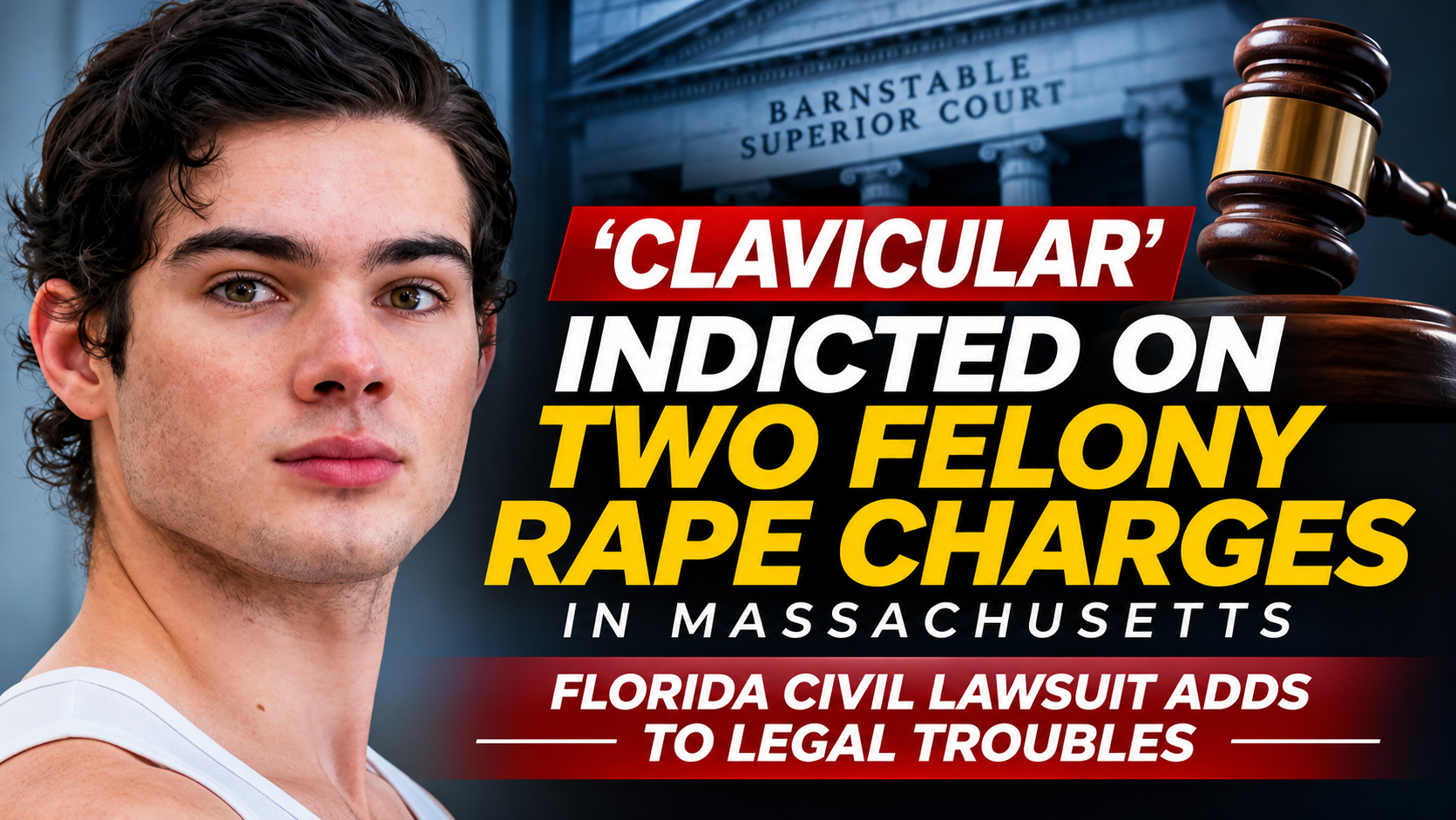
BARNSTABLE, MASSACHUSETTS — Social media influencer Braden Peters, better known online as “Clavicular,” is facing two felony rape charges after a Massachusetts grand jury returned a new indictment involving allegations that he sexually assaulted a 17 year old girl at a Cape Cod residence in May 2025. The indictment, filed November 13, 2026, moves the criminal prosecution into Barnstable Superior Court and adds a second rape count while eliminating an earlier charge alleging that Peters deliberately administered a substance to facilitate sexual intercourse.
The 20 year old internet personality, whose following grew through the controversial online movement known as “looksmaxxing,” was also indicted on a misdemeanor charge of providing alcohol to an underage person. The allegations involve an encounter at a family residence in Chatham, Massachusetts, where prosecutors allege Peters supplied the teenager with alcohol before sexually assaulting her. The accuser also told investigators that she awoke the following morning to find Peters engaging in sexual intercourse with her without her consent.
The new indictment represents a significant escalation in the criminal proceedings, exposing Peters to the possibility of substantial prison time if convicted. The case has attracted national attention because of his online following, the existence of Twitch livestream footage from the evening of the alleged incident and a separate civil lawsuit in Miami-Dade County, Florida, involving allegations of an unauthorized cosmetic injection and damage to the accuser’s professional reputation.
Peters pleaded not guilty to the original charges during an October court appearance and was released on $10,000 bail. His attorney, David Meier, has categorically denied the allegations and maintained that the encounter was consensual. Peters has not been convicted of any offense arising from the allegations, and the grand jury indictment is not a finding of guilt. Prosecutors must prove the criminal charges beyond a reasonable doubt, and Peters remains entitled to the presumption of innocence.
Massachusetts Grand Jury Adds Second Rape Charge Against Clavicular
A Barnstable County grand jury indicted Peters on November 13 on two counts of rape and one misdemeanor count involving the alleged provision of alcohol to someone under the legal drinking age. The indictment replaces the original District Court charging structure, which included one rape count, a felony allegation involving the administration of a substance to facilitate sexual intercourse and the alcohol related misdemeanor. The new prosecution will proceed in Barnstable Superior Court, where Massachusetts handles serious felony cases.
The change is legally significant because prosecutors are now pursuing two separate rape counts rather than one rape charge and the previously alleged drugging offense. Boston 25 News, WCVB and The Boston Globe independently reported the revised charges, confirming that the earlier drugging allegation was dropped and replaced by the additional rape count. The indictment does not establish why prosecutors changed their charging strategy, and there has been no verified public explanation demonstrating that the decision resulted from insufficient evidence, a tactical adjustment or another consideration.
The Superior Court proceedings will involve a new arraignment, pretrial scheduling and opportunities for both sides to challenge evidence and present legal arguments. As of November 19, no Superior Court arraignment date had been publicly announced. Although the indictment establishes that a grand jury found sufficient grounds to bring the charges, it does not establish that prosecutors can prove either allegation at trial.
Alleged Sexual Assault Occurred After Twitch Livestream at Cape Cod Home
The allegations stem from May 23, 2025, when the accuser, then 17, visited Peters at his grandmother’s home in Chatham, Massachusetts. According to a police report described by The Boston Globe, Peters was broadcasting on Twitch from a bedroom when the young woman arrived. Investigators reported that Peters allegedly instructed her to tell livestream viewers she was 18 years old and to describe the alcohol being consumed as water, purportedly to avoid violating the platform’s rules.
The accuser told police that Peters provided her with vodka and that she became increasingly intoxicated during the evening. Investigators reviewed livestream footage in which she could be heard discussing her intoxication, potentially providing evidence relevant to her condition before the alleged assault. According to the reported police account, the two kissed during the livestream and later engaged in additional physical contact after the broadcast ended.
The woman alleged that she subsequently fell asleep in Peters’ bed and awoke the following morning to find him having sexual intercourse with her. She told investigators that she had not consented to the activity and had not intended to have sex with Peters that night or the following morning. The available reporting does not conclusively establish which specific alleged conduct forms the basis of each separate rape count, making it important to distinguish the accuser’s account from the precise allegations that prosecutors will be required to prove in court.
The accuser reported the alleged assault to Chatham police in June 2026, approximately 13 months after the encounter. Investigators subsequently examined the allegations, including the livestream footage and other available evidence, before prosecutors filed the original criminal charges. The delay between the alleged incident and the police report is expected to be an issue in the defense’s challenge to the prosecution, although delayed reporting does not independently establish whether a sexual assault occurred.
Peters Pleaded Not Guilty and Was Released on $10,000 Bail
Peters appeared in Orleans District Court on October 22, 2026, where he pleaded not guilty to the original charges and was released after posting $10,000 bail. The judge imposed conditions requiring him to surrender his passport, remain away from the accuser and refrain from posting online about the case. The restrictions reflected the court’s concerns about managing the proceedings and protecting the parties while the allegations remain unresolved.
The conditions are particularly relevant because Peters built his public profile through livestreaming and social media, where his commentary frequently generates controversy and substantial online engagement. Restrictions on discussing the case may affect his ability to address the allegations publicly, although the precise scope and continuing effect of those restrictions will depend on subsequent court orders as the prosecution moves into Superior Court.
Defense attorney David Meier has disputed the allegations and emphasized that Peters and the accuser maintained a personal and professional relationship following the May 2025 encounter. In statements reported by The Boston Globe, Meier questioned the timing of the accusations and argued that they emerged shortly before the accuser pursued additional civil litigation in Florida. Those assertions represent the defense’s position and have not been established as findings by a court.
Florida Civil Lawsuit Alleges Unauthorized Cosmetic Injection and Financial Harm
Peters is also defending a separate civil lawsuit in Miami-Dade County brought by the same accuser, social media personality Aleksandra Mendoza, who has used the online name Alora Ziva. The Florida litigation includes allegations involving a November 2025 encounter in which Peters allegedly injected Mendoza’s cheek with Aqualyx, a fat dissolving substance, during a livestream without obtaining appropriate informed consent.
According to the civil complaint and reporting by The Boston Globe and Boston 25 News, Mendoza alleges that the injection damaged her right cheek and caused a perforation. The lawsuit further alleges that the substance was mixed with methamphetamine, a claim that has not been independently established through publicly verified toxicology or laboratory findings. Aqualyx is not approved by the U.S. Food and Drug Administration for cosmetic fat reduction, and the alleged procedure raises questions about the risks of unregulated cosmetic treatments promoted through social media.
The lawsuit also describes disputes involving Mendoza’s work as an online influencer, including a promotional agreement with an internet trading platform that allegedly would have paid her $15,000 per month. Mendoza claims Peters subsequently made statements and engaged in conduct that damaged her reputation, interfered with sponsorship opportunities and caused financial losses. Boston 25 News reported that she is seeking $50,000 in damages, although the amount ultimately recoverable, if any, would depend on the claims established in court.
The Florida allegations concern a separate encounter from the Massachusetts criminal case. They remain civil claims, have not resulted in a finding of liability and should not be interpreted as evidence that Peters committed the alleged rape offenses.
Accuser Removes Sexual Assault Claims From Florida Lawsuit
The relationship between the Massachusetts prosecution and the Florida civil litigation became more complicated in October 2026 when Mendoza amended her Miami-Dade lawsuit to remove the sexual assault allegations arising from the Cape Cod encounter. Her attorney, Drew Moss, explained that the decision was intended to avoid interfering with the criminal proceedings already underway in Massachusetts.
The amendment did not withdraw the criminal allegations or terminate the prosecution. Instead, the Florida lawsuit continued to focus on the separate cosmetic injection incident and related claims involving alleged physical injuries, reputational harm and financial losses. The distinction is important because removing allegations from a civil complaint does not automatically mean the underlying events have been disproved, just as the filing of a civil lawsuit does not establish that the allegations are true.
The parallel proceedings may create complications involving discovery and testimony. A defendant facing criminal charges can invoke the Fifth Amendment privilege against self incrimination in circumstances where civil testimony could expose that person to criminal liability. Unlike in criminal trials, where a defendant’s decision not to testify cannot be used as evidence of guilt, certain adverse inferences may be permitted in civil proceedings. Courts must balance those considerations when deciding whether related civil litigation should continue while a criminal prosecution is pending.
The latest reporting reviewed for this article indicates that the Florida lawsuit remains pending in Miami-Dade Circuit Court, with a hearing scheduled for February 24, 2027. The precise status of any temporary stay should be confirmed through the court’s docket, particularly because scheduling orders may change as the Massachusetts prosecution advances.
Prosecutors Must Prove Lack of Consent Beyond a Reasonable Doubt
The central legal issue in the Massachusetts case is whether prosecutors can establish the elements of each charged rape offense beyond a reasonable doubt. The accuser’s reported intoxication, her account of falling asleep and her allegation that she awoke to sexual intercourse without consent are expected to be important components of the prosecution’s case.
Massachusetts law distinguishes between voluntary sexual activity and conduct occurring when a person is unable to consent because of intoxication, unconsciousness or other incapacitating circumstances. The consumption of alcohol does not automatically establish that sexual activity was nonconsensual, but substantial impairment may be legally relevant when determining whether someone had the capacity to consent. Likewise, a sleeping person cannot provide contemporaneous consent to sexual activity, making the accuser’s account of what occurred after she fell asleep potentially significant.
The prosecution must establish the relevant facts through admissible evidence, which may include witness testimony, electronic communications, livestream recordings and other material obtained during the investigation. The defense will have opportunities to challenge the reliability, interpretation and admissibility of that evidence. Jurors will ultimately be responsible for determining whether the prosecution has met its burden on each count if the case proceeds to trial.
The alcohol-related misdemeanor presents a separate legal question concerning whether Peters unlawfully furnished alcohol to an underage person. Livestream footage and witness testimony may be relevant to that allegation, but a conviction would still require prosecutors to prove the applicable statutory elements. Evidence supporting an alcohol related offense would not automatically establish the separate rape charges.
Defense Expected to Challenge Timeline, Consent and Witness Credibility
Peters’ defense has maintained that the encounter was consensual and questioned the credibility and timing of the accusations. Meier has emphasized the parties’ continued relationship following the alleged incident and the fact that the police report was filed more than a year later, around the period when civil litigation involving the two parties was developing in Florida.
Those arguments may become important during pretrial proceedings and any eventual trial, but they are not conclusive evidence that the allegations are false. Continued communication after an alleged assault does not independently establish consent during an earlier encounter, and delayed reporting is not uncommon in sexual assault investigations. Conversely, prosecutors must still prove their allegations rather than relying on assumptions about how victims generally behave.
The defense may also examine the financial disputes described in the Florida lawsuit and argue that they provide a potential motive for making accusations. Prosecutors may challenge the relevance or factual basis of those arguments, and the court will determine which evidence can properly be presented to a jury. Allegations of financial motivation must be supported by evidence rather than treated as established simply because civil litigation exists.
The livestream footage could be particularly important because it provides a contemporaneous record of at least some events preceding the alleged assault. However, the available reporting does not establish that the recordings capture the alleged sexual activity itself. The video may therefore provide context without resolving the central dispute over what occurred after the livestream ended.
Two Rape Counts Carry Serious Potential Prison Exposure
Under Massachusetts General Laws Chapter 265, Section 22, rape convictions can carry substantial prison sentences. The applicable statutory provision and sentencing exposure depend on the precise offenses charged, including whether prosecutors allege additional aggravating circumstances. A conviction under Section 22(b), for example, can carry a maximum state prison sentence of 20 years.
Because Peters faces two separate felony rape counts, the potential consequences are serious. However, it would be misleading to assume that two counts automatically produce a particular combined sentence. Any eventual punishment would depend on the specific convictions, applicable sentencing laws, judicial findings and decisions about whether sentences should run concurrently or consecutively.
The removal of the original drugging charge also changes the prosecution’s legal theory. Prosecutors are no longer pursuing that offense as part of the reported Superior Court indictment, but the decision does not establish that the allegations were disproved. Without a public explanation from the district attorney’s office or a review of the complete charging documents, the reason for the change remains uncertain.
Predicting Peters’ likelihood of conviction or acquittal would be speculative. A grand jury proceeding uses a different legal standard from a criminal trial, and the defense has not yet had the opportunity to challenge all of the prosecution’s evidence before a trial jury. The eventual outcome will depend on the evidence admitted, the credibility determinations made by jurors and whether the prosecution can establish every required element beyond a reasonable doubt.
Clavicular’s Looksmaxxing Fame Places Criminal Case Under National Spotlight
Peters became a recognizable figure within the looksmaxxing movement, an internet subculture centered on maximizing physical attractiveness through grooming, fitness, cosmetic procedures and, in some communities, extreme body modification. His online content has attracted a large following while generating criticism over the movement’s emphasis on physical appearance and unconventional beauty practices.
The criminal case has intensified scrutiny of his public persona, particularly because the allegations involve a teenager who participated in his livestream content before the alleged assault. The separate Florida lawsuit has also raised questions about the risks associated with cosmetic procedures performed outside conventional medical settings and the influence that prominent online personalities can exercise over younger followers.
The attention surrounding the case underscores the difficulties of separating criminal allegations from the public controversies associated with internet celebrities. Peters’ online reputation, statements and personal conduct may influence public discussion, but they do not establish criminal guilt. The allegations must be evaluated through the judicial process, where evidence is subject to legal scrutiny and prosecutors carry the burden of proof.
What Happens Next in the Massachusetts Rape Case?
The next major development will be Peters’ arraignment in Barnstable Superior Court on the November 13 indictment. Court records reviewed by Massachusetts news organizations indicated that no hearing had been scheduled as of November 18. The proceedings are expected to address the formal charges, pretrial scheduling and any issues concerning the defendant’s release conditions.
Both sides may subsequently litigate questions involving electronic evidence, witness statements, the livestream recordings and the admissibility of material concerning the parties’ relationship. The separate Florida lawsuit will continue under its own procedural schedule, subject to any orders addressing discovery or the potential overlap with the criminal prosecution.
The indictment represents a significant development because prosecutors have replaced an earlier charging structure with two separate felony rape counts and moved the case into Superior Court. It does not establish that Peters committed the alleged offenses, nor does it determine whether the defense will ultimately succeed in challenging the prosecution’s evidence.
For now, the central facts are clear: A Massachusetts grand jury has indicted Braden Peters on two rape charges involving an alleged May 2025 encounter with a 17-year-old girl, while a separate Florida civil lawsuit continues to pursue allegations involving a cosmetic injection and financial harm. The criminal allegations remain unproven, and the outcome will depend on whether prosecutors can establish their case beyond a reasonable doubt.
Sources & Further Reading

Massachusetts Criminal Case
-
Boston 25 News — Clavicular Indicted on Two Rape Charges in Cape Cod Case
-
The Boston Globe — Grand Jury Indictment, Police Report and Defense Response
-
WCVB NewsCenter 5 — Superior Court Indictment and Bail Conditions
-
Associated Press — Original Massachusetts Rape Allegations and Criminal Complaint
Florida Civil Litigation
-
NBC 6 South Florida — Accuser Amends Civil Lawsuit Amid Criminal Prosecution
-
The Boston Globe — Cosmetic Injection and Financial Damage Allegations
-
Miami-Dade Circuit Court — Peters’ Motion to Stay Civil Proceedings
Previous SFL Media Reporting
Legal Commentary

Loading comments…