
Wrestling’s Most Dangerous Event: Ric Flair in North Korea
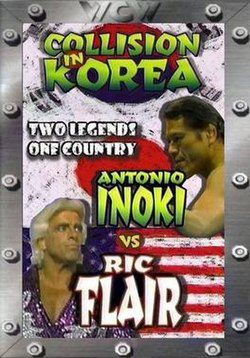
In April 1995, professional wrestling crossed a line it has never crossed again. American wrestling stars, including Ric Flair, boarded planes and flew into one of the most closed, authoritarian states on Earth. They arrived not for a pay-per-view, not for ratings, and not for fans, but to perform inside North Korea, under the direct control of the regime of Kim Jong-il. The event was called Collision in Korea. It is widely regarded as the most dangerous event in wrestling history, not because of in-ring violence, but because the performers were trapped inside a dictatorship where one wrong word could have ended everything.
How Collision in Korea Happened
The event was orchestrated by Antonio Inoki, founder of New Japan Pro-Wrestling and a political oddity even by wrestling standards. Inoki had long-standing ties to North Korea and believed professional wrestling could serve as a form of “sports diplomacy.” Working with North Korean officials, Inoki arranged a joint event featuring wrestlers from NJPW and World Championship Wrestling. WCW executives approved the trip. Many wrestlers later said they were given little information about what they were walking into.
Once they landed in Pyongyang, control vanished. Passports were taken. Movements were restricted. Translators and handlers shadowed them constantly. The performers were no longer entertainers, they were guests of the state.
The Venue and the Crowd
 The matches were held at May Day Stadium, one of the largest stadiums in the world. North Korean authorities claimed attendance figures exceeding 300,000 people. Independent estimates put the number lower, but still massive, likely over 150,000 per day. What stunned the wrestlers wasn’t the size. It was the silence. The crowd did not cheer. They did not boo. They did not react naturally to anything happening in the ring. Applause came only when signaled by officials. Wrestlers later described it as performing in front of a human wall tens of thousands of people, completely expressionless. This was not entertainment. It was choreography.
Ric Flair’s Role and Real Fear
Ric Flair wrestled Antonio Inoki in the event’s most prominent match. On paper, it was a dream clash. In reality, it was a psychological minefield. Flair has repeatedly said he feared for his safety during the trip. He later explained that he quickly realized there was no embassy protection, no American leverage, and no safety net of any kind.
If something went wrong, there would be no negotiation just consequences.
Wrestlers were warned not to joke, not to criticize the government, and not to act in ways that could be interpreted as disrespectful. The rules were vague by design. Uncertainty was the control mechanism. Alcohol flowed freely at official dinners, but the threat underneath never disappeared.
A Propaganda Spectacle Disguised as Wrestling
Collision in Korea was never meant to be a wrestling success. It was a propaganda event.
North Korean state media filmed the matches as proof that the regime could host massive international spectacles and compel American cultural figures to perform under its authority. The presence of Ric Flair a flamboyant, unmistakably American icon carried symbolic value far beyond the ring. The event footage aired in Japan. It was never broadcast in the United States at the time. For years, the event existed mostly as rumor, locker-room legend, and whispered warning.
Aftermath and Legacy
All wrestlers eventually left North Korea unharmed. But the experience left a permanent mark. Collision in Korea is remembered today as:
The largest attended wrestling event ever held
The most politically dangerous wrestling show in history
A case study in how entertainment can be weaponized by authoritarian power
Modern wrestling companies have never attempted anything similar not in North Korea, not anywhere remotely close. The risk was too real. The cost was too high.
Why This Story Still Matters
This was not just a bizarre footnote in wrestling history. It was a moment where celebrity, politics, and authoritarianism collided and where fame offered no protection. Ric Flair survived it. Many others under that regime never had the chance to leave. Collision in Korea stands as a reminder: when entertainment enters a dictatorship, it stops being entertainment very quickly.

















































Want to join the conversation?
Create an account or sign in to share your thoughts, vote,
and reply to other readers.
Showing 0 of 0 comments
Don't have an account?
Already have an account?