

Russian Air Defense Colonel Killed in St. Petersburg Car Bombing as Second Targeted Attack in Three Months Exposes Security Failures Deep Inside Russia
A powerful explosion killed a Russian military officer outside his St. Petersburg residence, marking the second deadly car bombing targeting an aerospace forces officer in the same neighborhood in less than three months and raising new questions about Moscow’s ability to protect military personnel far from the Ukrainian battlefield.
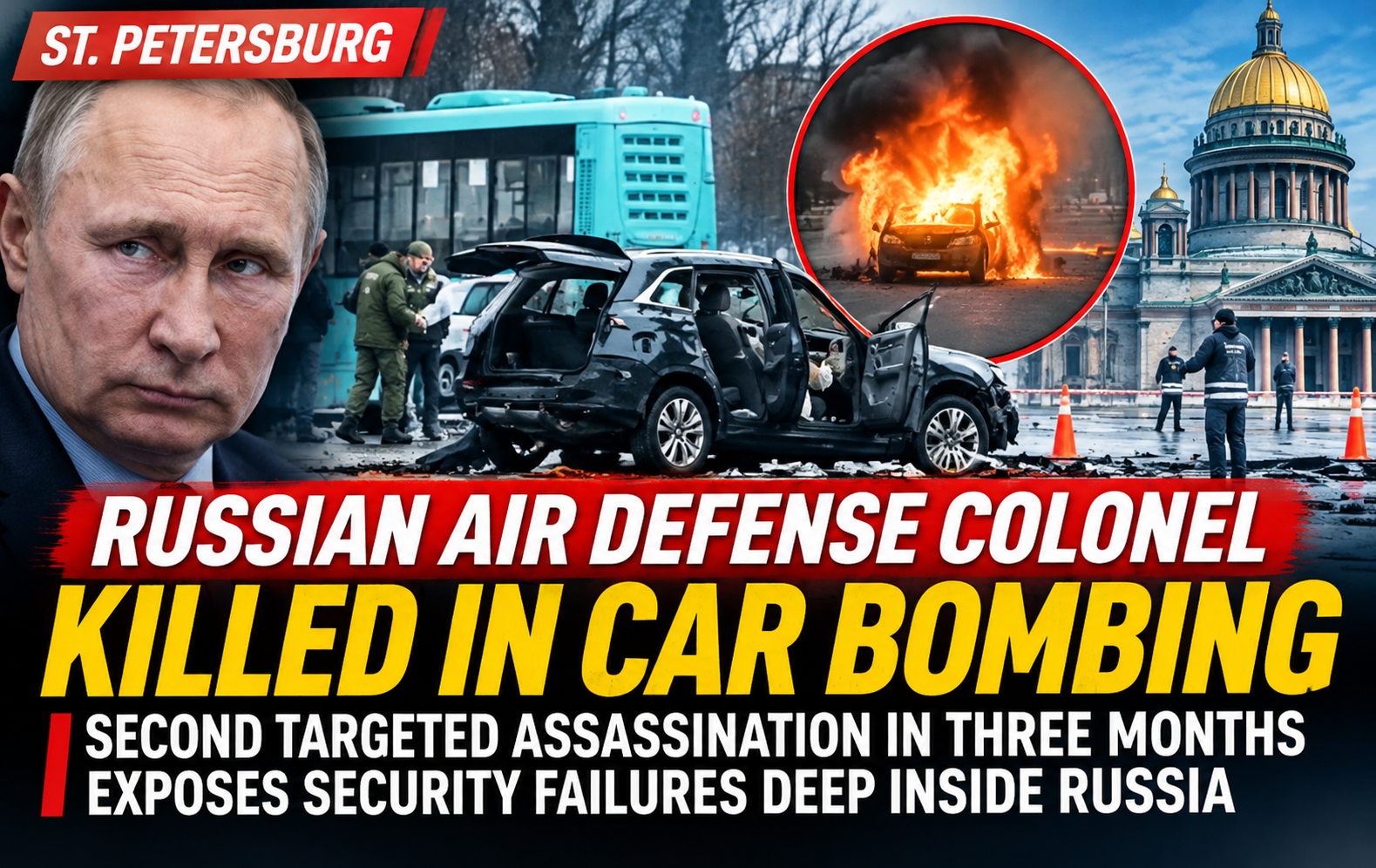
ST. PETERSBURG — A Russian military officer believed to be a senior colonel in the country’s air defense command was killed Thursday morning, November 12, when an explosive device planted beneath his vehicle detonated in a residential neighborhood on the southern outskirts of St. Petersburg, according to Russian investigators and local media reports.
The explosion occurred at approximately 7 a.m. in Slavyanka, a residential area of Shushary in St. Petersburg’s Pushkinsky district. Russian media reported that the officer had just left his residential courtyard and traveled approximately 300 meters when the device exploded, destroying his vehicle and scattering debris across a nearby roadway. Investigators believe the bomb was deliberately planted beneath the vehicle and remotely detonated, suggesting a targeted assassination rather than an accidental explosion.
Russia’s Investigative Committee confirmed that a serviceman had been killed and announced the opening of a criminal murder investigation. Authorities did not immediately release the victim’s name or rank, but Russian television channel 78 and other regional outlets reported that the deceased was a colonel associated with the 6th Air and Air Defense Army, a formation responsible for important Russian aviation and air defense operations.
Independent Russian reporting identified Colonel Dmitry Lobodin, reportedly the formation’s chief navigator, as one possible victim. However, the Institute for the Study of War noted that other accounts identified Colonel Andrei Khodykin, a deputy commander within the same formation, as another possibility. Neither identification had been officially confirmed in the reporting reviewed, making the officer’s precise identity an important unresolved question.
The killing is particularly significant because another Russian military officer died in an almost identical bombing in the same neighborhood on August 27. Both incidents involved explosives targeting military personnel near their homes, suggesting serious vulnerabilities in the protection of Russian officers outside active combat zones.
Explosion Rocks Residential Neighborhood During Morning Commute
The November 12 bombing unfolded along Kolpinskoye Highway, near a Lenta supermarket and a Tatneft gas station, in an area containing residential buildings, local businesses and commuter traffic. Russian media reported that the officer was driving away from his home when the explosive device detonated, causing severe damage to his vehicle and sending fragments into the surrounding roadway.
Security camera footage reportedly captured the moment of the explosion, showing a sudden flash followed by the force of the blast. Images circulated by Russian news organizations showed a heavily damaged sport utility vehicle, scattered wreckage and emergency responders working near the scene. A passenger bus traveling nearby also sustained damage, demonstrating the danger the attack posed to civilians in the surrounding area.
Local reporting indicated that the bus was carrying approximately 30 to 40 passengers, although no injuries among those passengers were reported. Authorities temporarily restricted traffic along the affected roadway while investigators examined the wreckage, collected evidence and attempted to reconstruct the sequence of events.
According to the Russian newspaper Fontanka, investigators believe the explosive device was attached to the underside of the vehicle and triggered remotely after the officer left his residential courtyard. The reported method suggests that the perpetrator may have monitored the officer’s movements, although authorities have not publicly established precisely how the attack was planned or who ordered it.
The location of the explosion also complicates the security picture for Russian authorities. Slavyanka is not a battlefield or a contested border settlement but a residential district within Russia’s second-largest city, hundreds of miles from the main fighting in Ukraine. The ability to attack a military officer in such an environment raises questions about surveillance, personal security and the effectiveness of Russian counterintelligence operations.
Russian Media Identify Possible Victim as Senior Air Defense Navigator
Russian television channel 78 initially reported that the officer killed in the explosion was the chief navigator of Russia’s 6th Air and Air Defense Army. The outlet subsequently modified its reporting, removing the specific reference to the chief navigator’s position while continuing to identify the victim as a colonel associated with the formation.
The independent Russian outlet ASTRA reported that Colonel Dmitry Lobodin, identified in available records as the army’s chief navigator, lived in the same residential area where the explosion occurred. The publication also identified Colonel Andrei Khodykin, a deputy commander responsible for military-political affairs, as another possible victim. Both men were reportedly associated with the same military formation, and the available information did not conclusively establish which officer was killed.
The 6th Air and Air Defense Army is an important component of Russia’s Aerospace Forces, responsible for aviation and air defense capabilities in the country’s northwestern military region. Its responsibilities include supporting military aviation operations and protecting strategically important territory, making senior officers within the formation potentially valuable targets for adversaries seeking to disrupt Russian military operations.
A chief navigator would typically hold responsibilities involving flight planning, navigation procedures and operational coordination, although the precise duties of the officer killed in St. Petersburg have not been publicly established. The significance of the position helps explain why investigators and military analysts are closely examining the victim’s identity and whether the attack was intended to eliminate someone with specialized operational knowledge.
Russian authorities had not publicly confirmed the officer’s name in the reporting reviewed, and reports identifying Lobodin or Khodykin should therefore be treated as provisional. The available evidence establishes that a Russian serviceman was killed in a vehicle explosion, while the precise rank, identity and operational role remain dependent on further confirmation.
Second Russian Military Officer Killed in Same Neighborhood in Less Than Three Months
Perhaps the most alarming aspect of the November attack is its striking similarity to an earlier bombing in Slavyanka on August 27, when another Russian military officer was killed after an explosive device detonated in his vehicle along Kolpinskoye Highway.
The earlier victim was identified by independent Russian and Ukrainian media as Sergei Sechkov, an officer associated with Russia’s 332nd Separate Guards Helicopter Regiment. Reporting differed on his precise rank, identifying him as either a major or a lieutenant colonel. His father subsequently confirmed his death to the independent Russian outlet Agentstvo.
Sechkov’s wife was also inside the vehicle when the explosion occurred and survived with serious injuries. The blast caused extensive damage to the car, prompting Russian investigators to open a criminal investigation and examine whether the attack had been deliberately directed at the officer because of his military service.
The November explosion occurred approximately 500 to 600 meters from the August bombing site, according to Russian independent media. Both attacks involved Russian aerospace or aviation personnel living in the same residential district, and both reportedly used explosives targeting private vehicles.
The similarities raise questions about whether the two incidents were connected, whether the victims were selected because of their service in related military formations and whether the perpetrators exploited recurring weaknesses in the security arrangements surrounding Russian military housing. However, investigators have not publicly established that the same organization planned both attacks. The similarities in location and method are significant investigative leads, but they do not independently prove a coordinated campaign by a single intelligence service or militant network.
Investigators Examine Suspect Who Reportedly Fled Russia
Russian media have reported that investigators identified a possible suspect in the November bombing, although authorities have not publicly confirmed an arrest or established who ordered the attack. According to Fontanka, investigators were examining a 31-year-old St. Petersburg resident who allegedly monitored the officer’s movements for approximately a month before placing the explosive device beneath his vehicle.
The newspaper reported that the suspect left Russia after allegedly planting the bomb, traveling through Turkey and reportedly onward to Moldova. Fontanka also published an extraordinary allegation that the explosive device had been transported into Russia from the direction of the Baltic states using a balloon before being recovered and placed beneath the officer’s car. Those details remain unverified, and Reuters reported that it could not independently substantiate the newspaper’s account.
The alleged escape route is particularly important because it suggests investigators may be examining whether the bombing involved advance preparation, international travel and assistance from additional individuals. However, the available public evidence does not establish the existence of a broader network, the nationality of anyone who may have assisted the suspect or whether a foreign intelligence service directed the operation.
Russia’s Investigative Committee has confirmed the murder investigation but has not publicly identified the suspected organizers. Until investigators release additional evidence, the reported surveillance operation, escape route and unusual method of transporting explosives should be treated as allegations rather than established findings.
A Growing Pattern of Assassinations Targeting Russian Military Leadership
The St. Petersburg bombing follows a series of attacks against senior Russian military officers, defense officials and individuals associated with Moscow’s war against Ukraine. Since Russia launched its full-scale invasion in February 2022, several prominent military figures have been killed in explosions far from the front lines, exposing vulnerabilities in security arrangements surrounding officials involved in the conflict.
One of the most significant cases occurred in December 2024, when Lieutenant General Igor Kirillov, commander of Russia’s Radiation, Chemical and Biological Protection Troops, was killed by an explosive device concealed in an electric scooter outside a residential building in Moscow. Ukrainian security sources claimed responsibility for that operation, which also killed Kirillov’s assistant.
In April 2025, Lieutenant General Yaroslav Moskalyk, a senior Russian General Staff officer, was killed in a car bombing in Balashikha, outside Moscow. The explosion targeted a vehicle near a residential building, demonstrating how senior military personnel could be attacked in locations that would ordinarily be considered secure.
Another high ranking officer, Lieutenant General Fanil Sarvarov, who headed the Russian General Staff’s operational training directorate, was killed in a vehicle explosion in Moscow in December 2025. The deaths of senior officers in separate incidents have intensified concerns about the security of Russian military leadership and the potential exposure of officers whose identities, routines and residential locations may be known to adversaries.
These attacks have involved different locations, targets and circumstances, and they should not automatically be attributed to the same perpetrators. Nevertheless, their cumulative effect has been to demonstrate that Russian military officials can face lethal threats even when stationed hundreds of miles from active combat operations.
Ukraine Has Not Claimed Responsibility for the St. Petersburg Bombing
Moscow has repeatedly accused Ukrainian intelligence agencies of conducting assassinations and sabotage operations inside Russia, particularly against military personnel and individuals associated with the invasion. Ukrainian authorities have acknowledged responsibility for certain operations, while denying involvement in others or declining to comment.
In the November 12 St. Petersburg bombing, no organization had publicly claimed responsibility in the reporting reviewed, and Ukrainian authorities had not issued a statement acknowledging involvement. Russian investigators also had not released evidence establishing that Ukrainian intelligence directed the attack. The distinction is important because a targeted killing involving a Russian military officer does not automatically establish Ukrainian responsibility. Investigators would need evidence connecting the perpetrators, financing, communications or operational planning to an identifiable organization before reaching such a conclusion.
The conflict has increasingly extended beyond conventional battlefield operations to include sabotage, intelligence gathering and attacks against military infrastructure deep inside Russian territory. However, the identities of those responsible for individual incidents remain critical to understanding whether they represent state directed operations, independent actors or other criminal activity. For now, the November bombing remains an officially acknowledged killing with an unresolved perpetrator and motive.
The Security Problem Facing Russia’s Military Command
The repeated targeting of Russian military personnel near their homes raises a difficult question for Moscow: How can the government protect officers whose daily routines, residences and vehicles may be identifiable to hostile intelligence organizations or individuals? The two Slavyanka bombings are particularly troubling from a security perspective because they occurred within a short distance of one another and targeted personnel associated with Russian military aviation. If the attacks were connected, investigators would need to determine whether the perpetrators exploited information about military housing, personal vehicles or predictable commuting patterns.
The reported use of remotely detonated explosives also illustrates the limitations of conventional security precautions. Unlike attacks against heavily guarded military facilities, vehicle bombings can occur in residential environments where officers may not have dedicated protective details and where security measures must coexist with ordinary civilian activity. Russia’s security services face the additional challenge of protecting military personnel across a vast country while simultaneously supporting a prolonged war in Ukraine.
The concentration of military families and personnel in particular residential developments could create vulnerabilities if adversaries are able to identify residents and monitor their movements. None of this establishes that Russian authorities ignored a specific warning or that the November attack could necessarily have been prevented. It does, however, underscore the difficulty of maintaining effective personal security for military personnel during a conflict in which intelligence operations and targeted violence have extended far beyond the front lines.
The War in Ukraine Is Reaching Deeper Into Russian Society
The November 12 explosion also illustrates how the consequences of Russia’s invasion of Ukraine continue to affect communities far removed from the battlefield. St. Petersburg is one of Russia’s largest economic and cultural centers, yet its residents have now witnessed two deadly vehicle explosions involving military personnel in the same suburban neighborhood within three months.
The proximity of the attacks to residential buildings, shops and public transportation underscores the danger that targeted violence poses to civilians. In the latest incident, a nearby passenger bus was reportedly damaged, while the August explosion seriously injured the earlier victim’s wife. The incidents demonstrate how attacks directed at military personnel can endanger people with no direct involvement in the conflict.
The broader pattern of attacks against military officials has forced Russian authorities to confront threats that cannot be addressed solely through conventional battlefield defenses. Protecting senior personnel now requires attention to residential security, counterintelligence, personal movements and the possibility that military officers may be targeted while carrying out ordinary daily activities. At the same time, the use of explosives in populated areas raises serious concerns about the potential for civilian casualties, regardless of the intended target or the identity of those responsible.
A Second Deadly Bombing Leaves Moscow Facing Unanswered Questions
The killing of another Russian military officer in St. Petersburg adds to a growing list of security incidents involving personnel connected to Moscow’s war effort. The November 12 explosion was not an isolated event in an unfamiliar location but the second fatal attack against an aviation-related serviceman in the same neighborhood in less than three months.
Russian investigators have confirmed the death and opened a murder case, while independent reporting has identified possible victims and described a suspected perpetrator who reportedly fled the country. Yet significant questions remain about the officer’s identity, the people who organized the bombing and whether the two Slavyanka attacks were connected.
The incident also highlights the limits of Russia’s ability to protect military personnel outside combat zones. While Moscow continues to devote enormous resources to its military campaign in Ukraine, attacks against officers in residential neighborhoods demonstrate that the conflict’s security consequences are not confined to the battlefield.
For Russian authorities, the immediate priority will be identifying the victim, establishing who planted the explosive device and determining whether additional suspects or accomplices were involved. For military commanders, the broader concern is whether the same vulnerabilities could expose other officers to similar attacks.
Two military officers killed in the same St. Petersburg neighborhood in less than three months represent more than a disturbing coincidence. Whether the bombings were coordinated or unrelated, they reveal a serious security challenge for a Russian military establishment increasingly confronting the consequences of war far beyond Ukraine’s front lines.

Sources & Further Reading
-
Reuters — Car Bomb Kills Russian Soldier Near St. Petersburg in Latest Targeted Assassination — November 12, 2026.
-
Meduza — Russian Colonel Killed in St. Petersburg Car Bombing — November 12, 2026.
-
Institute for the Study of War — Russian Offensive Campaign Assessment — November 12, 2026.
-
ASTRA — Russian Military Officer Killed in St. Petersburg Vehicle Explosion — November 12, 2026.
-
The Moscow Times — St. Petersburg Car Blast Kills Russian Aerospace Forces Officer — November 12, 2026.
-
Euronews — Russian Officer Killed by Car Bomb as Murder Investigation Begins — November 12, 2026.
-
SOFX — Russian Colonel Killed in Car Bomb Explosion Near St. Petersburg — November 12, 2026.
-
South Florida Media — International News, Politics and World Affairs














Loading comments…