
The Norvell Pressure Problem: Why Florida State’s Offense Collapses When the Clock Takes Away the Script
Mike Norvell Has Built Some of College Football’s Most Productive Offenses, but Florida State’s Record Reveals a Striking Pattern: Give His Teams Time and Control and They Can Be Dangerous. Force Them to Hurry, Chase the Score or Execute a Two Minute Drive, and the Entire Operation Falls Apart…
There is a recurring phenomenon surrounding Mike Norvell’s Florida State teams that becomes difficult to ignore once you know what to look for. The Seminoles can appear remarkably sophisticated when they control the circumstances of a football game, using formations, motion, shifts, personnel packages, the running game and play-action to reveal defensive intentions and manufacture favorable matchups before the football is snapped. When Florida State stays ahead of the chains, maintains access to its entire playbook and gives its coaches enough time to diagnose what the defense is doing, Norvell’s offense can look exceptionally well designed. The problem emerges when the game takes that control away. Put Florida State behind on the scoreboard, force the offense into obvious passing situations, shorten the available clock or hand Norvell the football late with an entire field to travel, and the same operation can suddenly look dramatically less prepared. Communication becomes slower, protections become more vulnerable, third downs become more difficult and an offense designed to create uncertainty for the defense begins looking uncertain itself.
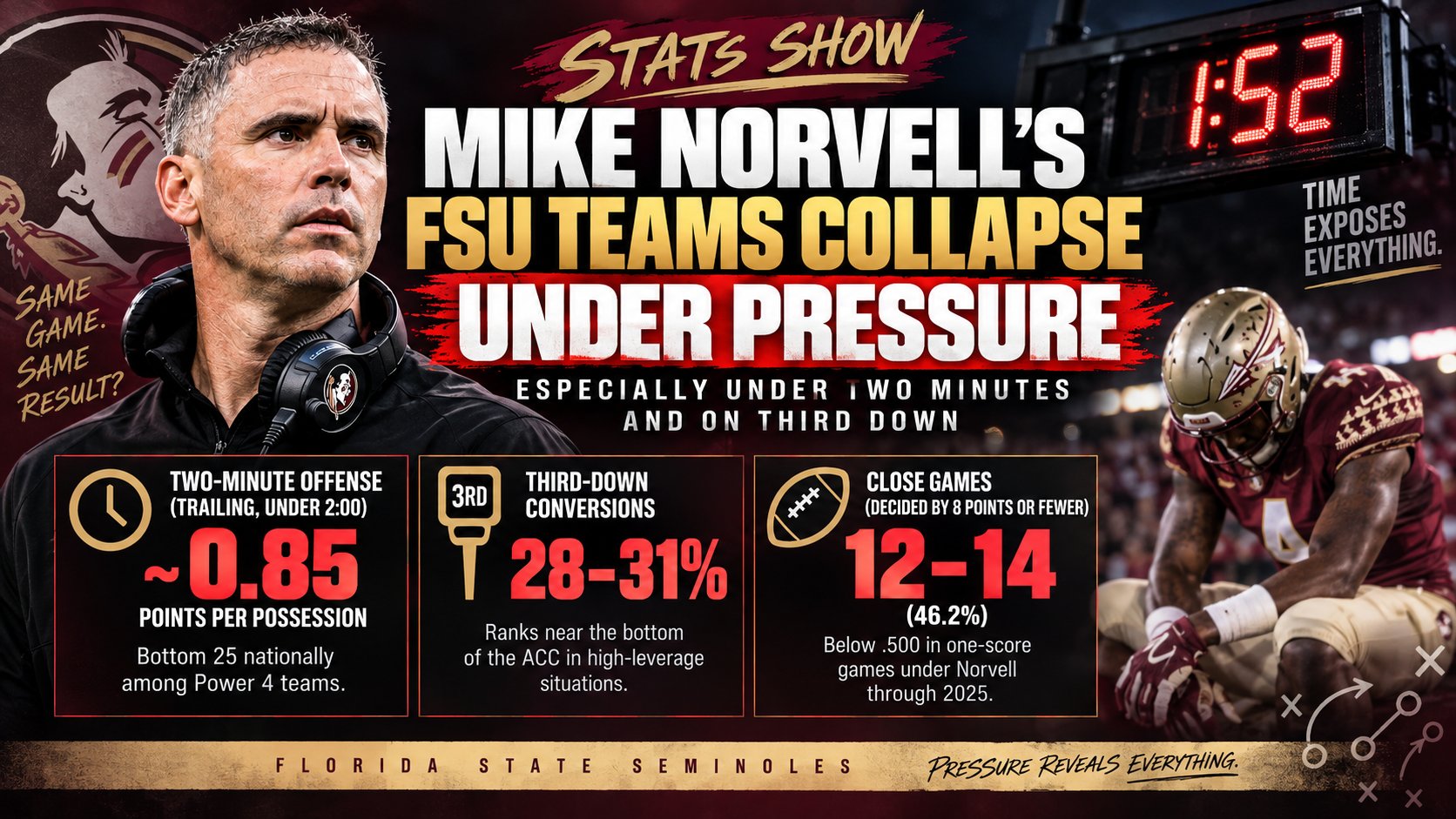
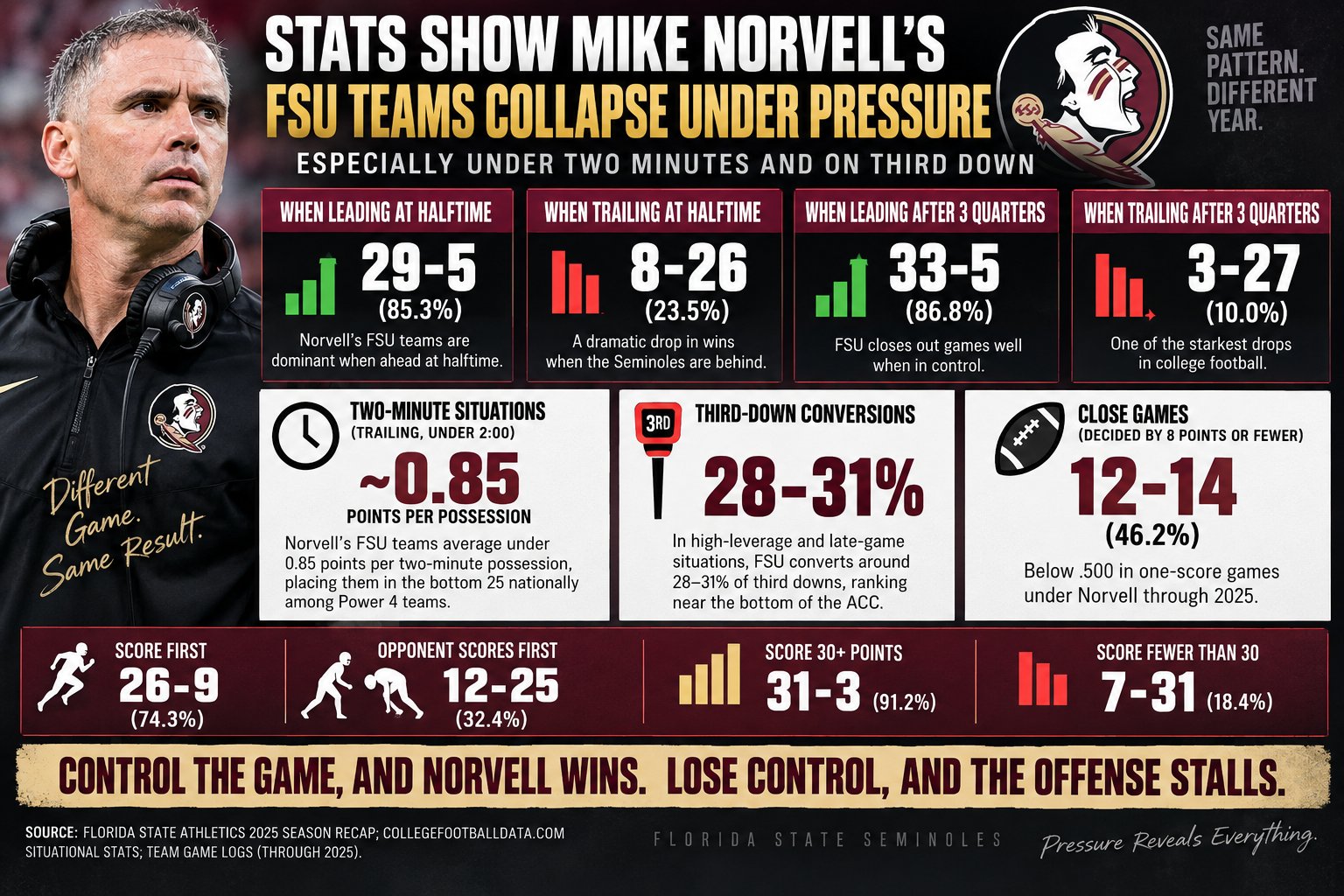
That is the phenomenon worth examining, and it does not require attaching questionable national rankings to Florida State’s two minute offense. There is no standardized public NCAA statistic measuring “Norvell two minute efficiency” across his entire FSU tenure, meaning claims that the Seminoles rank precisely 110th nationally in two minute EPA or average exactly 0.85 points per two minute possession should not be presented as established facts without possession-level data capable of reproducing them. Florida State’s verified situational records are compelling enough. Through the end of the 2025 season, Norvell’s Seminoles were 29-5 when leading at halftime but just 8-26 when trailing. When leading after three quarters, FSU was 33-5; when trailing after three, it was 3-27. In games decided by eight points or fewer, Florida State was 12-14 under Norvell through 2025. Those numbers do not mathematically prove that Norvell lacks a functional two minute offense because football outcomes involve roster quality, defense, special teams, opponent strength and numerous other variables, but they support a broader observation that has become increasingly difficult to dismiss: Florida State under Norvell has been dramatically better at finishing games it controls than changing games that begin controlling Florida State.
The Problem Is Not That Norvell Cannot Design an Offense
Any serious analysis has to begin by acknowledging what makes the problem so interesting: Mike Norvell clearly understands offensive football. Florida State led the ACC in total offense and rushing offense in 2025, averaging 472.1 yards per game and 218.7 rushing yards per game. Norvell’s offenses have produced explosive numbers throughout his coaching career, while his best Florida State teams demonstrated how difficult his system can be to defend when the Seminoles establish the run, remain balanced and force opponents to account for the entire field. This is therefore less a question of whether Norvell knows how to construct an offense than whether the architecture of that offense remains equally functional when circumstances eliminate the conditions it prefers.
That distinction becomes particularly important in the final minutes because two minute football is not simply a normal offense played at a higher speed. It is effectively a separate offensive discipline. The defense knows the offense is likely to throw, substitutions become more difficult, protection becomes more important because defensive linemen can rush without respecting the run to the same degree, the sidelines become strategically valuable because stopping the clock matters, and every second spent waiting for a play call, shifting formations or communicating an adjustment carries an opportunity cost. Successful two-minute offenses generally respond by reducing complexity and relying on a relatively small collection of concepts that the quarterback, offensive line and receivers can execute almost automatically. Florida State too often appears to be trying to accelerate its normal offense rather than operating a distinct emergency offense specifically constructed for those conditions.
Norvell’s Greatest Offensive Strength May Become a Weakness Under Time Pressure
Norvell’s offense is heavily dependent on creating information and leverage before the snap. Motion can help identify man or zone coverage, formation changes can alter run fits, shifts can force defensive communication, personnel packages can create mismatches and play action can exploit defenders conditioned to react aggressively against the run. Under normal circumstances, those mechanisms make life easier for the quarterback because the offense attempts to solve part of the defensive puzzle before the play begins. The potential weakness is that nearly every one of those advantages becomes more expensive when the clock is disappearing. Motion takes time, shifts take time, looking toward the sideline takes time, changing a play after seeing the defensive alignment takes time, and substitutions consume additional seconds while potentially allowing the defense to substitute as well.
The result is the central paradox of Norvell’s system. Its complexity is designed to make defenders think, communicate and hesitate, but under severe time pressure some of that complexity can force Florida State’s own players to think, communicate and hesitate. When FSU controls the tempo, the offense can impose a processing burden on the defense. When the clock controls the tempo, Florida State begins carrying more of that processing burden itself. At the same time, the scoreboard can remove the running game as a credible threat, weakening play action and allowing defensive linemen to attack the quarterback more aggressively. An offense built around manufacturing favorable conditions therefore becomes considerably less imposing when the game no longer provides enough time to manufacture them.
Florida State Does Not Simply Play Faster Under Pressure, It Often Looks Frantic
There is an enormous difference between playing fast and playing rushed. A well developed hurry up offense reaches the line knowing what it wants to accomplish. The quarterback understands the call and its answers against different defensive looks, the offensive line communicates the protection immediately, receivers know their adjustments and the offense can snap the football before the defense comfortably reorganizes. A rushed offense looks different. Players hurry toward the line and then stop, look toward the sideline, wait for communication, adjust an alignment and allow the defense to settle while precious seconds continue disappearing. By the time the football is snapped, much of the advantage supposedly created by tempo has vanished.
That distinction helps explain why Florida State can demonstrate tempo during ordinary game conditions and still look uncomfortable when forced into a genuine two minute environment. Norvell can dictate tempo when he decides when and how to accelerate, but that is fundamentally different from operating efficiently when the scoreboard dictates that virtually every snap must happen quickly. The issue becomes cognitive load. During normal conditions, Norvell can use offensive complexity against the opponent; during emergency conditions, that same complexity can become an additional burden on his own players. Florida State does not necessarily become incapable of playing quickly. It becomes less comfortable when it no longer controls why it has to play quickly.
Florida State Appears to Need a True Two Minute Operating System
This is where the criticism moves beyond individual play calls and toward offensive architecture. A serious two minute offense should function almost like a separate operating system installed inside the larger playbook, containing a limited collection of formations, protections and passing concepts that every offensive player knows so thoroughly that extensive sideline communication becomes unnecessary. The quarterback should be capable of reaching the line, identifying the coverage, communicating the protection and snapping the football. Receivers should understand automatic adjustments against pressure and common coverage structures, while the offensive line should immediately recognize how protection changes against different fronts. The offense should have established answers for attacking the sidelines, exploiting the middle when timeouts remain, beating pressure and producing manageable gains when the defense refuses to surrender anything deep.
That becomes particularly important with Norvell because his involvement in offensive structure and play calling has historically been central to his coaching identity. During an ordinary drive, a gifted play caller can create an advantage by finding the ideal concept against an opponent’s tendencies. During a two-minute drive, however, waiting for the perfect answer can become part of the problem because the final minutes reward decisiveness more than schematic cleverness. Sometimes the best play is simply the one all 11 players can execute immediately. Florida State too often appears to be trying to solve the entire defensive puzzle at the precise moment when the game demands that it reduce the puzzle to its simplest components.
The Numbers Show a Team Built to Protect Control, Not Recover It
Florida State’s official situational records provide the strongest evidence that this pressure problem extends beyond isolated two minute possessions. Through the end of 2025, Norvell’s teams were 29-5 when leading at halftime, an approximately 85% winning percentage, but only 8-26 when trailing. In 2025 specifically, Florida State went 5-1 when leading at halftime and 0-5 when trailing. The disparity becomes even more severe entering the fourth quarter, with FSU going 33-5 when leading after three quarters but only 3-27 when trailing. The Seminoles were also 26-9 when scoring first compared with 12-25 when the opponent scored first, while going 12-14 in games decided by eight points or fewer through the end of 2025.
Every football team performs better while leading than trailing, so none of those splits should be misrepresented as proof that Norvell cannot make adjustments or that another coach would automatically produce a dramatically different record. The significance lies in how consistently the same pattern appears across different game states. Florida State’s results deteriorate sharply as the opponent gains control of the circumstances, and the later the deficit persists, the more severe the deterioration becomes. That is consistent with what repeatedly appears on film: Norvell’s teams can be extremely dangerous when they are executing the offense they intended to execute, but they have been considerably less reliable when the scoreboard forces them to abandon that structure and manufacture offense immediately.
Third and Long Recreates the Same Problem in a Single Play
The phenomenon also appears on obvious passing downs because third-and-long creates many of the same conditions as late game football. On first and 10, the defense has to respect virtually the entire playbook. Florida State can run inside or outside, use play-action, attack the perimeter, move the quarterback, throw quickly or take a deep shot. On third-and-8, much of that uncertainty disappears. The defense knows where the first down marker is, understands that a pass is likely and can attack accordingly. The running game loses much of its influence over linebackers, play-action becomes less threatening, pass rushers can become more aggressive and defensive backs can organize their coverage around the yardage the offense must gain.
That is why Florida State’s third down disaster against SMU matters beyond one ugly statistic. In the Seminoles’ 27-24 loss, FSU converted only 2 of 15 third downs and failed on its first 10 third-down attempts, while SMU converted 8 of 14. Florida State generated 324 yards of offense, including only 125 passing yards, while SMU produced 585 total yards and 430 through the air. The Seminoles allowed three sacks while recording none, yet they were not incapable of moving the football overall. FSU rushed for 199 yards and averaged 4.4 yards per carry, with Ousmane Kromah producing 116 rushing yards and a touchdown. The offense could function while the running game remained credible and the entire playbook was available. The breakdown came when the situation told SMU what Florida State had to do, which is essentially the same structural challenge created by a two-minute drill.
SMU Became the Latest Case Study in the Norvell Pressure Problem
The SMU loss was particularly revealing because Florida State received enough assistance from its defense and special teams to put itself in position to win. The Seminoles forced four turnovers and committed none, yet converted those extra opportunities into only seven points, something Norvell himself acknowledged afterward was a failure. Florida State controlled possession for more than 32 minutes and produced a successful rushing attack, but the offense repeatedly failed when the game demanded high leverage conversions. SMU quarterback Kevin Jennings threw two interceptions but still finished with 430 passing yards and three touchdowns, while the Mustangs were able to produce the decisive fourth quarter possessions necessary to win.
Florida State’s inability to answer in the compressed, obvious situations at the end of the game did not create the argument about Norvell’s pressure offense, but it reinforced it. Once the Seminoles could no longer patiently establish the running game, sequence calls and manipulate the defense over an extended possession, the offense became much more fragile. The same team that could produce nearly 200 rushing yards struggled to generate consistent passing offense when SMU knew passing was required. That is the recurring concern: Florida State can function when it possesses multiple answers, but when the game eliminates those options and demands one immediate answer, execution too often deteriorates.
The Run Game Is Part of the Machinery That Makes Norvell’s Entire System Work
Understanding the pressure problem requires recognizing how important the running game is to Norvell’s overall architecture. Running the football is not simply another method of gaining yards. It forces linebackers to honor run fits, gives play action credibility, slows edge rushers, creates hesitation in the secondary and prevents defensive coordinators from treating every snap as an obvious passing situation. Most importantly, the running game preserves uncertainty, which is one of the fundamental weapons of Norvell’s offense.
Once the scoreboard effectively removes the run, several components of the system weaken simultaneously. Defensive linemen can attack the quarterback, linebackers can expand into passing windows, safeties can concentrate on route combinations and defensive coordinators can call pressures with less concern about being punished by a run. The quarterback is suddenly being asked to defeat a defense that has a much better idea of what is coming, without many of the pre-snap advantages the offense normally manufactures for him. That does not make Norvell’s philosophy ineffective, but it can make the system fragile. A robust offense continues functioning when one of its major components disappears; a fragile offense can look spectacular when all of its interconnected pieces are working and dramatically different when one is removed. Late-game deficits can remove several of Norvell’s preferred components at once.
Jordan Travis May Have Been Florida State’s Emergency Offense
The strongest counterargument to this theory is the 2023 season, when Florida State went undefeated through the regular season, won the ACC championship and survived several games that became uncomfortable. Any analysis claiming Norvell’s offense simply cannot function under pressure would have to account for a team that reached 13-0 before the Orange Bowl. Jordan Travis may explain much of the difference because he gave Florida State something extraordinarily valuable whenever the original structure disappeared: improvisation. If protection failed, Travis could escape. If the primary route was covered, he could extend the play. If the defense defeated the original concept, he could create another play outside the concept. His mobility also forced defenses to continue accounting for a running threat during situations in which another quarterback would make the offense far more predictable.
Travis, in effect, could become Florida State’s emergency offense when Norvell’s designed offense broke down. That raises one of the most important questions of the Norvell era: did the 2022 and 2023 teams demonstrate that the coaching staff had solved its situational weaknesses, or did an exceptional veteran quarterback temporarily conceal them? The seasons surrounding Travis provide legitimate reason to investigate the latter possibility. Florida State collapsed to 2-10 in 2024, improved only to 5-7 in 2025 and opened 2026 at 1-1 following the SMU loss. The dramatic difference between the Travis-era offense and the units that followed suggests his improvisational ability may have been doing more than complementing Norvell’s scheme. It may have been providing the system with an escape mechanism when its preferred structure disappeared.
Norvell’s Teams Are Far Better When the Game Goes According to Plan
Viewed together, Florida State’s situational numbers describe a remarkably consistent pattern. Through 2025, the Seminoles were 29-5 when leading at halftime but 8-26 when trailing, 33-5 when leading after three quarters but 3-27 when trailing, 26-9 when scoring first but 12-25 when the opponent scored first, and 31-3 when scoring at least 30 points compared with 7-31 when scoring fewer than 30. None of those statistics independently isolates play calling, and none should be presented as if it does. Collectively, however, they describe a football program whose success has been closely connected to its ability to establish control early and preserve it.
That is the broader version of the two-minute problem. Give Florida State time and options, and Norvell can be extremely effective. Allow the running game to remain credible, and his formations and play-action concepts become more dangerous. Give him the ability to sequence plays, study the defense and manipulate its responses, and the sophistication of his offense becomes an advantage. Take those things away, and that advantage begins disappearing. The pressure does not merely force Florida State to execute the same offense faster; it removes some of the very mechanisms the offense normally uses to make execution easier.
The Most Concerning Part Is That This Is a Coaching Problem That Can Be Fixed
The criticism does not require Florida State to abandon Norvell’s offense. His system has produced enough high level football to establish that its foundation can work. What Florida State appears to need is a stripped-down emergency version specifically designed for the moments when the normal machinery is unavailable. That package should contain a limited number of formations, protections and concepts, with the quarterback empowered to operate it at the line. The offensive line should communicate protections immediately, receivers should understand their adjustments without waiting for the sideline and the entire unit should be capable of getting aligned and snapping the football without requiring the coaching staff to manufacture the ideal matchup before every play.
That may require a philosophical adjustment because Norvell’s instinct as an offensive designer is understandably to find answers through scheme. Two minute football frequently demands the opposite. It requires removing information rather than adding it, reducing choices rather than expanding them and trusting repetition rather than searching for creativity. The best two minute offense is not necessarily the one containing the smartest individual play call; it is the one that wastes the fewest seconds getting 11 players to execute a sound play together. Florida State needs that package to become so familiar that operating it under pressure feels routine rather than exceptional.
Florida State’s Problem Is Not Playing Fast, It Is Being Forced to Play Fast
That distinction may explain the phenomenon better than any individual statistic. Norvell’s teams can play quickly when they choose to play quickly because the coaching staff controls when tempo is introduced. Choosing tempo, however, is fundamentally different from being subjected to time pressure. When Florida State controls the pace, Norvell can prepare the next call, organize personnel, anticipate the defensive response and maintain access to his entire offensive system. When the opponent, scoreboard and clock control the pace, those luxuries disappear, and the offense has to operate without its play caller being able to engineer every advantage.
That is when Florida State repeatedly appears most uncomfortable. The Seminoles do not simply become faster; they become rushed, and rushed football exposes communication problems, protection issues, quarterback processing, receiver adjustments, clock management and the loss of the running game as a credible threat simultaneously. The offense that normally makes the defense process multiple possibilities is suddenly the unit being forced to process everything immediately. What looks like panic may actually be the predictable result of an offensive system operating outside the environment for which it is best designed.
The Norvell Paradox Is Becoming Increasingly Difficult to Ignore
Mike Norvell has demonstrated that he can design an excellent college offense. Florida State led the ACC in total offense and rushing offense in 2025 despite finishing 5-7, his 2022 team won 10 games and his 2023 Seminoles completed an undefeated regular season and won the ACC championship. The evidence that Norvell understands offensive football is overwhelming, which is precisely why the pressure problem deserves greater scrutiny. The question is no longer simply whether his offense works. It clearly can. The more important question is when it works.
Florida State has been extraordinarily successful when leading at halftime and remarkably unsuccessful when trailing entering the fourth quarter. It has been considerably better when scoring first than when conceding first. Its latest loss featured 199 rushing yards and four takeaways, yet the Seminoles went 2-for-15 on third down, generated only 125 passing yards and failed to produce enough offense when the game narrowed into obvious, high-leverage situations. These are different statistics measuring different circumstances, but they repeatedly point toward the same structural concern: Norvell’s offense is built to dictate the terms of a football game, while championship offenses must also be capable of functioning after the opponent takes those terms away.
Eventually every elite football team encounters a game in which the script gets destroyed. The running game disappears, the opponent takes the lead, the quarterback gets pressured, the clock reaches two minutes and everyone in the stadium knows the football has to be thrown. There is no longer enough time to manufacture the perfect matchup or wait for the ideal defensive look. At that point, offensive football becomes brutally simple: protect the quarterback, get open, make the read, complete the pass, get lined up and do it again. That is the environment in which Florida State has too often looked least prepared under Norvell.
The available data reveals a powerful and persistent pattern throughout Mike Norvell’s tenure at Florida State: his teams have been dramatically more successful when they control the clock, the score and the offensive structure than when circumstances force them to hurry, chase the game and execute in predictable passing situations. Through 2025, FSU was 29-5 when leading at halftime but just 8-26 when trailing, and an overwhelming 33-5 when leading after three quarters compared with a staggering 3-27 when trailing. The problem continues to surface on the downs that most closely resemble two minute football, when the defense knows a pass is coming and Florida State simply has to execute. Through two games in 2026, the Seminoles are converting only 34% of their third downs, including an astonishing 2-of-15 performance against SMU. The numbers across different situations continue pointing toward the same conclusion: the more the game removes Norvell’s ability to dictate the circumstances, the less effective Florida State becomes.
The next evolution of Norvell’s offense may therefore have nothing to do with making it more sophisticated. It may require building a simpler, faster and genuinely independent two minute system that does not depend on the head coach finding the perfect call from the sideline. When Mike Norvell has time to construct the game, his offense can be brilliant. When the clock, score and opponent take that time away, Florida State too often stops looking like it knows what comes next, leaving the Seminoles scrambling around like a group of college kids who were never prepared for the pressure in the first place.

Sources & Further Reading
Florida State Athletics — 2025 Season Recap and Mike Norvell Situational Records
https://seminoles.com/documents/download/2025/12/13/Season_Recap.pdf
Florida State Athletics — Florida State vs. SMU Official Box Score, Sept. 7, 2026
https://seminoles.com/sports/football/stats/2026/smu/boxscore/16674
Florida State Athletics — Malzahn Announces Retirement; Tim Harris Promoted to Offensive Coordinator
https://seminoles.com/news/2026/2/2/football-malzahn-announces-retirement-harris-promoted-to-offensive-coordinator
SMU Athletics — No. 19 SMU Wins at Florida State, 27-24
https://smumustangs.com/news/2026/9/7/football-no-19-smu-wins-season-opener-at-florida-state-27-24
Tomahawk Nation — Mike Norvell on Four SMU Turnovers Producing Seven FSU Points: “That’s a Failure”
https://www.tomahawknation.com/florida-state-football/136775/mike-norvell-on-four-smu-turnovers-leading-to-just-seven-fsu-points-thats-a-failure
Tomahawk Nation — FSU Coordinators Break Down Third-Down Failures Against SMU
https://www.tomahawknation.com/florida-state-football/136744/fsus-coordinators-o-third-down-tape-vs-smu-things-were-there-and-we-just-have-to-execute-better
































































Want to join the conversation?
Create an account or sign in to share your thoughts, vote,
and reply to other readers.
Showing 0 of 0 comments
Don't have an account?
Already have an account?