
Former FSU Football Star Chuck Kennon Accused of Leading Police on 150 MPH Chase as Terrified Passenger Begged to Escape
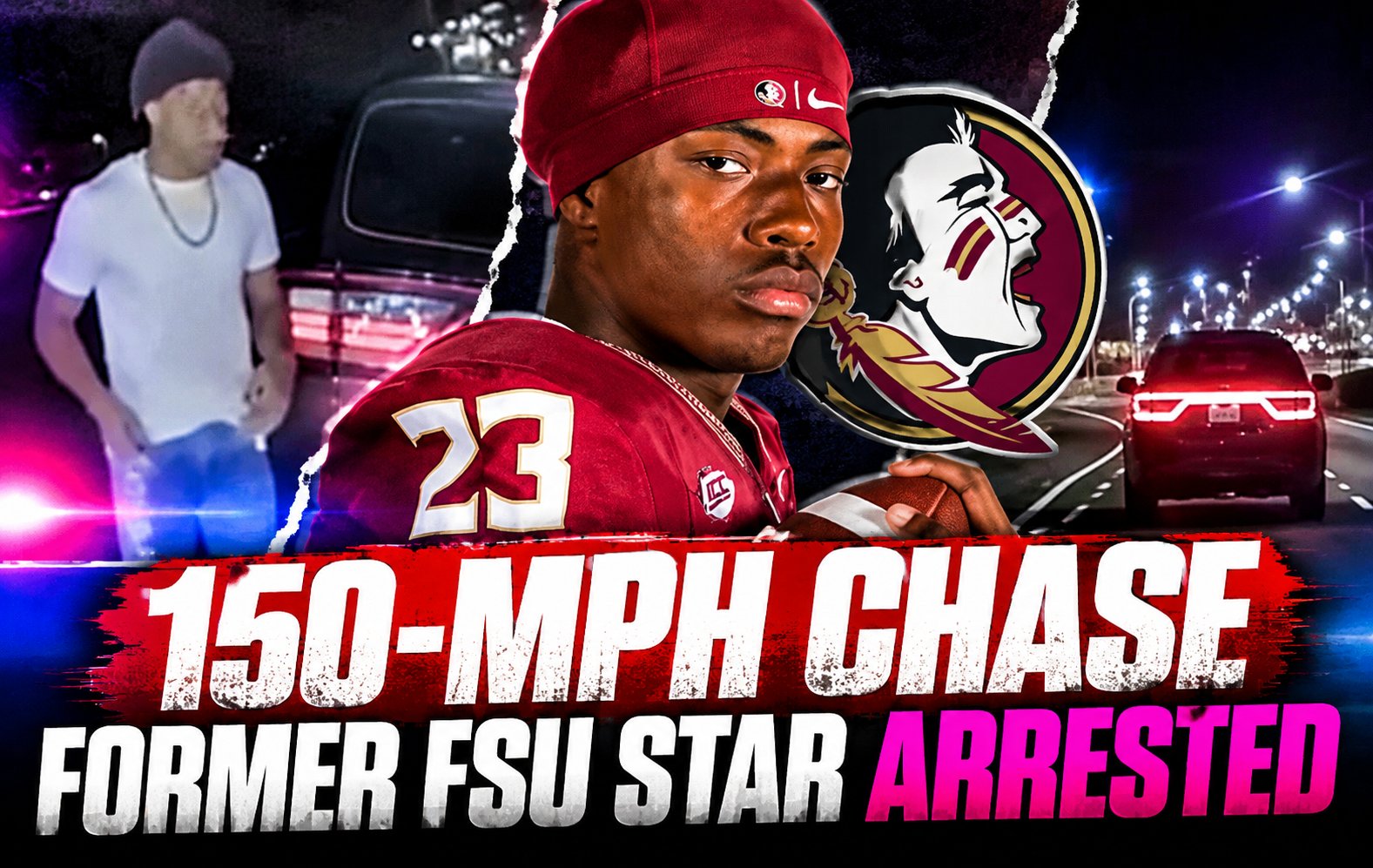
Florida State’s highest rated recruit of 2026 has been dismissed from the Seminoles football program after investigators say he fled police at speeds exceeding 150 mph while a young woman repeatedly pleaded with him to stop and let her out of the vehicle.
TAMPA, FLORIDA — What began as a routine speeding violation on a Florida highway has developed into a criminal case involving a former five star college football recruit, a police pursuit exceeding 150 miles per hour and allegations that a terrified passenger repeatedly begged to escape the vehicle. Chauncey “Chuck” Kennon, a former Florida State University freshman cornerback and the Seminoles’ highest rated recruit in the 2026 signing class, faces two felony charges and a misdemeanor following a dangerous pursuit through Hillsborough County that authorities say endangered motorists and left an accompanying passenger fearing for her life.
According to a Florida Highway Patrol arrest affidavit, Kennon, 18 at the time of the incident, allegedly accelerated away from law enforcement officers during the early morning hours of October 10, running a red light, striking a curb and eventually abandoning his disabled Dodge Durango before fleeing on foot. Investigators say a female passenger repeatedly demanded that Kennon stop the vehicle, telling authorities she had asked him more than 10 times to let her out because she feared being seriously injured or killed. The allegations have resulted in charges of aggravated fleeing to elude law enforcement, false imprisonment and resisting an officer without violence.
The criminal investigation has already cost Kennon his position at Florida State, where he arrived as one of the most promising defensive prospects in the country. University officials confirmed his dismissal from the football program, citing conduct detrimental to the team, while head coach Mike Norvell publicly acknowledged the decision. Kennon, who had appeared for only one snap during his freshman season, now faces a criminal prosecution that could carry substantial prison time if he is convicted.
A Routine Speeding Violation Escalates Into a Dangerous Police Pursuit
The incident began around 2 a.m. on Saturday, October 10, near State Road 60 and South Maydell Drive in Hillsborough County, where a sheriff’s deputy and a Florida Highway Patrol trooper were conducting traffic enforcement. According to investigators, a black Dodge Durango was recorded traveling 70 mph in a posted 50 mph zone. When officers attempted to catch up with the vehicle, its driver allegedly accelerated to approximately 90 mph, prompting a trooper to activate emergency lights and a siren. Rather than pulling over, the driver continued accelerating, initiating a pursuit that would eventually reach speeds exceeding 150 mph.
As the Durango approached the intersection of State Road 60 and U.S. Highway 301, investigators say the driver ran a red light while other vehicles were crossing the intersection. The SUV reportedly swerved to avoid a collision and struck a raised curb before continuing eastbound along State Road 60. According to the arrest affidavit, the vehicle subsequently reached speeds exceeding 150 mph in areas where the posted speed limit was just 50 mph. The pursuit continued onto southbound Interstate 75, where a Florida Highway Patrol trooper reported reaching approximately 140 mph in an unsuccessful attempt to close the distance between his patrol vehicle and the fleeing SUV.
The reported speeds illustrate the extraordinary danger posed by the pursuit. At 150 mph, a vehicle travels approximately 220 feet every second, covering the length of a football field in less than two seconds. A driver traveling at that speed has extremely limited time to respond to changing traffic conditions, unexpected obstacles or other motorists entering the roadway. Investigators allege that Kennon’s driving created precisely those dangers, particularly when the SUV entered an intersection against a red light and narrowly avoided crossing traffic.
The pursuit continued for approximately seven minutes before troopers lost sight of the Durango. Another officer subsequently located the SUV near U.S. Highway 41 and Big Bend Road in the Apollo Beach area, where its front passenger-side tire appeared damaged. Investigators believe the damage was consistent with the earlier collision involving the raised curb. The vehicle eventually became disabled and stopped along Big Bend Road near Wyandotte Road, bringing the high speed portion of the incident to an end.
Kennon Allegedly Abandons SUV and Flees From Officers on Foot
According to the Florida Highway Patrol, the driver exited the disabled SUV as officers approached and fled toward a nearby industrial area despite commands to stop. Troopers and Hillsborough County sheriff’s deputies established a perimeter while aviation and K-9 resources assisted in searching the surrounding area. Investigators later identified Kennon as the driver through dashboard camera footage and other evidence collected during the investigation.
Authorities also reported discovering an unlocked cellphone inside the Durango containing photographs of Kennon wearing a distinctive gold chain. Investigators compared the jewelry with images captured during the incident and Kennon’s driver’s license photograph as part of their effort to establish who had been operating the vehicle. The identification evidence became significant because the driver had left the scene before officers could take him into custody.
The search also led investigators to a female passenger whose account would substantially expand the criminal case. Shortly after 3:30 a.m., approximately 90 minutes after the initial traffic enforcement encounter, a trooper discovered a woman in the surrounding area with cuts on her arm and clothing covered in dirt, blood and grass. Authorities questioned her about how she arrived at the location, and she initially provided conflicting information before telling investigators she had been riding in Kennon’s SUV.
Passenger Says She Begged More Than 10 Times to Be Let Out of the Vehicle
According to the arrest affidavit, the woman told investigators that she and Kennon had been together in Tampa’s Ybor City entertainment district before leaving in his vehicle. She said Kennon began driving recklessly even before law enforcement officers attempted to stop him, causing her to become frightened and repeatedly demand that he pull over. Investigators reported that she did not want to participate in whatever was happening and wanted to leave the vehicle before the situation escalated further.
The woman’s account became particularly significant because she alleged that Kennon continued driving despite her repeated objections. According to investigators, she told officers that she asked him more than 10 times to stop the SUV and allow her to exit, but he refused. She described holding tightly to her seatbelt as the vehicle traveled at dangerous speeds and told authorities she feared for her life. Her statements suggest that the passenger’s fear began before the police pursuit and intensified as the SUV accelerated away from law enforcement.
Investigators have not publicly established exactly how the woman sustained the injuries observed by officers or fully explained the circumstances under which she exited the vehicle. The available reporting does not establish that Kennon physically assaulted her, and the injuries should not be interpreted as evidence of an additional offense without supporting findings. Nevertheless, her statements concerning repeated demands to leave the SUV formed a central part of the probable-cause determination supporting the false imprisonment allegation.
Under Florida law, false imprisonment generally involves unlawfully confining, abducting, imprisoning or restraining another person against that person’s will and without lawful authority. The offense does not necessarily require a locked room, physical restraints or a weapon. Prosecutors may pursue such a charge when they believe the evidence establishes that a person was unlawfully prevented from leaving a location or situation. In Kennon’s case, authorities allege that his refusal to stop the vehicle despite the passenger’s repeated requests constituted unlawful restraint.
The allegation introduces a separate legal issue beyond the dangerous driving itself. While the aggravated fleeing charge concerns Kennon’s alleged conduct toward law enforcement and the public, the false imprisonment charge focuses on the passenger’s freedom of movement and her reported inability to leave the vehicle. Prosecutors will ultimately have to establish the required elements of each offense independently if the case proceeds to trial.
Former FSU Recruit Faces Two Felony Charges and a Misdemeanor
Kennon surrendered to authorities on Monday, October 12, and was booked into the Hillsborough County jail system. Court records and reporting from WCTV in Tallahassee indicate that he faces aggravated fleeing to elude law enforcement, a second-degree felony; false imprisonment, a third-degree felony; and resisting an officer without violence, a first-degree misdemeanor. During a court appearance on October 14, a judge reportedly set bonds of $5,000, $2,500 and $500 for the respective charges, totaling $8,000. Kennon was also ordered to have no contact with the alleged victim and not to leave Hillsborough County.
The potential penalties are significant. Under Florida law, a second-degree felony generally carries a maximum sentence of 15 years in prison, while a third-degree felony is generally punishable by up to five years. A first-degree misdemeanor can carry up to one year in jail. These figures represent statutory maximums rather than a prediction of Kennon’s eventual sentence, and any punishment would depend on the applicable charges, evidence, sentencing guidelines, criminal history and outcome of the judicial proceedings.
The case also presents several evidentiary questions that prosecutors and defense attorneys may examine, including the identification of the driver, the circumstances of the passenger’s alleged confinement and the events that occurred after the SUV became disabled. Dashboard camera footage, the arrest affidavit, witness testimony and any additional investigative materials could become important in determining how the allegations are evaluated in court.
Kennon is presumed innocent unless proven guilty beyond a reasonable doubt. An arrest affidavit represents law enforcement’s account of an alleged crime and does not establish that the accused committed every act described in the document. The criminal proceedings will provide Kennon and his attorneys an opportunity to challenge the evidence and the prosecution’s interpretation of events.
Florida State Dismisses Its Highest Rated 2026 Football Recruit
The allegations have already produced immediate consequences for Kennon’s athletic career. Florida State University confirmed that the freshman cornerback had been dismissed from its football program for conduct detrimental to the team, ending his participation with the Seminoles less than a year after he enrolled. The decision represents a dramatic reversal for a player who arrived in Tallahassee with considerable expectations and a reputation as one of the nation’s most talented defensive back prospects.
Kennon attended Booker High School in Sarasota, Florida, where his performances attracted attention from major college football programs. Recruiting services rated him among the top defensive backs in the 2026 class, although his precise national ranking varied by publication. ESPN ranked him No. 56 overall in its ESPN 300 recruiting rankings, and Florida State regarded him as the highest rated player in its incoming class. His arrival was viewed as an important addition to the Seminoles’ defensive secondary.
Despite his recruiting credentials, Kennon’s college football career had barely begun. He appeared for only one snap during Florida State’s 2026 season, against Virginia on October 3, before his arrest and removal from the team. His dismissal eliminated an opportunity to develop within a major college football program and left his future in the sport uncertain.
Florida State head coach Mike Norvell addressed Kennon’s departure after the university confirmed the decision, expressing disappointment and emphasizing the standards expected of players and coaches within the program. Norvell said Kennon was no longer part of the team and indicated that he had failed to meet those expectations. Although the dismissal followed the arrest, university officials did not publicly provide a detailed explanation identifying every factor that contributed to the decision.
Kennon’s removal from the roster is an administrative and athletic consequence, separate from the criminal proceedings. Colleges and universities can establish behavioral standards for student-athletes that do not require a criminal conviction before disciplinary action is taken. Whether Kennon eventually attempts to continue his football career at another institution remains unknown and could depend on the resolution of his legal case, institutional decisions and applicable eligibility requirements.
What Happens Next in Kennon’s Criminal Case?
The next phase of the case will focus on the evidence supporting the three charges and the legal arguments presented by prosecutors and defense attorneys. The Florida Highway Patrol’s account describes a high-speed pursuit, an alleged attempt to escape officers and a passenger who repeatedly demanded to be released from the vehicle. Those allegations will need to withstand judicial scrutiny, particularly if the case proceeds beyond preliminary proceedings toward trial.
The prosecution could rely heavily on the reported dashboard camera footage and the testimony of officers who participated in the pursuit. Evidence concerning the speed of the SUV, the activation of emergency lights and sirens, the red-light violation and the driver’s alleged flight on foot could become important to the aggravated fleeing and resisting charges. The false imprisonment allegation, meanwhile, may depend substantially on the passenger’s testimony, corroborating evidence and the circumstances surrounding her repeated requests to exit the vehicle.
Defense attorneys may also examine inconsistencies or gaps in the available evidence, including the timeline of the pursuit, the identification process and the circumstances surrounding the passenger’s statements to investigators. The fact that the woman initially provided conflicting information about her whereabouts may become an issue during legal proceedings, although such inconsistencies do not automatically invalidate her later account.
Kennon’s background as a college student and highly recruited athlete does not exempt him from prosecution. As criminal defense attorney Bryant Camarino explained in WFLA News Channel 8’s coverage, factors such as a defendant’s prior criminal record and personal circumstances may be considered during the legal process. Those considerations, however, must be evaluated alongside the seriousness of the alleged offenses and the evidence presented.
As of the reporting reviewed for this article, no final adjudication of the charges had been established. The publicly reported court proceedings include Kennon’s initial appearance and bond conditions, but the eventual resolution of the case remains undetermined.
A Dangerous Pursuit That Could Have Ended in Tragedy
Beyond the consequences for Kennon’s football career, the case highlights the extraordinary risks associated with high-speed police pursuits on public roadways. Investigators allege that the SUV reached speeds exceeding 150 mph, entered an intersection against a red light and continued traveling at dangerous speeds despite the presence of another person inside the vehicle who repeatedly demanded that the driver stop.
The allegations are especially serious because the potential consequences extended well beyond Kennon and his passenger. Motorists crossing the intersection of State Road 60 and U.S. Highway 301 had no apparent involvement in the initial traffic violation or the subsequent pursuit, yet authorities say the SUV narrowly avoided colliding with vehicles traveling through the intersection. At the speeds described by investigators, even a momentary mistake could have resulted in a catastrophic crash involving multiple vehicles.
For the passenger, the alleged ordeal raises a different but equally important concern: the ability of someone inside a moving vehicle to protect themselves when the driver refuses to stop. According to investigators, the woman repeatedly expressed fear and demanded to leave, only to remain inside as the SUV continued accelerating. Her account forms the basis of a felony charge that could carry serious consequences independent of the alleged traffic offenses.
Kennon’s case is now unfolding on two separate fronts. Florida State has already ended his involvement with its football program, while the criminal justice system must determine whether the evidence supports the charges brought against him. His athletic reputation and the severity of the allegations have attracted national attention, but neither public reaction nor the university’s disciplinary decision can substitute for the legal process.
For a young athlete who entered college as one of Florida State’s most celebrated recruits, the consequences have been immediate and substantial. What began with an alleged speeding violation has become a criminal prosecution involving public safety, an alleged victim and the possible loss of personal freedom.
The most consequential questions remain for the courts to resolve. Kennon has not been convicted of the offenses, and the allegations against him must still be proven. What the available evidence already demonstrates is the seriousness of the incident described by law enforcement and the potential danger created when a vehicle travels at extreme speeds through ordinary public traffic.

Sources & Further Reading
































































Want to join the conversation?
Create an account or sign in to share your thoughts, vote,
and reply to other readers.
Showing 0 of 0 comments
Don't have an account?
Already have an account?