
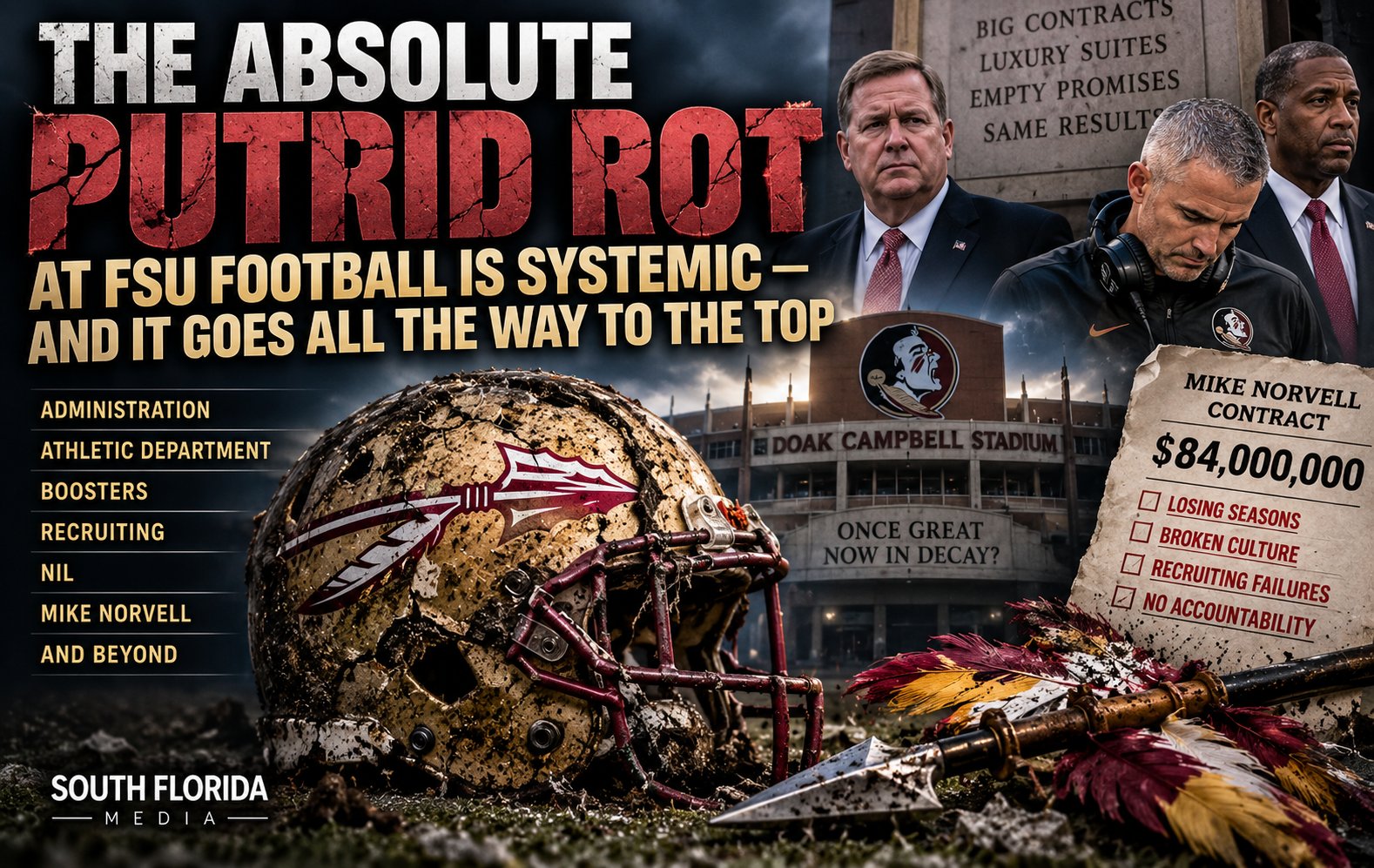
Florida State Football’s Collapse Is Bigger Than Mike Norvell: Inside the Institutional Failures Consuming a Once Elite Program
“From a $285 million stadium renovation and one of college football’s most punishing coaching contracts to recruiting instability and another disastrous night at Doak Campbell Stadium, Florida State increasingly looks like a program whose problems extend far beyond the scoreboard.” – Patrick Zarrelli
Florida State did not lose to SMU because the Seminoles lacked opportunities. They lost despite receiving enough of them to steal a game they had little business winning. FSU’s defense and special teams helped produce four SMU turnovers Monday night, yet the Seminoles still lost 27-24 at Doak Campbell Stadium. Florida State converted only 2 of 15 third downs, threw for just 125 yards and was outgained 585-324. SMU quarterback Kevin Jennings threw for 430 yards and three touchdowns, while Florida State quarterback Ashton Daniels finished 12-of-23 for 125 yards. The Seminoles fell to 1-1 overall and 0-1 in the ACC.
Those numbers are ugly enough by themselves, but the circumstances surrounding them were almost surreal. A transformer failure plunged portions of the newly renovated stadium into darkness and delayed kickoff for nearly two hours. When the game finally started, Florida State and SMU were forced to play without normal coach to player helmet communication, sideline tablets, a functioning primary scoreboard or public address system.
It would be easy to treat the night as another bizarre chapter in college football: a power failure, a ranked opponent, a three-point loss and an offense that could not convert third downs. That explanation is also becoming increasingly difficult to accept. Florida State’s football problem now looks larger than any single game, quarterback, coordinator or fourth down decision.
The Seminoles are dealing simultaneously with an enormously expensive head coaching commitment, repeated on field regression, a radically transformed college football economy, enormous capital investments in facilities and premium seating, persistent questions about roster construction and an administration that has made decisions whose consequences will extend years beyond the current season. The issue is no longer simply whether Mike Norvell can fix Florida State. The more uncomfortable question is whether Florida State’s entire football operation has been making the right decisions about what an elite program actually requires.
The SMU Loss Was a Symptom, Not the Disease
Florida State’s 27-24 loss to No. 19 SMU was competitive on the scoreboard but considerably less competitive statistically. The Mustangs produced 585 yards of offense to Florida State’s 324 and held a staggering 430-125 advantage through the air. FSU ran effectively, producing 199 rushing yards behind Ousmane Kromah’s 116-yard performance, but its passing game could not consistently threaten SMU or keep drives alive.
Third down was where the dysfunction became impossible to disguise. Florida State converted just twice in 15 attempts, while SMU converted eight of 14. The Seminoles went 2 for 4 on fourth down, but those additional gambles were necessary in part because the offense repeatedly failed to remain on schedule. The defense gave Florida State additional possessions and opportunities by forcing turnovers, yet the offense repeatedly failed to convert those advantages into control of the game. That is one of the clearest indicators of a struggling program: even when the opponent provides openings, the team lacks the efficiency to exploit them.
Norvell’s decision making deserves scrutiny within that context. One failed fourth down attempt in the first half gave SMU advantageous field position, and the Mustangs quickly turned it into a touchdown. Aggressive fourth down strategy is not inherently reckless in modern football, and analytically justified decisions can still fail. The larger concern is that Florida State increasingly appears to operate without a reliable offensive foundation capable of reducing the need for desperation decisions in the first place. That is particularly significant because offense is supposed to be Norvell’s area of expertise.
Mike Norvell Can No Longer Blame the Offense on Someone Else
Norvell built his reputation as an offensive coach, and the evaluation of Florida State ultimately has to begin there. When an offensive minded head coach controls the program and the offense repeatedly struggles with passing efficiency, third down execution, protection and situational football, responsibility cannot indefinitely be transferred to assistants or players.
Against SMU, Daniels was sacked three times and completed 12 passes for 125 yards. Florida State’s longest completion went for 39 yards, meaning the remaining 11 completions generated only 86 passing yards. The Seminoles were effective running the football but never developed a balanced offensive attack capable of forcing SMU to defend the entire field.
There is also an important correction to one criticism circulating after the game: Florida State was not ineffective in the red zone against SMU. The official statistics show the Seminoles scored on both of their red zone opportunities. The legitimate criticism is that they did not reach the red zone often enough and were dreadful on third down. That distinction matters because Florida State has enough actual problems without manufacturing additional ones.
The larger offensive concern reaches back several seasons. Florida State’s extraordinary 2022-23 ascent coincided with the development of Jordan Travis into one of the country’s most dangerous quarterbacks. Travis’ mobility, improvisation and command allowed him to extend plays that appeared broken, escape pressure and create explosive offense outside the original structure of a play.
That does not make the 2023 success fraudulent. Florida State went 13-0 before its bowl game because it had an excellent football team, and Norvell deserves credit for building it. What happened afterward, however, raises a legitimate question about how much of the offensive machine depended upon an exceptional quarterback capable of solving problems after the play broke down. Travis’ catastrophic leg injury against North Alabama in November 2023 became a dividing line in the modern history of the program, and Florida State has struggled to recreate anything resembling that offensive stability since.
The Jordan Travis Era May Have Hidden More Than Anyone Realized
Great quarterbacks make coaches look smarter. That is true everywhere in football, from high school to the NFL, and it does not diminish what Travis accomplished at Florida State. The relevant question is what happens when the quarterback capable of improvising his way out of structural problems disappears.
Travis became exceptionally effective at extending plays, manipulating defenses and creating offense when protection or play design deteriorated. His mobility allowed Florida State to survive situations in which a less dynamic quarterback might simply have taken a sack, thrown the ball away or forced a mistake. Once that improvisational ability disappeared from the offense, Florida State’s margin for error collapsed with it.
That should have forced an institutional reassessment of quarterback development, offensive line construction, high school recruiting and the sustainability of the offensive system. Instead, the program entered the transfer market repeatedly searching for experienced quarterbacks and immediate solutions. The portal can solve problems and dramatically accelerate roster improvement, but it cannot permanently replace player development.
Florida State Became One of the Transfer Portal’s Greatest Success Stories, Then Learned the Other Side of the Gamble
Norvell deserves significant credit for recognizing the transfer portal’s potential earlier than many established coaches. Florida State used transfers brilliantly during its reconstruction, adding players who became foundational pieces of the 2022 and 2023 teams. The problem was never using the portal. The problem was whether Florida State became too dependent upon it.
A championship roster cannot simply be a collection of one year transactions. Elite programs generally combine high level high school recruiting, multi-year player development, retention and selective portal additions. Transfers are extraordinarily useful when they fill specific roster weaknesses. They become dangerous when the portal is expected to repeatedly reconstruct the core of the team.
There is also an important distinction between criticizing portal dependency and dismissing transfer players as inherently inferior or mercenary. Many of the best players in modern college football are transfers, and Florida State’s own resurgence demonstrated that reality. The legitimate institutional question is whether a roster dominated by short term acquisition can create the continuity, leadership, depth and developmental pipeline required to sustain an elite program.
Florida State’s experience increasingly suggests that portal success can accelerate a rebuild without necessarily creating a durable foundation. The transfer market can supplement a championship culture, but expecting it to manufacture a new one every offseason creates enormous volatility.
The Battle’s End Cannot Substitute for a Complete Recruiting Operation
The arrival of NIL collectives transformed college football almost overnight, and Florida State’s ecosystem responded aggressively. The Battle’s End became one of the most visible organizations associated with retaining and acquiring Seminole talent during the early NIL era. That financial support was valuable, but money alone cannot solve roster construction.
NIL resources work best when integrated into an elite talent operation built around high school evaluation, recruiting relationships, player development, retention, portal scouting, coaching stability and a clear organizational identity. A collective can help finance retention and acquisition, but it cannot teach a quarterback to process coverage, develop an offensive lineman over three years or create continuity inside a position room.
The sport has also changed substantially again since the earliest collective driven NIL period, particularly as schools adjust to direct athlete revenue sharing and the post House settlement environment. The larger lesson remains the same: Florida State cannot purchase its way around weaknesses in evaluation and development any more than it can renovate its way around weaknesses on the football field. A healthy program needs both resources and a coherent system for using them.
Florida State Built a $285 Million Stadium While the Football Program Deteriorated
Nothing makes the institutional contrast more striking than Doak Campbell Stadium itself. Florida State recently completed an approximately $285 million renovation of one of college football’s most recognizable venues. The project modernized significant portions of the stadium and introduced expanded premium offerings including the West Sideline Club, Founders Suites and Founders Loge Boxes while renovating the Dunlap Champions Club. Sports Business Journal reported that Alford expects the changes to generate approximately $10 million in additional annual revenue from premium ticket sales.
There were legitimate reasons for renovating Doak. Florida State’s own construction documents show that portions of the project addressed structural repairs, life safety issues, ADA accessibility, fire suppression, lighting, concessions, restrooms and other aging infrastructure. Characterizing the entire project as nothing more than luxury suites would therefore be inaccurate. But the strategic choice to dramatically expand premium inventory is equally real. Official financing documents stated that the renovation would reduce Doak Campbell Stadium’s previous 79,560 seat capacity to somewhere between approximately 65,000 and 70,000 while significantly increasing the number and diversity of premium seating options. Plans included thousands of premium seats across loge boxes, sofa seating, ledge seating and club products.
That creates a legitimate philosophical debate about what Florida State wants Doak Campbell Stadium to be. Premium inventory produces revenue, and revenue is increasingly essential in modern college athletics. But college football stadiums are also competitive environments. Their atmosphere comes from scale, density, student participation, alumni engagement and thousands of ordinary supporters who may never purchase a luxury suite. The danger is not premium seating itself; the danger is allowing revenue optimization to become disconnected from the culture that made the product valuable in the first place.
Then the Newly Renovated Stadium Went Dark
Against SMU, the symbolism became almost impossible to ignore. Shortly before the scheduled kickoff, an electrical short involving the stadium’s main transformer caused a major outage. The game was delayed until approximately 9:15 p.m. before officials determined there was sufficient lighting to proceed. Even then, the teams played without several technologies normally considered basic infrastructure in major college football.
Coach to player communication was unavailable, sideline tablet video was unavailable, the public address system was unavailable and the primary scoreboard was not functioning. Officials had to adapt game operations while approximately 60,000 people waited through an extraordinary nationally televised spectacle.
A transformer failure does not prove that the renovation itself was defective, and there is currently no factual basis for claiming that premium seating expenditures caused the electrical failure. Those are separate issues unless an investigation establishes otherwise. Institutionally, however, the optics were brutal. Florida State had just invested hundreds of millions of dollars into transforming Doak Campbell Stadium into a modern premium revenue venue, only for a major conference game to begin nearly two hours late without basic football technology or a working scoreboard.
The building had been monetized for the future while, on one of the program’s biggest nights, it struggled to perform in the present. That contradiction does not establish causation, but it perfectly illustrated the broader frustration surrounding Florida State football: enormous investment is visible everywhere, while dependable execution remains elusive.
Michael Alford’s Infrastructure Bet Now Faces Its Real Test
Athletic Director Michael Alford has overseen one of the largest periods of athletics infrastructure investment in Florida State history. According to the university, more than $500 million in facility projects and improvements have moved forward under his leadership, including the Doak renovation and the Dunlap Football Center. FSU’s stated rationale is straightforward: modern facilities can improve recruiting and retention while creating additional revenue through premium seating, hospitality and sponsorship opportunities.
That strategy is not irrational. Major college football has become an infrastructure arms race, and Florida State competes against programs with enormous donor bases, massive conference distributions and increasingly sophisticated football facilities. The problem is that infrastructure is supposed to support winning, not become a substitute for it. An athletic department can build elite facilities and still make poor football decisions. It can create premium revenue and still mismanage coaching contracts. It can improve hospitality while losing recruiting battles. It can sell a sophisticated vision of the future while producing an offense that converts two of 15 third downs at home.
Alford therefore cannot be evaluated solely by the buildings Florida State has constructed. Eventually, the football operation has to demonstrate that the institution’s enormous investment is producing a competitive return.
The Norvell Contract Is Where Administrative Accountability Becomes Impossible to Ignore
The most consequential administrative decision may not involve concrete or luxury seating at all. It involves Mike Norvell’s contract. Following Florida State’s 13-0 regular season in 2023 and amid reported interest from Alabama after Nick Saban’s retirement, FSU gave Norvell an eight year extension through 2031 worth more than $84 million before incentives. The contract provides Norvell with 85% of his remaining compensation if Florida State terminates him without cause.
That decision made sense in the emotional and competitive context of January 2024. Florida State had just completed an undefeated regular season, won the ACC championship and believed it had a coach capable of restoring the program to national prominence. Alabama had an opening, coaching salaries were exploding, and FSU faced the possibility of losing the man who had just engineered its revival.
The problem with enormous guaranteed contracts is that universities are not purchasing yesterday’s results; they are assuming tomorrow’s risk. At Florida State, that risk materialized almost immediately.
Florida State collapsed to 2-10 in 2024, one of the most dramatic year to year declines ever experienced by a major college football program. Norvell subsequently restructured his contract, including a $4.5 million contribution connected to a university initiative supporting the changing athlete compensation environment. But the central buyout protection remained extraordinarily expensive.
Current reporting places the cost of firing Norvell around the end of the 2026 season at approximately $51 million, with the obligation declining as the remaining contract shrinks. If terminated without cause, Norvell could receive roughly $800,000 per month through the remainder of the agreement. At that scale, the contract is no longer merely a coaching issue. It is an institutional risk management problem.
Florida State Created Its Own Golden Handcuffs
Every major athletic department occasionally makes a coaching hire or extension that fails to produce the expected results. The more important question is whether the institution preserves enough flexibility to correct the mistake. Florida State did the opposite.
The 85% buyout provision effectively transferred an enormous amount of future risk from Norvell to the university. If he continued winning, Florida State would pay an elite salary for elite results. If the program collapsed, Florida State would still owe an enormous portion of the contract. The university therefore placed itself in a position where deciding that a coach should be replaced and being financially willing to replace him became two entirely different questions.
That is administrative paralysis created by contract design. It does not necessarily mean Florida State literally lacks the money to fire Norvell. Major athletic departments can access donor support, financing arrangements and other resources that make simplistic claims about being “unable to afford” a buyout difficult to prove. There is, however, an enormous difference between technically finding $50 million and determining that spending $50 million to make a coach disappear represents responsible financial management.
Every dollar used to unwind a bad contract is a dollar unavailable for something else, whether that means player acquisition, staff, facilities, debt obligations or the eventual contract required to hire the next coach. That opportunity cost is what makes the Norvell extension far more consequential than a large number printed on a contract.
The Real Cost of Norvell Is Bigger Than Salary Per Victory
It is tempting to calculate Norvell’s compensation on a price per win basis, particularly after Florida State paid him elite level compensation during a 2-10 season. Those calculations require caution because coaching compensation changes by year, restructuring can alter cash flows and a raw salary to win ratio treats every season and every dollar identically.
The broader financial argument does not require exaggerated arithmetic. Florida State gave Norvell an extension worth more than $84 million after the 2023 breakthrough and attached an unusually strong 85% termination guarantee. The university then watched the program collapse to two victories in 2024. By 2026, Norvell was again operating under enormous pressure to demonstrate that the 2022-23 ascent represented something sustainable rather than a temporary peak.
That is enough to establish the central point. Florida State committed elite-program money and long term contractual security based on an extraordinary two-year ascent, only to discover almost immediately how expensive it is to reverse a decision made near the peak of optimism. The financial damage is therefore not simply what Norvell has already been paid. It is the opportunity cost created by the remaining guarantee, the reduced flexibility available to the athletic department and the extraordinary price the university would have to absorb if its leadership eventually concludes that another coaching change is necessary.
Richard McCullough, Michael Alford and the Boosters Cannot Treat This as a Coaching Problem Alone
President Richard McCullough and Alford now face a challenge larger than deciding whether Norvell should remain Florida State’s head coach. They have to determine whether the institution that surrounds the coach is operating correctly.
That means evaluating recruiting strategy, NIL and revenue-sharing resources, player development, football operations, staffing, analytics, strength and conditioning, quarterback development, booster coordination, donor strategy, stadium economics and the athletic department’s tolerance for long-term contractual risk. The boosters belong in that examination as well. Florida State does not lack passionate alumni or wealthy supporters; the question is whether those resources are being coordinated as efficiently as they are at programs FSU expects to compete against.
Facilities matter, NIL matters, revenue sharing matters, coaching salaries matter, recruiting budgets matter and player development matters, but none of those can be treated as an independent kingdom. An elite football program is an integrated organization in which money, recruiting, development, coaching and institutional leadership reinforce one another.
Florida State increasingly looks like a collection of expensive pieces searching for integration.
Bobby Bowden’s Standard Was Not Built With Luxury Suites
Comparisons to Bobby Bowden can easily become sentimental and unfair. College football in 2026 bears little resemblance to the sport Bowden dominated during Florida State’s historic run, and no modern coach should be expected to reproduce one of the most extraordinary stretches in college football history. The underlying organizational principles, however, remain relevant.
Bowden’s Florida State teams became nationally dominant because the program recruited elite high-school talent, developed players over multiple seasons, built continuity, established an unmistakable identity and created an internal expectation that competing for championships was normal. From 1987 through 2000, Florida State finished in the Associated Press top five for 14 consecutive seasons, an achievement so extraordinary that it remains one of the defining records of modern college football.
That standard was historically abnormal and may never be replicated anywhere in the modern sport. The lesson is not that Norvell must become Bobby Bowden; the lesson is that sustainable greatness requires a sustainable institution. Coaching, recruiting, player development, administration and booster support have to operate toward the same competitive objective over years rather than individual offseasons.
Florida State currently does not look sustainable.
Even the Pregame Tradition Became an Uncomfortable Metaphor
Before the SMU game, an awkward moment involving the iconic Chief Osceola and Renegade pregame tradition quickly circulated among frustrated fans. In isolation, a horse or rider having difficulty during a live stadium performance means virtually nothing about the football program. After everything that followed, however, frustrated Seminoles could be forgiven for seeing symbolism everywhere.
A stadium experienced a major electrical failure, the scoreboard went dark, modern sideline technology disappeared, the opponent turned the ball over repeatedly and still won, and Florida State converted two third downs all night. A program with hundreds of millions invested in facilities and tens of millions committed to its head coach once again walked out of Doak Campbell Stadium with more questions than answers.
No single image explains institutional decline, and a pregame mishap certainly did not cause anything that happened afterward. Sometimes, however, an image captures how institutional decline feels. On a night when seemingly everything surrounding Florida State football malfunctioned at once, even one of the most iconic traditions in college football appeared caught in the dysfunction.
Florida State’s Problem Is No Longer a Rebuild, It Is an Organizational Reckoning
Florida State can replace coordinators, sign another transfer quarterback, pursue another portal class, restructure contracts, raise booster money, sell premium seating and promise that another recruiting cycle will finally fix the roster. Eventually, however, the university has to confront the possibility that repeatedly changing individual components will not repair a system whose incentives and decision-making need examination.
That is why the current crisis reaches beyond Mike Norvell. Norvell is responsible for the football team he coaches, the offensive product associated with his expertise, the staff he hires and the roster-development system operating under his leadership. Alford is responsible for the athletic department’s strategy and major financial commitments. McCullough ultimately presides over the university structure within which those decisions occur. Boosters and donors provide substantial resources and inevitably influence what the athletic department is capable of doing.
Accountability therefore cannot stop at the headset. Florida State has invested enormous amounts of money into football while simultaneously reducing its financial flexibility through one of the sport’s most expensive coaching guarantees. It has modernized Doak Campbell Stadium and expanded premium seating while its competitive product has struggled. It became an early master of the transfer portal without proving that portal-heavy roster construction could produce sustainable success. It has poured resources into infrastructure while the most basic measurement of institutional health, consistently winning football games, remains unstable.
The 27-24 loss to SMU did not create those problems. It exposed how many of them are now operating simultaneously, turning what might once have been dismissed as a bad night into something that increasingly resembles an institutional pattern. Florida State’s leadership now faces a decision far more important than whether to change a play caller, bench a quarterback or fire another assistant. The university has to decide what kind of football institution it intends to be in the post NIL, revenue sharing era and whether the people currently controlling that institution have built a structure capable of reaching that destination.
Because the most dangerous thing that can happen to a proud program is not one terrible season, one terrible game or even one terrible contract. Programs recover from all three. The greater danger is when dysfunction becomes institutionalized, when expectations gradually decline and when failures that once would have produced immediate alarm become accepted as part of doing business. Florida State spent decades establishing one of the highest standards in college football. The Seminoles now face a much less glamorous challenge: proving that the institution responsible for protecting that standard still understands how to build a football program capable of meeting it.

Sources & Further Reading
Florida State vs. SMU
Florida State Athletics — Official Football Statistics and Game Coverage
Reuters — Florida State-SMU Delayed by Doak Campbell Stadium Power Outage
Doak Campbell Stadium and Florida State Athletics
Florida State University — Doak Campbell Stadium and Football Facilities Construction Updates
Florida State Athletics — Michael Alford, Vice President and Director of Athletics
Florida State University Athletics Association — Doak Campbell Stadium Financing Documents
Mike Norvell’s Contract and Florida State’s Financial Exposure
On3 — Mike Norvell Buyout and Florida State Contract Details

































































Want to join the conversation?
Create an account or sign in to share your thoughts, vote,
and reply to other readers.
Showing 0 of 0 comments
Don't have an account?
Already have an account?