
StubHub’s Customer Service Collapse: Behind the Lawsuits, Lies, and the End of Buyer Trust
In an industry built on trust and experiences, StubHub is fast becoming the poster child for corporate dysfunction. Once praised as a trailblazer in online ticket resale, the company now finds itself mired in consumer outrage, legal trouble, and a freefalling reputation. StubHub still markets its so-called “FanProtect Guarantee” but consumer watchdogs, legal filings, and review platforms paint a different picture. The guarantee is flimsy, the customer service is hostile, and the user experience is deteriorating. From hidden fees and stonewalling agents to ticket failures and unanswered complaints, StubHub’s current model isn’t broken — it’s built to fail.
StubHub is a Digital Marketplace in Meltdown
StubHub was once a scrappy innovator in tech-driven ticketing. Today, it’s a cautionary tale. User experience issues that wouldn’t survive beta testing at a college startup are now systemic on a billion-dollar platform:
Tickets arrive late or not at all
“Guaranteed” refunds take weeks or never happen
Seat replacements are often worse than what was paid for
Support lines are riddled with language barriers and dead ends
This isn’t anecdotal, it’s verified, systemic, and damning. StubHub currently holds an “F” rating from the Better Business Bureau (BBB), the worst possible score, and has been officially flagged for a “pattern of complaints.” In BBB terms, that’s not just a red flag, it’s a four-alarm fire. It means the company has shown a consistent, documented failure to respond to customer concerns in good faith. But let’s be real: “pattern of complaints” is bureaucratic code for what thousands of consumers describe more bluntly as outright fraud.
We’re talking about tickets never delivered, refund promises repeatedly broken, and call centers that dodge accountability by design. StubHub has opted out of BBB accreditation entirely, meaning it refuses even the most basic third-party oversight. In an age where customer reviews are public record and government agencies are tracking digital misconduct, this isn’t just negligence it’s a willful decision to operate outside the lines of trust, transparency, and consumer rights.
“StubHub doesn’t even pretend to care anymore,” said one user in a BBB complaint.
“You call, and if you’re lucky enough to get a human, they transfer you or hang up.”
StubHub is now notably not accredited by the Better Business Bureau a red flag that speaks volumes. Accreditation isn’t just a vanity badge; it’s a commitment to transparency, responsiveness, and ethical business practices. Most legitimate companies pursue and maintain BBB accreditation as a baseline standard a public signal that they’re willing to be held accountable by an independent body. StubHub has chosen to opt out. That’s not a clerical oversight it’s a deliberate move that removes them from basic consumer arbitration protocols and allows them to sidestep third-party scrutiny.
In plain terms: StubHub has no interest in playing by fair consumer rules. When problems arise, and clearly, they do often, customers have no accredited recourse through the BBB. The company has effectively insulated itself from traditional avenues of complaint resolution, leaving buyers to shout into the void or give up entirely. It’s a clear-cut case of a corporation that knows it’s underwater and would rather unplug the lifeboats than face the music.

StubHub Has Horrible Reviews Across the Web
On Trustpilot, over a third of all reviewers give StubHub the absolute lowest possible rating and it’s not for minor bugs or digital hiccups. These aren’t complaints about clunky interfaces or a delayed confirmation email. These are stories of weddings disrupted, bucket-list concerts missed, and family trips derailed all because StubHub failed to deliver on the one thing it promises: a valid ticket at the promised time.
The stakes are real and emotional. Customers report losing thousands of dollars on travel, lodging, and event costs because their tickets never arrived, were invalid, or were suddenly canceled by the seller with no meaningful backup plan. And when those customers reached out for help? No one answered. Or worse, they were met with outsourced support centers staffed with undertrained agents who read from scripts, offered no escalation path, and often closed cases without resolution. It’s not just poor customer service it’s a complete breakdown of responsibility, leaving consumers alone, powerless, and financially gutted in moments that were supposed to be unforgettable.
“They offered me ‘similar’ seats and gave me worse ones with an obstructed view then refused to refund the difference.” — Verified reviewer, Reviews.io
On Reddit, a dedicated user base has documented case after case of catastrophic platform failures:
Tickets that don’t scan at the gate
Events missed due to last-minute cancellations
Refund requests ignored for months
No human escalation path when it all goes wrong
One Redditor described StubHub as a “ghost company, real enough to take your money, fake when you need support.” It’s a brutal indictment, but one echoed by thousands of frustrated users across forums and social platforms. The post didn’t stand alone it captured the collective disillusionment of a customer base that’s been burned too many times. When things go wrong, and they often do, StubHub’s digital storefront stays open, but its support systems all but vanish.
“I called three times. My case was never escalated, even though I stressed time was critical.” — Verified user, r/stubhub
The story is always the same: the clock’s ticking, the event is approaching, and instead of getting help, customers are sent in circles routed through endless phone trees, dumped into chatbot loops, or handed off to offshore agents with no authority to act. In a time-sensitive industry where hours matter, StubHub moves like it’s allergic to urgency. That’s not a glitch it’s a business decision. And one that leaves fans abandoned in moments that should have been memorable for all the right reasons.
Legal Trouble: A $100 Million Wake-Up Call
In July 2024, StubHub was hit with a $100 million lawsuit by the District of Columbia Attorney General a legal gut punch that exposed the platform’s deceptive “drip pricing” practices. The lawsuit alleges that StubHub lures consumers in with deceptively low ticket prices, only to tack on an avalanche of hidden fees at checkout often inflating the final cost by 30% to 40%. These include vague service charges, inflated delivery fees, and platform surcharges that only appear after the customer has committed time, attention, and emotional investment into the purchase.
“StubHub misleads consumers about the true cost of tickets. These deceptive practices are illegal.” — Office of the Attorney General, Washington D.C.
The lawsuit goes further, calling out the platform’s use of “dark patterns” manipulative design tactics such as countdown timers, multi-page checkouts, and fine print buried deep in the user flow. These features aren’t innocent UI choices; they’re engineered psychological pressure points designed to rush decisions, bury information, and prevent full price transparency. Regulators argue that this isn’t sloppy design it’s intentional exploitation. This isn’t a warning shot, it’s one of the most aggressive regulatory actions ever brought against a digital ticketing company. And it signals a growing shift: lawmakers are no longer letting tech platforms hide behind clever UX and vague terms of service. StubHub isn’t just being accused of unethical behavior it’s being called out for what regulators believe is an orchestrated, monetized deception of the public at scale.
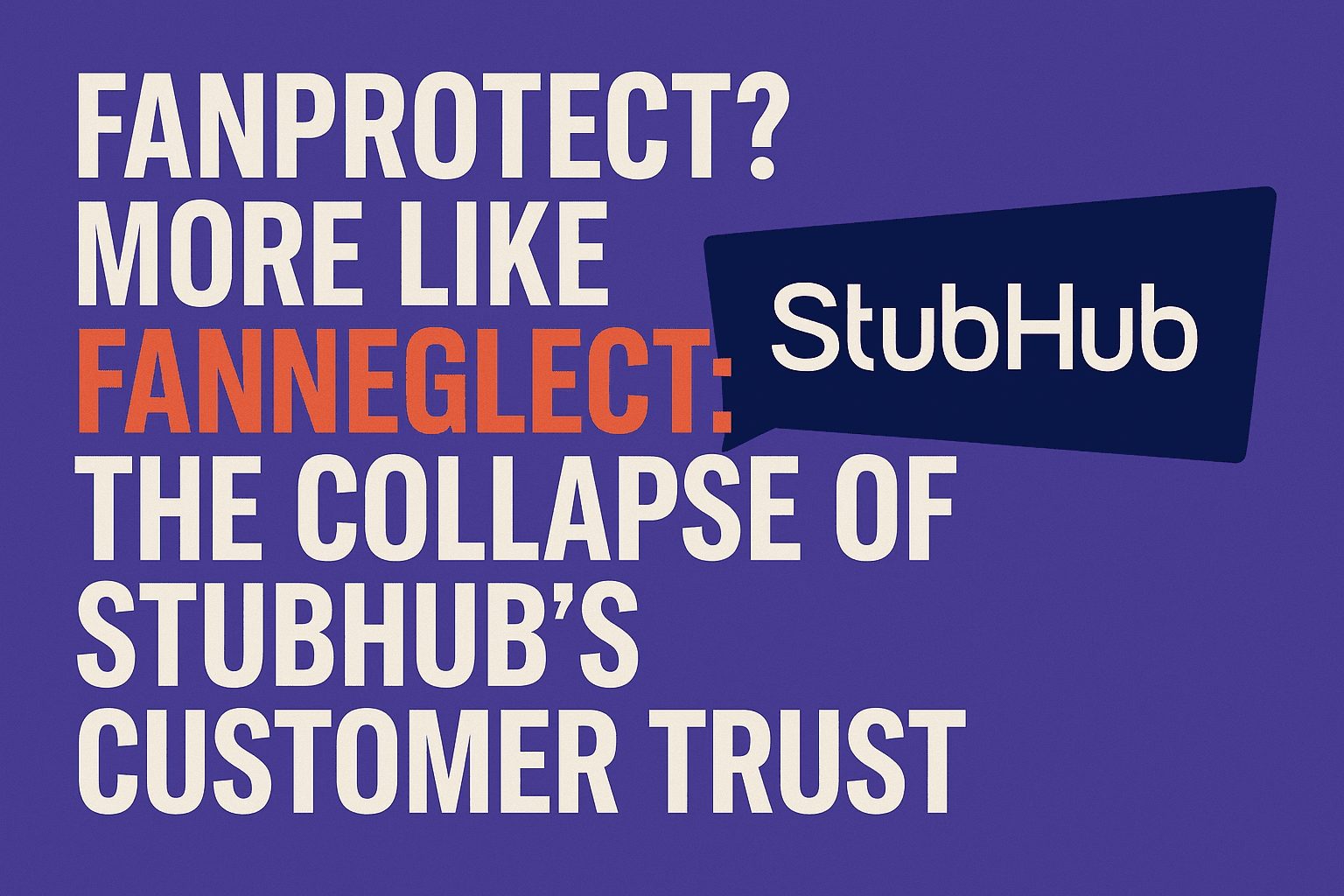
StubHub FanProtect: More Like FanNeglect
StubHub’s widely advertised “FanProtect Guarantee” is supposed to be the company’s consumer safety net a promise to shield buyers from scams, fraudulent listings, and last-minute failures. But in practice, that guarantee often functions more like a PR shield than an actual remedy. Beneath the marketing language is a system designed to minimize liability, not maximize protection.
Instead of full refunds, many customers report being offered store credit even when the fault lies entirely with the platform or seller. Others are issued replacement tickets that are significantly worse than what they paid for nosebleed sections swapped in for floor seats, or obstructed views passed off as “comparable.” In time-sensitive situations, when a concert or game is just hours away, StubHub’s response system completely collapses. There’s often no path to escalate urgent issues, no supervisors to speak with, and no one empowered to make real decisions.
“It’s not customer service it’s customer gaslighting,” said one former StubHub ticket seller who asked to remain anonymous due to ongoing NDA restrictions.
“They don’t solve the problem. They just reroute it until you give up.”
The internal support infrastructure seems deliberately fragmented. Agents are frequently outsourced, undertrained, and tethered to rigid scripts, unable to deviate even when the fix is obvious. This isn’t just a flawed model it’s a calculated system that relies on user fatigue. The longer a customer is kept in limbo, the more likely they are to walk away and swallow the loss. For many, the “FanProtect Guarantee” has become synonymous with false assurances, dead-end communication, and a slow bleed of trust.
In the end, StubHub’s safety net is less a guarantee and more of a gamble and the house always wins.
Poor Customer Service at StubHub: What the Data Shows
StubHub’s decline isn’t just a story told by angry customers it’s backed by a wall of data and documentation from independent review platforms and regulatory watchdogs. The numbers don’t lie, and the pattern is undeniable.
Better Business Bureau (BBB): StubHub holds an “F” rating, the lowest possible, and is not accredited due to a longstanding “pattern of complaints” that the company has failed to resolve. This means StubHub hasn’t just let consumers down — it’s actively refused to participate in even basic accountability mechanisms.
Trustpilot: Over one-third of all reviews are 1-star, with users citing everything from undelivered tickets and false promises to ghosted refund requests and unresolved fraud.
Reviews.io: StubHub clocks in at a weak 3.13 out of 5, with hundreds of users flagging the company’s replacement policy as deceptive. Many claim they received inferior tickets when orders went wrong and were then denied any form of monetary compensation.
“We were told we’d get ‘comparable’ tickets,” wrote one verified reviewer on Reviews.io.
“The replacements were far inferior and priced differently. A refund? Not possible.”
These aren’t isolated rants they represent a multi-platform avalanche of consistent, data-backed criticism. When independent consumer advocacy platforms, public forums, and government offices all report the same issues across years and regions, it’s no longer a customer service glitch. It’s a corporate model built on deflection, denial, and degradation of trust. StubHub doesn’t just have a PR problem it has a credibility crisis that spans every corner of its operation.

Real-World Impact: Fans Left Out in the Cold
Mainstream media is finally doing what StubHub won’t: holding the platform accountable. As complaints surged across the web, major news outlets have begun investigating and exposing how StubHub’s operational failures are not one-offs, but systemic. These are not isolated incidents they are evidence of a customer experience infrastructure that is collapsing under its own negligence.
In San Francisco, ABC 7’s investigative team stepped in when a Bay Area family nearly missed the Taylor Swift Eras Tour after their StubHub-purchased tickets were never released by the seller. Despite contacting customer service multiple times, the family got nowhere — until the media intervened. Only after the station’s consumer advocacy unit contacted StubHub did the company resolve the issue.
In another case reported by CBS and The Sun, a die-hard Denver Broncos fan was denied entry to the stadium because his ticket, purchased through StubHub, failed to generate a scannable barcode. Not only did he miss the game, but the refund wasn’t processed until three months later, long after the damage was done.
These aren’t fringe mistakes or fluke technical glitches. They’re the product of a broken fulfillment system, an inaccessible customer service model, and a business structure that places revenue above reliability. When trusted institutions like local news outlets have to step in and act as consumer ombudsmen just to get basic support from StubHub, something is deeply wrong.
These incidents underscore a hard truth: StubHub is not just disappointing customers it’s actively sabotaging the very experiences it claims to deliver. Fans don’t just lose money they lose moments they can never get back. And in the world of live events, that kind of failure is unforgivable.
What This Really Means? StubHub Isn’t Just Slipping, It’s Imploding
StubHub isn’t experiencing a rough patch it’s unraveling. And the cautionary tale here isn’t just about one platform. It’s about the broader danger of what happens when AI-driven, venture capital-fueled tech companies scale unchecked, with no real accountability to the public they serve. In today’s digital economy, platforms like StubHub promise speed, efficiency, and convenience. But in reality, they’ve quietly stripped out the most critical component of consumer trust: human accountability. In place of responsive service, you get chatbots. In place of escalation paths, you get outsourced agents reading from a script. In place of resolution, you get generic replies, canned apologies, and terms of service walls. What once felt like innovation now looks more like industrialized neglect.
StubHub is following the most toxic version of the Silicon Valley playbook:
Automate the profit. Outsource the pain. Obfuscate the failure.
And for years, it worked until it didn’t. Because now, the reputational debt is coming due. Regulators are circling. Class-action murmurs are growing louder. And the public is finally waking up to the fact that a so-called “FanProtect Guarantee” is only as good as the company willing to stand behind it. StubHub isn’t just losing market share it’s losing the right to call itself trustworthy. If it doesn’t rebuild from the ground up transparently, ethically, and with actual customer protections it won’t just be the fans who stop showing up. It’ll be the federal government. The attorneys general. And the media. And by then, it won’t be a comeback story it’ll be an obituary.
StubHub’s Time Is Running Out and a Reckoning Is Overdue
StubHub sold more than 200 million tickets in 2023 a staggering volume that makes it one of the most powerful forces in live event commerce. But scale without accountability is a recipe for disaster. If even 1% of those sales involved ticket errors, delivery failures, fraudulent listings, or refund disputes, that’s two million customers betrayed by a platform that sells itself on safety.
Two million missed memories. Two million people who paid for trust and got baited into chaos. And that’s being conservative.
StubHub doesn’t need a rebrand it needs a reckoning. This isn’t about public relations. It’s about corporate ethics, regulatory enforcement, and whether a tech giant can continue operating while systematically failing the public it profits from. The time for glossy commercials and vague guarantees is over. Unless StubHub’s leadership takes decisive action scrapping the broken infrastructure, retraining its workforce, enforcing seller accountability, and restoring real, money-back protections it won’t just fade from relevance.
It will become a toxic brand. A digital cautionary tale. A platform so synonymous with failure that even its own guarantees will become punchlines. In a marketplace built on moments, StubHub is wasting people’s time, money, and memories. And if it doesn’t clean house fast, the market, and the law, will do it for them.

How to Contact StubHub if You Have an Issue

StubHub Customer Support Number (U.S.):
📞 866‑788‑2482 (Available daily, 5 a.m. – 9 p.m. PT / 8 a.m. – 12 a.m. ET)
Support Email Contacts:
Customer Support: [email protected]
API/Technical: [email protected]
Press & Media: [email protected]
StubHub Executive Contacts:
Brian Gonas: [email protected]
Jeff Zwelling: [email protected]
Eric Baker (CEO): [email protected]
















































Want to join the conversation?
Create an account or sign in to share your thoughts, vote,
and reply to other readers.
Showing 3 of 3 comments
Don't have an account?
Already have an account?