
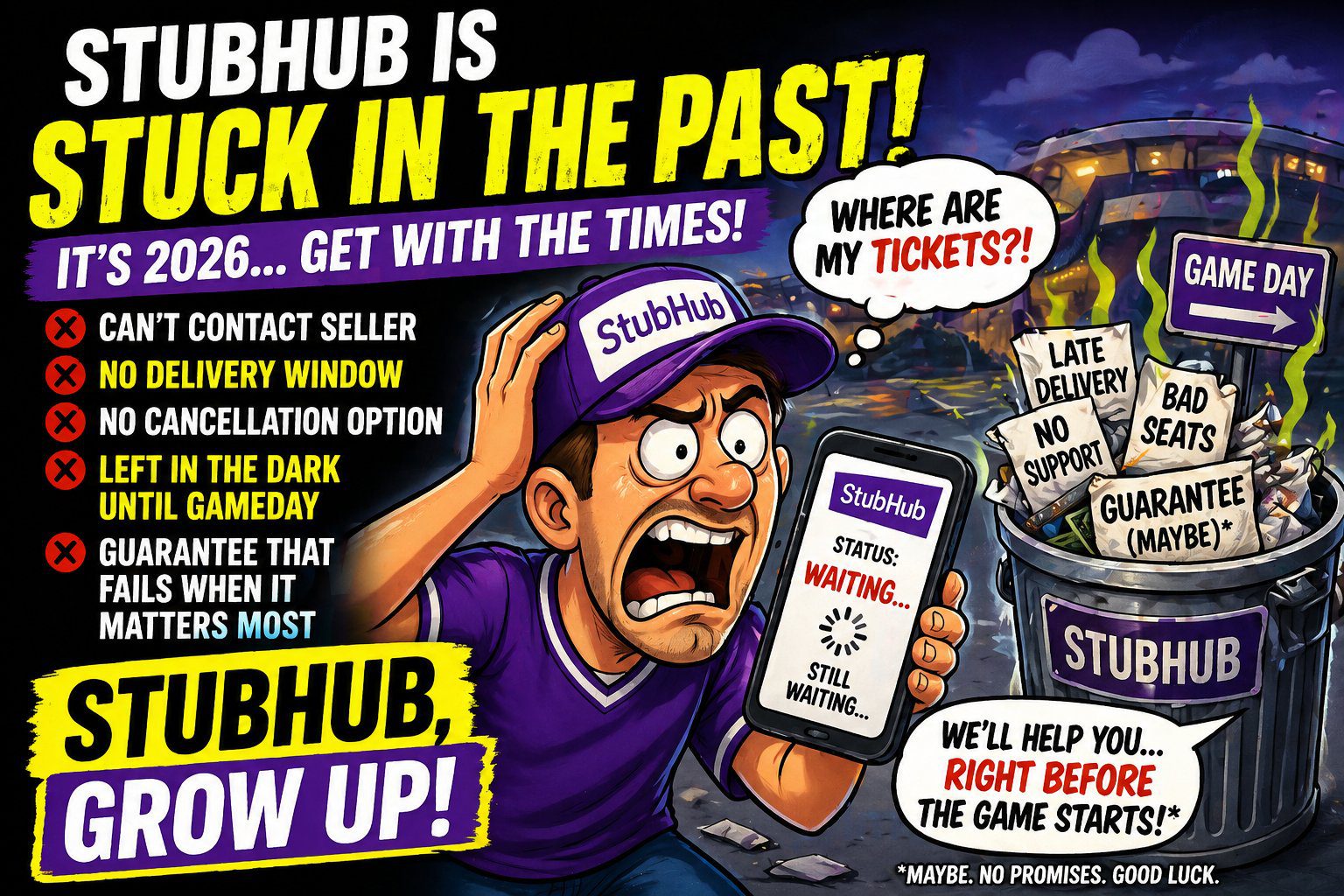
StubHub Is Stuck in the Past and It’s Ruining Game Day in 2026
There’s a fundamental problem with StubHub that no amount of marketing spin can hide anymore. The platform hasn’t evolved with the expectations of modern buyers. In an era where you can track a pizza in real time, message a driver instantly, and verify transactions down to the second, StubHub is still operating like it’s 2012, leaving customers in the dark, stuck waiting, and too often scrambling at the worst possible moment. Game time. This isn’t a minor inconvenience. It’s a systemic failure.
The Core Issue: Buyers Are Locked Out of Their Own Purchase
The biggest flaw in StubHub’s system is simple and hard to justify in 2026. Once you buy a ticket, you’re essentially cut off from the seller.
No direct communication.
No ability to request updates.
No way to confirm delivery timing beyond vague estimates.
That means if you buy tickets a week in advance and they aren’t delivered within a reasonable time frame, say 48 to 72 hours, you have zero control. You can’t cancel. You can’t switch inventory. You can’t even message the seller or send them a form email to ask what’s going on.
You just wait. And waiting is exactly what kills the experience.
No Early Exit, No Flexibility, Just Risk That’s StubHub
Every other modern marketplace has solved this problem. If something isn’t delivered on time, you can cancel, refund, or choose another option. That’s standard across e-commerce, travel platforms, and even ride sharing apps. StubHub doesn’t offer that flexibility.
Instead, it forces buyers into a high risk position: you commit your money early, but you don’t control the outcome until the last possible moment. If the seller delays, or never delivers, you’re stuck scrambling three hours before the game. That’s not a marketplace. That’s a gamble with horrible consequences.
The “Guarantee” That Fails When It Matters Most
StubHub leans heavily on its FanProtect Guarantee. On paper, it sounds solid: if your tickets don’t arrive, you’ll get replacements or a refund. In practice, it often collapses under real world conditions. The trigger point for action is typically very close to the event, sometimes just hours before it starts. That means customers can be standing outside a stadium, trying to reach support, while the clock is ticking down. And when replacements are offered? They’re rarely equivalent. Seats are often worse. Inventory is limited. And the process itself, calls, chats, escalations, can stretch right into game time, forcing buyers to miss part of the event they paid for.
“By the time StubHub steps in, your experience is already ruined.” – Patrick Zarrelli
That’s the reality users are dealing with, not the promise on the website.
A System That Incentivizes Delay
There’s another uncomfortable truth here: the current system doesn’t strongly penalize late delivery. Sellers can wait. They can delay transfer. They can push right up against the deadline and the burden falls entirely on the buyer. That creates a marketplace where timing is uncertain by design. And when you’re dealing with live events, concerts, sports, once-in-a-lifetime experiences, that uncertainty is unacceptable.
Real-World Impact: Stress, Embarrassment, and Lost Experiences
This isn’t just about inconvenience. It’s about what happens in real life. People buy tickets for birthdays, business events, client entertainment, or major games. These aren’t casual purchases, they’re planned experiences.
When tickets don’t arrive:
- You’re stuck refreshing your phone instead of enjoying the moment
- You’re dealing with customer service instead of walking into the venue
- You’re explaining to friends, clients, or family why you’re still outside
And in many cases, you end up doing the unthinkable: buying another set of tickets just to salvage the day. That’s not a safety net. That’s a failure point.
What StubHub Needs to Fix Now
The fixes here aren’t complicated. They’re overdue. First, buyers need direct communication with sellers even if it’s moderated or anonymized. Transparency eliminates uncertainty.
Second, there needs to be a clear delivery window. If tickets aren’t transferred within a set time frame (for example, 72 hours after purchase or a defined number of days before the event), buyers should have the right to cancel or switch to comparable inventory. Sellers should have escalating fees as delivery time goes by and they don’t deliver, those fees should come off selling price for buyer.
Third, the guarantee needs to move earlier in the process. Waiting until game day to solve a problem is not a solution, it’s damage control at best.
And finally, replacement tickets must be truly comparable, not whatever is left.
StubHub isn’t broken because of one bad experience. It’s broken because its system hasn’t kept up with reality. Customers in 2026 expect speed, transparency, and control. Right now, StubHub delivers none of those when it matters most.
The result is predictable:
Frustration.
Lost trust.
And a growing number of buyers who simply won’t take the risk anymore.
If the company doesn’t evolve, the market will move on without it. Because in live events, timing is everything and StubHub is still running late.




















































Want to join the conversation?
Create an account or sign in to share your thoughts, vote,
and reply to other readers.
Showing 0 of 0 comments
Don't have an account?
Already have an account?