
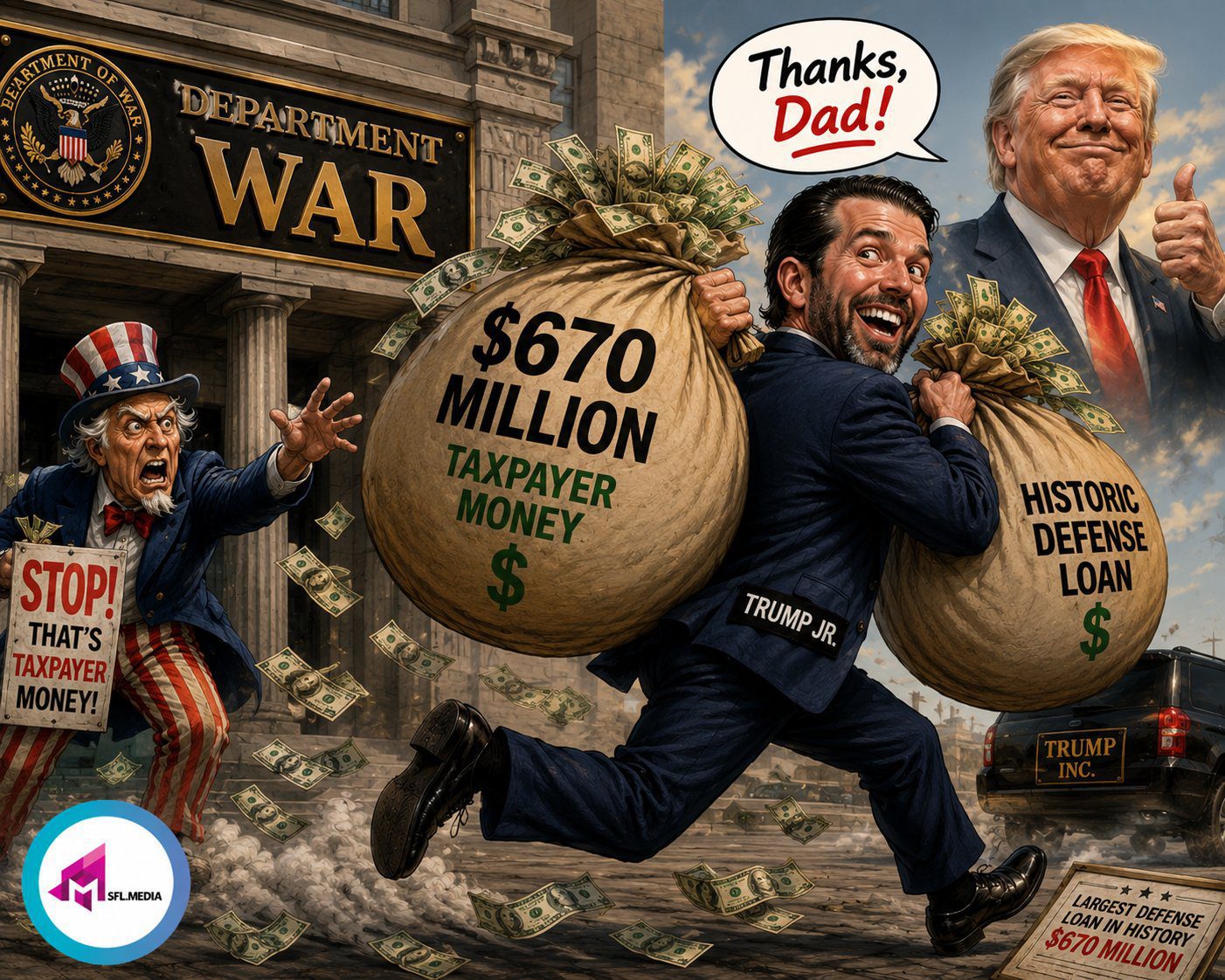
Trump Administration Fast Tracked $670 Million Pentagon Deal to Startup Backed by Donald Trump Jr.
The Trump administration’s decision to steer $670 million in federal support toward a defense startup tied to Donald Trump Jr. is rapidly becoming one of the most controversial national security financing deals in modern American history. At the center of the storm is Vulcan Elements, a relatively young rare earth magnet startup that suddenly became the recipient of one of the largest strategic industrial financing packages ever issued by the federal government. The controversy is not simply about the money. It is about timing, political proximity, and the dismantling of normal safeguards before the President’s son’s investment firm benefited from the deal.
According to public records and congressional inquiries, the Department of Defense’s Office of Strategic Capital approved a conditional $620 million loan commitment to Vulcan Elements in November 2025. At the same time, the Department of Commerce acquired a $50 million equity stake in the company, bringing total federal support to roughly $670 million. Only three months earlier, Donald Trump Jr.’s venture capital firm, 1789 Capital, had invested in Vulcan during a $65 million funding round. Soon after the government backing was announced, Vulcan’s valuation reportedly exploded from approximately $200 million to nearly $2 billion. Critics argue that taxpayers effectively transformed a politically connected startup into a defense-industry giant almost overnight.
The Executive Order That Changed the Rules
The most explosive aspect of the deal may not be the loan itself, but the mechanism used to approve it. The funding was accelerated under Executive Order 14241, signed by President Trump. According to critics and congressional investigators, the order fundamentally altered the normal federal procurement and review process for strategic mineral projects.
The order reportedly:
- waived traditional competitive bidding requirements,
- removed certain independent technical review processes,
- accelerated approval authority inside political appointees,
- and allowed projects to bypass standard acquisition “speed bumps” designed to protect taxpayers.
In practical terms, critics argue the administration removed many of the guardrails normally intended to prevent favoritism, political influence, and reckless investment decisions. That matters because Vulcan was not an established defense manufacturing giant with decades of production history. At the time of the award, the company was still a startup operating inside one of the riskiest sectors in American industry.
A Massive Bet in One of America’s Highest-Failure Industries
Defense startups fail constantly.
The Pentagon’s acquisition system is infamous for what insiders call the “Valley of Death” the brutal gap between early stage prototypes and full operational military procurement. According to research from Harvard’s DASH program and the Texas National Security Review, most defense startups never successfully transition into long-term production programs. Small firms routinely collapse under compliance costs, delayed contracts, capital shortages, and years long procurement timelines.
Federal data and industry analysis show:
- small businesses inside the defense industrial base have declined dramatically over the past decade,
- most federally funded defense prototypes never become operational programs,
- and roughly 71% of startups fail to generate meaningful revenue through federal procurement systems.
Despite those risks, the federal government committed financing to Vulcan that reportedly exceeded twice the company’s valuation at the time. That raises an unavoidable question: Why was this specific startup trusted with one of the largest strategic industrial loans in recent Pentagon history?
What Exactly Was Vulcan Elements?
That question has become central to the growing investigation. Supporters of the deal argue Vulcan represented a critical opportunity to break China’s dominance over rare earth supply chains, a legitimate national security concern that has alarmed multiple administrations for years.
Rare Earth magnets are essential components in:
- missiles,
- drones,
- fighter jets,
- radar systems,
- electric motors,
- and advanced military electronics.
The United States currently remains heavily dependent on Chinese refining and processing capacity for many of these materials. The administration argues the loan was an emergency industrial policy decision intended to rapidly rebuild domestic production capacity before a future geopolitical conflict leaves the U.S. vulnerable. But critics say that explanation still does not answer why Vulcan was selected over more established industrial players.
Publicly available information indicates Vulcan was still developing large-scale operational capabilities at the time of the deal. Questions remain regarding:
- how much infrastructure the company actually controlled,
- whether it possessed mature refining or manufacturing capacity,
- how advanced its proprietary technology truly was,
- and whether competing firms with longer track records were passed over.
At the center of the debate is whether Vulcan was chosen because it was the best qualified company or because it had the right political connections at the right moment.
Donald Trump Jr.’s Experience Under Scrutiny
Donald Trump Jr.’s involvement intensified scrutiny immediately. Trump Jr. has no formal background in military service, defense engineering, weapons manufacturing, or strategic procurement. His professional career has historically centered around real estate, branding, finance, media, and political advocacy through the Trump Organization. His entry into defense tech investing is relatively recent. Through 1789 Capital and related ventures, Trump Jr. has attached himself to several companies tied to drones, aerospace manufacturing, autonomous systems, and military adjacent technology firms. Supporters describe him as part of a new generation of venture capitalists attempting to modernize the Pentagon and disrupt slow-moving legacy contractors.
Critics argue something far more dangerous is happening. They say politically connected insiders are leveraging proximity to presidential power to profit from taxpayer backed industrial policy. That concern has only grown after reports that Trump aligned figures were involved in screening Pentagon personnel and influencing strategic spending priorities related to drones, autonomous warfare, and defense manufacturing sectors closely tied to Trump Jr.’s investment portfolio.
Congress Begins Circling the Deal
The political backlash escalated rapidly in early 2026. House Democrats pushed to subpoena Donald Trump Jr. regarding his financial interests and communications tied to the investment. Republicans blocked the effort, triggering accusations of a double standard compared to past investigations involving presidential relatives. Meanwhile, Senators Elizabeth Warren and Richard Blumenthal demanded documentation from Defense Secretary Pete Hegseth regarding internal Pentagon communications surrounding the deal.
Investigators are now reportedly examining:
- communications between political appointees and Vulcan,
- internal objections or competing bids,
- the role Executive Order 14241 played in bypassing safeguards,
- and whether the President’s family stood to benefit indirectly from federal intervention.
The Bigger Fear: State Corporatism
The Vulcan controversy is increasingly becoming symbolic of a broader fear spreading through Washington: that national security policy is evolving into a system where political proximity determines economic winners. Critics call it “state corporatism” a fusion of government power and politically connected private capital. The concern is not merely theoretical.
At a time when:
- the Pentagon still struggles to pass full financial audits,
- veterans continue facing healthcare and housing challenges,
- and taxpayers are repeatedly told there is not enough money for social programs,
The federal government rapidly approved one of the largest strategic industrial loans in recent memory to a startup tied to the President’s son after key safeguards were suspended. Even some supporters of aggressive industrial policy acknowledge the optics are catastrophic. Because the core issue is no longer whether America should rebuild its rare Earth industry. Most experts agree it should. The question is whether politically connected insiders should be allowed to personally benefit from extraordinary government intervention while normal oversight mechanisms are weakened or removed. That is the question now hanging over the Vulcan deal. And depending on what investigators uncover next, it may become one of the defining ethics scandals of the second Trump presidency.
















































Want to join the conversation?
Create an account or sign in to share your thoughts, vote,
and reply to other readers.
Showing 0 of 0 comments
Don't have an account?
Already have an account?