
Trump Promises Americans $5,000 if Republicans Win Congress, Testing the Legal Line Between a Campaign Pledge and Buying Votes
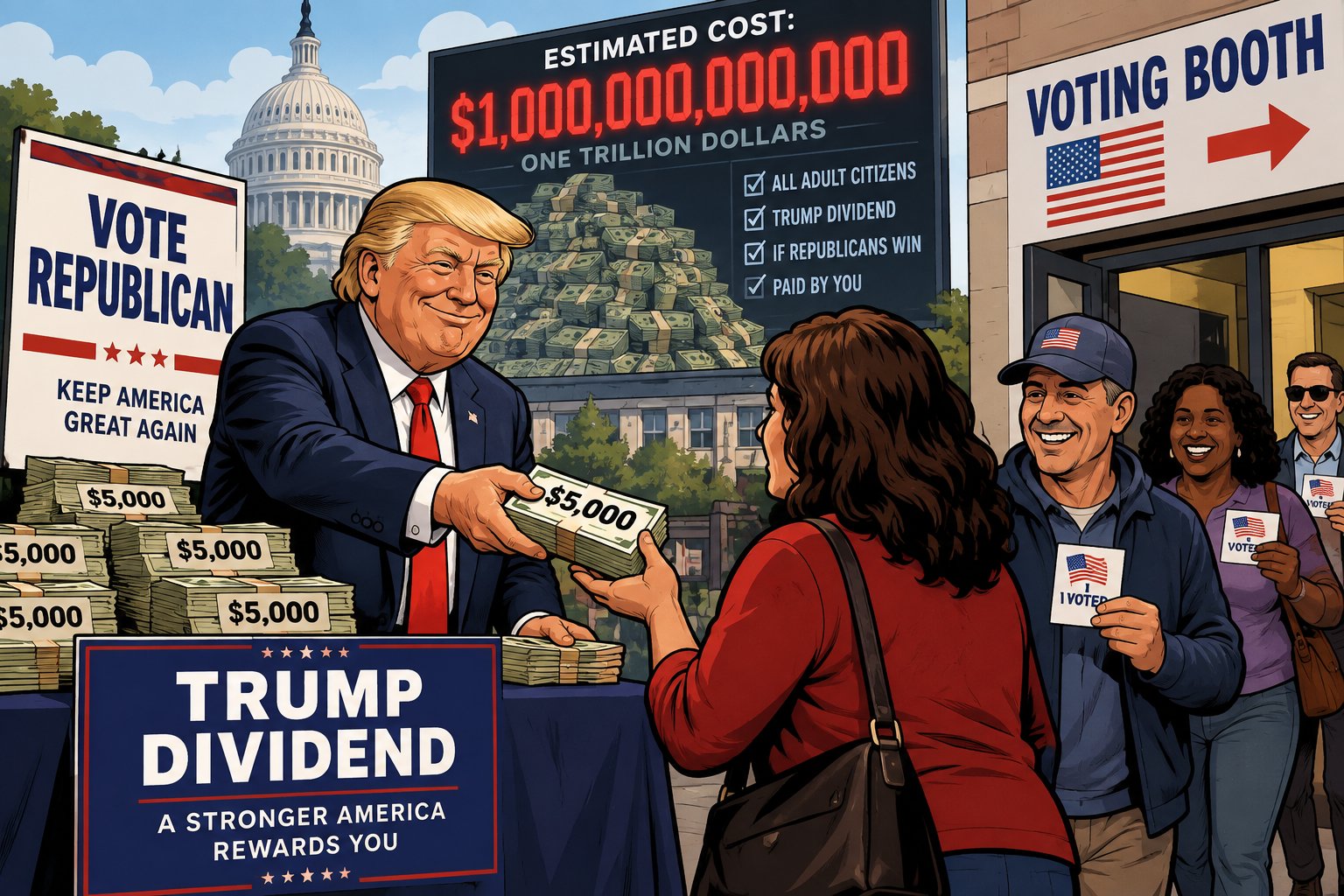
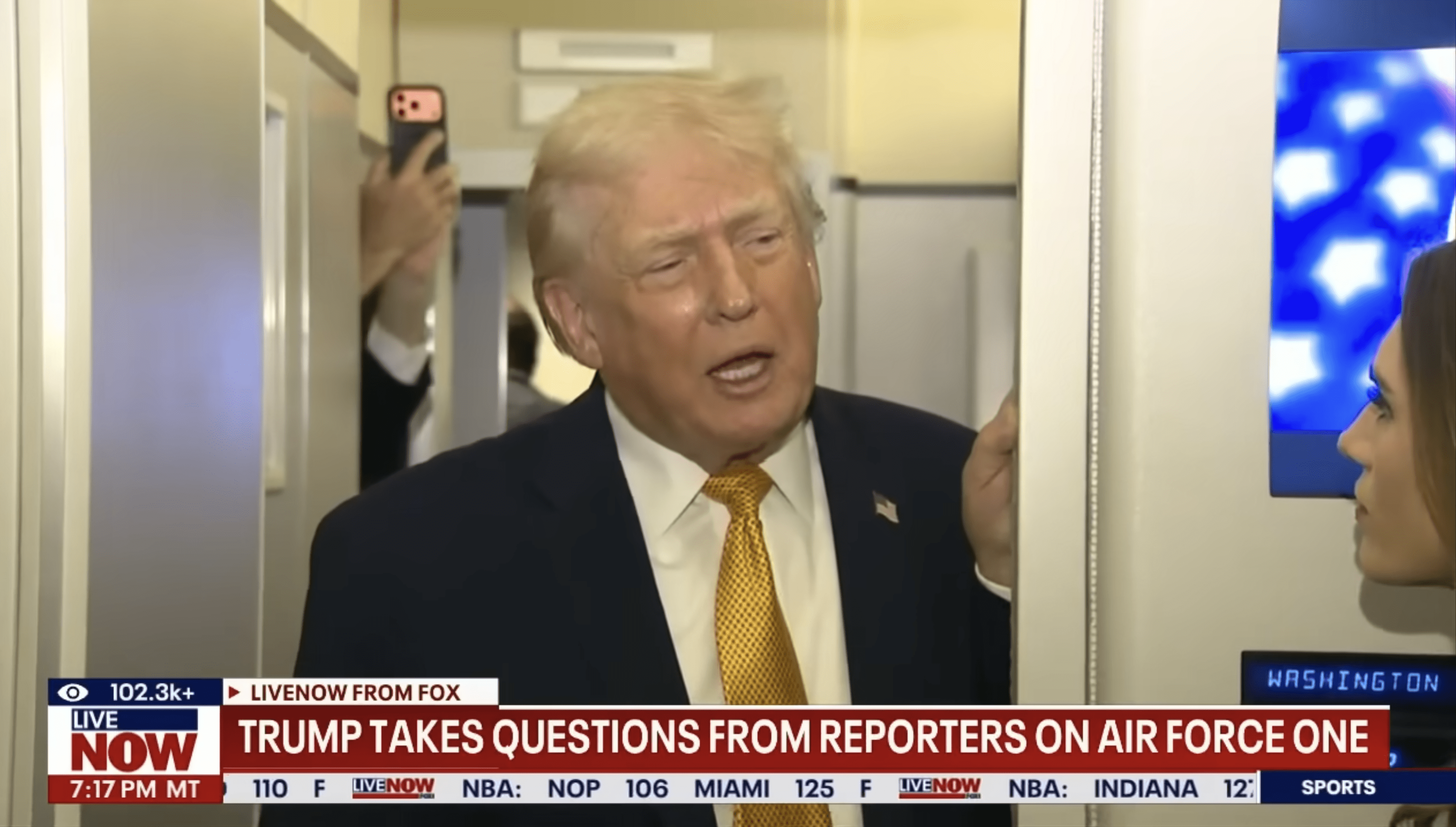
President Donald Trump has attached an unusually explicit dollar figure to the outcome of the 2026 midterm elections, promising American adults a $5,000 “Trump Dividend” if voters return Republicans to control of both chambers of Congress. Speaking Wednesday at the Republican Party’s midterm convention in Dallas, Trump told the audience that if Republicans win the House and Senate, he would issue a $5,000 payment to every adult U.S. citizen, later reducing the pitch to a strikingly simple formulation: “If the Republicans win, you win with us and you get $5,000.” The proposed payment, which Trump said would have to be spent inside the United States, could cost roughly $1.2 trillion to $1.35 trillion depending on eligibility.
The announcement immediately raises a question that reaches far beyond the price tag: How close can an elected president come to promising voters a direct cash benefit if they produce his party’s desired election result before that promise crosses from ordinary campaign politics into an unlawful electoral inducement? Federal law explicitly prohibits paying people to vote and separately prohibits certain promises of federally enabled benefits in exchange for political activity or support. At the same time, Supreme Court precedent provides substantial constitutional protection for candidates who publicly promise broadly available economic benefits as part of their political platforms. That distinction means Trump’s proposal may look remarkably similar to vote buying politically without necessarily satisfying the elements required to prosecute vote buying criminally.
Trump Explicitly Connected the Money to Republican Victory
The precise language matters. Trump did not simply propose a new tax credit, stimulus program or tariff rebate and then argue that Republicans were more likely to enact it. He publicly made the existence of the proposed payment contingent on Republicans controlling Congress after the November election. “If the Republicans win the House of Representatives and the United States Senate,” Trump said, “I will issue a dividend to every adult citizen in the United States of America for $5,000.” He subsequently told the audience, “If the Republicans win, you win with us and you get $5,000.”
That structure is what makes the announcement legally and ethically unusual. Presidents routinely campaign on policies that would financially benefit voters: lower taxes, higher benefits, subsidies, debt relief, health-care assistance, infrastructure spending and direct rebates are all familiar features of American politics. Trump’s statement, however, translated the stakes of congressional control into a specific cash amount for individual citizens and announced that payment while urging voters to preserve his party’s power in Congress. Reuters reported that the proposal’s legality and mechanics were immediately unclear, while the Associated Press noted that congressional authorization would be necessary.
Federal Law Really Does Prohibit Paying People for Their Votes
The federal criminal code leaves little ambiguity about conventional vote buying. Under 18 U.S.C. § 597, anyone who makes or offers an expenditure to another person to vote, refrain from voting, or vote for or against a candidate can face criminal penalties. Another federal provision, 52 U.S.C. § 10307(c), prohibits paying or offering to pay someone for registering to vote or voting in an election involving federal candidates. The Justice Department identifies vote buying as a federal election crime and specifically lists payments to vote or refrain from voting among offenses potentially subject to federal prosecution.
There is another potentially relevant statute. Under 18 U.S.C. § 600, federal law prohibits directly or indirectly promising certain employment, compensation or other benefits made possible by an act of Congress as consideration, favor or reward for political activity or support for or opposition to a candidate or political party. The statute is broader than the straightforward prohibition against handing an individual money for a ballot, and its language explains why Trump’s decision to connect a prospective federal benefit directly to Republican electoral success has attracted legal scrutiny.
But identifying potentially relevant statutes is not the same thing as proving that Trump violated them. A criminal prosecution would have to establish that the conduct actually falls within the statutory prohibition, and Trump’s strongest legal defense is substantial: he did not promise $5,000 only to people who personally vote Republican. The proposed dividend was described as a broadly available government program for adult citizens that would become possible if Republicans controlled Congress. That distinction could be decisive.
The Supreme Court Has Already Protected Broad Campaign Promises
The most important precedent complicating accusations of criminal vote-buying is the Supreme Court’s unanimous 1982 decision in Brown v. Hartlage. The case involved a Kentucky candidate who promised during a campaign to reduce his government salary if elected. Kentucky courts treated the pledge as an improper promise of material benefit to voters, but the Supreme Court reversed, emphasizing the profound First Amendment protection afforded political debate and campaign promises.
The underlying principle matters considerably here. Democratic elections inevitably involve candidates promising policies that materially benefit the people whose votes they seek. A candidate may promise lower taxes, larger tax credits, higher Social Security benefits or other government programs without every financially beneficial platform proposal automatically becoming criminal bribery. Otherwise, an enormous portion of ordinary democratic campaigning could potentially be characterized as offering voters something of value.
That does not make Trump’s $5,000 pledge legally identical to every conventional policy proposal, nor does Brown automatically resolve any future challenge. The unusually direct relationship between the election result and a specific cash payment creates factual circumstances that could invite litigation or investigation. But contemporary legal analysis published after Trump’s announcement has pointed to Brown as a significant obstacle to treating the speech itself as criminal vote-buying. Reuters reported that courts have protected comparable political pledges, while constitutional scholar Erwin Chemerinsky argued that the promise, however objectionable critics may find it, falls within protected political speech.
There Is a Critical Difference Between “Vote Republican and I’ll Pay You” and a Public Policy Promise
The legal distinction can be understood by comparing two hypothetical offers. Giving an individual voter $5,000 on the condition that the person cast a ballot for a Republican candidate would be classic vote-buying territory. Announcing a proposed $5,000 federal benefit available generally to eligible Americans after Republicans win Congress is structurally different because payment does not depend on proving how any individual recipient voted.
A Democrat could vote against every Republican candidate and still qualify for Trump’s proposed dividend if the program were enacted as described. A Republican voter would likewise receive nothing if Democrats won control of either chamber. The triggering condition is therefore the collective election result, not the recipient’s individual ballot. That distinction substantially weakens the straightforward claim that Trump has already committed criminal voter bribery, even though the political message unmistakably connects Republican victory with a promised personal financial benefit.
That nuance should not obscure how extraordinary the rhetoric is. Trump is the sitting president, speaking with the enormous institutional visibility of the presidency, and promising a four-figure federal payment while campaigning for continued control of Congress by his political party. Whether legally protected or not, the episode presents a significant test of the boundary separating government policy promises from direct financial electoral appeals.
Trump Cannot Simply “Issue” $5,000 Checks
There is another major problem with Trump’s statement: the president does not possess unilateral constitutional authority to distribute more than $1 trillion from the federal Treasury simply by declaring a dividend.
Article I, Section 9, Clause 7 of the Constitution provides that no money may be drawn from the Treasury except through appropriations made by law. The Congressional Research Service’s Constitution Annotated explains that the Supreme Court has interpreted the Appropriations Clause to mean Treasury money cannot be paid without an appropriation authorized by Congress. The requirement is specifically designed to prevent the executive branch from independently deciding how federal money will be spent.
Consequently, Trump’s statement that “I will issue a dividend” describes something he cannot accomplish alone. Congress would have to create or authorize the program and provide the necessary funding. The House and Senate would have to navigate the legislative process, and the resulting legislation would ultimately have to become law before Treasury could legally distribute the money. The president can advocate for such legislation, campaign on it and sign it if Congress passes it, but the constitutional power of the purse remains with Congress.
The Price Tag Could Exceed $1 Trillion
The fiscal mathematics are equally significant. Reuters estimated that payments to roughly 240 million eligible adults would cost about $1.2 trillion, while other estimates using a larger adult population place the cost around $1.35 trillion. Either figure would make the “Trump Dividend” one of the largest one-time federal cash distributions in American history.
Vice President JD Vance subsequently suggested that wealthy Americans might not receive the payment and pointed toward tariff revenue as a potential funding source. That clarification already differed from Trump’s declaration that the dividend would go to “every adult citizen,” and available tariff revenue falls far short of the amount necessary to finance a nationwide $5,000 payment on the scale Trump described. AP reported that the proposal would exceed $1 trillion and require congressional action, while economists warned that another massive injection of federal money could increase deficits and potentially add inflationary pressure.
The administration therefore faces two separate questions that should not be conflated. The first is whether the government could legally establish a broad $5,000 payment program after the election. Congress plainly possesses enormous authority to establish federal spending programs through legislation. The second is whether a sitting president’s explicit promise of that payment contingent upon his political party winning an election violates federal election law. That is the more novel question, and no court has ruled that Trump’s September 9 statement violated federal criminal law.
Previous Trump “Dividend” Proposals Never Produced the Promised Nationwide Checks
The latest announcement also comes after Trump previously floated other large direct-payment proposals that did not become nationwide dividend programs. Early in his second term, Trump discussed a roughly $5,000 “DOGE dividend” connected to projected government savings. He later proposed tariff-funded payments, including a $2,000 dividend for many Americans. Those broader proposals did not ultimately produce the promised nationwide checks.
Trump cited the $1,776 “Warrior Dividend” paid to eligible service members as evidence that his administration could deliver direct payments. But that example actually underscores the constitutional distinction surrounding the new proposal: federal payments require legal funding authority. The president can champion or politically brand a payment, but he cannot create a trillion-dollar appropriation from the Treasury by presidential announcement.
The Presidency Makes the Promise More Consequential, Not Automatically Illegal
Trump’s status as president gives the episode a dimension that would not exist if the same promise came from an ordinary congressional candidate. The president commands the executive branch, controls an enormous communications apparatus and occupies an office whose statements can move markets, alter government priorities and shape legislative agendas. When that office is used to tell Americans that Republican congressional control will result in a $5,000 payment, questions about the separation between governing and campaigning are unavoidable.
The Hatch Act does not provide a simple answer. The statute limits partisan political activities by many federal employees, but the president and vice president are exempt from its principal restrictions. Administration officials who participate in political activities, however, can face different rules depending on their positions and conduct. The more direct legal questions surrounding the dividend therefore involve election law, congressional spending authority and the constitutional protection afforded political campaign speech rather than a straightforward claim that the president personally violated the Hatch Act merely by making the announcement.
Calling It Illegal Today Goes Further Than the Evidence Supports
The facts are dramatic enough without overstating the law. Trump unquestionably told Americans that a Republican victory in the House and Senate would be followed by a $5,000 payment. Federal statutes unquestionably prohibit paying people for their votes and prohibit certain government-benefit promises made in exchange for political support. The Constitution unquestionably prevents Trump from spending approximately $1 trillion or more from the Treasury without congressional authorization.
What has not been established is that Trump’s speech itself constitutes a prosecutable federal election crime. Because the proposed payment would be a generally available public program rather than a private payment conditioned on an identifiable person casting a Republican ballot, Supreme Court precedent provides a serious First Amendment defense. No court has ruled the announcement unlawful, and reporting it as an established criminal act would therefore outrun the evidence currently available.
That legal distinction does not eliminate the broader institutional issue created by the announcement. The president of the United States publicly placed a specific dollar value on the financial benefit Americans would supposedly receive if his party wins control of Congress: $5,000 per adult. Whether courts ultimately view that as nothing more than aggressive campaign speech or whether the proposal generates a novel election-law challenge, Trump has pushed the traditional campaign promise into unusually direct territory by reducing the electoral proposition to a cash figure: Republican control of Congress first, government checks afterward.

Sources & Further Reading
Reuters — Trump Touts $5,000 Payout if Republicans Win
Reuters — Is Trump’s $5,000 “Dividend” Legal and How Would It Work?
Associated Press — Trump Pledges $5,000 if GOP Wins
CBS News — Trump Pitches $5,000 Checks if GOP Wins House and Senate
Cornell Legal Information Institute — 18 U.S.C. § 597
Cornell Legal Information Institute — 18 U.S.C. § 600
Cornell Legal Information Institute — 52 U.S.C. § 10307
Congress.gov Constitution Annotated — Article I, Section 9 and the Appropriations Clause












































Want to join the conversation?
Create an account or sign in to share your thoughts, vote,
and reply to other readers.
Showing 0 of 0 comments
Don't have an account?
Already have an account?