
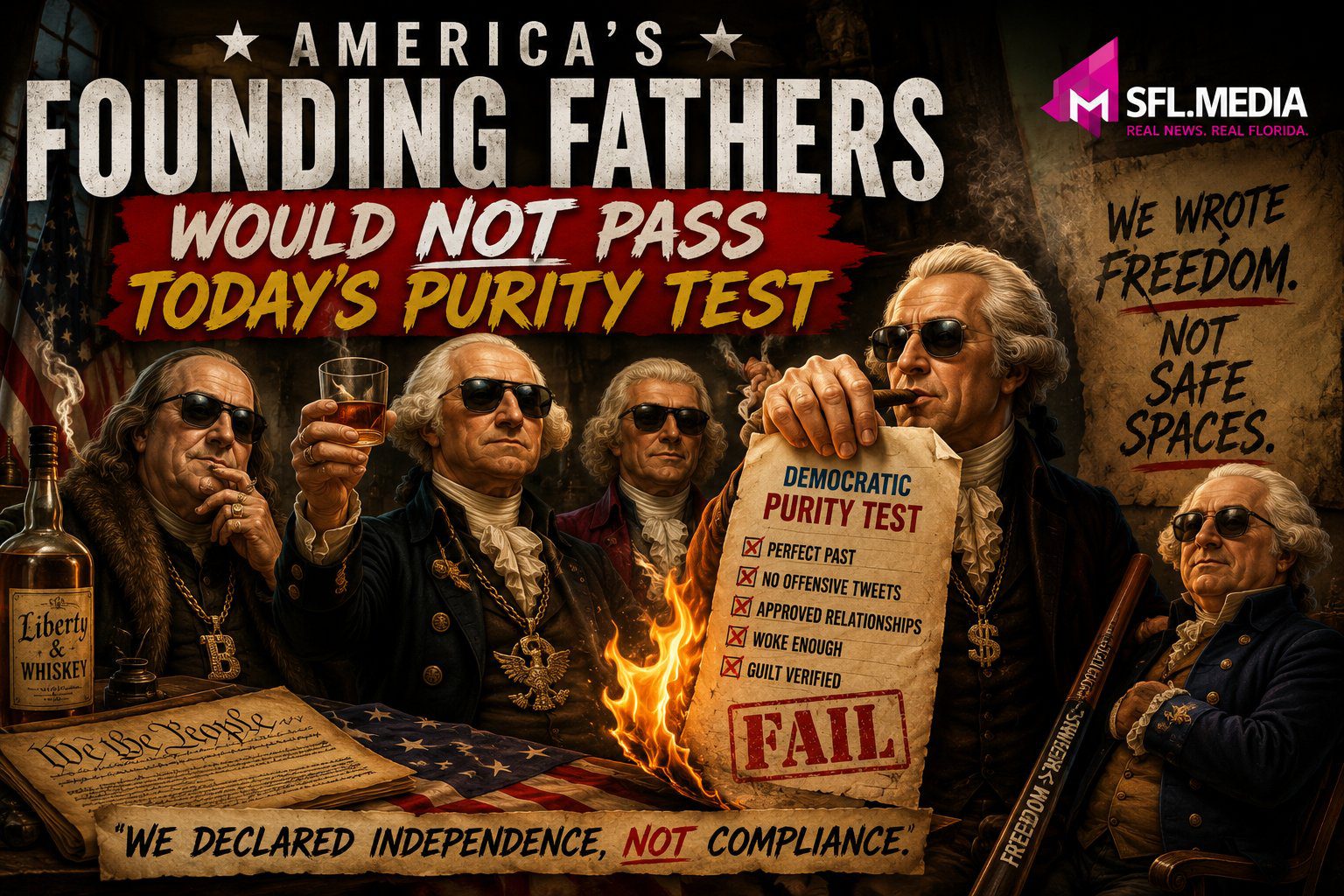
Would America’s Founding Fathers Survive Today’s Political Vetting?
The Men Who Built America Were Anything But Perfect
The United States was not founded by men with spotless résumés, carefully managed public images, or controversy free personal lives.
Its architects were merchants accused of smuggling, politicians who fought duels, military commanders responsible for costly mistakes, and public figures whose private lives often became the subject of scandal. Some openly admitted to youthful recklessness. Others accumulated legal troubles long before they became American icons.
More than 250 years later, modern American politics has evolved into an environment where candidates face unprecedented scrutiny over decades old relationships, financial decisions, social media posts, personal conduct, and allegations that may never be tested in a courtroom.
The contrast raises an increasingly debated question among historians, political observers, and campaign strategists: Would many of America’s most celebrated leaders have survived today’s political vetting long enough to change history?
The Founders Were Revolutionaries And Criminals Under British Law
Before they became America’s Founding Fathers, they were viewed by the British Empire as criminals. Signing the Declaration of Independence was an act of treason against the Crown, a crime punishable by death. Every delegate who signed the document knowingly accepted the possibility of execution if the American Revolution failed.
John Hancock, remembered today for his unmistakable signature on the Declaration, was already one of Britain’s most notorious colonial targets. Years before independence, British customs officials seized Hancock’s merchant ship, Liberty, accusing him of smuggling imported wine to evade customs duties. The seizure sparked riots throughout Boston and became one of the flashpoints that intensified colonial resistance against British rule.
Today, Hancock is remembered as a patriot. In 1768, he was considered a wealthy businessman accused of violating British law.
Benjamin Franklin Never Claimed Moral Perfection
Few Americans embodied self improvement more than Benjamin Franklin. Yet Franklin was remarkably honest about his own shortcomings. In his autobiography, he openly described what he called the “errata” of his youth, acknowledging mistakes, poor decisions, and personal failures. He fathered an illegitimate son, William Franklin, outside marriage and reflected extensively on the lessons he learned throughout adulthood. Franklin famously wrote:
“I conceived the bold and arduous project of arriving at moral perfection.”
He then admitted that despite his efforts, complete perfection proved impossible. Rather than hiding his flaws, Franklin treated them as part of the process of becoming wiser and more capable.
Alexander Hamilton’s Career Was Defined by Conflict
Alexander Hamilton helped build the American financial system, authored most of The Federalist Papers, and became the nation’s first Treasury secretary. He also lived one of the most turbulent personal lives among the Founders. Hamilton became embroiled in public feuds, admitted to an extramarital affair during what became known as the Reynolds scandal, published blistering political attacks against rivals, and ultimately died after participating in an illegal duel with Vice President Aaron Burr. His extraordinary political achievements and deeply flawed personal life existed simultaneously. History remembers both.
George Washington Nearly Ended His Career Before It Began
Long before becoming commander of the Continental Army and America’s first president, George Washington made one of the most consequential mistakes of his military career. At just 22 years old, following the Battle of Fort Necessity in 1754, Washington signed surrender documents written in French. Historians generally agree he did not fully understand that the translation appeared to acknowledge responsibility for the “assassination” of French officer Joseph Coulon de Jumonville.
The diplomatic fallout helped ignite the French and Indian War. Instead of permanently defining his legacy, Washington’s early mistake became part of the experience that shaped one of history’s most respected military and political leaders. Washington himself understood the value of perseverance, writing:
“Perseverance and spirit have done wonders in all ages.”
Abraham Lincoln Was Far From a Conventional Politician
Abraham Lincoln is remembered as the president who preserved the Union and led the nation through the Civil War.
His early political career, however, was considerably rougher. Lincoln earned a reputation as a formidable wrestler during his youth in Illinois and frequently engaged in aggressive political combat. He anonymously published satirical newspaper pieces ridiculing political opponents, one of which nearly resulted in a duel with Illinois State Auditor James Shields. While the duel never took place, the episode demonstrated that even one of America’s most admired presidents experienced significant controversy long before entering the White House.
Imperfect Leaders Have Always Shaped American History
The historical record consistently shows that extraordinary leadership rarely begins with an extraordinary résumé. Many of America’s most influential figures experienced public failures, personal scandals, legal disputes, financial setbacks, or youthful mistakes before ultimately earning their place in history. Among them were:
- John Hancock, accused by British authorities of smuggling.
- Benjamin Franklin, who openly acknowledged the mistakes of his youth and fathered a child outside marriage.
- Alexander Hamilton, whose political career was marked by public scandals and an illegal duel.
- George Washington, whose early military missteps helped trigger an international conflict.
- Abraham Lincoln, whose political career included anonymous attacks on rivals and a near-duel.
None of these episodes erased what these men ultimately accomplished.
The Modern Debate Over Political Vetting
None of this history suggests misconduct should be ignored or that public officials should be immune from accountability. Political parties have a legitimate interest in evaluating the character of those seeking public office, and voters deserve transparency when making electoral decisions. The debate instead centers on where that line should be drawn.
Supporters of aggressive political vetting argue that modern leaders should meet higher ethical standards than previous generations. Critics argue that increasingly expansive scrutiny, particularly over decades old conduct, personal relationships, or allegations that never result in criminal charges, may discourage veterans, entrepreneurs, business leaders, and other accomplished outsiders from ever seeking office.
History Offers Perspective, Not Perfection
History does not provide easy answers to today’s political debates. It does, however, remind Americans that many of the nation’s greatest leaders arrived with complicated pasts, public controversies, and personal failures that never prevented them from making extraordinary contributions to the country.
America was not built by perfect men. It was built by imperfect people whose achievements ultimately proved greater than the mistakes that came before them.














































Want to join the conversation?
Create an account or sign in to share your thoughts, vote,
and reply to other readers.
Showing 0 of 0 comments
Don't have an account?
Already have an account?