
Illinois Mother Charged With Murder of 2 Year Old Son After Allegedly Calling Him the “Devil” and “Anti-Christ”
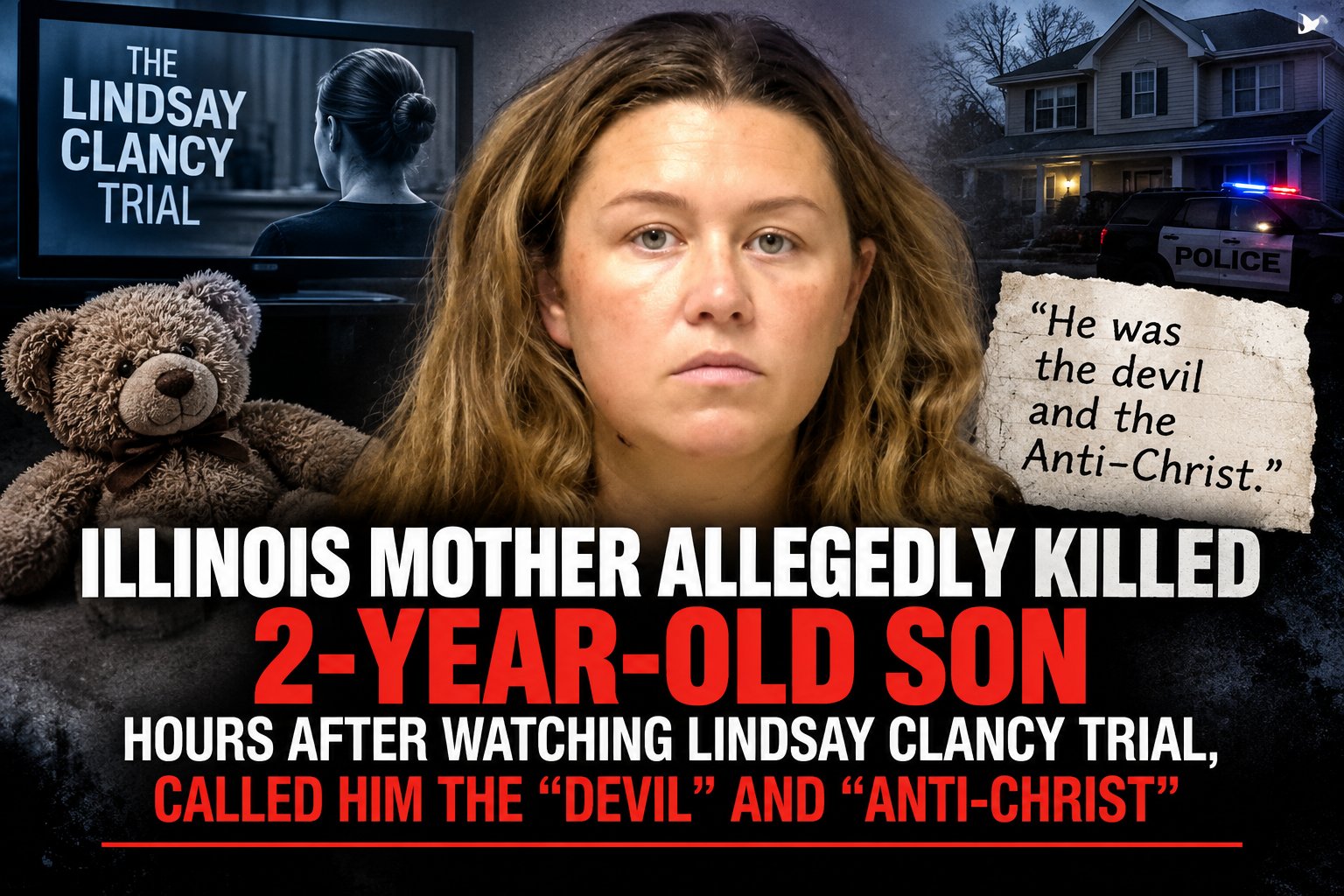
An Illinois mother has been charged with three counts of first degree murder after prosecutors say her 2 year old son was found hanging from a basement rafter inside the family’s Frankfort home, while the child’s mother was discovered upstairs suffering from apparent self inflicted wounds. The case has taken an even more disturbing turn because prosecutors say Corie A. Walsh had become “very invested” in the nationally watched Lindsay Clancy murder trial and was actively discussing the Massachusetts case with friends through group text messages only hours before her son was found.
Court filings identify the victim as 2 year old Barrett Walsh. Prosecutors allege Walsh subsequently told responding officers that she had killed her child because she believed he was the “devil” and the “anti-Christ.” Walsh’s defense attorney, Andrea Lyon, has said her client was experiencing a psychotic episode at the time. That assertion is expected to place Walsh’s mental condition at the center of the criminal case, although it remains a defense claim and has not been established by a court or independent psychiatric finding.
The timing of the killing has also drawn national attention because it occurred while jurors in Massachusetts were still deliberating in the Clancy case, another child homicide prosecution centered heavily on questions of psychosis and criminal responsibility. There is currently no evidence establishing that the Clancy trial caused Walsh’s alleged actions, however, and authorities have not publicly characterized Barrett’s death as a copycat killing.
Neighbor Found 2 Year Old Barrett Walsh in the Basement
Frankfort police responded shortly after 4 p.m. on Tuesday, Sept. 1, to the 22700 block of Brook Stone Court following a report of an unresponsive child. According to prosecutors and court records cited by Chicago news organizations, a 17-year-old neighbor discovered Barrett in the basement with a ligature around his neck attached to a rafter. The neighbor removed the ligature, lowered the child and began performing CPR while calling 911. Responding officers found the teenager attempting to resuscitate Barrett. The toddler was transported to a local hospital, where he was pronounced dead.
Court documents cited by prosecutors say preliminary autopsy findings determined that Barrett died from “asphyxia due to ligature compression of the neck.” Authorities have described the death as an apparent homicide, although the Will County Coroner’s Office’s final cause and manner of death remained pending additional investigation and testing as of the latest publicly available reports. The investigation is being handled by Frankfort police with assistance from other local authorities.
Walsh Was Found Upstairs in a Bathtub
After Barrett was discovered, the neighbor went upstairs and found Walsh inside a bathtub containing bloody water, according to prosecutors’ account of the scene. Court records say Walsh was fully clothed and had cuts to her wrists and thighs. The neighbor reportedly attempted to control the bleeding before emergency personnel arrived.
Walsh was transported to a hospital for treatment before being taken into custody. Reports initially differed over the severity of her injuries, with police describing them as serious enough to require medical treatment. Authorities later transferred Walsh to the Will County Adult Detention Facility ahead of her first scheduled court appearance on Sept. 8.
Prosecutors Say Walsh Told Police Her Son Was the “Devil” and “Anti-Christ”
What Walsh allegedly told authorities afterward has become one of the central pieces of the state’s case. According to court documents, Walsh allegedly told responding officers that she “did this to her baby because he was the ‘devil’ and the ‘anti-Christ.’” Authorities say Walsh later provided additional information at the hospital describing how Barrett was killed. Police said those statements were consistent with evidence investigators discovered inside the home.
Those statements remain allegations contained in the prosecution’s case. Walsh has been charged but has not been convicted, and prosecutors will ultimately have to prove the charges beyond a reasonable doubt. The alleged statements could also become central to the defense because Lyon has already asserted that Walsh was experiencing psychosis at the time of Barrett’s death.
Three Other Children Survived Unharmed
Three other children associated with the household survived the incident unharmed. According to prosecutors, an infant was inside the home when Barrett was killed, while two school-aged children returned home around the time the emergency was discovered. Walsh’s husband was reportedly outside Illinois for work. The Illinois Department of Children and Family Services told CBS Chicago that the agency had no previous contact with the family before Sept. 1. DCFS became involved following Barrett’s death. That detail is significant because there is currently no publicly reported history of prior state child-welfare intervention involving the family.
Walsh Had Been Closely Following the Lindsay Clancy Murder Trial
The timing of Barrett’s death has created another extraordinary dimension to the investigation. Prosecutors say Walsh had “recently become very invested in the Lindsay Clancy murder trial,” which had been closely followed across the country. According to the state’s court filing, Walsh had been “actively discussing the case via group text message with her friends” until only hours before Barrett was discovered. At the time, jurors in Massachusetts were still deliberating whether Clancy was criminally responsible for killing her three children.
Clancy’s trial ultimately ended in a mistrial on Sept. 4 after jurors were unable to reach a unanimous verdict following nearly six weeks of testimony and seven days of deliberations. The connection between Walsh and the Clancy case is significant enough that prosecutors included Walsh’s interest in the trial in their court filings. It would nevertheless be premature to characterize Barrett’s death as a copycat killing or conclude that watching the Clancy proceedings caused Walsh’s alleged actions.
The evidence currently establishes an unusual temporal connection and Walsh’s intense interest in the case. It does not establish causation.
Why the Lindsay Clancy Case Matters
Lindsay Clancy was charged in Massachusetts with killing her three children, Cora, 5, Dawson, 3, and Callan, 8 months, inside the family’s Duxbury home in January 2023. Clancy does not dispute killing the children. Her defense argued that severe mental illness, including postpartum psychosis, prevented her from appreciating the wrongfulness of her actions and therefore made her not criminally responsible under Massachusetts law.
Prosecutors argued that Clancy was severely mentally ill but nevertheless understood what she was doing and deliberately planned the killings. The nearly six week trial became a nationally watched examination of postpartum psychiatric illness, criminal responsibility and the extraordinarily difficult boundary between severe mental disease and legal insanity. After nearly 40 hours of deliberations over seven days, jurors remained unable to reach a unanimous verdict. Massachusetts Superior Court Judge William Sullivan declared a mistrial on Sept. 4.
Clancy remains charged and in psychiatric custody. A hearing is scheduled for Sept. 29, when the future of the prosecution could become clearer. Prosecutors could pursue another trial, negotiate a plea agreement or potentially take another course, although no final decision had been announced as of Sept. 5. Walsh’s alleged fixation on the Clancy proceedings does not mean the two women suffered from the same psychiatric condition, nor does it establish that Walsh was experiencing postpartum psychosis. Any determination concerning Walsh’s mental condition will require evidence and psychiatric evaluation specific to her.
Walsh’s Attorney Says She Was Experiencing a “Psychotic Episode”
Walsh’s attorney, veteran Chicago defense lawyer Andrea Lyon, has already publicly characterized the case as involving severe mental illness.
“This is a tragedy for the Walsh family, all of whom are mourning the loss of this child,” Lyon said in a statement reported by Chicago news outlets.
Lyon also said Walsh “was experiencing a psychotic episode at the time this happened” and expressed hope that a thorough investigation and presentation of the facts would reveal the full circumstances surrounding Barrett’s death. That is a defense assertion, not yet an independent psychiatric conclusion or judicial finding. The distinction will become critical as the case proceeds because psychosis does not automatically eliminate criminal responsibility.
Mental illness and legal insanity are not interchangeable concepts. A defendant can suffer from a serious psychiatric disorder and still be held criminally responsible if prosecutors establish that the defendant possessed the level of understanding required under applicable law.
Conversely, evidence that a defendant’s mental disease prevented her from appreciating the criminality of her conduct can fundamentally alter the outcome of a murder prosecution. Psychiatric evaluations, medical records, communications, witness testimony and Walsh’s behavior before, during and after Barrett’s death could therefore become some of the most consequential evidence in the case.
Walsh’s Phone Could Become Critical Evidence
Investigators are conducting a forensic examination of Walsh’s cellphone, according to authorities. That examination could become particularly important because prosecutors have already highlighted Walsh’s group-text conversations about the Clancy trial in the hours before Barrett’s death. Digital evidence could potentially help investigators establish a more precise timeline of Walsh’s actions, communications and state of mind before the killing. It could also show whether her interest in the Clancy case was isolated to ordinary discussion of a nationally watched trial or formed part of a broader pattern relevant to the prosecution. At this stage, authorities have not publicly released the complete contents of those communications.
Why Three Murder Charges Can Come From One Death
Walsh faces three counts of first-degree murder despite there being one homicide victim. That does not mean prosecutors are accusing her of committing three separate murders. Illinois law allows first degree murder to be prosecuted under different theories concerning a defendant’s intent and knowledge. The statute covers circumstances in which a person intends to kill or cause great bodily harm, knows that the conduct will cause death, or knows that the conduct creates a strong probability of death or great bodily harm.
Charging alternative theories gives prosecutors different legal pathways for establishing first degree murder based on the same underlying death. If multiple counts ultimately result in findings of guilt for the killing of a single victim, sentencing and merger issues would be addressed by the court under Illinois law. Three charging counts should therefore not be interpreted as three separate homicide victims or three independently committed killings.
Walsh Could Face Decades in Prison if Convicted
First degree murder carries extraordinarily severe penalties under Illinois law. The standard sentencing range is generally 20 to 60 years in prison. Illinois law also provides for an extended-term sentence of 60 to 100 years when the statutory requirements for an extended term are satisfied, while natural life imprisonment is authorized under certain circumstances.
Whether any enhanced sentencing provision would apply to Walsh cannot be definitively determined simply from the charging announcement. The ultimate sentencing range would depend on the offenses proved, statutory aggravating factors, rulings by the court and the final disposition of the case. Illinois abolished the death penalty in 2011, meaning capital punishment is not available.
The Case Is Not Yet Proof of a “Clancy Copycat”
The timing is impossible to ignore. Prosecutors say Walsh had become deeply interested in a nationally watched case involving another mother who killed her children, was discussing that trial with friends only hours before her own son’s death and is now accused in a homicide case in which her defense attorney is already asserting psychosis. Those facts make the connection legitimately newsworthy. They do not prove imitation.
No publicly available evidence currently demonstrates that Clancy’s actions inspired Walsh, that Walsh attempted to reproduce the Massachusetts killings or that media coverage of the Clancy trial caused Barrett’s death. That distinction is particularly important in a case involving allegations of psychosis. A person experiencing delusions can incorporate information from the surrounding world into those delusions without the external information necessarily being the underlying cause of the behavior.
The forensic examination of Walsh’s phone, interviews with friends and relatives, medical records and eventual psychiatric evaluations could provide considerably more evidence about what happened during the hours and days preceding Barrett’s death. Until then, the most accurate description is also one of the most disturbing: prosecutors say Walsh was closely following the Clancy murder trial immediately before her 2 year old son was killed, but exactly what relationship, if any, exists between those events remains unknown.
A Murder Case Likely to Center on Walsh’s Mental State
The physical evidence described by prosecutors is stark. A neighbor allegedly discovered 2 year old Barrett Walsh hanging in the basement. Preliminary autopsy findings cited in court documents say he died from asphyxia caused by ligature compression of the neck. Prosecutors say Walsh admitted responsibility while expressing an apparent delusional belief that her toddler was the devil or Antichrist.
The defense, meanwhile, says Walsh was experiencing psychosis. Those positions create two fundamentally different questions that will have to be resolved through the criminal justice system: what happened to Barrett Walsh, and what was Corie Walsh capable of understanding when it happened? The first question forms the foundation of the murder prosecution. The second could become central to determining her criminal responsibility.
For now, Walsh is a criminal defendant presumed innocent unless and until the state proves the charges against her beyond a reasonable doubt. At the center of the case is Barrett Walsh, a 2 year old boy whose death transformed a quiet suburban Illinois home into the scene of a homicide investigation and created another deeply disturbing American criminal case involving the intersection of alleged child murder, severe mental illness and criminal responsibility.

Sources & Further Reading
Corie Walsh Case and Court Allegations
NBC Chicago — Court documents detailing the discovery of Barrett Walsh, Corie Walsh’s alleged statements to police, preliminary autopsy findings and the investigation into her cellphone.
NBC Chicago — Reporting on Walsh’s alleged interest in the Lindsay Clancy trial and group-text conversations in the hours before Barrett’s death.
Read NBC Chicago’s Clancy Connection Report
ABC7 Chicago — Reporting on the murder charges, Frankfort police investigation and circumstances surrounding Barrett Walsh’s death.
CBS News Chicago — Detailed reporting on the three first-degree murder charges, surviving children, Walsh’s detention, DCFS involvement and the Clancy-trial connection.
Read CBS News Chicago’s Report
FOX 32 Chicago — Court-document reporting on the allegations against Walsh and circumstances surrounding Barrett’s death.
Chicago Sun-Times — Reporting on the murder charges, Frankfort Police Department statements and Walsh’s medical treatment following the incident.
Read the Chicago Sun-Times Report
Illinois Murder Law and Sentencing
Illinois General Assembly — Official statutory definition of first-degree murder under 720 ILCS 5/9-1.
Read the Illinois First-Degree Murder Statute
Illinois General Assembly — Official sentencing provisions for first-degree murder under 730 ILCS 5/5-4.5-20, including standard, extended-term and natural-life sentencing provisions.
Read the Illinois First-Degree Murder Sentencing Statute
Lindsay Clancy Trial and Mistrial
Associated Press — Coverage of the Sept. 4 mistrial and the legal options facing prosecutors and Clancy following the deadlocked jury.
Read the Associated Press Report
WBUR — Coverage of Judge William Sullivan declaring a mistrial after jurors failed to reach a unanimous verdict in the Lindsay Clancy case.
CBS News — Detailed explanation of the mistrial, seven days of jury deliberations and what could happen next in the Clancy prosecution.
Read CBS News’ Clancy Mistrial Analysis
Reuters — Legal analysis of the possible retrial, plea negotiations and other potential next steps following the Clancy mistrial.



















































Want to join the conversation?
Create an account or sign in to share your thoughts, vote,
and reply to other readers.
Showing 0 of 0 comments
Don't have an account?
Already have an account?