
Scott Pelley Went Down Fighting, And CBS May Never Be the Same
For generations of Americans, 60 Minutes was more than a television show. It was one of the last institutions in American journalism that still carried genuine weight. Presidents feared it. CEOs dreaded it. Corrupt politicians, war profiteers, dictators, and fraudsters all understood that if a 60 Minutes correspondent showed up asking questions, the story was about to become very real. That reputation wasn’t built by corporate executives sitting in Manhattan boardrooms. It was built by journalists willing to risk everything to tell the truth.
Mike Wallace built it. Morley Safer built it. Ed Bradley built it. Lesley Stahl helped build it. And for nearly four decades, Scott Pelley carried that tradition forward. Now, according to multiple reports, Pelley is out at CBS following an explosive confrontation with the network’s new leadership. If the reports are accurate, one of the most respected journalists in America didn’t quietly accept what was happening to his newsroom. He stood up, spoke his mind, and went to war for the institution he spent 37 years helping build. Whether one agrees with every criticism Pelley reportedly made is almost beside the point. The bigger story is that one of the last giants of American broadcast journalism apparently believed 60 Minutes was worth fighting for.
A Show That Defined American Journalism
Long before social media influencers called themselves journalists and cable news devolved into partisan food fights, 60 Minutes represented something different. The program broke major investigations that changed laws, exposed corruption, and shaped public debate. It became the most successful news magazine in television history because audiences trusted that the people on screen were reporters first and personalities second.
That trust is incredibly difficult to earn and remarkably easy to destroy. For decades, CBS News built its credibility on the idea that journalists, not politicians, advertisers, activists, or corporate owners, would decide what stories mattered. Today, many inside the industry fear that principle is under attack.
The Explosion Inside CBS
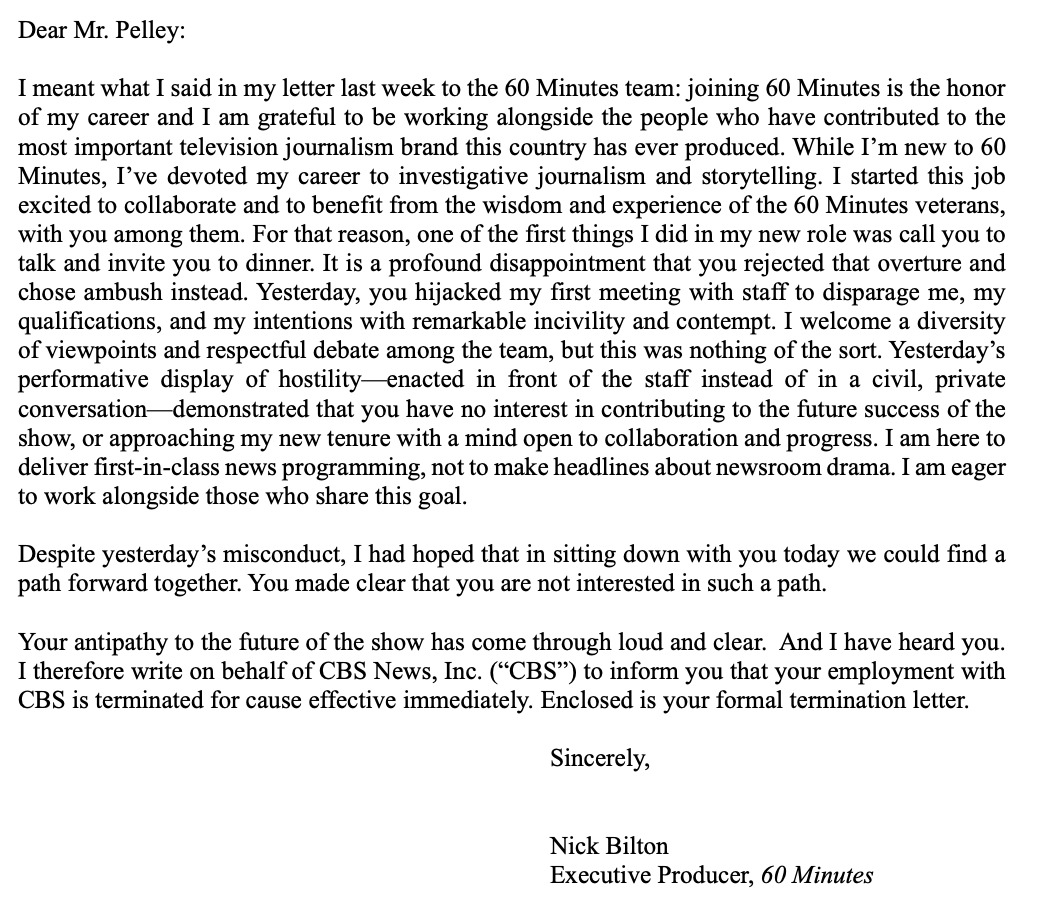
The reported confrontation took place during an introductory meeting led by new 60 Minutes Executive Producer Nick Bilton, who was installed after a sweeping restructuring of CBS News under new ownership. According to leaked accounts reported by Status, The New York Times, and other outlets, Pelley directly challenged management over recent firings and the direction of the news division. The exchange reportedly became especially heated when the discussion turned to Bari Weiss, the newly appointed Editor-in-Chief of CBS News.
According to multiple reports, Pelley bluntly rejected management’s defense of Weiss and accused leadership of dismantling the culture that made 60 Minutes successful.
“She’s murdering 60 Minutes. She does not love this place. She was brought in to kill it and she’s doing exactly that.”
If accurate, it was one of the most extraordinary moments in modern television news history. Veteran journalists rarely criticize their employers so publicly. Fewer still do it while standing in front of colleagues and management knowing their careers may be on the line. Pelley reportedly did exactly that.
The Ellison Takeover and the Future of CBS
The conflict cannot be understood without understanding the larger battle taking place at CBS. The network now sits under the control of Skydance Media following the completion of the Paramount merger led by David Ellison, son of billionaire Oracle founder Larry Ellison.
The transaction occurred after months of political controversy, including Donald Trump’s lawsuit against CBS over a 60 Minutes interview with Kamala Harris and a reported $16 million settlement by Paramount. Critics of the merger have argued that the changes occurring inside CBS News are not isolated management decisions but part of a broader effort to reshape one of America’s most influential news organizations. Supporters of the new leadership argue that CBS needs modernization, fresh perspectives, and structural reform to compete in a rapidly changing media environment.
The problem is that many longtime journalists inside the organization appear unconvinced. Recent departures, reported firings, and growing internal unrest have fueled fears that the network is abandoning the editorial independence that made it successful. Whether those fears ultimately prove justified remains to be seen. The perception alone, however, is already causing enormous damage.
Why Journalists Are Rallying Around Pelley
What has shocked much of the media industry is not simply that Scott Pelley may be leaving CBS. It is how he reportedly left. Pelley had every reason to remain silent. At 68 years old, he has nothing left to prove. His place in journalism history was secured years ago. He reported from Iraq and Afghanistan. He covered conflicts around the world. He anchored the CBS Evening News. He became one of the defining faces of American television journalism.
Yet according to those present, he chose confrontation over comfort. That decision resonates because many journalists believe newsrooms across America are increasingly struggling against forces that have little interest in journalism itself. Political polarization has transformed news into a battlefield. Billionaires increasingly own major media companies. Public trust in institutions continues to collapse. Economic pressures have gutted local newsrooms from coast to coast. Against that backdrop, Pelley’s reported refusal to stay quiet looks less like a workplace dispute and more like a final stand.
A Farewell That Felt Like a Warning
After news of his departure emerged, Pelley released a statement that many journalists immediately interpreted as both a farewell and a warning.
“I depart after 37 years at CBS with one emotion, a heart brimming with gratitude for the men and women of CBS News who encouraged and enriched my work, very often at the risk of their own lives. I pray for a day when those people and their ideals are honored again.”
The statement landed like a punch to the gut for many current and former journalists. Pelley wasn’t talking about ratings. He wasn’t talking about profits. He wasn’t talking about market share. He was talking about ideals. For reporters who have spent their careers chasing facts through war zones, corruption scandals, and dangerous investigations, those ideals are the foundation of the profession. Without them, journalism becomes content. Without them, news becomes marketing. Without them, institutions like 60 Minutes become brands rather than watchdogs.
An American Tragedy for the Free Press
The real tragedy is not that Scott Pelley may no longer work at CBS. The tragedy is that millions of Americans are now asking whether one of the country’s most trusted news organizations still stands for the principles that earned that trust in the first place. Trust, once lost, is almost impossible to regain.
For nearly six decades, 60 Minutes represented the very best of American journalism. It proved that serious reporting could attract massive audiences and hold the powerful accountable at the same time. Today that legacy appears to be under extraordinary strain.
History will ultimately decide whether the changes underway at CBS were necessary reforms or catastrophic mistakes. But if the reports surrounding Scott Pelley’s departure are accurate, one thing is already clear. When he believed the institution he loved was in danger, he didn’t stay silent. He stood up. He fought. And if this truly is the end of his remarkable career at CBS News, he left the same way great journalists often do, challenging power instead of serving it.










































Want to join the conversation?
Create an account or sign in to share your thoughts, vote,
and reply to other readers.
Showing 0 of 0 comments
Don't have an account?
Already have an account?